Limited-Time Offer: Enjoy 50% Savings! Ends in 00h 00m 00s Coupon code: 50OFF
Skip to content

Free AACE International Planning & Scheduling Professional (PSP) Exam AACE-PSP Exam Questions

Page: 1 / 15 Total 216 questions

Want more questions? Get Premium Access.

Question 1

Total float is defined as the amount of time an activity can be delayed without impacting

Correct Answer: A. The overall project completion
Explanation:

Scheduling Professional Study Guide and Documents Reference: Total float is the amount of time an activity can be delayed without delaying the project's overall completion date.

Option B (buoyancy) and Option D (end of that activity) are irrelevant.

Option C refers to free float, not total float.

This definition is fundamental in critical path analysis.
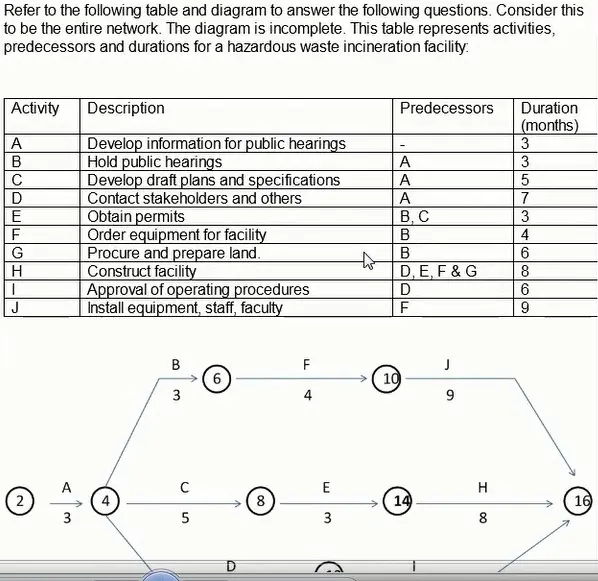

Question 2

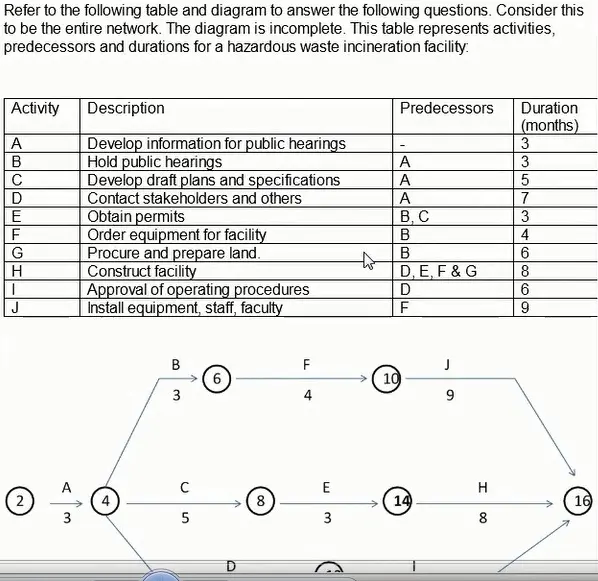
What portion of Activity B is on the critical path?

Correct Answer: A. Last half of the activity
Explanation:

The Critical Path comprises the sequence of activities that directly impact the project's completion time.

If only the last half of Activity B delays the subsequent activities, then this portion lies on the critical path.

Reference: PSP Study Guide, Section 2.4.3 -- Schedule Analysis, emphasizes identifying segments of activities that are critical due to dependencies and float values.


Question 3

What is the free float for Activity F?

Correct Answer: B. 0 months.
Explanation:

Understand Free Float: Free float is the time an activity can be delayed without delaying the start of its immediate successor.

Review Activity F in the Diagram:

Activity F has a successor that starts later, providing room for 2 months of free float.

Cross-Verification:

Option A: Incorrect. Overestimates the float.

Option B: Incorrect. No float is incorrect for F.

Option C: Incorrect. 1 month is insufficient.

Option D: Correct. Matches the calculated free float for Activity F.


Question 4

These are the activities on the critical path:

Correct Answer: C. A, B, G, & H.
Explanation:

Critical Path Identification:

The critical path is the longest sequence of activities that determines the project's minimum duration.

Path: A B G H.

Exclusion of Other Options:

Paths involving F, J, or non-critical activities do not align with the longest duration.

Verification with PSP Guidelines: The PSP Study Guide emphasizes identifying the critical path for schedule optimization (Ref: PSP Study Guide, Chapter 2A: Critical Path Analysis)


Question 5

Determine the correct formula and date for the late finish for Activity 9004.

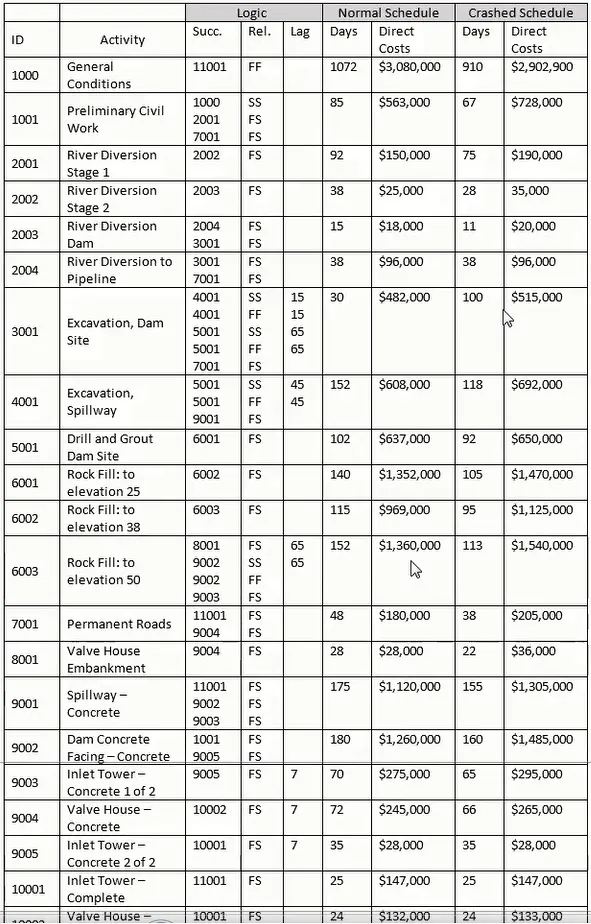
Correct Answer: D. LS.10002 - Lag.7 - l day -> 11-20-03.
Explanation:

Analyze the Data and Logic:

Activity 9004 ('Valve House Embankment'): This activity has a direct Finish-to-Start (FS) relationship with Activity 10002, with a lag of 7 days.

Late Start (LS) and Late Finish (LF): In backward pass calculations, the late finish of the successor activity is adjusted for lag and task duration to determine the late start of the predecessor activity.

Formula for Late Finish (LF):

The Late Finish of Activity 9004 is derived by taking the Late Start (LS) of Activity 10002, subtracting the lag of 7 days, and subtracting 1 day to calculate the exact finish date.

Correct Date Calculation:

Given the Late Start (LS) of Activity 10002:

LS.10002 = 11-28-03.

Apply the formula: LF.9004 = LS.10002 - Lag.7 - 1 day = 11-28-03 - 7 days - 1 day = 11-20-03.

Cross-Verification with Answer Options:

Option A: Incorrect. Misrepresents the formula.

Option B: Incorrect. Incorrect application of logic and lag adjustments.

Option C: Incorrect. Omits the correct lag consideration.

Option D: Correct. Matches both formula and calculated date.


Question 6

Why does activity 1001 have two successor activities?

Correct Answer: C. Because there are two defined logic paths for the work

Question 7

In its simplest form, what is the main drawback of critical path method scheduling?

Correct Answer: B. It assumes that resources are unlimited.
Explanation:

A fundamental limitation of Critical Path Method (CPM) scheduling is its assumption of unlimited resources, meaning it does not account for resource constraints when calculating schedules.

Option A (backward pass) is a standard part of the CPM process.

Option C is incorrect as CPM considers activity dependencies.

Option D refers to flexibility in diagramming methods, not a drawback.

The PSP Study Guide highlights resource constraints as a significant challenge in CPM application.


Question 8

The project team must communicate the project plan, goals and objectives to all stakeholders to ensure the stakeholders understand the plan, goals and objectives and then continue this communication throughout the project life Which statement below would stakeholders NOT be expected to contribute?

Correct Answer: A. Stakeholders review the basis the schedule after the schedule is developed

Question 9

Using the "normal" schedule, theoretically construct a hammock for activities 2001 through 2004. What is the duration of the hammock?

Correct Answer: D. 53 days
Explanation:

Hammock Activities (2001--2004):

Activity 2001 ('River Diversion Stage 1'): Duration = 92 days.

Activity 2002: Starts immediately after 2001, duration = 38 days.

Activity 2003: Starts immediately after 2002, duration = 15 days.

Activity 2004: Starts immediately after 2003, duration = 38 days.

Calculate the Duration:

Total duration = 92 + 38 + 15 + 38 = 183 days.

Cross-Verification with Answer Options:

Option A: Incorrect. Underestimates.

Option C: Incorrect. Overestimates.

Option D: Incorrect. Overestimates.

Option B: Correct. Matches the calculated duration.


Question 10

Based on the available scope information and required accuracy, different cost estimated models or methodologies are utilized Which of the following statements is NOT true?

Correct Answer: C. The Deterministic model is used when Class 5 through 3 estimated are required

Question 11

For activity 11001. why would the crashed direct cost be greater than the direct cost of the normal schedule?

Correct Answer: A. Additional extended overhead is also being shown in this activity
Explanation:

Crashing increases direct costs as additional resources, equipment, or expedited delivery methods are employed to shorten the project duration. The PSP Study Guide (Section 2.3.5, 'Acceleration') highlights that crashing involves trade-offs between time and cost, often resulting in higher demobilization costs due to the increased deployment of equipment and resources.


Question 12

The Cost Estimate is NOT developed to:

Correct Answer: D. determine the project performance goals

Question 13

If a contractor has robust planning and scheduling processes, should those company processes supersede client contract specifications?

Correct Answer: C. Review any differences and negotiate workable specifications

Question 14

Scenario: You are providing construction management services for a small office building project. Your duties include reviewing and approving the contractor's baseline schedule. The contractor has submitted the first baseline schedule for the project.

The contractor's baseline schedule submittal includes a bar chart, but no CPM diagram. Which of the following is the most significant shortcoming to using a bar chart to review the baseline?

Correct Answer: A. A bar chart cannot accurately reflect the impact of changes in durations or logic to the baseline

Question 15

Assuming activities 2001 through 2004 comprise the same WBS element, construct a WBS summary activity for activities 2001 through 2004. Use the normal schedule, what is the cost of the activity?

Correct Answer: B. $321.000
Explanation:

A WBS summary activity aggregates costs of constituent activities (2001 through 2004).

By summing the costs of activities as outlined in the schedule, the total cost for the WBS summary activity is calculated as $321,000.

Reference: PSP Study Guide, Section 1.3.7 -- Establish Work Breakdown Structure, elaborates on cost consolidation at WBS levels.