
Limited-Time Offer: Enjoy 50% Savings! Ends in 00h 00m 00s Coupon code: 50OFF
Skip to content

Free AACN CCRN (Adult) - Direct Care Eligibility Pathway CCRN-Adult Exam Questions

Page: 1 / 15 Total 150 questions

Want more questions? Get Premium Access.

Question 1

A patient is admitted for hypertensive crisis. As a nurse is starting a peripheral IV, the patient appears increasingly anxious as the catheter is about to be inserted. The patient threatens to harm the nurse if the catheter insertion causes pain. Which of the following is the nurse's best action?

Correct Answer: A. Engage the patient in a conversation and encourage him to verbalize his feelings.
Explanation:

When a patient exhibits anxiety and threats of harm, it is crucial to de-escalate the situation through verbal communication and engagement. By encouraging the patient to verbalize their feelings, the nurse can address the patient's fears and anxieties, reducing the likelihood of aggression. This approach promotes a therapeutic nurse-patient relationship and ensures the safety of both the patient and healthcare staff. Reference: = CCRN Exam Handbook, AACN Adult CCRN Certification Review Course

Question 2

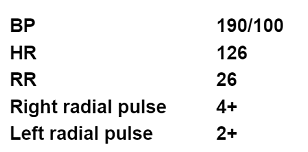
Assessment of a patient admitted with excruciating back pain reveals:

Appropriate therapy should include

Correct Answer: D. nitroprusside (Nipride).
Explanation:

The patient's vital signs indicate hypertensive urgency or emergency (BP 190/100, HR 126), with a differential radial pulse, suggesting aortic dissection. Nitroprusside is a potent vasodilator used in the management of hypertensive crises and can help reduce blood pressure and the shear force on the aortic wall, which is crucial in managing aortic dissection. Nitroglycerin, diltiazem, and digoxin are not appropriate first-line therapies for this condition. Reference: AACN Adult CCRN Certification Review Course, AACN CCRN Exam Handbook.


Question 3

A patient is receiving therapeutic hypothermia post-cardiac arrest. Which of the following orders should a nurse clarify?

Correct Answer: D. sequential compression devices
Explanation:

Sequential compression devices (SCDs) are not recommended for patients receiving therapeutic hypothermia (TH) post-cardiac arrest, because they may interfere with the cooling process and increase the risk of skin injury. SCDs are used to prevent deep vein thrombosis (DVT) by applying intermittent pneumatic pressure to the lower extremities, but they may also increase peripheral blood flow and heat exchange, which can counteract the effects of TH. SCDs may also cause skin breakdown, blisters, or burns in patients with impaired sensation and reduced perfusion due to TH. Therefore, a nurse should clarify the order for SCDs and consider alternative methods of DVT prophylaxis, such as pharmacological agents or early mobilization.


Therapeutic Hypothermia (TH) Education Components: This document states that ''Avoid use of sequential compression devices (SCDs) during cooling phase as they may interfere with cooling process and increase risk of skin injury.''

Sequential Compression Devices: Clinical Effectiveness, Cost- Effectiveness and Guidelines: This document states that ''One evidence-based guideline from the American Heart Association (AHA) and the American Stroke Association (ASA) recommended against the use of SCDs in patients undergoing therapeutic hypothermia after cardiac arrest, as they may interfere with the cooling process and increase the risk of skin injury.''

Question 4

Question 5

A patient is admitted following a motor vehicle crash. A fluid challenge is initiated immediately after assessing a BP of 80/palpable. Fifteen minutes later,

vital signs are as follows:

BP 86/50

HR 150

RR 36

The most appropriate action should be to

Correct Answer: B. administer a second fluid challenge.

Question 6

A patient has gained 8 kg in the past week. Serum sodium is 115 mEq/L, CVP is 20 mm Hg, and serum osmolality is decreased. The patient has just experienced a generalized tonic-clonic seizure. In this situation, which of the following IV solutions should a nurse be prepared to administer?

Correct Answer: A. 3% sodium chloride
Explanation:

The patient has signs of severe hyponatremia, which is a low level of sodium in the blood. Hyponatremia can cause cerebral edema, which can lead to seizures, confusion, coma, and death. The patient needs a hypertonic solution, which is a fluid that has a higher concentration of solutes than the blood, to draw water out of the brain cells and restore the normal sodium level. 3% sodium chloride is a hypertonic solution that can be used to treat severe hyponatremia. 0.45% sodium chloride, 0.9% sodium chloride, and 5% dextrose with 0.25% sodium chloride are all hypotonic solutions, which are fluids that have a lower concentration of solutes than the blood, and would worsen the patient's condition by adding more water to the blood and the brain.


AACN. (2023). CCRN (Adult) Exam Handbook. Retrieved from [CCRN Exam Handbook], p. 18.

AACN. (2023). CCRN (Adult) Exam Blueprint. Retrieved from [CCRN Exam Blueprint], p. 2.

AACN. (2020). Practice Alert: Hyponatremia. Retrieved from [Practice Alert], p. 1-2.

Lewis, S. L., Bucher, L., Heitkemper, M. M., Harding, M. M., Kwong, J., & Roberts, D. (2017). Medical-surgical nursing: Assessment and management of clinical problems (11th ed.). St. Louis, MO: Elsevier. Retrieved from [Textbook], p. 303-304.

Question 7

A nurse should expect which of the following plans of care for a patient with a complicated RV infarction?

Question 8

A patient is admitted for sepsis secondary to pneumoni

a. The patient has received 2000 mL of plasmalyte and their BP remains 80/50. What should the nurse anticipate next for the patient?

Correct Answer: B. norepinephrine

Question 9

A patient who had a liver resection now has a copious amount of serous drainage from the surgical incision. Which of the following should a nurse anticipate when caring for this patient?

Correct Answer: B. applying several abdominal dressings
Explanation:

A copious amount of serous drainage from a liver resection incision may indicate a bile leak, which can cause pain, infection, and delayed healing. The nurse should anticipate applying several abdominal dressings to absorb the fluid and protect the wound. The nurse should also monitor the patient for signs of infection, such as fever, increased white blood cell count, and foul-smelling drainage. The nurse should notify the surgeon of the excessive drainage and follow the orders for further interventions, such as imaging studies, drainage catheter placement, or surgical repair. Antibiotics may be prescribed, but they are not the first-line treatment for a bile leak. Incision and debridement of the wound may be necessary if there is necrotic tissue or infection, but it is not the initial action. Applying a drainage pouch to the site may not be sufficient to contain the large amount of fluid and may increase the risk of skin breakdown.


Problems after cancer surgery to remove part of your liver: This article states that ''The bile ducts connect the liver and gallbladder to the small bowel. There is a risk of bile leaking from the ducts on the cut surface of the liver. This may cause pain, sickness and a high temperature. Rarely, you might need another operation to repair the leak.''

Understanding Liver Abscess Treatment - Saint Luke's Health System: This article states that ''The provider uses CT scan or ultrasound to help place the wire in the right spot. A thin, flexible tube (catheter) is then placed over the wire and into the abscess. The tube is left in place for 5 to 7 days to drain the fluid. In some cases, surgery may be done to cut into the liver abscess and drain it.''

How Much Time Does it Take to Recover from Liver Surgery?: This article states that ''If you have any drainage from your incision or if the area around your incision is puffy or red, visit your surgeon. Take a shower every day with warm water. When you are ready to take solid foods, make sure to eat 4 to 6 small meals every day. Do not lift heavy weights for 8 weeks after your surgery.''

Question 10

A nurse has responded to a rapid response call on a medical-surgical floor in the hospital. The nurse finds the patient with the following data:

BP 72/30

HR 132

RR 24

T 102.3 F (39.0 C)

SpO2 95%

Ph 7.13

PaCO2 34 mm Hg

PaO2 88 mm Hg

HCO3 14 mEq/L

Na+ 142 mEq/L

The nurse should anticipate an order to administer which of the following?

Correct Answer: B. phenylephrine (Neo-Synephrine)
Explanation:

The patient's data indicate that the patient is in shock, which is a life-threatening condition characterized by inadequate tissue perfusion and organ dysfunction. The patient has a low blood pressure, a high heart rate, a fever, and a metabolic acidosis, which suggest that the patient may have septic shock, which is caused by a severe infection that triggers a systemic inflammatory response. The nurse should anticipate an order to administer phenylephrine (Neo-Synephrine), which is a vasopressor agent that constricts the blood vessels and increases the blood pressure and tissue perfusion. Phenylephrine is recommended as a first-line agent for septic shock by the Surviving Sepsis Campaign guidelines1. 8.4% sodium bicarbonate is not indicated for the treatment of septic shock, as it may worsen the acid-base balance and increase the risk of complications2. 0.9% sodium chloride is a normal saline solution that may be used for fluid resuscitation, but it may not be sufficient to restore the blood pressure and may cause fluid overload, hyperchloremia, and kidney injury3. Amiodarone (Cordarone) is an antiarrhythmic drug that is used to treat ventricular tachycardia or fibrillation, but it is not effective for septic shock and may cause hypotension, bradycardia, and other adverse effects4.


Surviving Sepsis Campaign. (2020). Surviving Sepsis Campaign: Guidelines on the Management of Critically Ill Adults with Coronavirus Disease 2019 (COVID-19). Retrieved from 1, p. 16.

Marik, P. E., & Bellomo, R. (2013). A rational approach to fluid therapy in sepsis. British Journal of Anaesthesia, 110(3), 323-329. Retrieved from 2, p. 327.

Semler, M. W., & Rice, T. W. (2019). Saline versus balanced crystalloids for intravenous fluid therapy in the emergency department: study protocol for a cluster-randomized, multiple-crossover trial. Trials, 20(1), 1-10. Retrieved from 3, p. 2-3.

Lexicomp Online. (2021). Amiodarone. Retrieved from 4, p. 1-2.