
Limited-Time Offer: Enjoy 50% Savings! Ends in 00h 00m 00s Coupon code: 50OFF
Skip to content

Free Acams Advanced CAMS-Financial Crimes Investigations CAMS-FCI Exam Questions

Page: 1 / 11 Total 101 questions

Want more questions? Get Premium Access.

Question 1

Refer to the exhibit.
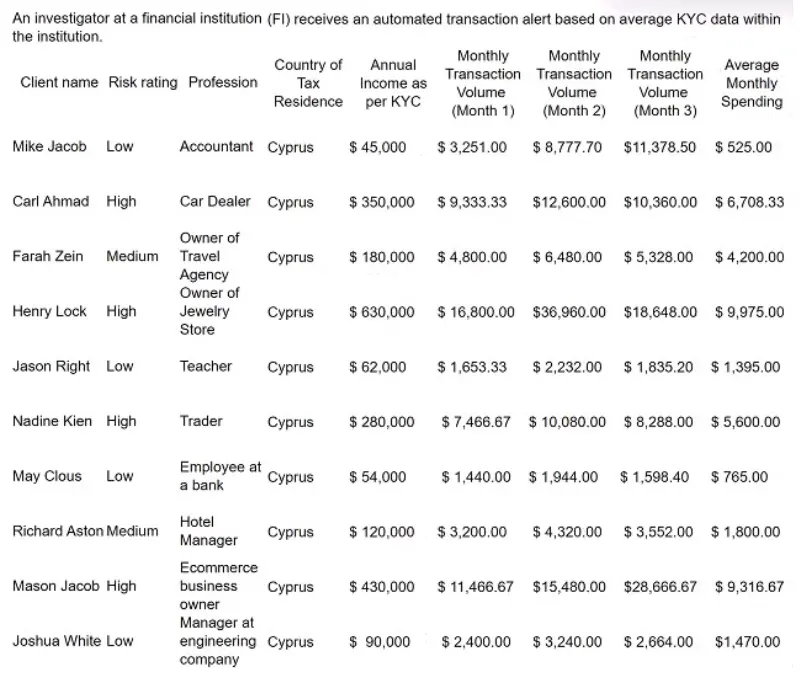
In a review of the account activity associated with Nadine Kien, an investigator observes a large number of small- to medium-size deposits from numerous individuals from several different global regions. The money is then transferred to a numbered company. Which is the next best course of action for the investigator?

Correct Answer: B. File a SAR/STR on the account activity in relation to a potential funnel account.
Explanation:

The next best course of action for the investigator is to file a SAR/STR on the account activity in relation to a potential funnel account. This is because a funnel account is a type of money laundering scheme that involves depositing funds from multiple sources into a single account, and then transferring them to another account, often in a different jurisdiction. A funnel account can be used to conceal the origin, ownership, and destination of illicit funds, and to evade currency transaction reporting requirements. The investigator should report the suspicious activity to the relevant authorities and document the findings and actions taken. The other options are incorrect because:

A . Completing the monthly review and noting the activity for next month's review is not sufficient, as it delays the reporting of a possible money laundering scheme and exposes the financial institution to regulatory and reputational risks.

C . Recommending the account for exit due to frequent global transactions is not appropriate, as it does not address the underlying issue of potential money laundering and may alert the customer of the investigation.

D . No further action is required as the customer is already rated at high-risk and the monthly spending is within expectations is not acceptable, as it ignores the red flags of a funnel account and fails to comply with the anti-money laundering obligations of the financial institution.


Advanced CAMS-FCI Certification | ACAMS, Section 2: Investigating Financial Crimes, page 9

Leading Complex Investigations Certificate | ACAMS, Module 2: Identifying Red Flags, page 5

Question 2

An investigator is reviewing a case generated from the transaction monitoring system, with two large amounts of incoming remittance (IR) to an individual customer. Based on the KYC profile, the customer is a plant manager of a famous multi-national electronics manufacturing firm. As the customer has no similarly large transaction patterns for the past 2 years, the investigator sends an inquiry to the relationship manager (RM) about the nature of the transaction. The RM replies that the transaction is a consultancy fee provided from two different electronics companies with a debit note provided However, there is no detail of service provided on the debit note, and the remitters are two individuals.

Which actions should the investigator recommend to mitigate risk? (Select Two.)

Correct Answer: D. Conduct enhanced due diligence.; E. Re-evaluate the customer risk profile.
Explanation:

The actions that the investigator should recommend to mitigate risk are conducting enhanced due diligence (D) and re-evaluating the customer risk profile (E). These actions are appropriate and prudent, as they allow the investigator to obtain more information and evidence about the nature and purpose of the transactions, the source and destination of the funds, and the identity and legitimacy of the parties involved. According to the ACAMS Advanced Financial Crimes Investigations Certification Study Guide1, ''the FI should conduct enhanced due diligence on all parties involved in the investigation, including checking various sources of information, such as watch lists, sanctions lists, negative news, and official registries'' (p. 24). The FI should also ''re-assess the customer risk profile based on any new information obtained during the investigation, and adjust the customer due diligence and monitoring requirements accordingly'' (p. 25).

The other options are not as appropriate or effective as options D and E. The investigator should not recommend exiting the relationship with the customer (A), as this could be premature or disproportionate, as well as potentially discriminatory or illegal. The investigator should not recommend documenting and maintaining a file with the investigative findings (B), as this is not an action to mitigate risk, but rather a standard procedure for any investigation. The investigator should not recommend discussing the investigation findings with the customer , as this could compromise the integrity and objectivity of the investigation, as well as expose the FI to legal or regulatory risks.


Question 3

A client with many personal and business deposits with the financial institution (Fl) seeks a business loan. The client wants to guarantee the loan with a trust for which they are the beneficiary.

An investigator examines the trust. The trust has many layers, including shell companies in known tax havens. The client's ultimate beneficial ownership claim cannot be validated, and the loan is denied.

Two months later, the Fl receives a law enforcement (LE) request on one of the client's business accounts. While reviewing the business account, the Fl receives another LE request on the same account from another agency. The requested information is shared.

Three months later, a branch manager receives a request to open a business deposit account related to a complex trust. The manager forwarded the request because of the complexity. The trust was the same as the previously examined trust, but the request came from a different client. The second client also has many accounts with the Fl. Further inspection finds links between the second client and the Paradise Papers. The Papers state the client led illegal activities and committed tax evasion.

What steps should the investigator perform in reference to the first client's existing accounts? (Select Three.)

Correct Answer: A. Review all client-signed documents relating to all accounts.; D. Perform secondary scans of the client's other owners/authorized signers; F. Prepare a relationship flow chart of all existing accounts to better understand the client's activities.
Explanation:

The investigator should review all client-signed documents relating to all accounts (A) to check for any discrepancies or red flags. The investigator should also perform secondary scans of the client's other owners/authorized signers (D) to identify any possible connections or associations with the second client or the Paradise Papers. Additionally, the investigator should prepare a relationship flow chart of all existing accounts (F) to better understand the client's activities and patterns. These steps are consistent with the ACAMS Advanced Financial Crimes Investigations Certification Study Guide1, which states that investigators should ''review all relevant documentation, including account opening documents, transaction records, and customer correspondence'' (p. 23), ''conduct enhanced due diligence on all parties involved in the investigation'' (p. 24), and ''use data visualization tools to map out complex relationships and transactions'' (p. 25).


Question 4

Which is a key characteristic of the Financial Action Task Force (FATF) Regional Style Bodies for combatting money laundering/terrorist financing?

Correct Answer: B. Implementing regional mutual evaluation procedures
Explanation:

According to the CAMS study guide, the Financial Action Task Force (FATF) Regional Style Bodies are organizations created by the FATF to promote the implementation of anti-money laundering and countering the financing of terrorism (AML/CFT) measures in specific regions. One of the key characteristics of these bodies is the implementation of regional mutual evaluation procedures.

Regional mutual evaluations involve member countries evaluating each other's AML/CFT regimes to identify strengths and weaknesses and to develop best practices for improvement. This process allows for greater cooperation between countries and can help to identify and address regional AML/CFT risks more effectively. It also promotes consistency in AML/CFT standards and practices within the region.


Question 5

A compliance analyst is reviewing the account activity of a customer that they suspect may be indicative of money laundering activity. Which is difficult to determine solely from the customer's account activity and KYC file?

Correct Answer: C. If there is negative media associated with counterparties
Explanation:

According to the Certified Anti-Money Laundering Specialist (CAMS) study guide, 6th edition, page 105, the correct answer is C. It can be difficult to determine if there is negative media associated with counterparties solely from the customer's account activity and KYC file.

The study guide explains that negative media can include news articles, government sanctions lists, and other sources of public information that may indicate that a counterparty is involved in illicit activities. However, this information may not be readily available in a customer's account activity or KYC file, and may require additional research or investigation.


Question 6

The intended benefits of section 314(b) of the USA PATRIOT Act include: (Select Three.)

Correct Answer: B. participating FIs sharing information about suspicious activity by customers that may have otherwise gone unnoticed.; E. detecting money laundering and TF approaches and schemes across multiple financial institutions (FIs).; F. obtaining additional information on customers or transactions regarding potential money laundering or terrorist financing (TF).
Explanation:

Section 314(b) of the USA PATRIOT Act allows financial institutions to share information with each other, under a safe harbor that offers protection from liability, in order to better identify and report potential money laundering or terrorist financing activities. The intended benefits of this information sharing include:

Participating financial institutions sharing information about suspicious activity by customers that may have otherwise gone unnoticed. For example, if a customer is conducting transactions with multiple financial institutions that individually do not appear suspicious, but collectively indicate a pattern of money laundering or terrorist financing, the financial institutions can share this information and report it to the authorities.

Detecting money laundering and terrorist financing approaches and schemes across multiple financial institutions. For example, if a financial institution identifies a new typology or modus operandi of money laundering or terrorist financing, it can share this information with other financial institutions to help them prevent or detect similar activities by their customers.

Obtaining additional information on customers or transactions regarding potential money laundering or terrorist financing. For example, if a financial institution has incomplete or insufficient information on a customer or a transaction that raises suspicion, it can request more information from another financial institution that may have dealt with the same customer or transaction.


Section 314(b) | FinCEN.gov

Section 314(b) Fact Sheet - FinCEN.gov

Question 7

An investigator receives an alert documenting a series of transactions. A limited liability corporation (LLC) wired 59.000,000 USD to an overseas account associated with a state-run oil company. A second account associated with the state-run oil company wired 600,000,000 USD to the LLC. The LLC then wired money to other accounts, a money brokerage firm, and real estate purchases.

The investigator initiated an enhanced KYC investigation on the LLC. The financial institution opened the LLC account a couple of weeks prior to the series of transactions. The names associated with the LLC had changed multiple times since the account opened. A search of those names revealed relations with multiple LLCs. Public records about the LLCs did not show any identifiable business activities.

Open-source research identified mixed reports about the brokerage firm.

The firm indicated it purchased mutual funds for its clients and dispensed returns to clients.

Media reports claimed the firm laundered money by holding money for a fee before returning it to investors.

Which information should the investigator review first when examining the wire transaction documentation?

Correct Answer: D. How the wire transfers were initiated (e.g., phone, online, branch visit)
Explanation:

The investigator should review how the wire transfers were initiated first, because this could indicate the level of involvement and knowledge of the LLC account holders. If the wire transfers were initiated online or by phone, it could suggest that the account holders were trying to avoid face-to-face contact with the bank staff and reduce the chances of being questioned or identified. If the wire transfers were initiated in person at a branch, it could indicate that the account holders were confident or careless about their activities, or that they had some relationship with the bank staff. The method of initiation could also affect the quality and quantity of information collected by the bank about the wire transfers, such as the purpose, source, and destination of the funds. Reference: ACAMS Advanced Financial Crimes Investigations Certification Study Guide, page 65.


Question 8

Potential indicators of money laundering associated with Trust and Company Service Providers include: (Select Two.)

Correct Answer: A. use of legal persons in jurisdictions with strict secrecy laws.; C. multi-jurisdictional wire transfers with no legal purpose.
Explanation:

This is stated in the Certified Anti-Money Laundering Specialist (the 6th edition) manual on page 595, which states: ''Potential indicators of money laundering associated with Trust and Company Service Providers include the use of legal persons in jurisdictions with strict secrecy laws, structuring cash deposits into third party accounts, multi-jurisdictional wire transfers with no legal purpose, and frequent deposits to or withdrawals from bank accounts.''


Question 9

A retail bank prepares a yearly AML risk assessment. Which inherent risk factor is likely the most relevant?

Correct Answer: B. The provision of cash services
Explanation:

Retail banks typically have a high inherent risk of money laundering due to their provision of cash services. This is because cash is a preferred medium of exchange for criminals and terrorists, and retail banks provide a convenient way for them to move large sums of money without detection. Retail banks are also vulnerable to money laundering through the use of false identities and other deceptive practices. (CAMS Manual, 6th Edition, Page 8).


Question 10

During transaction monitoring. Bank A learns that one of its customers. Med Supplies 123, is attempting to make a payment via wire totaling 382.500 USD to PPE Business LLC located in Mexico to purchase a large order of personal protective equipment. specifically surgical masks and face shields. Upon further verification. Bank A decides to escalate and refers the case to investigators.

Bank A notes that days prior to the above transaction, the same customer went to a Bank A location to wire 1,215,280 USD to Breath Well LTD located in Singapore. Breath Well was acting as an intermediary to purchase both 3-ply surgical masks and face shields from Chin

a. Bank A decided not to complete the transaction due to concerns with the involved supplier in China. Moreover, the customer is attempting to send a third wire in the amount of 350,000 USD for the purchase of these items, this time using a different vendor in China. The investigator must determine the next steps in the investigation and what actions, if any. should be taken against relevant parties.

The investigator is gathering more information to determine if a SAR/STR filing is needed. Which steps are the correct ways of collecting the additional information? (Select Two.)

Correct Answer: A. Reach out to the relationship manager asking if more up-to-date customer due diligence information can be collected on the customer.; D. Conduct open-source research to determine if the customer and involved counterparties are in the same business field.
Explanation:

The correct answer is A and C because these indicators suggest that the customer is using fraudulent documents and misrepresenting the goods to conceal the illicit nature of the transactions. Fentanyl traffickers often use front companies and falsified invoices to disguise their shipments as legitimate products, such as medical supplies or chemicals. Reviewing the invoices and transportation documents, as well as the FDA product certifications, can help to identify discrepancies or anomalies that indicate fraud or deception.