Question 1
A bank is evaluating the credit risk for a company seeking to optimize costs and originate a high volume of outgoing ACH payments. What is the BEST provision the bank should establish to control its credit exposure?
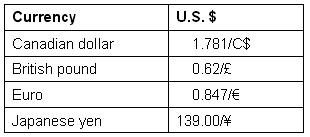
On the basis of the following exchange rates,

which of the following currency amounts has the greatest value in U.S. dollars?
A cash manager at a U.S. retailer forecasts a positive collected cash position for the end of the current day. The company has an overdraft facility at 10%, a separate investment account earning 8% before taxes, an earnings credit rate of 8% and an outstanding single payment note at 9.5% maturing in 1 week. This month's bank service fees are expected to exceed the earnings credit. Which of the following options would be the MOST economically positive for the company?
A bank's reserve requirement on demand deposits is 10%, and its earnings credit rate is 6%. If a company uses bank services amounting to $2,600 and has an excess of $550 in earnings credit, what is the average collected balance in the account based on a 30-day month?
Which of the following are interest-bearing instruments?
I . Certificates of deposit
II . Treasury bills
III . Treasury notes
IV . Banker's acceptances
A company has a $300,000 credit line of which $200,000 was the average amount outstanding for the year. The terms of the loan include a 1/2 of 1% commitment fee on the unused portion, an interest rate of 10%, and a compensating balance requirement of 2% of the total credit line. The company's compensating balances are funded from credit-line borrowings.
If the company negotiates to eliminate the compensating balance requirement and the average borrowings remain at $200,000, the annual interest rate would be:
Three college roommates open a fast-food restaurant chain after graduation. They decide to offer a 401(k) plan to all of their 700+ employees and a defined benefit retirement plan for themselves and their six Group Vice Presidents. If the company initially funds the defined benefit plan with $10 million and is in the 32% tax bracket, what is the after-tax cost of the funding?
Which one of the following ties a user's private key to a user's public key?
Which of the following ONLY measures the time required to convert a credit sale into cash?
Company A has decided to purchase $3,000,000 of real estate from Company B. Company A will make the payment in 3 parts. The electronic payments will be sent from Bank A to Bank B. On Day 1 Company A will send a $400,000 check as a deposit, which is deductible from the balance. The check is expected to clear in 4 days. On Day 2, two payments are initiated, one wire transfer for $2,000,000 and an ACH for $600,000 to complete the balance. On Day 2 what percentage of the payment to Company B is NOT final?
Which of the following is a KEY objective when instituting a collection and concentration policy?
Which of the following is NOT a short-term cash forecasting technique?
XYZ Company is a U.S. based company that has just issued some euro-denominated bonds in London. The bonds have a duration of 10 years at a rate of 3.5% with a par value of EUR 50 million. An FX swap contract was created on the date of the issuance in EUR/USD, with a spot rate of 1.2908 and a forward rate of 1.1102. This bond is subject to what type of risk?
A treasury employee of Company XYZ is privy to financial reporting information yet to be released to the public. He knows that year-end earnings exceed last year's and would be viewed as positive to the investment community. He casually mentions to a relative that now would be a good time to buy the stock of Company XYZ. Which section of the treasury code of ethics would typically be violated by such a disclosure?
XYZ Company has decided to purchase a close competitor. This acquisition would make XYZ Company the 4th largest in its industry allowing it better purchasing power and greater distribution channels. After completing the M&A analysis, it is determined that the combined companies would produce a 40% increase in revenue, reduce manufacturing costs by 30%, but would increase current liabilities by 27%. Which of the following would keep the acquisition from happening?