Free AICPA CPA Financial Accounting and Reporting CPA-Financial Exam Questions
Page: 1 / 11Total 163 questions
Want more questions? Get Premium Access.
Question 1
Hyde Corp. has three manufacturing divisions, each of which has been determined to be a reportable segment. In 1989, Clay division had sales of $3,000,000, which was 25% of Hyde's total sales, and had operating costs of $1,900,000, as reported to the CFO. In 1989, Hyde incurred operating costs of $500,000 that were not directly traceable to any of the divisions. In addition, Hyde incurred corporate interest expense of $300,000 in 1989. In reporting segment information, what amount should be shown as Clay's operating profit for 1989?
Correct Answer:D. $1,100,000
Explanation:
Choice 'd' is correct. $1,100,000 operating profit for clay.
Rule: Operating profit by segments is based on the measure of profit reported to the 'chief operating decision maker.'
Allocations for general operating costs and interest, etc., should not be made solely for purposes of segment disclosures.
Question 2
On January 2, 1993, Quo, Inc. hired Reed to be its controller. During the year, Reed, working closely with Quo's president and outside accountants, made changes in accounting policies, corrected several errors dating from 1992 and before, and instituted new accounting policies.
Quo's 1993 financial statements will be presented in comparative form with its 1992 financial statements.
This question represents one of Quo's transactions. List A represents possible clarifications of these transactions as: a change in accounting principle, a change in accounting estimate, a correction of an error in previously presented financial statements, or neither an accounting change nor an accounting error.
Item to Be Answered
As a result of a production breakthrough, Quo determined that manufacturing equipment previously depreciated over 15 years should be depreciated over 20 years.
List A (Select one)
Correct Answer:B. Change in accounting estimate.
Explanation:
Choice 'b' is correct. Change in lives of fixed assets is a change in accounting estimate.
Question 3
An extraordinary gain should be reported as a direct increase to which of the following?
Correct Answer:A. Net income.
Explanation:
Choice 'a' is correct. Extraordinary items are reported as a component of net income, after income from continuing operations and discontinued operations.
Choice 'b' is incorrect. An extraordinary gain (or loss) only indirectly affects comprehensive income as a component of net income.
Choice 'c' is incorrect. Extraordinary items are reported net of tax after income from continuing operations and discontinued operations.
Choice 'd' is incorrect. Extraordinary items are reported net of tax after income from continuing operations and discontinued operations.
Income Statement
Question 4
On January 2, 1993, Quo, Inc. hired Reed to be its controller. During the year, Reed, working closely with Quo's president and outside accountants, made changes in accounting policies, corrected several errors dating from 1992 and before, and instituted new accounting policies.
Quo's 1993 financial statements will be presented in comparative form with its 1992 financial statements.
This question represents one of Quo's transactions. List B represents the general accounting treatment required for these transactions. These treatments are:
* Cumulative effect approach - Include the cumulative effect of the adjustment resulting from the accounting change or error correction in the 1993 financial statements, and do not restate the 1992 financial statements.
* Retroactive or retrospective restatement approach - Restate the 1992 financial statements and adjust 1992 beginning retained earnings if the error or change affects a period prior to 1992.
* Prospective approach - Report 1993 and future financial statements on the new basis but do not restate 1992 financial statements.
During 1993, Quo increased its investment in Worth, Inc. from a 10% interest, purchased in 1992, to 30%, and acquired a seat on Worth's board of directors. As a result of its increased investment, Quo changed its method of accounting for investment in Worth, Inc. from the cost method to the equity method.
List B
Correct Answer:B. Retroactive or retrospective restatement approach.
Explanation:
Choice 'B' is correct. The equity method of accounting is applied retroactively when the investor has acquired 20% ownership. Prior to acquiring the ability to influence the investee, the cost method is proper. The retroactive restatement approach does not mean that this change is the correction of an error (which is now treated retroactively), a change in accounting principle (which is now treated retrospectively), or a change in accounting entity (which is now treated retrospectively). It just means that retroactive restatement is the proper treatment.
Question 5
During the first quarter of 1993, Tech Co. had income before taxes of $200,000, and its effective income tax rate was 15%. Tech's 1992 effective annual income tax rate was 30%, but Tech expects its 1993 effective annual income tax rate to be 25%. In its first quarter interim income statement, what amount of income tax expense should Tech report?
Correct Answer:C. $50,000
Explanation:
Choice 'c' is correct. Interim period tax expense is the estimated annual effective tax rate (25% in this case) applied to the year-to-date income before taxes minus the tax expense recognized in previous interim periods. Since this question involves the first quarter, there are no previous interim periods. 25% $200,000 = $50,000. FIN 18, para. 16
Choice 'a' is incorrect. Income tax expense is reported in interim income statements.
Choice 'b' is incorrect. The 1993 annual estimated tax rate, not the first quarter effective tax rate, is used to calculate income tax expense for interim statements.
Choice 'd' is incorrect. The 1993 annual estimated tax rate, not the 1992 annual effective tax rate, is used to calculate income tax expense for interim statements.
Question 6
On December 2, 20X1, Flint Corp.'s board of directors voted to discontinue operations of its frozen food division and to sell the division's assets on the open market as soon as possible. The division reported net operating losses of $20,000 in December and $30,000 in January. On February 26, 20X2, sale of the division's assets resulted in a gain of $90,000. Assuming that the frozen foods division qualifies as a component of the business and ignoring income taxes, what amount of gain/loss from discontinued operations should Flint recognize in its income statement for 20X2?
Correct Answer:C. $60,000
Explanation:
Choice 'c' is correct. The $60,000 gain from discontinued operations would be reported in Flint's 20X2 income statement. The operating loss for January would offset the gain from disposal in February, and the net amount would be reported as a gain (in this case) from discontinued operations.
The operating losses for December would have been reported in Flint's 20X1 income statement.
Choice 'a' is incorrect per the above. It would be correct if all of the gains and losses were included in 20X1 instead of 20X2. However, gains and losses from discontinued operations are included in the year they occur.
Choice 'b' is incorrect. It includes the operating loss for December, 20X1 in with the 20X2 amounts.
Choice 'd' is incorrect. It ignores the January operating loss. Operating losses are included in gain/loss from discontinued operations, along with impairment losses and gains/losses on disposal.
Question 7
Which of the following statements best describes an operating procedure for issuing a new Financial Accounting Standards Board (FASB) statement?
Correct Answer:C. A new statement is issued only after a majority vote by the members of the FASB.
Explanation:
Choice 'c' is correct. A new statement from the FASB is issued only after a majority vote of the members of the FASB.
Choice 'a' is incorrect. There is no necessity for the EITF to approve a discussion memorandum
(presumably the question means a discussion memorandum of the FASB statement itself and not an EITF statement) before it is disseminated to the public.
Choice 'b' is incorrect. There is no necessity for an exposure draft to be modified per public opinion before issuing the discussion memorandum (a question can be raised here as to 'what' discussion memorandum'). Exposure drafts are quite/most often modified before they are issued as FASB statements, but they do not have to be. Whether they are or are not modified is a function of whether the FASB thinks they should be modified, partly due to the public comments that have been received.
Choice 'd' is incorrect. There is no way to rescind a new FASB statement, although, in reality, a FASB statement can be rescinded by the issuance of a new statement on the same subject. However, even if there was a way to rescind a new FASB statement, it would not be by a majority vote of the AICPA membership, but by a majority vote of the members of the FASB.
Reporting Net Income
Question 8
Which of the following assumptions means that money is the common denominator of economic activity and provides an appropriate basis for accounting measurement and analysis?
Correct Answer:C. Monetary unit.
Explanation:
Choice 'c' is correct. The monetary unit assumption means that money is the common denominator for economic activity and provides an appropriate basis for accounting measurements and analysis.
Choice 'a' is incorrect. The going concern assumption has nothing to do with money per se. The going concern assumption presumes that an entity will continue to operate in the foreseeable future.
Choice 'b' is incorrect. The periodicity has nothing to do with money per se. The periodicity assumption is that economic activity can be divided into meaningful time periods.
Choice 'd' is incorrect. The economic entity assumption has nothing to do with money per se. The economic entity assumption is that economic activity can be accounted for when considering an identifiable set of activities.
Question 9
An inventory loss from a permanent market decline of $360,000 occurred in May 1989. Cox Co. appropriately recorded this loss in May 1989 after its March 31, 1989 quarterly report was issued. What amount of inventory loss should be reported in Cox's quarterly income statement for the three months ended June 30, 1989?
Correct Answer:D. $360,000
Explanation:
Choice 'd' is correct. $360,000 inventory loss reported for the quarter ended 6-30-89.
Rule: Inventory losses from 'permanent market declines' are recognized in the interim period, incurred and later, if they 'turn-around,' are recognized as gains in a subsequent interim period only to the extent of previously reported losses.
Rule: 'Temporary' market declines need not be recognized at interim when a 'turn-around' can reasonably be expected to occur before the end of the fiscal year.
Facts: This $360,000 inventory decline is permanent and the entire loss would be recognized in the quarter interim period incurred (6-30-89).
Question 10
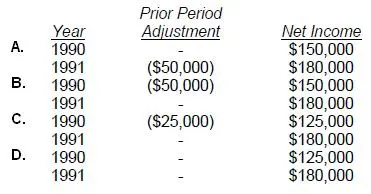
While preparing its 1991 financial statements, Dek Corp. discovered computational errors in its 1990 and 1989 depreciation expense. These errors resulted in overstatement of each year's income by $25,000, net of income taxes. The following amounts were reported in the previously issued financial statements:
Dek's 1991 net income is correctly reported at $180,000. Which of the following amounts should be reported as prior period adjustments and net income in Dek's 1991 and 1990 comparative financial statements?
Correct Answer:C. Option C
Explanation:
Choice 'c' is correct. 1990 ($25,000) $125,000
1991 -- 180,000
Because these are comparative financial statements, prior period adjustments require retroactive treatment for the years presented. Because 1989 is not presented, the 1989 correction is shown as a prior period adjustment of $25,000 to retained earnings statement of 1990.
Question 11
In 1990, Brighton Co. changed from the individual item approach to the aggregate approach in applying the lower of FIFO cost or market to inventories. The cumulative effect of this change should be reported in Brighton's financial statements as a:
Correct Answer:A. Retrospective adjustment on the retained earnings statement, with separate disclosure.
Explanation:
Choice 'a' is correct. A change in the composition of the elements of cost such as changing from the individual item approach to the aggregate approach in applying the lower of FIFO cost or market to inventories (LCM is covered in F4) is an example of a change in accounting principle. The cumulative effect of the change in accounting principle should now be shown on the retained earnings statement as an adjustment to the beginning balance of retained earnings, in what is called retrospective application.
Choices 'b', 'c', and 'd' are incorrect. The cumulative effect of a change in accounting principle is now reported on the retained earnings statement, not the income statement. Most of these types of changes (changes in accounting principle) used to be reported on the income statement. SFAS No. 154 changed that.
Question 12
According to the FASB conceptual framework, the quality of information that helps users increase the likelihood of correctly forecasting the outcome of past or present events is called:
Correct Answer:B. Predictive value.
Explanation:
Choice 'b' is correct. The quality of information that helps users increase the likelihood of correctly forecasting the outcome of past or present events is called predictive value. Forecasting is predicting.
Choice 'a' is incorrect. The quality of information that helps users increase the likelihood of correctly forecasting the outcome of past or present events is called predictive value, not feedback value. Feedback value enables decision makers to confirm prior expectations or to adjust or correct the decisions made previously.
Choice 'c' is incorrect. The quality of information that helps users increase the likelihood of correctly forecasting the outcome of past or present events is called predictive value, not representational faithfulness. Representational faithfulness is the agreement between financial reporting and the resources or events represented.
Choice 'd' is incorrect. The quality of information that helps users increase the likelihood of correctly forecasting the outcome of past or present events is called predictive value, not reliability. Reliability is the combination of neutrality, representational faithfulness, and verifiability.
Question 13
At December 31, 1998, Off-Line Co. changed its method of accounting for demo costs from writing off the costs over two years to expensing the costs immediately. Off-Line made the change in recognition of an increasing number of demos placed with customers that did not result in sales. Off-Line had deferred demo costs of $500,000 at December 31, 1997, $300,000 of which were to be written off in 1998 and the remainder in 1999. Off-Line's income tax rate is 30%. In its 1998 financial statements, what amount should Off-Line report as cumulative effect of change in accounting principle?
Correct Answer:A. $0
Explanation:
Choice 'a' is correct. When a change in accounting principle is considered inseparable from a change in estimate, the change is handled as a change in estimate - prospectively. No cumulative effect adjustment is made.
Choices 'b', 'c', and 'd' are incorrect since no cumulative effect adjustment is made.
Question 14
On March 15, 1992, Krol Co. paid property taxes of $90,000 on its office building for the calendar year 1992. On April 1, 1992, Krol paid $150,000 for unanticipated repairs to its office equipment. The repairs will benefit operations for the remainder of 1992. What is the total amount of these expenses that Krol should include in its quarterly income statement for the three months ended June 30, 1992?
Correct Answer:C. $72,500
Explanation:
Rule: Actual and estimated expenditures benefiting all interim periods equally should be expensed ratably throughout the year.
Choice 'c' is correct. $72,500 total expense for the three months ended June 30, 1992.
Question 15
On January 2, 1993, Quo, Inc. hired Reed to be its controller. During the year, Reed, working closely with Quo's president and outside accountants, made changes in accounting policies, corrected several errors dating from 1992 and before, and instituted new accounting policies.
Quo's 1993 financial statements will be presented in comparative form with its 1992 financial statements.
This question represents one of Quo's transactions. List B represents the general accounting treatment required for these transactions. These treatments are:
* Cumulative effect approach - Include the cumulative effect of the adjustment resulting from the accounting change or error correction in the 1993 financial statements, and do not restate the 1992 financial statements.
* Retroactive or retrospective restatement approach - Restate the 1992 financial statements and adjust 1992 beginning retained earnings if the error or change affects a period prior to 1992.
* Prospective approach - Report 1993 and future financial statements on the new basis but do not restate 1992 financial statements.
Item to Be Answered
As a result of a production breakthrough, Quo determined that manufacturing equipment previously depreciated over 15 years should be depreciated over 20 years.
List B (Select one)
Correct Answer:C. Prospective approach.
Explanation:
Choice 'C' is correct. This affects only the prospective (current and subsequent) periods - not prior periods, not retained earnings.