
Limited-Time Offer: Enjoy 50% Savings! Ends in 00h 00m 00s Coupon code: 50OFF
Skip to content

Free Amazon AWS Certified: SAP on AWS - Specialty PAS-C01 Exam Questions

Page: 1 / 7 Total 65 questions

Want more questions? Get Premium Access.

Question 1

An SAP solutions architect is designing an SAP HANA scale-out architecture for SAP Business Warehouse (SAP BW) on SAP HANA on AWS. The SAP solutions architect identifies the design as a three-node scale out deployment of x1e 32xlarge Amazon EC2 instances

The SAP solutions architect must ensure that the SAP HANA scale-out nodes can achieve the low-latency and high-throughput network performance that are necessary for node-to-node communication

Which combination of steps should the SAP solutions architect take to meet these requirements? (Select TWO.)

Correct Answer: A. Create a cluster placement group Launch the instances into the cluster placement group; D. Based on the operating system version verify that enhanced networking is enabled on all the nodes
Explanation:

A cluster placement group is an Amazon EC2 feature that enables low-latency and high-throughput network performance for the instances that are launched into the group. This is achieved by placing the instances in the same availability zone and physically close to each other, which reduces network latency and increases network throughput.

Enhanced networking is a feature provided by AWS that enables higher network performance by using specialized network interfaces that support higher IOPS and throughput. To meet the requirement of low-latency and high-throughput network performance, it is necessary to check that enhanced networking is enabled on all the nodes, based on the operating system version.

Question 2

A company is running SAP ERP Central Component (SAP ECC) with a Microsoft SQL Server database on AWS A solutions architect must attach an additional 1 TB Amazon Elastic Block Store (Amazon EBS) volume. The company needs to write the SQL Server database backups to this EBS volume before moving the database backups to Amazon S3 for long-term storage.

Which EBS volume type will meet these requirements MOST cost-effectively?

Correct Answer: A. Throughput Optimized HDD (st1)
Explanation:

'For SQL Server database backup, you can use one of the following methods: SQL native tools to take backup on disk: Backup requires high throughput compared to IOPS. We recommend using Throughput Optimized HDD (st1) which provides maximum throughput of 500 MB/s per volume.'


Question 3

A company is moving to the AWS Cloud gradually. The company has multiple SAP landscapes on VMware The company already has sandbox development and QA systems on AWS The company's production system is still running on premises. The company has 2 months to cut over the entre landscape to the AWS Cloud

The company has adopted a hybrid architecture for the next 2 months and needs to synchronize its shared file systems between the landscapes These shared file systems include trans directory mounts, /software directory mounts, and third-party integration mounts in the on-premises landscape the company has NFS mounts between the servers On the AWS infrastructure side the company is using Amazon Elastic File System (Amazon EFS) to share the common files

An SAP solutions architect needs to design a solution to schedule transfer of these shared files bidirectional four times each day. The data transfer must be encrypted

Which solution will meet these requirements?

Correct Answer: B. Install an AWS DataSync agent on the on-premises VMware platform Use the DataSync endpoint to synchronize between the on-premises NFS server and Amazon EFS on AWS
Explanation:

AWS DataSync can be used to schedule and automate the transfer of data between on-premises NFS servers and Amazon EFS on AWS. It also allows data to be encrypted during transfer, which meets the requirement for encryption.


Question 4

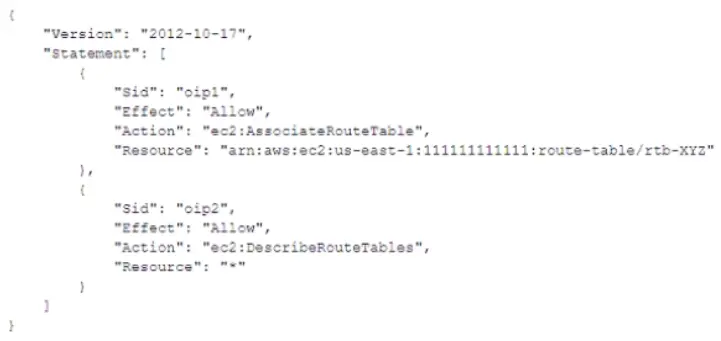
A company has deployed SAP HANA m the AWS Cloud. The company needs its SAP HAN A database to be highly available An SAP solutions architect has deployed the SAP HANA database in separate Availability Zones in a single AWS Region SUSE Linux Enterprise High Availability Extension is configured with an overlay IP address. The overlay IP resource agent has the following IAM policy:

During a test of failover the SAP solutions architect finds that the overlay IP address does not change to the secondary Availability Zone Which change should the SAP solutions architect make in the policy statement for Sid oip1 to dx this error1?

Correct Answer: B. Change the Action element to ec2 ReplaceRoute

Question 5

A company is planning to migrate its on-premises SAP applications to AWS. The applications are based on Windows operating systems A file share stores the transport directories and third party application data on the network attached storage of the company's on-premises data center. The company's plan is to lift and shift the SAP applications and the file share to AWS. The company must follow AWS best practices for the migration

Which AWS service should the company use to host the transport directories and third-party application data on AWS?

Question 6

An SAP solutions architect is leading the SAP basis team for a company. The company's SAP landscape includes SAP HANA database instances for the following systems sandbox development quality assurance test {QAT} system performance test (SPT) and production. The sandbox development and OAT systems are running on Amazon EC2 On-Demand Instances. The SPT and production systems are running on EC2 Reserved Instances All the EC2 instances are using Provisioned IOPS SSO (K)2) Amazon Elastic Block Store (Amazon EBS) volumes.

The entire development learn is in the same time zone and works from 8 AM to 6 PM. The sandbox system is for research and testing that are not critical. The SPT and production systems are business critical The company runs load-testing jobs and stress-testing jobs on the QAT systems overnight to reduce testing duration. The company wants to optimize infrastructure cost for the existing AWS resources.

How can the SAP solutions architect meet these requirements with the LEAST amount of administrative effort?

Question 7

A company is running an SAP ERP Central Component (SAP ECC) system on an SAP HANA database that is 10 TB m size The company rs receiving notifications about long-running database backups every day The company uses AWS Backint Agent for SAP HANA (AWS Backint agent) on an Amazon EC2 instance to back up the database An SAP NetWeaver administrator needs to troubleshoot the problem and propose a solution

Which solution will help resolve this problem'?

Correct Answer: B. Check the UploadChanneiSize parameter for AWS Backint agent increase this value in the aws-backint-agent-config yaml configuration file based on the EC2 instance type and storage configurations
Explanation:

The problem is long-running database backups every day, it is likely that the backups are taking too long to complete because the upload channel size is not sufficient for the size of the backups. By increasing the UploadChannelSize parameter, the SAP NetWeaver administrator can adjust the amount of data that is sent over the network at a time, which can help to speed up the backups and reduce the time they take to complete. This can be done by editing the aws-backint-agent-config yaml configuration file and increasing the value of the UploadChannelSize parameter based on the EC2 instance type and storage configurations.

https://docs.aws.amazon.com/sap/latest/sap-hana/aws-backint-agent-installing-configuring.html


Question 8

A company is planning to migrate its SAP workloads to AWS. The company will use two VPCs One VPC will be for production systems and one VPC will be for non-production systems. The company will host the non-production systems and the primary node of all the production systems in the same Availability Zone.

What is the MOST cost-effective way to establish a connection between me production systems and the non-production systems?

Correct Answer: B. Establish a VPC peering connection between the two VPCs Add the appropriate routes in the subnet route tables
Explanation:

Establish a VPC peering connection between the two VPCs Add the appropriate routes in the subnet route tables is the most cost-effective way to establish a connection between the production systems and the non-production systems. VPC Peering allows for direct and private communication between VPCs and does not require any additional components such as internet gateways or VPN connections. This method is more cost-effective than using a Transit Gateway or Direct Connect and also provides better security as the traffic remains within the AWS network.


Question 9

A company is implementing SAP HANA on AWS According 10 the company's security policy SAP backups must be encrypted Only authorized team members can have the ability to decrypt the SAP backups

What is the MOST operationally efficient solution that meets these requirements?

Correct Answer: B. Configure AWS Backint Agent for SAP HANA to use AWS Key Management Service (AWS KMS) for SAP backups Create a key policy to grant decryption permission to authorized team members only
Explanation:

This is the most operationally efficient solution that meets the company's security policy requirements. AWS KMS is a service that enables you to create and manage encryption keys that are used to encrypt and decrypt data. By configuring AWS Backup Agent for SAP HANA to use AWS KMS for SAP backups, the company can ensure that the backups are encrypted at rest and that only authorized team members have the ability to decrypt them. The key policy allows the company to define which team members are authorized to access the key, so that it can be used to decrypt the backup. This approach is operationally efficient because it does not require the company to manually encrypt and decrypt backups, and it enables the company to manage access to the encryption key through IAM policies, without the need for sharing encryption keys.


Question 10

A company has deployed its SAP applications into multiple Availability Zones in the same AWS Region To accommodate storage of media files database table export and import and files dropped by third-party tools the company has mounted Amazon Elastic File System (Amazon EFS) file systems between the SAP instances The company needs to retrieve the files quickly for installations updates and system refreshes

Over time the EFS file systems have grown exponentially to multiple terabytes An SAP solutions architect must optimize storage cost for the tiles that are stored in Amazon EFS.

Which solution will meet this requirement with the LEAST administrative overhead?

Correct Answer: C. Apply a lifecycle policy on the files in Amazon EFS to move the files to EFS Standard-Infrequent Access (Standard-IA)
Explanation:

Apply a lifecycle policy on the files in Amazon EFS to move the files to EFS Standard-Infrequent Access (Standard-IA) is the solution that will meet this requirement with the least administrative overhead. This solution allows you to automatically move files that have not been accessed for a certain period of time to a lower-cost storage class, reducing storage costs without the need for manual intervention.

C is correct because applying a lifecycle policy on files in Amazon EFS to move files to EFS Standard-Infrequent Access (Standard-IA) reduces storage cost for files that are rarely accessed. This solution allows you to automatically move files that have not been accessed for a certain period of time to a lower-cost storage class, reducing storage costs without the need for manual intervention. Reference: https://docs.aws.amazon.com/whitepapers/latest/sap-on-aws-technical-deployment-guide/cost-optimization.html https://docs.aws.amazon.com/efs/latest/ug/lifecycle-management-efs.html