
Limited-Time Offer: Enjoy 50% Savings! Ends in 00h 00m 00s Coupon code: 50OFF
Skip to content

Free APA Fundamental Payroll Certification Exam FPC-Remote Exam Questions

Page: 1 / 11 Total 162 questions

Want more questions? Get Premium Access.

Question 1

To ensure net pay is correct and taxes are deposited timely, which items need to be reconciled?

Correct Answer: D. Accounts payable payments and end-of-the-month balances; general ledger entries and payroll register
Explanation:

Comprehensive and Detailed Explanation:

Payroll reconciliation ensures that payroll transactions match financial records to avoid errors in tax deposits, employee payments, and financial reporting.

The correct answer includes all necessary reconciliation points:

Accounts payable payments (ensure wages were paid)

End-of-the-month balances (cross-check payroll liabilities)

General ledger entries (confirm correct postings)

Payroll register (check against wage statements)

Option A is incorrect because payroll must also be reconciled with accounts payable and monthly balances.

Option B & C are incorrect because they exclude payroll register validation.


Payroll.org -- Payroll Reconciliation Best Practices

IRS -- Employer's Tax Guide (Publication 15)
Question 2

The journal is commonly referred to as the record of:

Correct Answer: C. Original entry
Explanation:

A journal is known as the 'original entry' because transactions are first recorded here before posting to the ledger.

The general ledger is the final entry (B), not the journal.


Payroll Accounting Standards (Payroll.org)

Question 3

When an employee does not answer an unclaimed wage inquiry, the employer should:

Correct Answer: A. Refer to state laws for final resolution of the wages
Explanation:

State unclaimed property (escheat) laws govern how unclaimed wages must be handled.

Employers must report and transfer unclaimed wages to the state treasury after a specified period.

Maintaining wages indefinitely (B) is not compliant, and reissuing payments (C) without confirmation could lead to payroll errors.


State Escheatment Laws (National Association of Unclaimed Property Administrators - NAUPA)

IRS Payroll Compliance Guidelines

Question 4

When testing a payroll business continuity plan, all of the following tasks are critical to issuing payments to employees EXCEPT:

Correct Answer: B. Adding a new cost center.
Explanation:

A payroll business continuity plan (BCP) is designed to ensure payroll processes continue during a disruption. Critical tasks include validating system access, creating ACH files, and printing paychecks. Adding a new cost center is NOT critical to issuing payroll, as it primarily affects financial reporting rather than payment processing. Payroll.org recommends focusing on system access, banking functions, and ensuring payroll runs smoothly.


Payroll.org, Business Continuity and Disaster Recovery Guidelines

IRS Publication 15 (Employer's Tax Guide)

Question 5

An employee has YTD wages in the amount of $250,000.00 and receives a $1,753.00 bonus payment. Using the optional flat rate method, calculate the federal income tax withholding from the bonus payment.

Correct Answer: A. $385.00
Explanation:

Comprehensive and Detailed Explanation:

Under IRS guidelines, supplemental wages such as bonuses are subject to a flat federal tax rate of 22% if paid separately.

Federal Tax Calculation:

$1,753.00 22% = $385.66

Rounded to the nearest cent, the closest answer is $385.00.

Thus, the correct answer is A. $385.00.


IRS Publication 15-T -- Federal Income Tax Withholding Methods

Payroll.org -- Supplemental Wage Withholding Rules

Question 6

Even if a worker meets the definition of an employee, an employer can still treat the worker as an independent contractor if the worker passes the:

Correct Answer: B. Reasonable Basis Test
Explanation:

Comprehensive and Detailed Explanation:

The Reasonable Basis Test allows an employer to classify a worker as an independent contractor if:

A previous IRS audit approved similar treatment

A court ruling or IRS ruling supports classification

Industry practices support independent contractor status

Option A (Common Law Test) determines if a worker should be an employee or independent contractor, but does not override misclassification.

Option C (Physical Presence Test) applies to foreign earned income exclusions.

Option D (Permanent Resident Test) applies to immigration status, not worker classification.


IRS -- Reasonable Basis Test (Section 530 Relief)

Payroll.org -- Independent Contractor vs. Employee Guidelines

Question 7

Which of the following deductions from pay is considered a voluntary deduction?

Correct Answer: B. Wage assignments
Explanation:

Wage assignments are voluntary deductions authorized by employees for things like loan payments or union dues.

Garnishments, wage attachments, and medical support orders are court-mandated deductions, making them involuntary.


IRS Publication 15 (Employer's Tax Guide)

Payroll Deduction Compliance Guide (Payroll.org)

Question 8

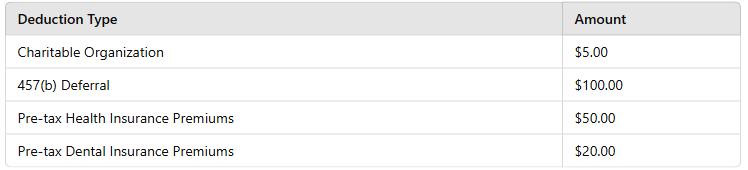
During open enrollment, the employee elects the following deductions. What is the total of the Section 125 Cafeteria Plan deductions?

Correct Answer: A. $70.00
Explanation:

Comprehensive and Detailed Explanation:

Section 125 Cafeteria Plan deductions include only pre-tax health and dental insurance contributions.

Eligible Pre-Tax Deductions:

Health Insurance Premiums: $50.00

Dental Insurance Premiums: $20.00

Total Section 125 Deductions: $70.00

Non-Eligible Deductions:

Charitable Contributions ($5.00) Not pre-tax.

457(b) Deferral ($100.00) Retirement savings, not a Section 125 deduction.

Thus, the correct answer is A. $70.00.


IRS -- Section 125 Cafeteria Plan Guidelines

Payroll.org -- Employee Benefit Deduction Compliance

Question 9

The due date for filing Form 941 is the:

Correct Answer: C. Last day of the month following the end of the quarter
Explanation:

Form 941 is due on the last day of the month following the end of the quarter.

Example:

Q1 (Jan--Mar) due: April 30

Q2 (Apr--Jun) due: July 31


IRS Form 941 Instructions

Question 10

A semiweekly depositor accumulates a payroll tax liability of $49,000.00 on Thursday. The next day, the company has bonus payroll with a tax liability of $120,200.00. Calculate the amount of tax deposit and its due date.

Correct Answer: C. $169,200.00 on the following Monday
Explanation:

As a semiweekly depositor, if the tax liability exceeds $100,000 in a single day, the employer must deposit the full amount by the next business day.

The combined liability of $169,200 must be deposited on Monday.


IRS Publication 15 (Federal Deposit Rules)

Question 11

When providing wage data for a workers' compensation audit, which of the following wage types would be included as compensation?

Correct Answer: B. Commissions
Explanation:

Workers' compensation includes commissions (B) as part of employee earnings.

Gratuities (A) and uniform stipends (D) are usually excluded.


State Workers' Compensation Audit Guidelines

Question 12

The FIRST action an employer should take when a natural disaster occurs is:

Correct Answer: B. Determine the well-being of employees
Explanation:

Comprehensive and Detailed Explanation:

When a natural disaster occurs, the first priority of any employer should be to ensure the safety and well-being of employees.

Step 1: Confirm employee safety -- Employers should account for all employees and provide immediate assistance if needed.

Step 2: Assess business operations impact -- Once employees are safe, the employer can begin securing records and office space.

Option A is incorrect because accessing payroll records is important but secondary to employee safety.

Option C is incorrect because temporary housing is not the employer's primary responsibility.

Option D is incorrect because securing office space is a later step in disaster recovery.


FEMA -- Emergency Preparedness Guidelines for Businesses

Payroll.org -- Disaster Recovery for Payroll Operations

Question 13

An order for unpaid federal taxes is an example of a:

Correct Answer: D. Wage Attachment
Explanation:

Comprehensive and Detailed Explanation:

A wage attachment (also called a wage levy) is a legal withholding from an employee's paycheck to satisfy an outstanding debt.

IRS tax levies are a type of wage attachment used to collect unpaid federal taxes directly from an employee's wages.

Employers must comply immediately when notified by the IRS.

Option A (Bankruptcy Order) is incorrect because bankruptcy payments are handled by court-appointed trustees, not wage levies.

Option B (Creditor Garnishment) is incorrect because IRS tax levies do not require a court order like private creditor garnishments.

Option C (Voluntary Deduction) is incorrect because IRS wage levies are mandatory, not voluntary.


IRS Publication 1494 -- Wage Levy Exemptions and Employer Responsibilities

Payroll.org -- Wage Attachments and Tax Levies

Question 14

An employer who takes the tip credit has an employee who worked 25 hours and received $100.00 in tips. Calculate the employee's gross pay.

Correct Answer: B. $153.25
Explanation:

Comprehensive and Detailed Explanation:

Under the FLSA tip credit rules, the employer may pay a reduced cash wage of $2.13 per hour, as long as tips bring the total wage to at least $7.25 per hour.

Cash Wage Calculation:

$2.13 25 hours = $53.25

Tips Received:

$100.00

Total Gross Pay:

$53.25 + $100.00 = $153.25

Thus, the correct answer is B. $153.25.


FLSA -- Tip Credit Rules and Minimum Wage Compliance

Payroll.org -- Employer Guidelines for Tip Reporting

Question 15

Specifying a defined response time for an employee's payroll-related question is a component of a Payroll Department's:

Correct Answer: B. Service Level Agreement
Explanation:

Comprehensive and Detailed Explanation:

A Service Level Agreement (SLA) (Option B) outlines the expected response times and resolution times for payroll inquiries, ensuring efficient service delivery.

Option A (General Service Contract) is incorrect because it governs third-party payroll providers, not internal payroll responses.

Option C (Standards of Excellence) is incorrect because it refers to broad performance benchmarks rather than defined service times.

Option D (Time Management) is incorrect because it focuses on individual productivity, not service expectations.


Payroll.org -- Payroll Service Level Agreements Best Practices

HR Compliance Guide -- Payroll Inquiry Handling