Limited-Time Offer: Enjoy 50% Savings! Ends in 00h 00m 00s Coupon code: 50OFF
Skip to content

Free APMG-International Agile Project Management (AgilePM) Practitioner AgilePM-Practitioner Exam Questions

Page: 1 / 13 Total 184 questions

Want more questions? Get Premium Access.

Question 1

When preparing for the workshop, which 2 items should the Workshop Facilitator be provided with?

Correct Answer: B. An understanding of the decision-making process.; C. Background to the disagreement and the reasons for this.
Explanation:

The two items that the Workshop Facilitator should be provided with when preparing for the workshop are:

* B . An understanding of the decision-making process. This will help the facilitator guide the discussion and help the group reach a consensus.

* C . Background to the disagreement and the reasons for this. This will help the facilitator understand the context of the disagreement and facilitate a more effective discussion.

Please note that while hints and tips on how to influence and persuade others (option A), empowerment to discuss any wider project issues that may arise during the workshop (option D), and a step-by-step guide to running an effective workshop (option E) could be helpful, they are not as crucial as understanding the decision-making process and the background to the disagreement for this specific workshop.


Question 2

How should the lack of provision of a fire escape from the upstairs of the building in Timebox B initially be dealt with?

Correct Answer: C. The Architect, in the role of Technical Co-ordinator, should escalate the issue to Architecture Angels' Senior Management Team.
Explanation:

The initial action to deal with the lack of provision of a fire escape from the upstairs of the building in Timebox B should be:

* C . The Architect, in the role of Technical Co-ordinator, should escalate the issue to Architecture Angels' Senior Management Team.

This is because the lack of a fire escape is a significant safety concern that could have legal and regulatory implications. It's important that the Senior Management Team is aware of this issue so they can make informed decisions about how to address it. The Architect, in the role of Technical Co-ordinator, is well-positioned to understand the technical implications of this issue and communicate them to the Senior Management Team.

While revising the Timebox Plans (option A) or commencing understanding and delivering the new requirement (option B) could be part of the solution, these actions should be taken after the issue has been escalated and discussed with the Senior Management Team. Escalating the issue to the Marketing Director (option D) may not be the most effective course of action, as this is primarily a technical and safety issue, not a marketing one.


Question 3

Sales staff failed to achieve last month's sales targets when training in the mobile products and supporting sales systems and processes was first started. This month the sales team is working after hours and weekends to try to meet the current targets while developing the new skills needed. It is generally felt that this situation is unsustainable.

Which 2 actions by the Sales Director are the MOST appropriate when responding to this type of resistance?

Correct Answer: A. Visibly celebrate examples of the Sales staff using the new skills and systems.; D. Assign some of the sales team to work exclusively on developing the necessary skills.
Explanation:

Comprehensive and Detailed Step-by-Step

Context from the UniCo Scenario:

The sales team is struggling with the transition to mobile products and new supporting systems, resulting in missed sales targets and unsustainable work practices. This resistance stems from change fatigue, lack of skills, and a perceived lack of support during the transition period. The Sales Director must address this resistance by providing motivation, clear guidance, and practical solutions.

Analysis of Each Option:

A . Visibly celebrate examples of the Sales staff using the new skills and systems.

Celebrating successes motivates the sales staff and creates positive reinforcement, boosting morale during challenging transitions. This approach aligns with AgilePM's emphasis on recognizing progress to encourage a sense of achievement and reduce resistance.

Correct.

B . Allow those Sales staff with opposing attitudes to use the old systems in parallel.

Using the old systems in parallel creates inconsistency, confusion, and prevents full adoption of the new approach. It may reinforce resistance rather than addressing it. AgilePM principles advocate for consistent implementation of changes to ensure alignment and long-term success.

Incorrect.

C . Identify the options available for moving people out of the Sales area to other jobs.

This action does not address the core issue of resistance and the challenges in adapting to the new systems. It may also demoralize staff and increase turnover, contrary to the AgilePM principle of building team engagement and capability.

Incorrect.

D . Assign some of the sales team to work exclusively on developing the necessary skills.

Providing focused time for skill development allows staff to adapt without the pressure of simultaneously meeting sales targets. This aligns with AgilePM's emphasis on supporting capability development and creating a sustainable pace of work during transitions.

Correct.

E . Provide a clear timetable of change to those Sales staff preparing for future operations.

While planning is essential, a timetable alone does not directly address the immediate challenges faced by the sales team. The focus here should be on reducing current pressure and supporting skill development.

Incorrect.

Why A and D Are Correct:

Celebrating Success (A):

Boosts morale and encourages adoption of new systems through visible recognition of progress.

Reinforces a positive culture of adaptability, which is crucial in AgilePM for overcoming resistance.

Focused Skill Development (D):

Eases the transition by giving staff the necessary time to master new skills without being overwhelmed.

Aligns with AgilePM's focus on supporting team development to ensure successful change adoption.

Reference to AgilePM Framework:

Team Morale and Engagement:

Recognizing team achievements fosters collaboration and reduces resistance. (AgilePM Practitioner Guide, Chapter 12: Managing People)

Supporting Capability Development:

Ensuring teams have time and resources to upskill is a key factor in managing transitions. (AgilePM Practitioner Guide, Chapter 10: Preparing for Change)

Sustainable Pace of Work:

AgilePM emphasizes balancing work demands to prevent burnout and maintain productivity during change initiatives. (AgilePM Practitioner Guide, Chapter 9: Leadership and Engagement)


Question 4

What action should the Project Manager take to plan the deployment activities?

Correct Answer: B. Check the Delivery Plan for deployment activities and update as required.

Question 5

Which 2 individuals would be suitable for the role of Workshop Facilitator?

Correct Answer: A. Team Leader; E. Project Manager
Explanation:

The two individuals most suitable for the role of Workshop Facilitator would be:

A . Team Leader E. Project Manager

The rationale for choosing these individuals is that both the Team Leader and the Project Manager are likely to have the necessary skills to facilitate a workshop effectively. They are typically trained to manage team dynamics, guide discussions, remain neutral, and drive towards a resolution. The IT Operations Manager and the Marketing Director are parties to the disagreement and thus would not be appropriate as facilitators due to the potential for bias. The Software Developer is likely to be more involved in the technical aspects rather than facilitation.


Question 6

Which 2 statements represent appropriate entries for the Prioritised

Requirements List?

Correct Answer: B. All correspondence sent to coffee shop owners by the new system should contain the XAN logo in the top left hand corner of the page.; C. Further website developments to allow existing customers to access services online are NOT to be included within the scope of this project.

Question 7

Midway through Project Increment 4, a joint Sprint Retrospective is held with Developers from both Delivery Teams.

Some members from Marketing and IT, based in India, join via video conferencing.

Issues raised:

. Dependency management challenges

* Concerns about AgilePM principle 'Demonstrate Control'

To address this, Mira Bachar and the Developers invite Hira and Sukra Aroon to help Delivery Teams understand the

issues, assess the consequences, and collaborate on solutions that align with AgilePM and Scrum.

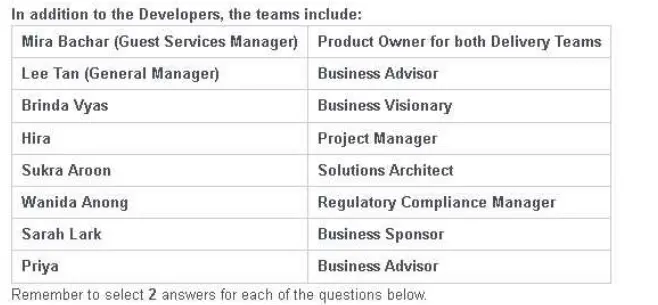
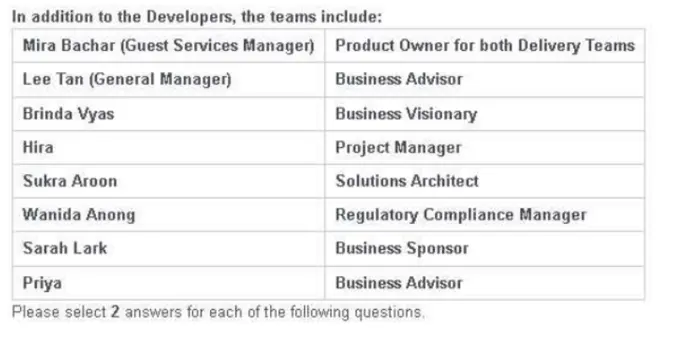
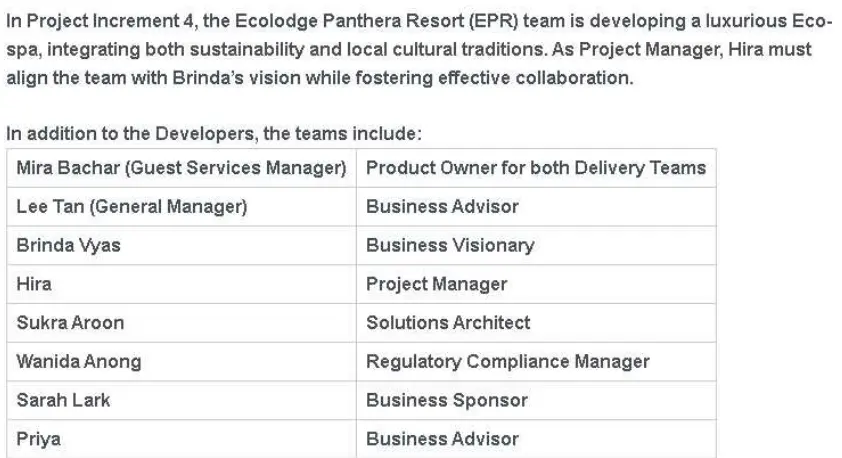
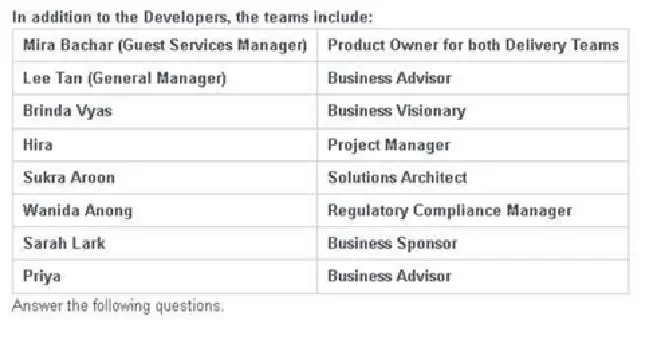
In addition to the Developers, the teams include:

(During the Sprint, Mira Bachar identified inconsistencies between what she wanted, expressed in Product Backlog items, and the Product Increments delivered by the Delivery Teams.

Which 2 of the following would be appropriate actions for Mira to take in the next Sprint?)

Correct Answer: A. Increase her availability to engage in discussion, reviews and give her feedback.; B. Define clear acceptance criteria and provide practical examples for Backlog items.
Explanation:

The best answers are A and B.

A is correct because AgilePM depends on active business involvement. If Mira sees a mismatch between intended outcomes and delivered increments, she should increase her availability to clarify needs, answer questions, review progress, and provide timely feedback.

B is also correct because clear acceptance criteria and practical examples reduce ambiguity and help the Delivery Teams understand what ''done correctly'' looks like for each Backlog item.

Why the others are weaker:

C is too document-heavy and not aligned with AgilePM's lightweight, collaborative approach.

D adds translation layers instead of improving direct collaboration and clarity.

E is about estimation, not about resolving misunderstanding between need and delivered outcome.

So the correct answers are A, B.


Question 8

Which 2 actions demonstrate transparency?

Correct Answer: A. Ensure everyone is treated fairly by providing the same information, in the same format, to everyone impacted by this change.; C. Distribute the key milestones and target dates for including Selco's mobile technology and approaches into the UniCo operations.
Explanation:

Comprehensive and Detailed Step-by-Step Explanation

Understanding Transparency in Change Management

Transparency refers to open communication, ensuring that stakeholders are well-informed and have access to relevant information. It promotes trust and reduces resistance to change by making the process visible and understandable.

Option Analysis

A . Ensure everyone is treated fairly by providing the same information, in the same format, to everyone impacted by this change

Providing consistent information ensures that all stakeholders receive the same details and feel equally valued, reinforcing transparency in communication.

Correct.

B . Send daily emails to everyone to remind them how important this change is and why they should support it

While frequent communication is helpful, daily emails emphasizing importance can feel repetitive or coercive, which does not align with the principle of transparency.

Incorrect.

C . Distribute the key milestones and target dates for including Selco's mobile technology and approaches into the UniCo operations

Sharing milestones and timelines increases clarity and accountability, providing stakeholders with a clear understanding of progress and expectations.

Correct.

D . Ask Corporate Services to provide guidelines to ensure all written communications are easy to read and navigate

Although clarity in communication is valuable, creating guidelines focuses on internal documentation rather than openly sharing information with stakeholders.

Incorrect.

E . Publish how staff members can raise complaints and suggestions, formally and anonymously if needed

While this supports inclusion and feedback, it does not inherently align with transparency as it focuses more on creating a feedback mechanism than on open sharing of information.

Incorrect.

Why A and C are the Correct Answers (Scenario Alignment)

A: Ensures equality in information dissemination, helping all stakeholders feel informed and included.

C: Offers visibility into the change process, timelines, and progress, building trust through clear and open communication.

Reference (AgilePM and Scenario Alignment):

AgilePM Handbook, Chapter 7: Transparent Communication Strategies in Change Management.

UniCo Scenario: 'UniCo staff must be kept informed of the integration process and timelines to align their efforts with the organization's goals.'

Agile Business Consortium -- Importance of Milestones and Open Communication in Stakeholder Engagement.


Question 9

Mira Bachar has spoken with a guest who wanted an aromatherapy scent to remember their holiday. Inspired by this, Mira suggested creating a unique aromatherapy oil for spa treatments and guest sales, which could also serve as a marketing tool.

Brinda Vyas supports exploring the idea, but Sukra Aroon notes that selling products is not in scope and could introduce complexities.

(Which 2 of the following actions align with AgilePM practices for defining and estimating the work of Project Increment 4 during the Foundations phase?)

Correct Answer: B. Host a stakeholder workshop to prioritize integrating the Spa into the resort experience.; C. Develop high-level estimates of effort and cost for Spa facilities and IT systems.
Explanation:

The correct answers are B and C.

During the Foundations phase in AgilePM, the goal is not to fully specify everything in exhaustive detail. Instead, the aim is to establish enough shared understanding, scope, priorities, feasibility, and estimating confidence so the project can proceed sensibly.

Why B is correct

''Host a stakeholder workshop to prioritize integrating the Spa into the resort experience.''

This is strongly aligned with AgilePM because Foundations emphasizes:

collaboration,

shared understanding,

business engagement,

and early prioritization.

A stakeholder workshop helps clarify what matters most, align the increment with the business vision, and ensure the work is focused on delivering value.

Why C is correct

''Develop high-level estimates of effort and cost for Spa facilities and IT systems.''

This also aligns well with AgilePM. In Foundations, estimates should be:

useful,

proportionate,

and appropriate to the current level of knowledge.

High-level estimates are exactly what AgilePM expects at this stage. They help planning and viability assessment without pretending to offer premature precision.

Why the other options are not the best answers

A is incorrect because it pushes toward a fixed, fully analyzed specification, which is not AgilePM's approach.

D may be useful in a general sense, but it is not as directly aligned with defining and estimating work as B and C.

E is too detailed for Foundations. Work should be defined enough to begin sensibly, but not fully elaborated into detailed design-ready form across everything.

So the best answers are B, C.


Question 10

One member of the Customer Services team has been chatting informally to some Sales co-workers. They felt that the Sales process changes are causing more work for Customer Services and that the whole customer experience has now been compromised.

Which 2 actions by the Sales Director are the MOST appropriate when responding to this type of resistance?

Correct Answer: B. Include the member of Customer Services in the planning of the sales process changes to reduce disruption.; D. Counter the informal views by inviting the Change Manager to explain the changes at the next Sales staff meeting.
Explanation:

Comprehensive and Detailed Step-by-Step

Context from UniCo Scenario:

The Sales staff at UniCo are resistant to changes related to the company's new strategic focus on mobile applications. The concern raised here involves Customer Services staff feeling overburdened and Sales staff perceiving the changes as impacting customer experience negatively. This type of resistance reflects miscommunication, lack of engagement, and uncertainty---key elements that require addressing.

Analysis of Each Option:

A . Do nothing and allow the informal view to circulate, knowing it will eventually be proved wrong.

This is not appropriate as it fails to address resistance proactively, which may lead to low morale, increased misunderstandings, and further negativity among teams. The AgilePM framework emphasizes collaboration and communication over passive approaches to resistance management.

Rejected.

B . Include the member of Customer Services in the planning of the sales process changes to reduce disruption.

This approach directly engages the affected parties (Customer Services staff) by involving them in planning. It fosters ownership, reduces resistance, and creates solutions that are practical and inclusive. Aligning this action with AgilePM principles ensures engagement of stakeholders in the change process, which is key to minimizing disruption.

Selected.

C . Invite Sales staff to help with planning the next phase of internal Sales training for the process changes.

While involving Sales staff is useful, the issue here centers around Customer Services staff concerns about disruption and added workload. This option fails to address the root cause of the resistance.

Rejected.

D . Counter the informal views by inviting the Change Manager to explain the changes at the next Sales staff meeting.

This action ensures that informal resistance is addressed through formal communication channels. By providing clarity and transparency about the Sales process changes, this approach prevents misunderstanding and builds alignment across teams. AgilePM emphasizes the importance of clear communication to manage resistance.

Selected.

E . Revisit the Stakeholder mapping work to ensure that the engagement of parties affected by the Sales changes is accurate.

Stakeholder mapping is a strategic action but may not immediately address the informal resistance in question. The issue at hand requires immediate communication and engagement rather than long-term structural adjustments.

Rejected.

Why B and D Are Correct:

Inclusion in Planning (B):

Including Customer Services staff in planning ensures their concerns are heard and integrated into the solutions. This aligns with AgilePM's focus on stakeholder collaboration and engagement to reduce resistance.

Clear Communication via the Change Manager (D):

Inviting the Change Manager provides an authoritative and transparent explanation of the changes. This aligns with AgilePM's emphasis on using regular communication to manage resistance and mitigate informal, negative narratives.

Reference to AgilePM Framework:

Stakeholder Engagement:

AgilePM highlights involving stakeholders in planning as essential for building trust and reducing resistance to change. (AgilePM Practitioner Guide, Chapter 9: Stakeholder Engagement)

Transparent Communication:

AgilePM emphasizes clarity and frequent communication to manage resistance effectively. Using formal channels ensures alignment and prevents misinformation from spreading. (AgilePM Practitioner Guide, Chapter 11: Managing People)

Proactive Resistance Management:

AgilePM promotes proactive actions (like engaging affected staff and using formal communication) rather than passive approaches to manage resistance. (AgilePM Practitioner Guide, Chapter 12: Change Management)


Question 11

The Change Manager is looking to develop the change agent network that will support the changes related to the Operational delivery processes workstream.

Which information is MOST likely to be relevant for the change agents when being inducted into the change programme for the Operational delivery processes workstream?

Correct Answer: A. Expected new ways of working for UniCo technical delivery.
Explanation:

Comprehensive and Detailed Step-by-Step Explanation

When inducting change agents into a change programme, it is critical to provide them with the information that will directly support their role in facilitating the specific workstream. The Operational delivery processes workstream is focused on integrating technical systems and processes, making it essential for change agents to understand the new expectations and ways of working that will arise from this integration.

1. Why A (Expected New Ways of Working) is Correct

Relevant to the Workstream: This information is directly related to the changes being implemented, such as process integration, operational alignment, and technical system modifications.

Preparation of Change Agents: Change agents must understand the new ways of working to effectively communicate, advocate for, and facilitate the changes among their teams.

Focus on Operational Changes: Since this workstream involves technical delivery processes, equipping change agents with relevant knowledge ensures they are aligned with the workstream's objectives.

2. Analysis of Incorrect Options

Option B (Staff Contact Details):

While useful for logistical purposes, this information is not directly linked to the change programme's objectives or the responsibilities of change agents in driving operational changes.

Eliminate.

Option C (Staff Satisfaction Survey Results):

Staff satisfaction data is more relevant for monitoring cultural and engagement-related impacts rather than guiding operational delivery process changes.

It does not provide actionable insights for the change agents in this specific workstream.

Eliminate.

Option D (Portfolio, Programme, and Project Management Office Service Catalogue):

This information is related to overall project management frameworks and tools but does not offer specific guidance for the change agents tasked with facilitating operational delivery changes.

Eliminate.

3. Practical Implications

Equipping Change Agents: Providing detailed insights into expected new ways of working ensures that the change agents can address potential resistance, clarify expectations, and serve as knowledgeable advocates for the change.

Alignment with Strategic Goals: By focusing on the technical delivery processes, the induction program helps ensure that change agents are aligned with UniCo's broader strategy of integrating Selco and delivering innovative solutions.


Question 12

What should be done to allow the requirement for a secondary exit from the upstairs of the building to be changed into a Must Have priority and moved into Timebox B?

Correct Answer: C. The Business Visionary, Business Sponsor and Solution Development Team should reassess the Prioritised Requirements List and its priorities.
Explanation:

C . The Business Visionary, Business Sponsor and Solution Development Team should reassess the Prioritised Requirements List and its priorities.

Rationale:

In Agile Project Management, priorities are often reassessed and reprioritized based on new information or changes in the project's context. The need for a secondary exit due to compliance with fire safety regulations would necessitate such a reassessment. The Business Visionary and Business Sponsor, who provide the vision and funding for the project, together with the Solution Development Team, who are responsible for implementing solutions, should collaboratively review the Prioritised Requirements List to reflect this new priority. This change must be agreed upon by these key stakeholders to ensure that it aligns with the business needs and project goals.


Question 13

(Hira is considering splitting the Developers into two Delivery Teams: one focused on Spa infrastructure and the other on guest experience. Mira Bachar, the Guest Services Manager, will be the Product Owner for both teams.

Which one of the following statements support Hira's proposed Delivery Team structure?)

Correct Answer: D. Collaboration within specialized teams improves communication and commitment to goals.
Explanation:

In AgilePM, a Delivery Team structure should support effective collaboration, clear focus, frequent delivery, and alignment to business needs. Hira's proposal to split the Developers into two Delivery Teams can be justified when that structure improves communication, coordination, and commitment around a coherent area of work.

Option D is correct because it best reflects a practical AgilePM reason for organizing teams in this way. If one team concentrates on Spa Infrastructure and the other on Guest Experience / Spa Operations, each team can build stronger collaboration around a shared purpose. Team members working toward closely related outcomes often communicate more effectively, develop stronger ownership, and stay better aligned to their immediate goals. In AgilePM, this supports the principle of creating empowered teams that can focus on delivering business value.

Why the other options are incorrect from an AgilePM perspective:

A is incorrect because one Delivery Team should not dictate another team's priorities. In AgilePM, priorities are driven by the business need and managed through appropriate roles such as the Business Visionary and especially the Product Owner / Business Ambassador-style representation of business needs, not by one team controlling another. Teams collaborate; they do not command each other.

B is incorrect because separate Delivery Teams do not eliminate the need for coordination. In this scenario, the spa infrastructure and guest experience elements are clearly connected. For example, treatment rooms, utilities, hydrotherapy capability, reservations support, and guest experience design are likely to have dependencies. AgilePM supports iterative delivery, but it also recognizes the importance of active coordination where workstreams are interdependent.

C is incorrect because although team focus is valuable, the wording suggests separation from ''other skill sets'' in a way that promotes silos. AgilePM favors collaborative, multi-skilled teams, not isolated specialist groups that avoid interaction. A team may have a specialization in outcome or domain, but Agile ways of working still depend on cross-functional cooperation and shared understanding.

From the case context, Hira is managing a significant initiative that combines:

construction and sustainable infrastructure,

wellness services,

guest operations,

local traditions,

compliance,

and business value delivery.

Because the work spans distinct but related domains, having two specialized Delivery Teams can make sense only if it improves communication and commitment within each area while still preserving overall coordination under shared product direction. That is exactly what Option D captures.

So, from an AgilePM viewpoint, D is the strongest supporting statement because it aligns with the idea that an effective team structure should enhance collaboration, ownership, and focus while contributing to successful incremental delivery.


Question 14

(Which 2 statements describe appropriate team behaviour for effective risk management?)

Correct Answer: A. Team members should adopt a collaborative mindset, sharing responsibility for identifying and mitigating risks.; E. Risk management should be proactive and part of daily activities, not a separate process.
Explanation:

The correct answers are A and E.

In AgilePM, effective risk management depends on shared responsibility, continuous awareness, and proactive behaviour across the whole team. Risk is not something handled only by one role, one document, or one event. It is woven into the way the team works every day.

Why A is correct

''Team members should adopt a collaborative mindset, sharing responsibility for identifying and mitigating risks.''

This aligns strongly with AgilePM. Risks emerge from many areas:

business priorities,

technical feasibility,

compliance,

dependencies,

stakeholder engagement,

and delivery constraints.

Because of that, the best way to manage risk is for the team to work collaboratively and raise concerns early. Different people see different risks:

Mira may see value or prioritization risk,

Sukra may see architecture or integration risk,

Hira may see coordination or dependency risk,

Wanida may see compliance risk,

Developers may see delivery feasibility risks.

AgilePM encourages a culture where risks are surfaced openly and addressed together rather than left to a single person.

Why E is correct

''Risk management should be proactive and part of daily activities, not a separate process.''

This is also a core AgilePM principle. Risk management is most effective when it is:

continuous,

visible,

built into team discussions,

and handled as part of normal delivery activity.

That means risks should be considered during:

planning,

backlog discussions,

reviews,

daily collaboration,

dependency conversations,

and stakeholder feedback.

AgilePM does not treat risk as something only reviewed in occasional formal meetings. The team should be alert to emerging issues and respond before they become major problems.

Why the other options are incorrect

B . Hira should have sole responsibility for managing all risks with clear accountability.

This is incorrect. Hira, as Project Manager, has an important role in coordinating risk management, but AgilePM does not place all risk responsibility on one person. Risk management is shared across business, technical, and delivery roles.

C . Developers should resolve all risks collaboratively and promptly without escalation.

This is incorrect because some risks should be escalated. AgilePM encourages teams to resolve issues at the right level, but not to avoid escalation when broader decisions, sponsorship, governance, or cross-team intervention are needed.

D . Sukra Aroon should handle all technical risks independently to ensure the solution is fit for purpose.

This is incorrect because even technical risks often require collaboration. Sukra contributes architectural leadership, but technical risks may affect priorities, cost, compliance, usability, and business outcomes, so they should not be handled in isolation.

AgilePM perspective

AgilePM supports team behaviour where:

everyone is alert to risk,

risks are discussed early,

people collaborate across roles,

escalation happens when needed,

and risk thinking is part of everyday delivery.

So the two statements that best describe appropriate team behaviour for effective risk management are:

A, E


Question 15

During the Foundations phase for Project Increment 4, Sukra Aroon held a meeting with Hira, Mira Bachar, andWanida Anong, to ensure alignment and compliance with EPR company policies, local regulations, and international standards. The meeting also clarified how financial and investment decisions would be made for Project Increment 4, ensuring alignment with EPR business priorities, and how this information will be tracked,

controlled and evidenced.

Wanida Anong, who works across multiple sites worldwide, attended the meeting in person but has limited availability throughout the Project Increment.

(During the meeting, Hira shared concern that the fixed end date for Project Increment 4, aligned with the start of next season, creates a risk as elements of the Eco-spa may not be ready in time. Based on AgilePM guidance, which of the following is an appropriate response to managing this risk?)

Correct Answer: B. Use MoSCoW prioritization to ensure that Must Have features are delivered first, while lower-priority features can be deferred or adjusted if time runs out.
Explanation:

The correct answer is B.

In AgilePM, when the end date is fixed, the primary control mechanism is not to move time, but to manage scope intelligently. That is exactly what MoSCoW prioritization is for.

Why B is correct:

AgilePM protects delivery dates by ensuring that Must Have requirements are delivered first.

Lower-priority items such as Should Have and Could Have can be deferred, reduced, or reshaped if time becomes constrained.

This preserves business viability while maintaining control.

Why the other options are weaker:

A is too narrow. Compliance may be critical, but AgilePM would not automatically prioritize all compliance work ahead of everything else without using agreed prioritization logic.

C is not the primary AgilePM response. Adding temporary resources is not always effective and may introduce more complexity.

D conflicts with the principle of protecting time. AgilePM generally fixes time and cost, flexing scope where needed.

So the most appropriate AgilePM response is B.