Limited-Time Offer: Enjoy 50% Savings! Ends in 00h 00m 00s Coupon code: 50OFF
Skip to content

Free Arcitura Education Cloud Technology Lab C90.03 Exam Questions

Page: 1 / 4 Total 21 questions

Want more questions? Get Premium Access.

Question 1

Cloud Provider X has deployed a virtualization environment in Cloud X comprised of Physical Server A hosting Virtual Servers A and B. Cloud Provider X implements Cloud Service A on Virtual Server A and makes it available to Cloud Service Consumer A, which interacts with Cloud Service A by sending and receiving messages (1, 2). Cloud Provider Y has deployed a virtualization environment comprised of Physical Server B hosting Virtual Servers C and D. Virtual Server C is made available to Cloud Service Consumer B, which interacts with Virtual Server C (3,4) in order to prepare for the deployment of a new cloud service that will be used internally by Cloud Provider Y to process data obtained from Cloud Service A .
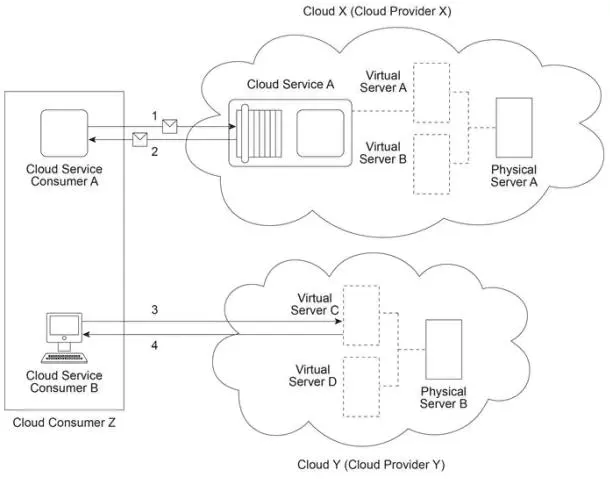
Cloud X is administered by a group of organizations and makes Cloud Service A available only to cloud service consumers from that group. Cloud Consumer Z belongs to one of the organizations within this group. Cloud Y and Cloud Consumer Z are owned by the same organization. Which of the following statements provides a valid scenario that accurately describes the involvement of cloud deployment models, cloud delivery models, roles and/or boundaries? (Note that the correct answer represents one of multiple valid scenarios that can exist.)
Correct Answer: C. Cloud X is based on the community cloud deployment model. Cloud Service A is based on the SaaS delivery model. Cloud Y is based on the private cloud deployment model. Virtual Server C is being offered as part of the IaaS delivery model. A cloud resource administrator working for Cloud Consumer Z uses Cloud Service Consumer B to access Virtual Server C . Cloud Consumer Z' s trust boundary encompasses Cloud Service Consumers A and B, as well as Cloud Service A and Virtual Server C . The organization that owns Cloud Consumer Z will be the cloud service owner of the new cloud service that will be deployed on Virtual Server C .

Question 2

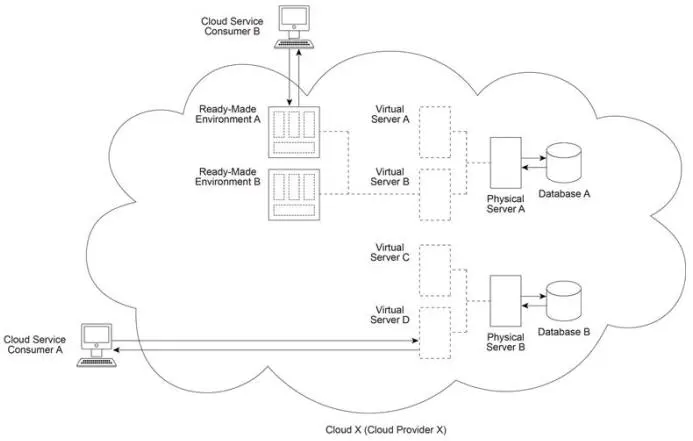
Cloud Provider X (which owns Cloud X) deploys two physical servers (Physical Servers A and B) and two databases (Databases A and B). Virtual Servers A and B are hosted by Physical Server A and Ready-Made Environments A and B are hosted by Virtual Server B . Virtual Servers C and D are hosted by Physical Server B . Cloud Service Consumer A regularly accesses Virtual Server D in order to test and deploy a new cloud service that was developed on-premise by the cloud consumer organization operating Cloud Service Consumer A . Cloud Service Consumer B (operated by a different cloud consumer organization) has been regularly accessing Ready-Made Environment A in order to develop and deploy a different new cloud service. The cloud consumer organizations that own and operate Cloud Service Consumers A and B will soon be ready to launch their respective cloud services for use by their customers. Both cloud consumer organizations are concerned that Cloud X does not provide sufficient security and they demand that Cloud Provider X take the necessary steps to mitigate the denial of service, insufficient authorization and overlapping trust boundaries security threats.

Which of the following statements accurately describes the cloud delivery models used now by the cloud service consumers and in the future by their customers - and - further describes a solution that fulfills the identified security requirements by implementing a single cloud security mechanism?

Correct Answer: C. Cloud Service Consumer A is using the IaaS delivery model. Cloud Service Consumer B is using the PaaS delivery model. Customers of the cloud services will be using the SaaS delivery model. An identity and access management mechanism can be implemented to mitigate the denial of service, insufficient authorization and overlapping trust boundaries security challenges.

Question 3

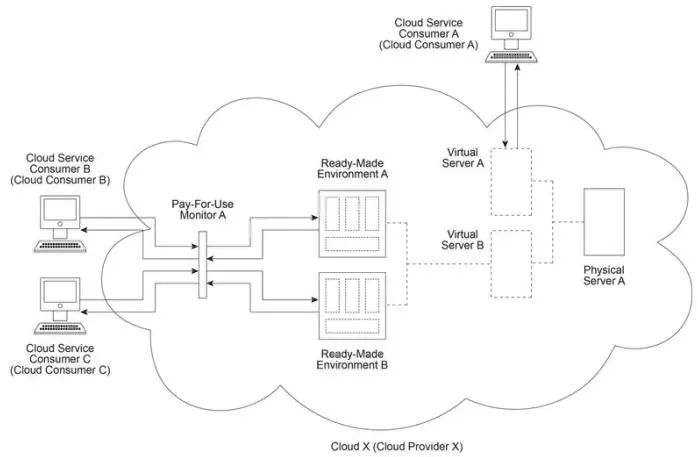
Cloud X (owned by Cloud Provider X) provides Physical Server A which hosts Virtual Servers A and B. Virtual Server B hosts Ready-Made Environments A and B . Cloud Service Consumer A uses Virtual Server A as part of an IaaS leasing agreement in which Cloud Consumer A is charged a fixed monthly fee for unlimited access. Cloud Service Consumers B and C use Ready-Made Environments A and B respectively as part of a PaaS leasing agreement based on per-minute usage fees. In both cases, access is monitored via Pay-For-Use Monitor A, which keeps track of log-in and log-out times in order to calculate the usage charges that are billed to Cloud Consumers B and C .

Physical Server A begins to become unstable. Over the course of a 24 hour period, the server shuts down three times, taking down Virtual Servers A and B with it. This causes numerous problems for Cloud Service Consumers A, B and C, which lose connections and encounter a variety of exceptions. A subsequent investigation of the log files generated by Pay-For-Use Monitor A reveals that the three server crashes coincided with the usage periods of Ready-Made Er n'ronment B b> Cloud Service Consumer B. De 'elopers at the Cloud Consumer 3 organization confirm they did not actually log in during those periods, which leads Cloud Provider X to discover that another cloud service consumer has been posing as Cloud Service Consumer B in order to maliciously access Ready-Made Environment B, Virtual Server B, and Physical Server B on Cloud X. The investigation concludes that the malicious cloud service consumer was able to carry out the attack successfully by obtaining a weak password being used by developers from Cloud Consumer B . Which of the following statements accurately identifies the type of security threat that corresponds to the described attack - and -provides a solution that can directly mitigate this type of security threat within Cloud X?

Correct Answer: A. Ready-Made Environment B. Virtual Server B and Physical Server B were subjected to a weak authentication attack that can be mitigated by implementing the encryption and digital signature mechanisms.

Question 4

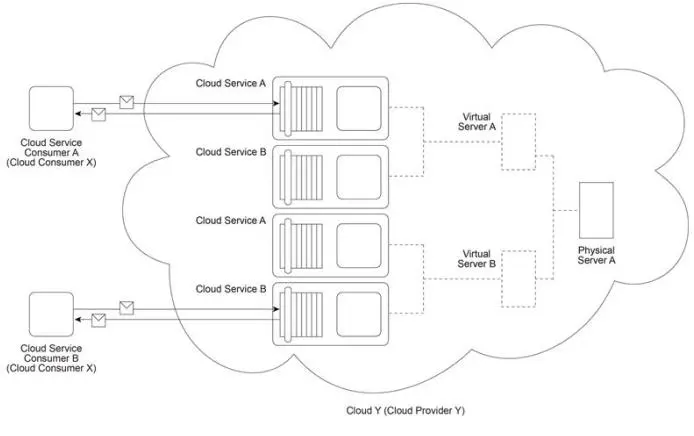
Cloud Provider Y owns Cloud Y, which provides a set of cloud services, virtual servers, and one physical server. Cloud Services A and B are hosted on Virtual Server A, which is hosted by Physical Server A . Physical Server A also hosts Virtual Server B, which hosts redundant implementations of Cloud Services A and B for load balancing purposes. Cloud Service Consumer A is accessing Cloud Service A located on Virtual Server A . Cloud Service Consumer B is accessing Cloud Service B located on Virtual Server B . Cloud Service Consumers A and B are both owned by Cloud Consumer X. Cloud Consumer X has recently complained that Cloud Service A is becoming increasingly unreliable. Cloud Provider Y launches an investigation that reveals that Virtual Server A has been crashing sporadically due to successful malicious intermediary attacks where malicious service agents have been inserting harmful data into messages sent by Cloud Service Consumer A to Cloud Service A

Which of the following statements describes a solution that can mitigate the malicious intermediary attacks that have been occurring on Virtual Server A - and - can further help prevent the same types of attacks from occurring on Virtual Server B?

Correct Answer: B. Cloud Provider Y can implement the encryption and digital signatures mechanisms to protect the contents of messages from being augmented by malicious service agents.

Question 5

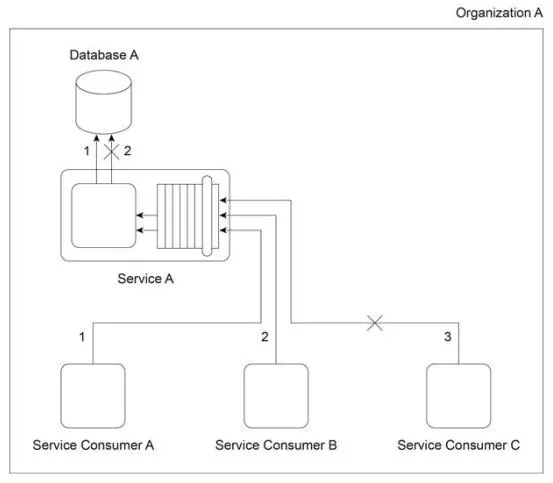
Organization A has been expanding and, as a result, is outgrowing the processing capacity of its on-premise Service A implementation. It is determined that this is due to usage thresholds of Service A and complex data processing limitations in Database A . The diagram depicts Organization A's current on-premise environment, where Service Consumers A . B and C attempt to access Service A at the same time. Service Consumer A successfully accesses Service A, which then successfully retrieves the requested data (1). Service Consumer B successfully accesses Service A, but due to the complex data structure, the request for the data times out and fails (2). Finally, Service Consumer C attempts to access Service A, but is rejected because Service A is unable to accept more concurrent requests.

Organization A is required to continue using its on-premise Service A implementation, with the exception of Database A, which does not need to remain on-premise. Database A is dedicated to Service A and is comprised of relational data. Which of the following statements provides a solution that uses cloud-based IT resources to solve the performance limitations of Service A and Database A?

Correct Answer: D. None of the above.

Question 6

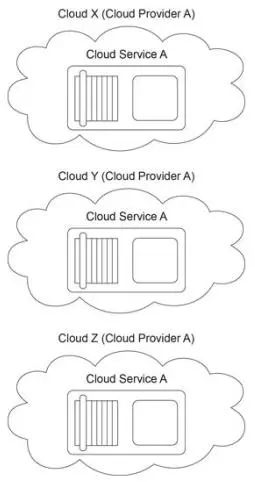
The cloud service owner of Cloud Service A is evaluating Clouds X, Y and Z to determine which cloud environment can offer the greatest level of reliability. All three clouds are geographically dispersed across three separate time zones. As a result, each cloud experiences usage peaks at different times. Based on the metrics provided, the greater the usage of a cloud, the lower its reliability. When the cloud service owner complains to Cloud Provider A (the owner of all three clouds) that none of the clouds provide an adequate level of reliability, Cloud Provider A suggests a solution that increases resiliency.

Which of the following statements accurately describes a solution that can be used to fulfill the resiliency requirements of Cloud Service A?

Correct Answer: A. Redundant implementations of Cloud Service A are deployed in all three clouds. The failover system mechanism and a special type of automated scaling listener mechanism are implemented to establish a system whereby one redundant Cloud Service A implementation will automatically take over from another.