Limited-Time Offer: Enjoy 50% Savings! Ends in 00h 00m 00s Coupon code: 50OFF
Skip to content

Free Arcitura Education Cloud Architecture Lab C90.06 Exam Questions

Page: 1 / 3 Total 15 questions

Want more questions? Get Premium Access.

Question 1

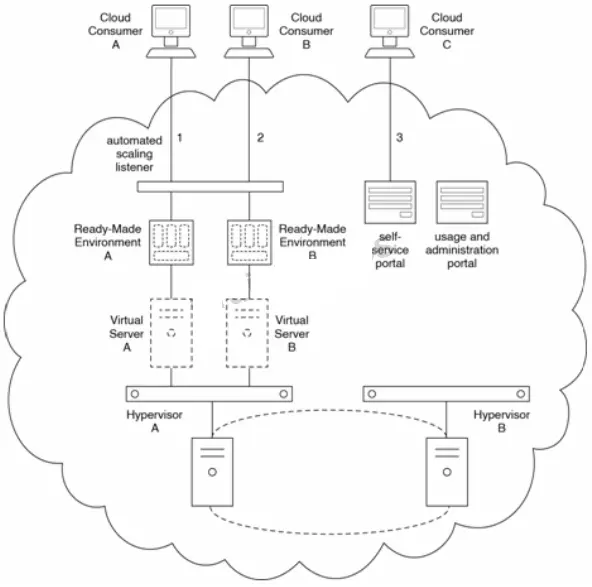
Ready-Made Environment A is hosted by Virtual Server A and Ready-Made Environments is hosted by Virtual Server B. Virtual Servers A and B are hosted by Hypervisor A, which is part of a hypervisor cluster. An automated scaling listener intercepts cloud consumer requests and automatically invokes the on-demand generation of additional instances of ready-made environments, as required.

A self-service portal and a usage and administration portal are also available to cloud consumers.

The self-service portal can be used to request the provisioning of a new ready-made environment.

Any cloud consumer that has already had a ready-made environment provisioned can configure and view information about that ready-made environment via the usage and administration portal.

Cloud Consumer A accesses Ready-Made Environment A to work on the development of a new cloud service (1). Cloud Consumer B accesses Ready-Made Environment B to test a recently completed application comprised of three cloud services (2). Cloud Consumer C accesses the self-service portal to request the creation of a new ready-made environment (3).
The cloud provider is required to perform an emergency maintenance outage on a cloud storage device used by all ready-made environments. The unplanned outage takes two hours. During this period, Cloud Consumers A and B are unable to access Ready-Made Environments A and B and Cloud Consumer C receives an error when submitting a request to create a new ready-made environment.

After the maintenance outage is over, Cloud Consumers A and B encounter the following problems:

Cloud Consumer A is unable to recover session data that was kept in memory for an extended period, prior to the time of the outage.

Cloud Consumer B has no access to Virtual Server B, which was moved to Hypervisor B during the maintenance outage. When Cloud Consumer B attempts to ping Virtual Server B, the request times out.

Even though Cloud Consumer C is able to log into the usage and administration portal to confirm that its ready-made environment was successfully provisioned, the unexpected outage has raised concerns about the stability of the ready-made environment's underlying infrastructure. Cloud Consumer C informs the cloud provider that it cannot proceed with its lease of the ready-made environment if there are future occurrences of this type of maintenance outage.

Which of the following statements can help address the problems and concerns of the three cloud consumers?
Correct Answer: C. The Service State Management pattern can be applied to establish a system that can persist session data in a database. The Persistent Virtual Network Configuration pattern can be applied to centralize the configuration data necessary for virtual servers to remain accessible after they have been relocated to different hypervisors. The Storage Maintenance Window pattern can be applied to establish a system that allows cloud storage devices to be maintained without causing outages.

Question 2

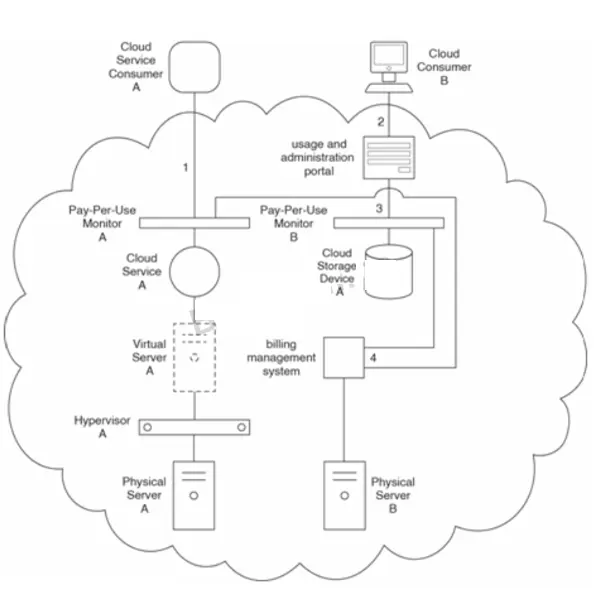
Virtual Server A is hosted by Hypervisor A, which resides on Physical Server A. Virtual Server A

hosts Cloud Services A and B. Virtual Server B is hosted by Hypervisor B on Physical Server B.

Physical Server C is currently not being used.

Cloud Service Consumer A sends a request to Cloud Service A that is intercepted by Pay-Per-Use

Monitor A

(1), which collects billing-related usage data that is later forwarded to the billing management system

(2). Cloud Service A receives and processes the request

(3). Cloud Consumer B accesses the usage and administration portal

(4) to access data on Cloud Storage Device B. Pay-Per-Use Monitor B intercepts the data access to collect and forward billing-related usage data to the billing management system

(5). Cloud Storage Device B processes the data access request from Cloud Consumer B

(6).

Cloud Service Consumer A and Cloud Consumer B belong to Organization A

Cloud Storage Device B is accessed on a regular basis by Cloud Consumer B. However,

managers at Organization A receive reports from their cloud resource administrator that Cloud Storage Device B is unavailable for longer periods and more frequently than what they expected, based on the SLA availability guarantee they were provided by the cloud provider. This results in wasted time when the cloud resource administrator attempts to upload or access data and then discovers that Cloud Storage Device B is unavailable. The cloud resource administrator requires a means of checking for the availability of Cloud Storage Device B prior to attempting access.

As the workload increases on Physical Server B, Cloud Consumer B begins to receive runtime exceptions and degraded data access performance from Cloud Storage Device B. It is determined that the cause of the deteriorating performance is a network bottleneck that has formed on Physical Server B due to its bandwidth capacity being reached, primarily because of other cloud consumer organizations also sharing its hosted IT resources.

Organization A receives a monthly billing statement that shows the charges for the total usage of Cloud Service A during that period. However, Organization A requires a more detailed breakdown of the types of usage and their associated costs. For example, Cloud Service Consumer A can issue requests for information by employees within Organization A and on behalf of clients of Organization A. Organization A requires a breakdown of the usage costs incurred on behalf of clients so that it can bill the clients for this usage accordingly. The cloud provider informs Organization A that it has no existing monitor that can collect and log this detailed usage information and suggests that Organization A customize its own monitor.

Which of the following statements lists the patterns that can be applied to solve these three problems?

Correct Answer: A. Real-time Resource Availability, Elastic Network Capacity, Usage Monitoring

Question 3

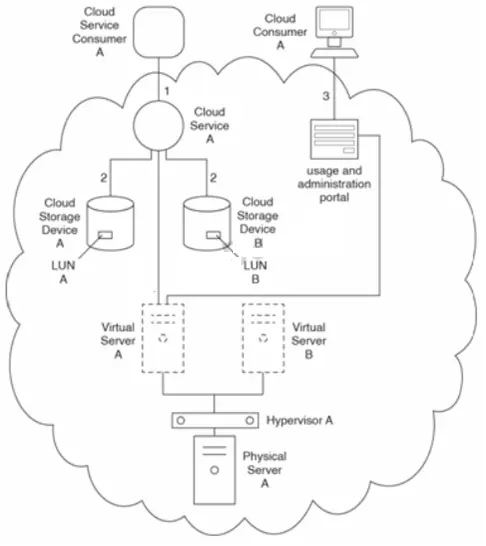
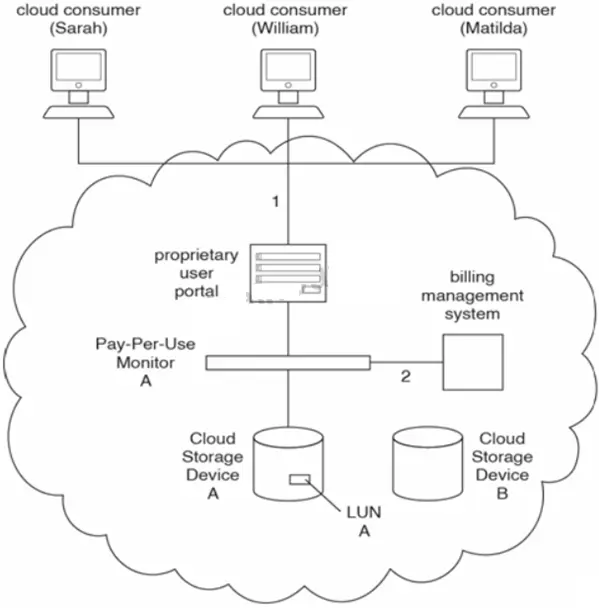
Cloud Storage Device A contains LUN A and can be accessed by external cloud consumers via a proprietary user portal that is used primarily by cloud consumers to upload and manage data for backup purposes. Pay-Per-Use Monitor A tracks the amount of data being uploaded and forwards this information to a billing management system. Cloud Storage Device B is a secondary cloud storage device. Data from Cloud Storage Device A is replicated synchronously to Cloud Storage Device B using a storage replication program (not shown). Cloud Storage Device A is further administered by a cloud resource administrator that works for the cloud provider, who accesses the cloud storage device via an internal usage and administration portal.

Three different cloud consumers (Sarah. William, Matilda) access Cloud Storage Device A to upload data for backup purposes (1). These three cloud consumers belong to different departments within the same organization, and therefore all three share LUN A. Pay-Per-Use

Monitor A collects the storage space data and forwards it to the billing management system (2).

The cloud provider offers premium and discount storage plans. With the premium plan, the data stored on Cloud Storage Device A is also replicated to Cloud Storage Device B. With the discount plan, the data stored on Cloud Storage Device A is not replicated. Both plans are based on fixed disk storage allocation. The cost of the premium plan is $5 per week for every GB of storage space and the cost of the discount plan is $2 per week for every GB of storage space. The SLA from the cloud provider guarantees availability of 97% for access to Cloud Storage Device A.

The three cloud consumers use Cloud Storage Device A as follows:

Sara signs up for the discount backup plan and is allocated 50 GBs of storage space. A week later, she uploads 10 GBs of backup data. A week after that, she uploads another 35 GBs. She later finds out that for those two weeks her organization was billed $200, which is more than she was expecting. After she complains to the cloud provider, she learns about how fixed-disk storage allocation is billed. She asks the cloud provider to change her account to a different storage plan where she is only billed for the actual amount of storage space she uses at any given time. The cloud provider assures her that a new system will be set up to accommodate this request.

William is on the premium backup plan. He uploads 1 to 3 GBs of important business data every day. After two weeks of daily uploads, he realizes that the centralized nature of the backup data on the cloud makes it more convenient for reporting purposes than the distributed nature of the same data in his on-premise environment. He uses an analysis tool to run queries against the cloud-based data. However, due to the large quantity of redundant data, the queries end up being ineffective and take too long to run. He asks the cloud provider to find a solution that can streamline the cloud-based data by reducing redundancy. By reducing the overall quantity of the data, the analysis queries will run faster.

Matilda is on the discount backup plan and uploads backup data on a daily basis. Over the course of two weeks she uploads over 200 GBs of data. She performs a daily backup at the end of each day by identifying the data to back up and then using the proprietary user portal to run the cloud backup procedure. This procedure can take 5 to 45 minutes, depending on the amount of data she is uploading. Matilda performs this as her last task of the day and therefore initiates the procedure before she leaves, but does not wait for it to complete. One day, she receives an e-mail from the cloud provider explaining that the backup procedure from the previous day had failed due to an unexpected hardware failure that occurred on Cloud Storage Device A. The notification e-mail goes on to state that this type of failure falls within the 97% availability guarantee of her organization's SLA, and is therefore in compliance with the current provisioning agreement. Had a disaster occurred that night, the on-premise data could have been lost and Matilda would be held accountable. Matilda contacts the cloud provider to demand that the provisioning agreement be amended to upgrade their existing SLA to the maximum possible availability (which, for this cloud provider, is 99.999%). The cloud provider agrees to establish a system to accommodate this request.

Which of the following statements lists the patterns that can be applied to address the three issues raised by the three cloud consumers?

Correct Answer: B. Elastic Disk Provisioning, Dynamic Data Normalization, Zero Downtime

Question 4

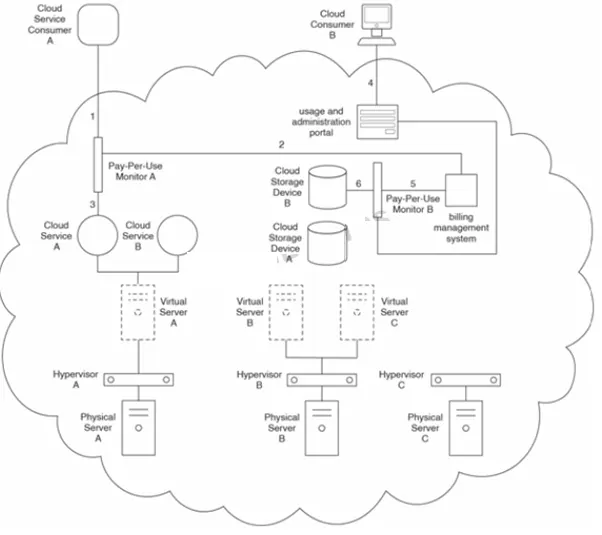
Cloud Service A is hosted by Virtual Server A, which is hosted by Hypervisor A that resides on Physical Server A. Cloud Storage Device A is used to store media library data that is continuously replicated with a redundant, secondary implementation of Cloud Storage A (not shown). Access to Cloud Service A is monitored by Pay-Per-Use Monitor A. Access to Cloud Storage Device A is monitored by Pay-Per-Use Monitor B. Pay-Per-Use Monitors A and B capture billing-related usage data that is forwarded to a billing management system that is hosted by Physical Server B.

Cloud Service Consumer A accesses Cloud Service A and the usage data is captured by Pay-Per-Use Monitor A (1). Cloud Consumer B accesses Cloud Storage Device A via a usage and administration portal that it uses to upload media data (2). This usage is captured by Pay-Per-Use Monitor B (3). Pay-Per-Use Monitors A and B store collected usage data in the billing management system (4), which is later used by the cloud provider to bill for the usage of Cloud Service A and Cloud Storage Device A.

Each service instance of Cloud Service A requires a virtual server with 2 virtual CPUs and 4 GBs of RAM at a package price of $2.00 for each initial invocation and an additional $0.50 for each consecutive 60 seconds of usage. Cloud Service Consumer A accesses Cloud Service A twice in one day. The two exchanges with Cloud Service A last 60 seconds and 120 seconds. For that one day, the organization that owns Cloud Service Consumer A is billed $6.50, which it determines is incorrect. After complaining to the cloud provider, it is discovered that the rapid provisioning system responsible for provisioning instances of Cloud Service A is not de-provisioning Cloud Service A when Cloud Service Consumer A indicates it has completed an exchange. Instead, Cloud Service A is de-provisioned after a 60 second timeout that occurs after Cloud Service Consumer A is completed with an exchange.

Storage space on Cloud Storage Device A can only be purchased in units of terabytes (TBs), with each TB costing $1 per day. Cloud Consumer B purchases 5 TBs of storage space on day 1 and stores 5 TBs of data on days 6 and 7. Cloud Consumer B was expecting to be billed $10.00, but is billed $35. After raising a complaint, Cloud Consumer B is informed by the cloud provider that cloud consumers are billed based on the allocation of storage space, regardless of how much storage space they actually use.

Which of the following statements describes a solution that can update the cloud architecture to avoid these billing-related problems and discrepancies?

Correct Answer: D. None of the above.

Question 5

Cloud Service A requires access to Cloud Storage Device A and Cloud Storage Device B. Cloud Service A is hosted by Virtual Server A. Virtual Server A and Virtual Server B are hosted by Hypervisor A, which resides on Physical Server A.

Cloud Service Consumer A sends a request to access Cloud Service A (1). Cloud Service A retrieves data from Cloud Storage Device A and Cloud Storage Device B (2). Cloud Consumer A uses the usage and administration portal to access resource usage reports for Cloud Service A (3).

Cloud Service Consumer A and Cloud Consumer A belong to Organization A, which is leasing an laaS environment from the cloud provider.

The cloud provider makes Cloud Service A available to several new cloud service consumers.

Additionally, new LUNs are created on Cloud Storage Devices A and B for new cloud consumers to perform regular data access functions. This increase in workload causes Virtual Server A to fail during peak usage periods. Organization A and the new cloud consumer organizations request that the cloud provider find a way to dynamically support the higher usage workloads.

Organization A keeps its master files and data in LUN B in Cloud Storage Device B. One day, a cloud resource administrator accidentally changes the path used to access LUN B. The original path cannot be retrieved. The cloud resource administrator informs Organization A's IT department that it must change any systems or tools it uses to access LUN B to the new path.

This causes significant challenges, as well as a costly period of disruption. Organization A asks the cloud provider to create a system that would help avoid disruption in access to LUN B, if this was to ever happen again.

The cloud provider has made Cloud Storage Device A part of a resource pool of synchronized cloud storage devices. Organization A is sharing Cloud Storage Device A with another cloud consumer organization. When cloud consumers from both organizations access Cloud Storage Device A at the same time, they encounter a resource constraint condition that causes Cloud Storage Device A to fail. Organization A requests that the cloud provider extend the existing cloud architecture to prevent this situation from happening again.

Which of the following statements provides a solution that can address all of these problems?

Correct Answer: C. The Elastic Resource Capacity pattern can be applied to establish a system that can dynamically allocate resources to Virtual Server A. The Multipath Resource Access pattern can be applied to establish a multipathing system that can provide an alternative path to LUN B in Cloud Storage Device B. The Resource Reservation pattern can be applied to establish a system that enables Organization A to have exclusive access to pre-defined resources on Cloud Storage Device A for a given period of time.

Question 6

Virtual Server A and Virtual Server B are hosted by Hypervisor A, which resides on Physical Server A. Virtual Server A hosts Cloud Service A. Virtual Server C. Virtual Server D, Virtual Server E and Virtual Server F are hosted by Hypervisor B on Physical Server B. Physical Server C, which hosts Hypervisor C, is currently not being used.

Cloud Service Consumer A accesses Cloud Service A (1), which accesses files stored in a folder on Virtual Server A (2). Cloud Consumer B uses Proprietary User Portal A to administer legacy software (not shown) installed on Virtual Server D (3). Proprietary User Portal B and Proprietary User Portal C are also available for accessing additional legacy systems located on Virtual Server F; however, they are not often used.

The cloud shown in the figure is a private cloud. Department A and Department B share IT resources within the private cloud and are part of the same organization. Cloud Service Consumer A belongs to Department A and Cloud Consumer B belongs to Department B.

During routine access of Cloud Service A by Cloud Service Consumer A, the Department A cloud resource administrator is notified that a hardware fault is occurring within Physical Server A that will soon cause it to fail. The cloud resource administrator scrambles to arrange for Cloud Service A to be relocated but is unable to do so before Physical Server A does fail. It takes several more hours of downtime until, with the cooperation of the cloud provider, the Cloud Service A implementation is successfully moved to Physical Server C and made live again. Managers at Department A demand that a system be put in place to avoid this scenario in the future.

Cloud Service A was initially developed specifically for Department A's Cloud Service Consumer A. However, recently Department B has indicated that it will be developing its own cloud service consumer that will also need to regularly access Cloud Service A. After this new cloud service consumer is deployed, both Department A and Department B experience occasional runtime errors when their cloud service consumers attempt to access Cloud Service A at the same time.

Cloud Service A accesses a legacy system on Virtual Server A that requires regular updates and patches to stay current. Each time the legacy system is updated, Cloud Service A needs to undergo an update as well, during which it needs to be temporarily unavailable. Department A managers ask the cloud provider to extend the cloud architecture so that a duplicate, secondary implementation of Cloud Service A can be made available while the primary implementation undergoes a maintenance update.

Which of the following statements provide a solution that can adequately resolve all of Departments A and B's issues?

Correct Answer: C. The Non-Disruptive Service Relocation pattern can be applied to establish a system that uses live VM migration to move the virtual server hosting Cloud Service A to a new physical server without allowing any downtime. The Dynamic Scalability pattern can be applied to establish a system whereby multiple instances of Cloud Service A can be created and an automated scaling listener can be used to redirect concurrent requests to the Cloud Service A instances. The Non-Disruptive Service Relocation pattern can be applied to establish a system whereby cloud service consumer requests to Cloud Service A can be temporarily redirected to a duplicate implementation of Cloud Service A while the original implementation undergoes a maintenance outage.