Free Arcitura Education SOA Design & Architecture Lab with Services & Microservices S90.08B Exam Questions
Page: 1 / 3Total 17 questions
Want more questions? Get Premium Access.
Question 1
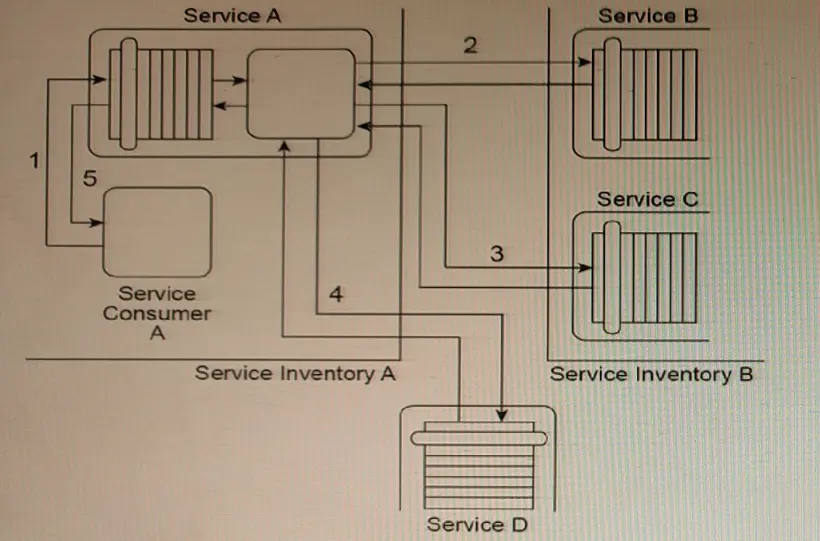
Refer to Exhibit.
Service Consumer A and Service A reside in Service Inventory
Correct Answer:D. The Asynchronous Queuing pattern can be applied to position a message queue between Service A and Service B, between Service A and Service C, and between Service A and Service D. Additionally, a separate messaging queue is positioned between Service A and Service Consumer A. The Data Model Transformation and Protocol Bridging patterns can be applied to enable communication between Service A and Service B, between Service A and Service C, and between Service A and Service D. The Redundant Implementation pattern can be applied so that a copy of Service D is brought in-house. The Legacy Wrapper pattern can be further applied to wrap Service D with a standardized service contract that is in compliance with the design standards used in Service Inventory B.
Explanation:
The Asynchronous Queuing pattern is applied to position a messaging queue between Service A, Service B, Service C, Service D, and Service Consumer A. This ensures that messages can be passed between these services without having to be in a stateful mode.
The Data Model Transformation and Protocol Bridging patterns are applied to enable communication between Service A and Service B, Service A and Service C, and Service A and Service D, despite their different data models and transport protocols.
The Redundant Implementation pattern is applied to bring a copy of Service D in-house to ensure that it can be accessed locally and reduce the unpredictability of its performance.
The Legacy Wrapper pattern is applied to wrap Service D with a standardized service contract that complies with the design standards used in Service Inventory B. This is useful for service consumers who want to use Service D but do not want to change their existing applications or service contracts.
Overall, this approach provides a comprehensive solution that addresses the issues with Service A, Service B, Service C, and Service D, while maintaining compliance with the Service Abstraction principle.
Question 2
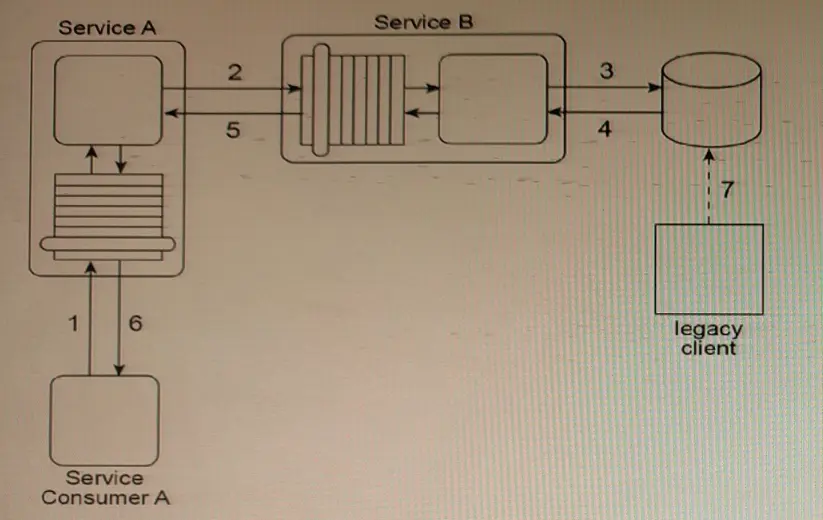
Refer to Exhibit.
Service A is an entity service that provides a Get capability which returns a data value that is frequently changed.
Service Consumer A invokes Service A in order to request this data value (1). For Service A to carry out this request, it must invoke Service B (2), a utility service that interacts (3, 4) with the database in which the data value is stored. Regardless of whether the data value changed, Service B returns the latest value to Service A (5), and Service A returns the latest value to Service Consumer A (6).
The data value is changed when the legacy client program updates the database (7). When this change will occur is not predictable. Note also that Service A and Service B are not always available at the same time.
Any time the data value changes, Service Consumer A needs to receive It as soon as possible. Therefore, Service Consumer A initiates the message exchange shown In the figure several times a day. When it receives the same data value as before, the response from Service A Is ignored. When Service A provides an updated data value, Service Consumer A can process it to carry out its task.
The current service composition architecture is using up too many resources due to the repeated invocation of Service A by Service Consumer A and the resulting message exchanges that occur with each invocation.
What steps can be taken to solve this problem?
Correct Answer:A. The Event-Driven Messaging pattern can be applied by establishing a subscriber-publisher relationship
between Service A and Service B. This way, every time the data value is updated, an event is triggered
and Service B, acting as the publisher, can notify Service A, which acts as the subscriber. The
Asynchronous Queuing pattern can be applied between Service A and Service B so that the event
notification message sent out by Service B will be received by Service A, even when Service A is
unavailable.
Explanation:
This solution is the most appropriate one among the options presented. By using the Event-Driven Messaging pattern, Service A can be notified of changes to the data value without having to be invoked repeatedly by Service Consumer A, which reduces the resources required for message exchange. Asynchronous Queuing ensures that the event notification message is not lost due to the unavailability of Service A or Service B. This approach improves the efficiency of the service composition architecture.
Question 3
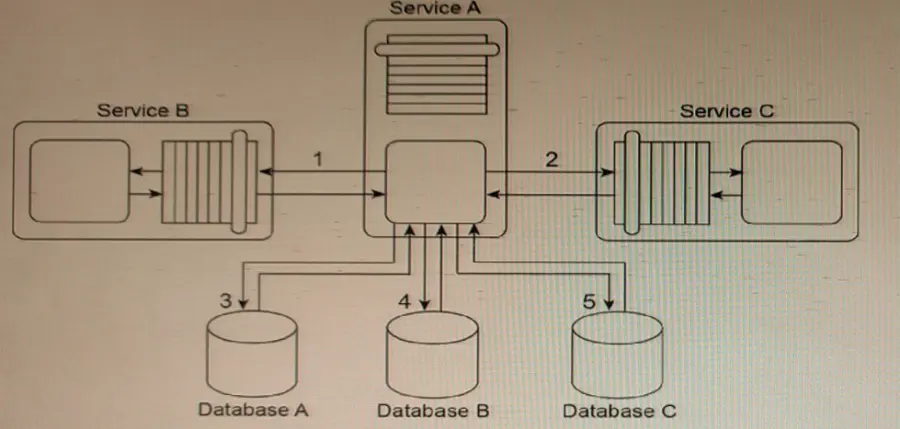
Refer to Exhibit.
Service A is an entity service that provides a set of generic and reusable service capabilities. In order to carry out the functionality of any one of its service capabilities, Service A is required to compose Service B (1) and Service C (2), and Service A is required to access Database A (3), Database B (4), and Database C (5). These three databases are shared by other applications within the IT enterprise.
All of service capabilities provided by Service A are synchronous, which means that for each request a service consumer makes, Service A is required to issue a response message after all of the processing has completed.
Service A is one of many entity services that reside In a highly normalized service Inventory. Because Service A provides agnostic logic, it is heavily reused and is currently part of many service compositions.
You are told that Service A has recently become unstable and unreliable. The problem has been traced to two issues with the current service architecture. First, Service B, which Is also an entity service, is being increasingly reused and has itself become unstable and unreliable. When Service B fails, the failure is carried over to Service
Correct Answer:C. The Redundant Implementation pattern can be applied to Service B, thereby making duplicate deployments of the service available. This way, when one implementation of Service B is too busy, another implementation can be accessed by Service A instead. The Service Data Replication pattern can be applied to establish a dedicated database that contains a copy of the data from shared Database B that is required by Service A. The replicated database is designed with an optimized data model to improve query execution performance.
Explanation:
This solution addresses both issues with the current service architecture. By applying the Redundant Implementation pattern to Service B, duplicate deployments of the service are made available, ensuring that when one implementation fails, another can be accessed by Service A. Additionally, the Service Data Replication pattern can be applied to establish a dedicated database that contains a copy of the data from shared Database B that is required by Service A. This replicated database is designed with an optimized data model to improve query execution performance, ensuring that queries issued by Service A to the database can complete more quickly, improving the overall stability and reliability of Service A. By applying these patterns, the problems with Service A can be solved without compromising the normalization of the service inventory.
Question 4
Refer to Exhibit.
Service A is a SOAP-based Web service with a functional context dedicated to invoice-related processing. Service B is a REST-based utility service that provides generic data access to a database.
In this service composition architecture, Service Consumer A sends a SOAP message containing an invoice XML document to Service A (1). Service A then sends the invoice XML document to Service B (2), which then writes the invoice document to a database (3).
The data model used by Service Consumer A to represent the invoice document is based on XML Schema
Correct Answer:A, A
Explanation:
The recommended solution is to use the Data Model Transformation pattern to transform the invoice XML document from Schema B to Schema A before passing it to Service B. This solution maintains the separation of concerns and allows each service to work with its own specific XML schema. Additionally, the Standardized Service Contract principle should be applied to Service B and Service Consumer A to ensure that unnecessary validation is avoided, thus optimizing the invoice XML document. This solution avoids adding logic that will increase the runtime performance requirements.