Free Arcitura Education SOA Security Lab S90.20 Exam Questions
Page: 1 / 5Total 30 questions
Want more questions? Get Premium Access.
Question 1
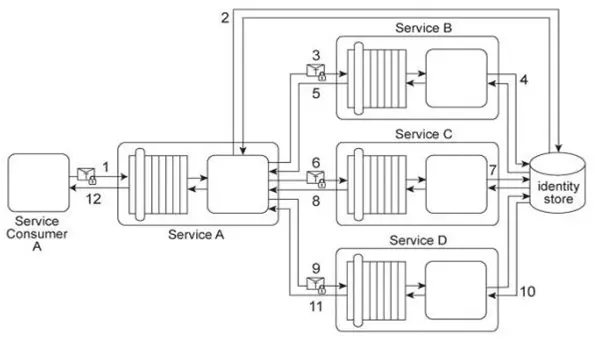
Service Consumer A sends a request message with a Username token to Service A (1). Service B authenticates the request by verifying the security credentials from the Username token with a shared identity store (2). To process Service Consumer A's request message, Service A must use Services B, C, and D .Each of these three services also requires the Username token (3. 6, 9) in order to authenticate Service Consumer A by using the same shared identity store (4, 7, 10). Upon each successful authentication, each of the three services (B, C, and D) issues a response message back to Service A (5, 8, 11). Upon receiving and processing the data in all three response messages, Service A sends its own response message to Service Consumer A (12). You are asked to redesign this service composition architecture so that it can still carry out the described message exchanges while requiring that Service Consumer A only be authenticated once using the identity store. Which of the following statements describes an accurate solution?
Correct Answer:A. A single sign-on mechanism is implemented. The Brokered Authentication pattern is applied, resulting in Service A becoming the authentication broker. The authentication broker authenticates the security credentials received from Service Consumer A against the identity store. After successful authentication, the authentication broker issues a signed SAML token for Service Consumer A .The SAML token is subsequently provided to Services B.C .and D by Service A, on behalf of Service Consumer A .
Question 2
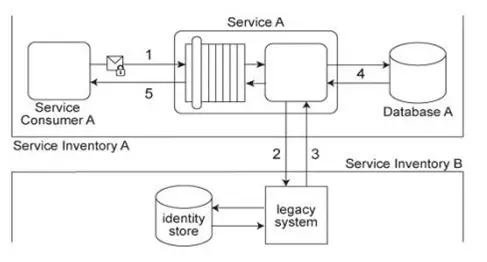
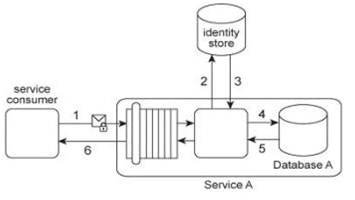
Service Consumer A submits a request message with security credentials to Service A (1). The identity store that Service A needs to use in order to authenticate the security credentials can only be accessed via a legacy system that resides in a different service inventory. Therefore, to authenticate Service Consumer A, Service A must first forward the security credentials to the legacy system (2). The legacy system then returns the requested identity to Service A (3). Service A authenticates Service Consumer A against the identity received from the legacy system. If the authentication is successful, Service A retrieves the requested data from Database A (4), and returns the data in a response message sent back to Service Consumer A (5). Service A belongs to Service Inventory A which further belongs to Security Domain A and the legacy system belongs to Service Inventory B which further belongs to Security Domain B .(The legacy system is encapsulated by other services within Service Inventory B, which are not shown in the diagram.) These two security domains trust each other. Communication between Service A and the legacy system is kept confidential using transport-layer security. It was recently discovered that a malicious attacker, posing as Service Consumer A, has been accessing Service A .An investigation revealed that these attacks occurred because security credentials supplied by Service Consumer A were transmitted in plaintext. Furthermore, vulnerabilities to replay attacks and malicious intermediaries have been detected. Which of the following statements describes a solution that can counter these types of attacks?
Also, list the industry standards required by the proposed solution.
Correct Answer:A. Apply the Data Origin Authentication pattern together with the Data Confidentiality pattern in order to establish message-layer security that guarantees the confidentiality and integrity of messages exchanged by Service Consumer A and Service A .Further, a security policy can be created to require that security credentials submitted to Service A must be digitally signed and encrypted and also contain a timestamp to validate the actual time the request was issued. Industry standards that can be used for this solution are WS-Policy, WS-Security-Policy, XMLEncryption, and XML-Signature.
Question 3
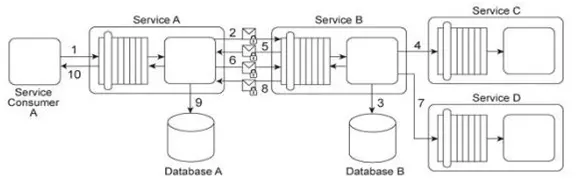
Service Consumer A sends a request message to Service A (1), after which Service A sends a request message with security credentials to Service B (2). Service B authenticates the request and, if the authentication is successful, writes data from the request message into Database B (3). Service B then sends a request message to Service C (4), which is not required to issue a response message. Service B then sends a response message back to Service A (5). After processing Service B's response, Service A sends another request message with security credentials to Service B (6). After successfully authenticating this second request message from Service A, Service B sends a request message to Service D (7). Service D is also not required to issue a response message. Finally, Service B sends a response message to Service A (8), after which Service A records the response message contents in Database A (9) before sending its own response message to Service Consumer A (10). To use Service A, Service Consumer A is charged a per usage fee. The owner of Service Consumer A has filed a complaint with the owner of Service A, stating that the bills that have been issued are for more usage of Service A than Service Consumer A actually used. Additionally, it has been discovered that malicious intermediaries are intercepting and modifying messages being sent from Service B to Services C and D .Because Services C and D do not issue response messages, the resulting errors and problems were not reported back to Service B .Which of the following statements describes a solution that correctly addresses these problems?
Correct Answer:A. The Data Confidentiality and Data Origin Authentication patterns need to be applied in order to establish message-layer-confidentiality and integrity for messages sent to Services C and D .The Direct Authentication pattern can be applied to require that service consumer be authenticated in order to use Service A .
Question 4
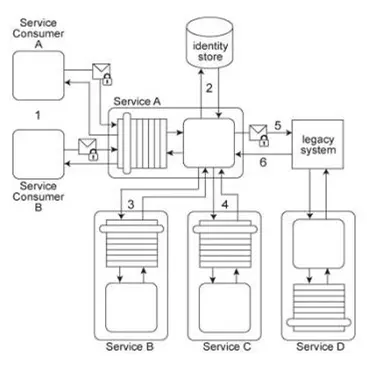
Service A has two specific service consumers, Service Consumer A and Service Consumer B (1). Both service consumers are required to provide security credentials in order for Service A to perform authentication using an identity store (2). If a service consumer's request message is successfully authenticated, Service A processes the request by exchanging messages with Service B (3) and then Service C (4). With each of these message exchanges, Service A collects data necessary to perform a query against historical data stored in a proprietary legacy system. Service A's request to the legacy system must be authenticated (5). The legacy system only provides access control using a single account. If the request from Service A is permitted, it will be able to access all of the data stored in the legacy system. If the request is not permitted, none of the data stored in the legacy system can be accessed. Upon successfully retrieving the requested data (6), Service A generates a response message that is sent back to either Service Consumer A or B .The legacy system is also used independently by Service D without requiring any authentication. Furthermore, the legacy system has no auditing feature and therefore cannot record when data access from Service A or Service D occurs. If the legacy system encounters an error when processing a request, it generates descriptive error codes. This service composition architecture needs to be upgraded in order to fulfill the following new security requirements:
1. Service Consumers A and B have different access permissions and therefore, data received from the legacy system must be filtered prior to issuing a response message to one of these two service consumers.
2. Service Consumer A's request messages must be digitally signed, whereas request messages from Service Consumer B do not need to be digitally signed. Which of the following statements describes a solution that fulfills these requirements?
Correct Answer:A. The Trusted Subsystem pattern is applied by introducing a utility service that encapsulates the legacy system. To support-access by service consumers issuing request messages with and without digital signatures, policy alternatives are added to Service A's service contract. Service A authenticates the service consumer's request against the identity store and verifies compliance to the policy. Service A then creates a signed SAML assertion containing an authentication statement and the authorization decision. The utility service inspects the signed SAML assertions to authenticate the service consumer and then access the legacy system using a single account. The data returned by the legacy system is filtered by the utility service, according to the information in the SAML assertions.
Question 5
Service A provides a data access capability that can be used by a variety of service consumers. The database records accessed by Service A are classified as either private or public. There are two types of service consumers that use Service A:
Service consumers with public access permissions (allowed to access only public data records) and service consumers with private access permissions (allowed to access all data records). For performance reasons the Service A architecture uses a single database, named Database A .Each record in Database A is classified as either private or public. After Service A is invoked by a service consumer (1), it authenticates the request message using an identity store and retrieves the corresponding authorization (2, 3). Once authorized, the service consumer's request is submitted to Database A (4), which then returns the requested data (5) If the service consumer has private access permissions, all of the returned data is included in Service A's response message (6). If the service consumer has public access permissions, then Service A first filters the data in order to remove all unauthorized private data records before sending to the response message to the service consumer (6). In addition to retrieving data, Service A's data access capability can be used to update database records. An investigation recently revealed an information leakage problem that can occur when service consumers with public access permissions attempt to update the ID value of a database record The ID values of all database records (private or public) must be unique. When a service consumer with public access permissions updates a public database record with an ID value that is already assigned to a private database record, the database returns an error message describing this conflict. This error text reveals confidential information by stating that the ID value submitted by the service consumer with public access permissions already exists within a private database record. What steps can be taken to avoid this problem while preserving the requirement that all database records (private and public) have unique ID values?
Correct Answer:A. The Exception Shielding pattern is applied to replace the error description text before a response message is returned to the service consumer. Furthermore, the ID value of all database records is appended with a code indicating whether the database record is private or public
Question 6
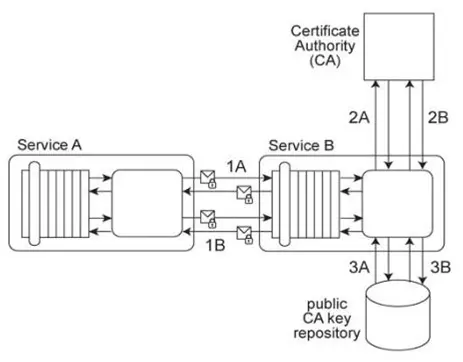
Service A exchanges messages with Service B multiple times during the same runtime service activity. Communication between Services A and B has been secured using transport-layer security. With each service request message sent to Service B (1A .IB), Service A includes an X.509 certificate, signed by an external Certificate Authority (CA). Service B validates the certificate by retrieving the public key of the CA (2A .2B) and verifying the digital signature of the X.509 certificate. Service B then performs a certificate revocation check against a separate external CA repository (3A, 3B). No intermediary service agents reside between Service A and Service B .Service B has recently suffered from poor runtime performance plus it has been the victim of an access-oriented attack. As a result, its security architecture must be changed to fulfill the following new requirements:
1. The performance of security-related processing carried out by Service B when communicating with Service A must be improved.
2. All request messages sent from Service A to Service B must be screened to ensure that they do not contain malicious content. Which of the following statements describes a solution that fulfills these requirements?
Correct Answer:B. Add a service agent to screen messages sent from Service A to Service B .The service agent can reject any message containing malicious content so that only verified messages are passed through to Service B .Instead of using X.509 certificates, use WS-Secure Conversation sessions. Service A can request a Security Context Token (SCT) from a Security Token Service and use the derived keys from the session key to secure communication with Service B .Service B retrieves the session key from the Security Token Service.