
Limited-Time Offer: Enjoy 50% Savings! Ends in 00h 00m 00s Coupon code: 50OFF
Skip to content

Free ASQ Quality Engineer CQE Exam Questions

Page: 1 / 12 Total 175 questions

Want more questions? Get Premium Access.

Question 1

What type of audit should be used to determine how well an organization's activities conform to its quality program?

Correct Answer: C. System
Explanation:

A system audit evaluates the overall quality management system (QMS) of an organization to ensure it conforms to established standards, such as ISO 9001.

This type of audit examines whether the processes and activities are effectively integrated and implemented to achieve quality objectives.

It focuses on the adequacy and compliance of the entire QMS rather than individual processes or products.

Reference: ISO 9001 and the ASQ 'Quality Audits for Improved Performance' emphasize the role of system audits in assessing conformance to quality programs.
Question 2

Who has primary responsibility for determining the purpose and scope of an audit?

Correct Answer: A. Client
Explanation:

The client, or the party commissioning the audit, has the primary responsibility for defining the purpose and scope of the audit.

The client sets the objectives, scope, and criteria to ensure the audit meets their specific needs and requirements.

The audit manager and auditor may assist in refining the scope and purpose but the initial determination lies with the client.

Reference: The ASQ 'Auditing Handbook' and ISO 19011:2018 guidelines on auditing management systems outline the client's role in defining audit scope and objectives.


Question 3

The primary characteristic of risk management is being

Correct Answer: D. all-inclusive
Explanation:

Risk management in software quality engineering aims to identify, assess, and mitigate risks that could affect project outcomes. The primary characteristic of effective risk management is that it should be all-inclusive. This means it should encompass all potential risk areas, including technical, project management, resource allocation, and external factors. An all-inclusive approach ensures that no significant risk is overlooked and that comprehensive strategies are in place to manage identified risks effectively. Reference:

Software Quality Assurance: Principles and Practice by Nina S. Godbole.

ASQ Software Quality Engineer Handbook.


Question 4

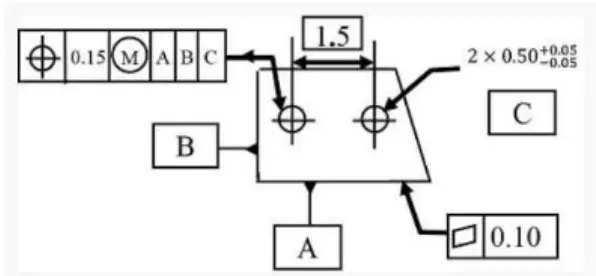
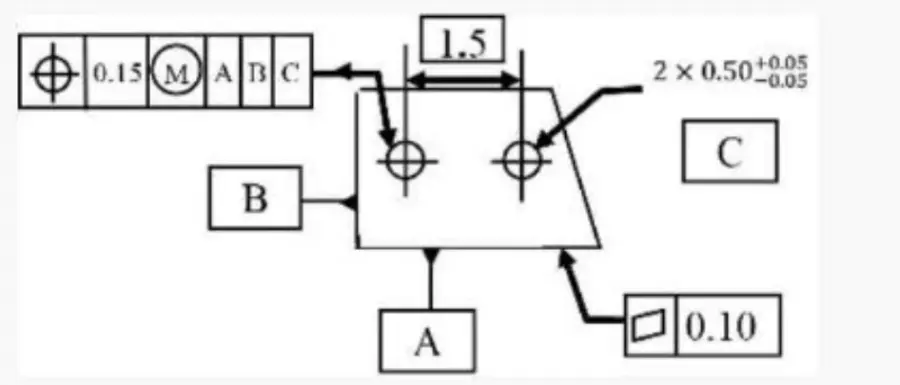
The holes in this drawing have what kind of tolerance?

The holes in this drawing have what kind of tolerance?

Correct Answer: B. Bilateral
Explanation:

Bilateral tolerance means that the allowable deviation is specified in both directions from the nominal dimension.

In the provided drawing, the hole dimension is given with an equal tolerance range on both sides, indicating bilateral tolerance.

Reference: 'Engineering Drawing and Design' by David A. Madsen and 'Geometric Dimensioning and Tolerancing' by Alex Krulikowski discuss bilateral tolerances and their representation in technical drawings.


Question 5

Reliability prediction is

. The process of performance estimation.

. The process of estimating the probability that a product will perform its intended function for a stated time.

. The process of telling "how you can get there from here".

Correct Answer: B. II only

Question 6

The values of two different variables are related to each other such that an increase in the value of the first variable is accompanied by a decrease in the value of the second variable. If the variables are perfectly correlated, their correlation coefficient will be equal to

Correct Answer: D. -1.0
Explanation:

The correlation coefficient measures the strength and direction of a linear relationship between two variables. A correlation coefficient of -1.0 indicates a perfect negative correlation, meaning that as one variable increases, the other decreases.


Moore, D.S., McCabe, G.P., & Craig, B.A. (2017). Introduction to the Practice of Statistics. W.H. Freeman.

Montgomery, D.C. (2009). Introduction to Statistical Quality Control. Wiley.

Question 7

Rank in order the following items from most effective to least effective when developing materials for a quality training program.

1. Case studies

2. General examples

3. Job related examples

4. Theory

Correct Answer: C. 3,1,2,4
Explanation:

When developing materials for a quality training program, the most effective to least effective methods are:

Job related examples (3)

Case studies (1)

General examples (2)

Theory (4)

This ranking emphasizes practical, relevant, and specific training content over more theoretical or generalized examples.


'Training for Quality' by David Goetsch and Stanley Davis

ASQ guidelines on training effectiveness

Question 8

An auditor who finds a major discrepancy during a pre-award audit of a new supplier should take which of the following actions?

Correct Answer: D. Include the discrepancy in the final report
Explanation:

When an auditor finds a major discrepancy during a pre-award audit of a new supplier, the appropriate action is to include the discrepancy in the final report. This documentation is essential for transparency and for the organization to make informed decisions regarding the supplier. While other actions like verifying corrective actions and investigating the cause are important, they are typically follow-up steps after the discrepancy has been officially recorded.


'Quality Audits for Improved Performance' by Dennis R. Arter

ISO 19011: Guidelines for auditing management systems

Question 9

How many total degrees of freedom are in an unreplicated 23 factorial experiment?

Correct Answer: B. 6
Explanation:

In an unreplicated 232^323 factorial experiment, there are 8 runs (since 23=82^3 = 823=8). The total degrees of freedom are calculated as the number of runs minus 1, which is 81=78 - 1 = 781=7. However, considering there are three factors, each with one degree of freedom, and their interactions (1 for each main effect, 3 two-way interactions, and 1 three-way interaction), the correct total degrees of freedom are 7. Reference:

Design and Analysis of Experiments by Douglas C. Montgomery.

ASQ Quality Press: The Certified Quality Engineer Handbook.


Question 10

During a daily production meeting, the materials manager discusses a priority shipment that is being delayed due to material being placed on hold from a nonconformance. The process engineer was present when the material was placed on hold and states that the nonconformance will not impact fit. form or function. The manufacturing manager shares that per the ISO standard, the risk should be accepted and the product should be shipped. Which action would be most appropriate for the quality engineer to take first?

Correct Answer: C. Commit to expediting the review and disposition of the nonconforming material with the MRB
Explanation:

In this scenario, the most appropriate action for the quality engineer is to expedite the review and disposition of the nonconforming material with the Material Review Board (MRB). This approach ensures that the nonconformance is assessed quickly by a team of experts, leading to an informed decision on whether the material can be used or needs further action. This aligns with ISO 9001:2015 requirements for handling nonconforming outputs and ensures that decisions are made based on a thorough review process. Reference: ISO 9001:2015 - Quality management systems -- Requirements, specifically the clauses dealing with nonconforming product management.


Question 11

Typically Pareto diagrams are used for which of the following reasons?

. To display the significant few categories.

. To compliment attribute data charting.

. To eliminate insignificant categories.

. To focus attention in priority order.

Correct Answer: D. I, II, III and IV

Question 12

Refer to the exhibit.

A in this drawing, the symbol is being used to indicate the

Correct Answer: C. datum
Explanation:

In the provided drawing, the symbol marked 'A' is being used to indicate a datum. A datum is a reference point, line, or surface used as a basis for measurement and to establish the location or orientation of other features. It serves as a starting point for dimensional control and ensures consistency in the manufacturing process.


'Geometric Dimensioning and Tolerancing' by Alex Krulikowski

ASME Y14.5 - 2009 (Dimensioning and Tolerancing)

Question 13

Which of the following techniques is used when implementing single minute exchange of die?

Correct Answer: C. Separating internal and external setup operations
Explanation:

When implementing Single Minute Exchange of Die (SMED), separating internal and external setup operations is a key technique. Internal setup operations are those that can only be performed when the machine is stopped, whereas external setup operations can be performed while the machine is running. By distinguishing and optimizing these operations, setup times can be significantly reduced. Reference:

Single Minute Exchange of Die: A Comprehensive Guide to SMED by Shigeo Shingo.

Lean Production Simplified by Pascal Dennis.


Question 14

The limits of a pre-control chart are based on

Correct Answer: A. specifications
Explanation:

Pre-control charts are a simple form of process monitoring used primarily for short production runs or setups. Unlike traditional control charts, the limits of pre-control charts are not based on statistical calculations of process variation but are derived directly from specification limits.

Specifications:

Pre-control chart limits are determined by dividing the specification range into zones.

Typically, the specification limits are divided into green, yellow, and red zones to indicate areas of acceptable and unacceptable performance.

The green zone is typically the middle 50% of the specification range, yellow zones are the next 25% on either side, and the red zones are the outer 25%.

Natural Tolerance:

Refers to the spread of the process data within 3 standard deviations from the process mean, but not used in pre-control charts.

Process Standard Deviation:

Used in traditional control charts to calculate control limits, not in pre-control charts.

Process Capability:

Evaluates how well a process can meet specifications, but pre-control limits are directly based on the specifications themselves.


Question 15

Choosing design settings to minimize the effect of noise is a goal of

Correct Answer: A. robust design
Explanation:

Robust design focuses on improving the quality of a product by minimizing the effects of variations without eliminating the causes of those variations.

Robust Design:

Techniques to make products or processes less sensitive to variations.

Aim to ensure performance under a wide range of conditions.

Tolerance Design:

Setting acceptable ranges of variation for product dimensions or performance metrics.

Design Verification:

Testing and validating that a design meets its requirements.

Design for Maintainability:

Designing products to be easy to maintain and repair.

Choosing design settings to minimize the effect of noise aligns with robust design principles.