
Limited-Time Offer: Enjoy 50% Savings! Ends in 00h 00m 00s Coupon code: 50OFF
Skip to content

Free ASQ Certified Software Quality Engineer CSQE Exam Questions

Page: 1 / 12 Total 175 questions

Want more questions? Get Premium Access.

Question 1

Which of the following types of test coverage is most appropriate when the objective is to determine if the software has any problems handling all the required possible hardware and software designs?

Correct Answer: D. Platform configuration
Explanation:

Platform configuration testing ensures that the software works correctly across different hardware and software environments.

Objective: The primary goal is to verify that the software can handle all the required hardware and software configurations it is expected to run on.

Comprehensive Testing: This type of coverage involves testing the software on various combinations of operating systems, browsers, hardware devices, and other configurations to ensure compatibility and performance.

Identification of Issues: It helps in identifying issues that may arise due to differences in the environments, which can be crucial for software that needs to run on multiple platforms.

Question 2

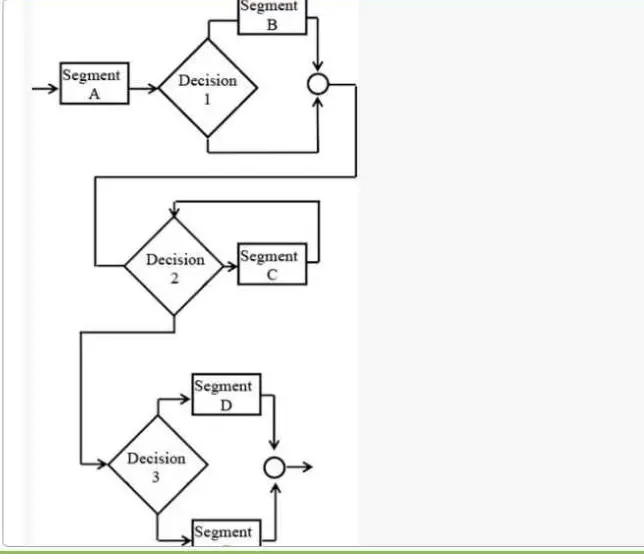
In the following control diagram, all paths are feasible and the decisions are not correlated to each other.

How many rests are necessary for branch coverage?

Correct Answer: B. 4
Explanation:

Branch coverage, also known as decision coverage, ensures that every possible branch (i.e., true and false conditions) in the code is executed at least once. To determine the number of tests necessary for branch coverage in the given control flow diagram, we must count the distinct branches resulting from each decision point.

Decision 1: 2 branches (true and false)

Decision 2: 2 branches (true and false)

Decision 3: 2 branches (true and false)

Since each decision has two branches and they are independent of each other, the number of distinct paths that need to be tested is: 2(Decision1)+2(Decision2)+2(Decision3)=6branches2 (Decision 1) + 2 (Decision 2) + 2 (Decision 3) = 6 \text{ branches}2(Decision1)+2(Decision2)+2(Decision3)=6branches

However, the number of tests needed to cover all branches is the maximum number of branches any path could take, considering that a single test might cover multiple branches. For the given control diagram, 4 tests will suffice to cover all branches:

Path: A -> Decision 1 (true) -> B

Path: A -> Decision 1 (false) -> Decision 2 (true) -> C

Path: A -> Decision 1 (false) -> Decision 2 (false) -> Decision 3 (true) -> D

Path: A -> Decision 1 (false) -> Decision 2 (false) -> Decision 3 (false)

These four tests ensure all branches are covered at least once.


Question 3

When the number of failures found during acceptance testing is compared to the number of failures found after release, the result is a measure of

Correct Answer: A. test effectiveness
Explanation:

Measuring Test Effectiveness: This involves comparing the number of defects found during testing phases to those found after release.

Importance of Test Effectiveness: It provides insight into how well the testing process is identifying defects before the product reaches the customer.

Impact on Quality: High test effectiveness means most defects are caught during testing, leading to higher quality products and fewer post-release issues.


Question 4

In agile development, requirements changes are

Correct Answer: C. added to the product backlog and prioritized by the product owner
Explanation:

In agile development, changes to requirements are a common and expected part of the process. The product backlog, which is a prioritized list of tasks and requirements for the project, is the main tool for managing these changes.

Requirement Identification: New requirements or changes are identified during various stages of the development process, often during interactions with stakeholders or as the team gains a deeper understanding of the project.

Product Backlog: These new requirements are then added to the product backlog. The product backlog is managed by the product owner, who is responsible for maintaining its order of priority based on the project's goals and stakeholder feedback.

Prioritization: The product owner prioritizes the backlog items to ensure that the most valuable and important features are addressed first. This prioritization helps in managing scope and delivering value incrementally.

Sprint Planning: During sprint planning, the team selects items from the top of the product backlog to include in the next sprint, based on their capacity and the priority set by the product owner.


Question 5

Which of the following documents must be under configuration control?

Correct Answer: C. Test procedures
Explanation:

Test procedures must be under configuration control to ensure that all testing activities are performed consistently and according to the specified standards. Configuration control involves managing changes systematically so that the integrity and traceability of the testing process are maintained. This helps in ensuring that the tests are repeatable and that any changes in the procedures are documented and approved.


'Configuration Management Principles and Practice' by Anne Mette Jonassen Hass

IEEE Standard for Configuration Management in Systems and Software Engineering (IEEE Std 828-2012)

Question 6

Test data requirements

Correct Answer: C. describe the data items and their characteristics and properties needed to execute the tests
Explanation:

Test data requirements describe the specific data needed to execute test cases effectively. This includes defining the characteristics and properties of data items, such as format, type, and values. Properly describing test data ensures that tests can be executed accurately and consistently, which is crucial for validating software functionality and performance.


Question 7

One of the biggest challenges in software testing is knowing

Correct Answer: D. when to stop testing
Explanation:

Knowing when to stop testing is one of the biggest challenges in software testing. This challenge stems from the fact that exhaustive testing is practically impossible due to constraints of time and resources. Testers must decide when enough testing has been done to ensure an acceptable level of quality and risk. This decision is often based on various factors such as coverage of requirements, defect discovery rates, risk assessments, and project timelines.


'Software Testing: A Craftsman's Approach' by Paul C. Jorgensen.

ISTQB Foundation Level Syllabus.

Question 8

Which of the following diagrams is most appropriate for showing the relationship between software design input requirements and software design output?

Correct Answer: B. Matrix
Explanation:

A matrix diagram is most appropriate for showing the relationship between software design input requirements and software design output. This type of diagram:

Visual Mapping: Displays how different elements (inputs and outputs) are related or interact with each other.

Traceability: Helps in tracing requirements to their corresponding design elements, ensuring that all requirements are addressed.

Matrix diagrams are useful for verifying that design outputs meet the specified requirements, facilitating quality and completeness in the design process.


The Quality Toolbox by Nancy R. Tague

Total Quality Management for Engineers by M. Zairi

Question 9

Which of the following libraries would be most appropriate for a tester to use when experimenting with different test case designs?

Correct Answer: C. Dynamic
Explanation:

The lead auditor acts as the final arbitrator for any audit-related issues that cannot be handled at a lower level. This individual is responsible for the overall conduct of the audit, ensuring that the audit is performed according to the plan and that all findings are appropriately addressed and resolved.

The lead auditor has the authority to make final decisions on disputes or issues that arise during the audit process, ensuring objectivity and adherence to audit standards.


ISO 19011: Guidelines for Auditing Management Systems

'Internal Auditing: Assurance & Advisory Services' by Urton L. Anderson, Michael J. Head, et al.

Question 10

A software quality engineer (SQE > is testing software in a system used to monitor critically ill patients and administer dosages of life-sustaining medicines Tests reveal a flaw that could result in an unscheduled shutdown under certain circumstances. Ox er the SQE's verbal and written objections: the director of engineering decides to ship the system. The SQE knows from experience that "whistle-blowers" in the company have lost their jobs The most appropriate next step for the SQE would be to

Correct Answer: C. discuss with top management
Explanation:

In a situation where a software quality engineer (SQE) identifies a critical flaw and the immediate superior decides to proceed despite the risk, the most appropriate next step is to discuss the issue with top management. This involves:

Documenting the Issue: Clearly outlining the flaw, its potential impact, and the SQE's objections.

Escalating the Concern: Bringing the issue to the attention of higher management levels who have the authority to reconsider the decision.

Focusing on Safety: Emphasizing the critical nature of the flaw, especially in a system used for monitoring critically ill patients.

This step ensures that the concerns are heard at the highest level, potentially preventing a decision that could endanger lives and the company's reputation.


'Software Quality Assurance: Principles and Practice' by Nina S. Godbole

IEEE Code of Ethics

Question 11

One of the direct benefits of improved software quality is

Correct Answer: C. a reduction in the number of defects
Explanation:

One of the direct benefits of improved software quality is a reduction in the number of defects. High-quality software undergoes thorough testing, rigorous quality assurance processes, and adherence to best practices in development, leading to fewer bugs and issues. This results in more reliable and robust software, reduces the need for costly fixes and rework, and enhances user satisfaction and trust in the product. Reference:

Pressman, Roger S. 'Software Engineering: A Practitioner's Approach.' 8th Edition, McGraw-Hill, 2014.

IEEE Std 730-2014, IEEE Standard for Software Quality Assurance Processes.


Question 12

Which of the following elements must be in place for a measure to be reliable?

Correct Answer: C. An operational definition of the measure
Explanation:

For a measure to be reliable, it must be consistently interpreted and applied across different contexts and by different people.

Operational Definition: An operational definition specifies the exact procedures or criteria used to measure something, ensuring consistency and repeatability.

Consistency: With a clear operational definition, different people can use the measure in the same way, which is crucial for reliability.

Clarity: This definition eliminates ambiguity and ensures that everyone understands what is being measured and how.

Example: If measuring 'response time,' the operational definition might specify that it is the time between a user submitting a request and the system's initial response.


Question 13

Each software development process should have a clearly defined set of inputs, activities, outputs, and

Correct Answer: B. entry exit criteria
Explanation:

Each software development process should have a clearly defined set of inputs, activities, outputs, and entry exit criteria. These criteria specify what conditions must be met to enter a particular phase of the development process and what conditions must be met to exit that phase. This ensures that each phase is properly completed before moving on to the next, thereby maintaining the quality and integrity of the development process.


Sommerville, I. (2011). Software Engineering (9th Edition).

IEEE Standard for Software and System Test Documentation (IEEE 829-2008).

Question 14

Which of the following steps comes first during release planning for waterfall-type projects?

Correct Answer: A. Define the scope of the software being developed.
Explanation:

Scope Definition: In the waterfall model, the first step in release planning is to define the scope of the software. This involves understanding what the software is supposed to do, the boundaries of the project, and the major features and functionalities to be included.

Importance of Scope: Defining the scope provides a clear understanding and agreement among stakeholders about what the project will deliver, preventing scope creep and ensuring all parties are aligned.

Reference: Software Engineering Body of Knowledge (SWEBOK) and IEEE standards emphasize the importance of scope definition as an initial phase in project planning.


Question 15

Results from a process audit show that the requirements group does not control changes to its software specifications. Which of the following basic requirements should be added to the software configuration management (SCM) policy?

Correct Answer: C. Responsibility- for SCM must be explicitly assigned for each project
Explanation:

When the requirements group does not control changes to software specifications, a basic requirement is to assign explicit responsibility for software configuration management (SCM) for each project. Here's why:

Clear Accountability: Assigning explicit responsibility ensures that someone is accountable for managing and controlling changes.

Consistency in Process: This ensures consistent application of SCM practices across different projects.

Improved Control: Clear responsibility helps in better monitoring and controlling changes, reducing the risk of unauthorized or untracked changes.

Policy Enforcement: Facilitates the enforcement of SCM policies and procedures, ensuring compliance and integrity of the project.


'Software Configuration Management Patterns: Effective Teamwork, Practical Integration' by Stephen P. Berczuk and Brad Appleton.

'Software Configuration Management Strategies and Rational ClearCase: A Practical Introduction' by Brian A. White.