Question 1
What is the output of the program?
#include
#include
using namespace std;
int main()
{
string s1="Wo";
string s2;
s2 = s1;
string s3;
s3 = s2.append("rldHello");
cout << s3;
return( 0 );
}
What is the output of the program?
#include
#include
using namespace std;
int main()
{
string s1="Wo";
string s2;
s2 = s1;
string s3;
s3 = s2.append("rldHello");
cout << s3;
return( 0 );
}
What is the meaning of the following declaration? (Choose two.)
char **ptr;
What happens when you attempt to compile and run the following code?
#include
using namespace std;
int fun(int x) {
return 2*x;
}
int main(){
int i;
i = fun(0.5) || fun(0);
cout << i;
return 0;
}
What happens when you attempt to compile and run the following code?
#include
using namespace std;
int op(int x, int y);
int main()
{
int i=2, j=2, k;
float f=0.3;
k = op(i, j);
cout<< k << "," << op(1, f);
return 0;
}
int op(int x, int y)
{
return x+y;
}
What happens when you attempt to compile and run the following code?
#include
using namespace std;
int main()
{
int *t;
t = new int[2];
for (int i=0; i<2; i++) {
t[i]=0;
}
cout << t[1];
}
Which code, inserted at line 14, generates the output "3.14 10"?
#include
using namespace std;
namespace myNamespace1
{
int x = 5;
int y = 10;
}
namespace myNamespace2
{
float x = 3.14;
float y = 1.5;
}
int main () {
//insert code here
cout << x << " " << y;
return 0;
}
What happens when you attempt to compile and run the following code?
#include
#include
#include
using namespace std;
int main(void)
{
string s;
s = "Test";
s.resize (s.size() ? 1);
cout<
return 0;
}
What happens when you attempt to compile and run the following code?

Which code, inserted at line 12, generates the output "5b"?
#include
using namespace std;
namespace myNamespace1
{
int var = 5;
}
namespace myNamespace2
{
char var = 'b';
}
int main () {
//insert code here
return 0;
}
What happens when you attempt to compile and run the following code?
#include
using namespace std;
int main(){
int i, j;
for(i = 0, j = 1; j < 2, i < 4; i++, j++);
cout << i << " " << j;
return 0;
}
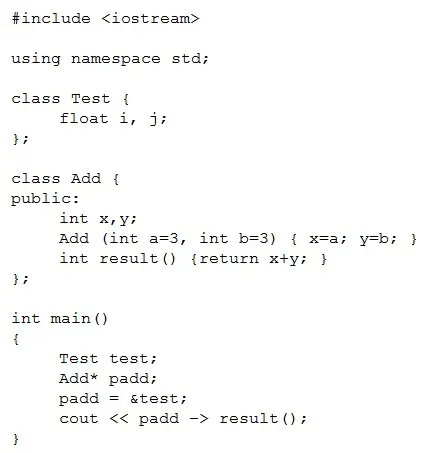
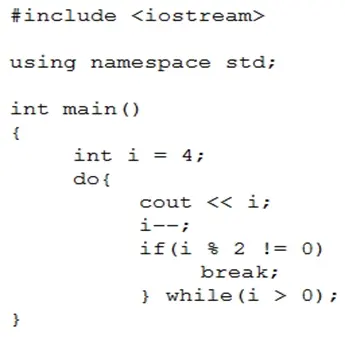
What is the expected result of the following program?

What happens when you attempt to compile and run the following code?
#include
using namespace std;
class BaseC
{
int *ptr;
public:
BaseC() { ptr = new int(10);}
BaseC(int i) { ptr = new int(i); }
~BaseC() { delete ptr; }
void Print() { cout << *ptr; }
};
int main()
{
BaseC *o = new BaseC(5);
o?>Print();
}
Which of the following operations is INCORRECT?
What will the variable "age" be in class B?
class A {
int x;
protected:
int y;
public:
int age;
A () { age=5; };
};
class B : public A {
string name;
public:
B () { name="Bob"; };
void Print() {
cout << name << age;
}
};
What happens when you attempt to compile and run the following code?
#include
using namespace std;
int op(int x, int y)
{
int i;
i = x + y;
return i;
}
int main()
{
int i=1, j=2, k, l;
k = op(i, j);
l = op(j, i);
cout<< k << "," << l;
return 0;
}