Limited-Time Offer: Enjoy 50% Savings! Ends in 00h 00m 00s Coupon code: 50OFF
Skip to content

Free CFA Institute CFA Level II Chartered Financial Analyst CFA-Level-II Exam Questions

Page: 1 / 48 Total 715 questions

Want more questions? Get Premium Access.

Question 1

Connor Burton, CFA, is the managing partner for United Partners, a small investment advisory firm that employs three investment professionals and currently has approximately $250 million of assets under management. The client base of United Partners is varied, and accounts range in size from small retirement accounts to a $30 million private school endowment. In addition to Burton's administrative responsibilities as the managing partner at United, he also serves as an investment advisor to several clients. Because United Partners is a small firm, the company does not employ any research analysts but instead obtains its investment research products and services from two national brokerage firms, which in turn execute all client trades for United Partners. The arrangement with the two brokers has enabled United to assure its clients that the firm will always seek the best execution for them by having both brokers competitively bid for United's business.

A prospective client, Harold Crossley, has approached Burton about shifting some of his personal assets under management from MoneyCorp to United Partners. Burton provides Crossley with a packet of marketing information that Burton developed himself. The packet contains five years of historical performance data for the private school endowment, Unitcd's largest client. Burton states that the composite's management style and performance results are representative of the management style and returns that United can be expected to achieve for Crossley. Also included in the information packet are brief bios on each of United's three investment professionals. Crossley notices that all three of United's investment professionals are described as "CFA charterholders," but he is not familiar with the designation. In response to Crossley's inquiry. Burton explains the significance of the program by stating that the designation, which is only awarded after passing three rigorous exams and obtaining the requisite years of work experience, represents a commitment to the highest standards of ethical and professional conduct.

As a condition of moving his account to United Partners, Crossley insists that all of his trades be executed through his brother-in-law, a broker for Security Bank. Security Bank is a large, New York-based broker/dealer but is not one of the two brokerage firms with which United currently does business. Burton contacts Crossley's brother-in-law and determines that Security Bank's trade execution is competitive, but Crossley's account alone would not generate enough volume to warrant any soft dollar arrangement for research materials.

However, Crossley'-s brother-in-law does offer for Security Bank to pay a referral fee to Burton for directing any of United's clients to Security Bank's retail banking division. To bring Crossley on as a client, Burton agrees to the arrangement. Going forward. Burton will use Security Bank to execute all of Crossley's trades but will use research materials provided by the other two brokers to assist in the management of Crossley's account.

Several months later, Burton is invited to a road show for an initial public offering (IPO) for Solution Ware, a software company. Security Bank is serving as lead underwriter on SolutionWare's IPO. Burton attends the meeting, which is led by two investment bankers and one software industry research analyst from Security Bank who covers SolutionWare. Burton notes that the bankers from Security Bank have included detailed financial statements for SolutionWare in the offering prospectus and also disclosed that Security Bank provides a warehouse line of credit to SolutionWare. After the meeting, Burton calls Crossley to recommend the purchase of SolutionWare equity. Crossley heeds Burton's advice and tells him to purchase 5,000 shares. Before placing Crossley's order, Burton reads the SolutionWare marketing materials and performs a detailed analysis of expected future earnings and other key factors for the investment decision. Burton determines that the offering would be a suitable investment for his own retirement portfolio in addition to Crossley's portfolio. United Partners, being a small firm, has no formal written policy regarding trade allocation, employee participation in equity offerings, or established blackout periods for employee trading. Burton adds his order to Crossley's order and places a purchase order for the combined number of shares with Security Bank. Burton is later notified that the offering was oversubscribed, and United Partners was only able to obtain roughly 75% of the desired number of shares. To be fair. Burton allocates the shares on a pro rata basis between Crossley's account and his own retirement account. When Burton notifies Crossley of the situation, Crossley is nonetheless pleased to have a position, though smaller than requested, in such a "hot" offering.

According to CFA Institute Standards of Professional Conduct, Burton's recommendation to Crossley that he purchase shares of the Solution Ware initial public offering is most likely:

Correct Answer: B. in violation of Standard V(A) Diligence and Reasonable Basis for not thoroughly analyzing the investment before making a recommendation and in violation of Standard III(C) Suitability for not determining the appropriateness of the investment for the portfolio.
Explanation:

Standard V(A) Diligence and Reasonable Basis stares that the member or candidate must exercise diligence, independence, and thoroughness before making an investment recommendation. The Standard also requires that members and candidates have a reasonable and adequate basis supported by research and investigation for any investment recommendations or actions. Burton made his purchase recommendation to Crossley purely on the basis of the Security Bank road show and did not perform his own evaluation to determine whether or not the SolutionWarc IPO was a good investment opportunity. Burton has therefore violated Standard V(A).

Standard Iil(C) Suitability was also violated because there is no indication that Burton made any effort to determine if the investment was appropriate for Crossley's portfolio. Burton should have determined that the investment was consistent with Crossley's written objectives and constraints before he recommended the investment. Even though he later determined that the investment was suitable, he did not know this was the case before he told Crossley that he should purchase shares in the IPO. (Study Session 1, LOS 2.a)
Question 2

Andrew Carson is an equity analyst employed at Lee, Vincent, and Associates, an investment research firm. In a conversation with his supervisor, Daniel Lau, Carson makes the following two statements about defined contribution plans.

Statement I: Employers often face onerous disclosure requirements.

Statement 2: Employers often bear all the investment risk.

Carson is responsible for following Samilski Enterprises (Samilski), a publicly traded firm that produces motorcycles and other mechanical parts. It operates exclusively in the United States. At the end of its 2009 fiscal year, Samilski's employee pension plan had a projected benefit obligation (PBO) of $320 million. Also, unrecognized prior service costs were $35 million, the fair value of plan assets was $316 million, and the unrecognized actuarial gain was $21 million.

Carson believes the rate of compensation increase will be 5% as opposed to 4% in the previous year, and the discount rate will be 7% as opposed to 8% in the previous year.

This past year, Samilski began using special purpose entities (SPEs) for various reasons. In preparation for analyzing the SPE disclosures in the footnotes to the financial statements, Carson prepares a memo on SPEs. In the memo, he correctly concludes that the company will be required under new accounting rules to classify them as variable interest entities (VIE) and consolidate the entities on the balance sheet rather than report them using the equity method as in the past.

Which of the following items, when recognized, will likely increase:

PBO? Pension expense?

Correct Answer: B. Actuarial loss Amortization of prior service costs
Explanation:

An actuarial loss results from a change in actuarial assumptions. In the case of a loss, the amount of pension benefits payable in the future would increase, thus increasing the PBO. Actuarial gains have the opposite effect.

The amortization of prior service costs results in pension expense being increased gradually over a number of years, rather than all at once in the year of occurrence. In contrast, the expected return on plan assets is an 'income' component in calculating pension cost (service cost and interest cost being the expense components), so recognition of expected return on plan assets would decrease pension expense. (Study Session 6, LOS 22.b)


Question 3

Martha Gillis, CFA, trades currencies for Trent, LLC . Trent is one of the largest investment firms in the world, and its foreign currency department trades more currency on a daily basis than any other firm. Gillis specializes in currencies of emerging nations.

Gillis received an invitation from the new Finance Minister of Binaria, one of the emerging nations included in Gillis's portfolio. The minister has proposed a number of fiscal reforms that he hopes will help support Binaria's weakening currency. He is asking currency specialists from several of the largest foreign exchange banks to visit Binaria for a conference on the planned reforms. Because of its remote location, Binaria will pay all travel expenses of the attendees, as well as lodging in government-owned facilities in the capital city. As a further inducement, attendees will also receive small bags of uncut emeralds (as emeralds are a principal export of Binaria), with an estimated market value of $500.

Gillis has approximately 25 clients that she deals with regularly, most of whom are large financial institutions interested in trading currencies. One of the services Gillis provides to these clients is a weekly summary of important trends in the emerging market currencies she follows. Gillis talks to local government officials and reads research reports prepared by local analysts, which are paid for by Trent. These inputs, along with Gillis's interpretation, form the basis of most of Gillis's weekly reports.

Gillis decided to attend the conference in Binaria. In anticipation of a favorable reception for the proposed reforms, Gillis purchased a long Binaria currency position in her personal account before leaving on the trip. After hearing the finance minister's proposals in person, however, she decides that the reforms are poorly timed and likely to cause the currency to depreciate. She issues a negative recommendation upon her return. Before issuing the recommendation, she liquidates the long position in her personal account but does not take a short position.

Gillis's supervisor, Steve Howlett, CFA, has been reviewing Gillis's personal trading. Howlett has not seen any details of the Binaria currency trade but has found two other instances in the past year where he believes Gillis has violated Trent's written policies regarding trading in personal accounts.

One of the currency trading strategies employed by Trent is based on interest rate parity. Trent monitors spot exchange rates, forward rates, and short-term government interest rates. On the rare occasions when the forward rates do not accurately reflect the interest differential between two countries, Trent places trades to take advantage of the riskless arbitrage opportunity. Because Trent is such a large player in the exchange markets, its transactions costs are very low, and Trent is often able to take advantage of mispricings that are too small for others to capitalize on. In describing these trading opportunities to clients, Trent suggests that "clients willing to participate in this type of arbitrage strategy are guaranteed riskless profits until the market pricing returns to equilibrium."

According to CFA Institute Standards of Professional Conduct, Howlett's best course of action with regard to the suspected violations by Gillis would be to:

Correct Answer: C. place limits on Gillis's personal trading and increase monitoring of Gillis's personal trades.
Explanation:

Standard 1(A). Warning Gillis and/or reporting the violation up Trout's management structure are inadequate solutions. Limiting the trading activity and increased monitoring to prevent future violations are more appropriate initial responses, in accordance with Standard 1(A) Professionalism - Knowledge of the Law. (Study Session l,LOS2.a)


Question 4

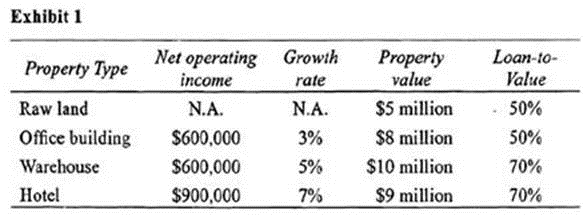
Josh Atwell recently inherited a large sum of money and wants to invest a portion of the inheritance into a real estate investment that provides a tax shelter. Atwell wants to take a limited management role in the real estate investment, and avoid the expense of hiring professional project management. Also, Atwell requires that the real estate investment generate high cash flows. Atwell hired Kellogg Investments to provide him potential real estate investments. Kellogg created Exhibit 1 outlining alternative real estate investments, from which Atwell can make his selection. Atwell's cost for any loan is 8%. The loan would be amortized over 20 years with annual payments. His required rate of return is 11%.

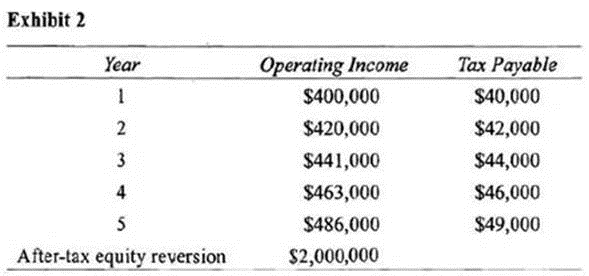
After reviewing the potential real estate investments generated by Kellogg, Atwell decided against all of the choices. Instead, Atwell requested a detailed report on the investment merits of an apartment complex. In Exhibit 2, Kellogg details the operating income of a targeted apartment complex investment. Atwell will make an equity contribution of $1,000,000. The loan-to-value ratio for the apartment complex investment would be 75%.

An adviser from Kellogg states that Atwell should purchase the apartment complex because the net present value of the investment is positive. The adviser also states, however, that the investment's IRR is less than Atwell's required rate of return. After reviewing the historical financial statements of the potential hotel investment, the advisor notes its erratic net operating income. In fact, the hotel generated several years of growing cash flow followed by two negative years and then a return back to a positive cash flow.

Based upon the information presented in Exhibit 2, the after-tax cash flow for year 2 is closest to;

Correct Answer: B. $72,000.
Explanation:

Loan-to-value ratio is 75%, Atwell's equity contribution is $1M, so the total value is:

(Study Session 13, LOS 45.c)


Question 5

Tobin Yoakam, CFA, is analyzing the financial performance of Konker Industries, a U .S . company which is publicly traded under the ticker KONK. Yoakam is particularly concerned about the quality of Konker's financial statements and its choices of accounting methodologies.

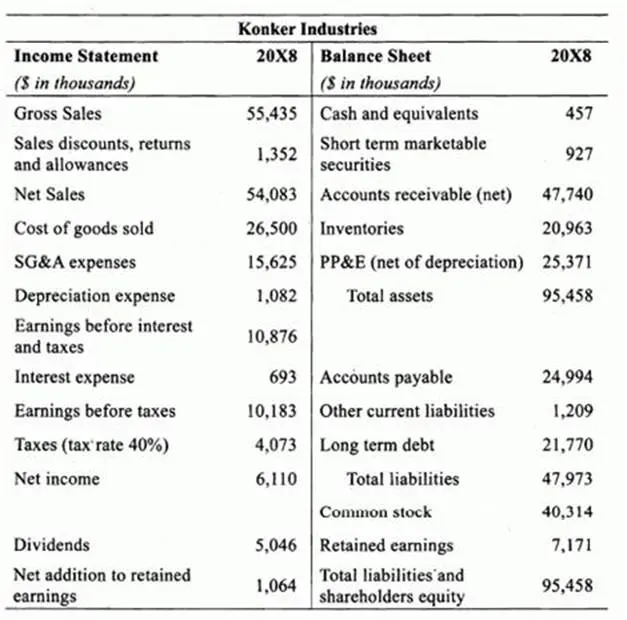
Below is a summary of Konker's financial statements prepared by Yoakam.

Konker has an operating lease for several of its large machining tools. The lease term expires in five years, and the annual lease payments are $2 million. The applicable interest rate on the operating lease is 9%. Yoakam believes that the operating lease should be capitalized and treated as a finance lease. For purposes of adjusting the financial statements, Yoakam believes that the machining tools should be depreciated using straight-line depreciation with a salvage value of $3 million.

At the beginning of 20X8, Konker formed a qualified special purposes entity (QSPE) and sold a portion of its accounts receivables to the QSPE. The total amount of accounts receivables sold to the QSPE was $13.5 million. Yoakam has noted in his research that the Financial Accounting Standards Board (FASB) is considering the elimination of qualified special purposes entities.

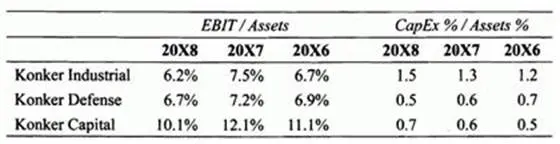
Konker has three major operating divisions: Konker Industrial, Konker Defense, and Konker Capital. Yoakam has computed the EBIT margin for each division over the last three years as well as the ratio of the percentage of total capital expenditures to the percentage of total assets for each division.

Since Yoakam is concerned about the quality of Konker's earnings, he decides to analyze the accrual ratios using the balance sheet approach. The table below contains the last three years of accrual ratios for Konker and the industry average.

If Yoakam capitalizes Konker's operating lease in his analysis, the Konker's adjusted interest coverage ratio for 20X8 would be closest to:

Correct Answer: B. 8.56.
Explanation:

The unadjusted interest coverage ratio is calculated as follows:

To adjust the interest coverage ratio for the operating lease, we need to take EBIT and add back the lease/rental expense (the lease payment amount) and subtract an estimate of depreciation for the machinery. Then, we need to add the appropriate interest expense for the operating lease to the overall interest expense.

To compute the interest expense and depreciation for the operating lease, we must first calculate the present value of the operating lease as follows:

PMT = 2,000

I/Y = 9

N = 5

FV = 0

CPT PV = 7,779.30

Depreciation and interest expense are then calculated as:

The adjusted interest coverage ratio is:

(Study Session 7, LOS 26.c)


Question 6

Lorenz Kummert is a junior equity analyst who is following Schubert, Inc. (Schubert), a small publicly traded company in the United States. His supervisor, Markus Alter, CFA, has advised him to use the residual income model to analyze Schubert.

In his preliminary report to Alter, Kummert makes the following statements:

Statement 1: Residual income models are appropriate when expected free cash flows are negative for the foreseeable future.

Statement 2: Residual income models are not applicable when cash flows are volatile.

Kummert has determined Schubert's cost of equity, cost of debt, and weighted average cost of capital (WACC) to be 12.8%, 8.4%, and 11.9%, respectively. The current price of the stock is $35 per share and there are 130,000 shares outstanding. The relevant tax rate is 30%, and return on equity (ROE) is expected to be 13%.

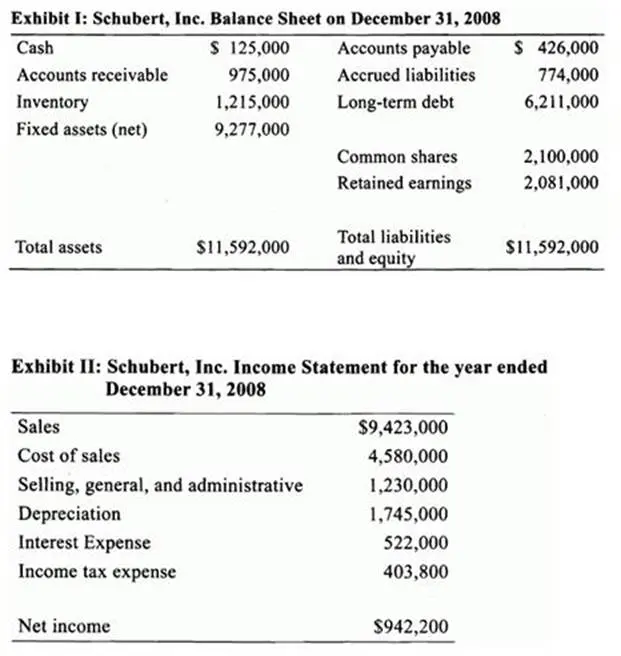
Summarized financial information about Schubert for 2008 is provided in Exhibits I and II.

Based on his analysis of several years of financial statements, Kummert notes that 2008 was an exceptionally profitable year for Schubert, and that its dividend payouts are usually low because the funds are mainly reinvested in the firm to promote growth. Furthermore, there are very few nonrecurring items on the income statement. Upon review of Kummert's preliminary report, Alter concurs with his analysis of the financial statements but reminds him that Schubert's long-term debt is currently trading at 95% of its book value. He also cautions Kummert that violations of the clean surplus relation can bias the results of the residual income model.

The consensus annual EPS estimate for 2009 is $6.15, and the dividend payout ratio for 2009 is estimated at 5%.

Which of the following amounts is closest to the forecast of Schubert's book value per share and residual income, respectively, for 2009?

Book value per share Residual income

Correct Answer: A. $38.00 $2.03

Question 7

Jerry Sanders, CFA, has been asked to analyze the 20-year bonds of Marietta Tech, Inc., which are currently being held in a corporate bond portfolio managed by a colleague, and to recommend whether the bonds should be sold or held. The bonds currently have a yield spread of 1.55% over Treasuries.

Marietta Tech, Inc. designs, manufactures, and markets specialty trucks and truck bodies mounted on new truck chassis produced by others, including concrete mixers, refuse bodies, fire and emergency vehicles, defense trucks, cut-away and dry freight van bodies, refrigerated units, stake bodies, and other specialized trucks. Marietta also manufactures fiberglass wind deflectors, armored trucks, shuttle buses, and cargo vans. Marietta's customers are located in the United States and Canada.

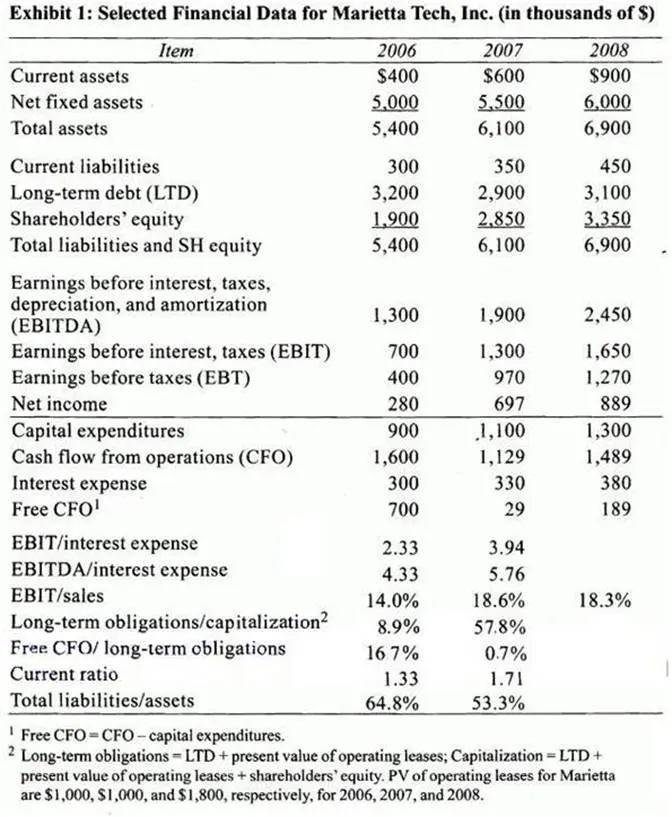
Exhibit 1: Selected Financial Data for Marietta Tech, Inc. (in thousands of $)

At lunch Sanders discusses the credit analysis of various types of bonds with Elizabeth Yan, who was just hired as a bond analyst. Yan makes the following statements:

Statement 1: An analysis of the issuer's business and operating risks is important to the analysis of corporate bond credit risk but not important for the credit analysis of asset backed securities (ABS).

Statement 2: The unique bond covenants in a municipal bond's trust indenture require an additional level of credit analysis not necessary in a corporate credit analysis.

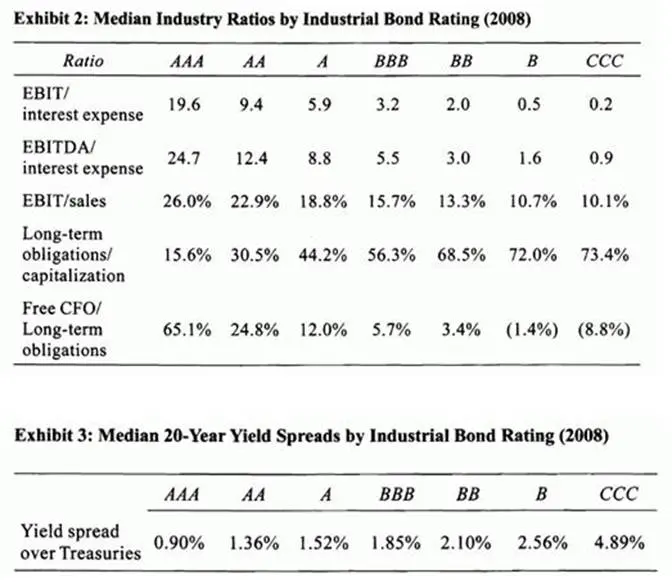
Compare the 2008 long-term obligations to capitalization ratio benchmarks to Marietta's ratio. Marietta is between the:

Correct Answer: B. BBB and BB benchmark ratios.
Explanation:

Mariettas long-term obligations-to-capitalization ratio of 59.4% is between the BBB median (56.3%) and the BB median (68.5%).

(Study Session 14, LOS 51.c)


Question 8

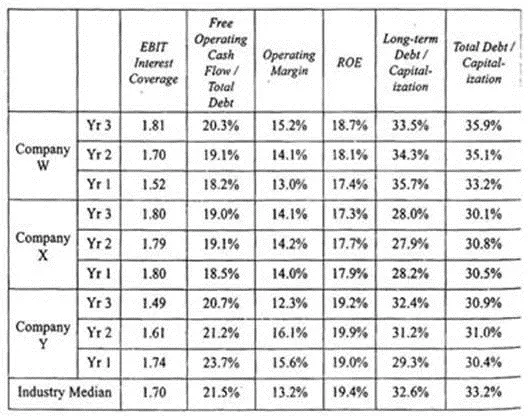
Michael Thomas, CFA, is a fixed-income portfolio manager for TFC Investments. As part of his portfolio strategy for the Prosperity Fund, Thomas searches for companies that he expects to be upgraded or downgraded. Those potential upgrades he finds are added to the portfolio or if already in the portfolio are increased in proportion to other holdings before the upgrade takes place. Potential downgrades are sold from the portfolio before the downgrade takes place. Thomas is evaluating his portfolio's current holdings which include several bonds issued by companies in the oil and gas exploration and refining industries. Year-end rating updates are expected to occur in a few days and Thomas is preparing to adjust his portfolio based on expected changes in credit ratings. He has assembled the following annual data on four of the oil and gas stocks in the portfolio:

Exhibit: 1

Thomas has been discussing his fixed-income strategies with a fellow portfolio manager, Shawna Reese. Reese has indicated that while his initial approach is good, the overall credit analysis strategy could be improved and has made the following suggestions to Thomas for both the Prosperity Fund and other fixed-income funds he manages:

* The current methodology does not consider special issues related to high-yield debt which makes up approximately 5% of the Prosperity Fund. Because most high-yield issuers have such a heavy dependence on short-term debt financing, analysis of the firm's debt structure will be extremely important to determine the priority of claims on the firm's assets as well as what source(s) of funds will be used to repay the principal. In addition, the corporate structure of high-yield issuers must be examined to determine the issuer's access to cash flows generated by its subsidiaries. A simple analysis of the parent's financial ratios will not reveal complicated corporate structures and indebtedness of subsidiaries that may restrict the issuer's ability to obtain the cash flows necessary to service its debt.

* The current methodology as applied to the Municipal Opportunities Fund does not include the necessary specialized analysis for municipal securities. Among other items, tax-backed munis must be scrutinized as to the issuer's ability to maintain balanced budgets as well as to ensure that the issue has first priority of claims to revenue from public works projects. Revenue-backed munis require an assessment of the sufficiency of rate covenants to cover expenses and debt servicing of the underlying project as well as the ability for other government entities to access the revenues generated by the enterprise before they are passed on to revenue bondholders.

As part of his portfolio analysis, Thomas also examines yield volatility. Thomas makes the following statements:

Statement 1: Implied yield volatility estimates are based on the assumptions that the option pricing model is correct and that volatility is constant.

Statement 2: Yield volatility has been observed to follow patterns over time that can be modeled and used to forecast future volatility.

He concludes his analysis by comparing the swap rate curve to a government bond yield curve as a benchmark.

Which of the following statements regarding the choice between government bond yield curves and swap rate curves as benchmark yields is most likely correct?

Correct Answer: A. The swap yield curve is preferred because swaps reflect similar levels of credit risk.
Explanation:

Market participants typically prefer to use the swap rate curve as a benchmark for the following reasons;

* The availability of swaps and the equilibrium pricing arc only driven by the interaction of supply and demand. It is not affected by technical market factors that can affect government bond yields.

* Swap curves across countries arc also more comparable than sovereign bond yield curves because they reflect similar levels of credit risk, while sovereign bond yield curves also reflect credit risk unique to each country's government bonds.

* The swap curve typically has yield quotes at 11 maturities between 2 and 30 years. The U .S . government bond yield curve typically only has on-che-run issues trading at four maturities between 2 and 30 years.

* . The swap market is not regulated by any government, which makes swap rates

across different countries more comparable.

(Study Session 14, LOS 53.d)


Question 9

Donnie Nelson, CFA, has just taken over as Chief Financial Officer of MavsHD, a high-tech company that delivers high-definition technology to a broad-based group of sports enthusiasts. MavsHD has 40% debt and 60% equity in its capital structure. For the year just ended, net income and dividends for MavsHD were equal to $145 million and $21.75 million, respectively. The consensus estimate for net income at the end of the current year is equal to $ 153 million. The company's current book value is $550 million. MavsHD's stock is currently trading on the NYSE for a price of S50 per share and has been steadily decreasing for the past twelve months.

MavsHD has gone through its pioneer and growth phases and is now settling in to the early stages of maturity. The business model is starting to shift from reliance almost exclusively on new customers, to a focus on retaining and satisfying existing customers. The previously experienced very high growth rate has slowed considerably. Nelson believes that the shareholder composition has changed over time as well, favoring shareholders who have a greater interest in dividend stability than explosive growth. In the past, however, the firm has favored a low dividend rate due to the availability of attractive internal investment opportunities.

Nelson wants to develop an optimal dividend policy for MavsIID that will create the most value for the shareholders and at the same time protect corporate assets. He is concerned, however, that there is sometimes a disconnect between an optimal dividend policy and how actual dividend rates are perceived in the marketplace.

Nelson is preparing a recommendation to senior management and the board of directors regarding the firm's dividend policy going forward. Nelson is considering recommending that MavsHD engage in a stock repurchase plan, and repurchase 1.5 million shares of the 12.75 million shares outstanding. This repurchase would eliminate any need to increase the cash dividend payout. Other managers at the firm, besides Nelson, believe MavsHD should increase its dividend and gravitate toward what they perceive to be the target payout ratio over the next eight years. Thus, at the end of the current year, the firm will increase the dividend payment by $250,000 over the dividend in the prior year.

During the board meeting, two of the directors raised concerns over Nelson's proposed repurchase plan. The directors' comments follow:

Director 1: I support the repurchase plan, especially relative 10 varying our dividend. Firms should not vary dividends---this lowers investors' confidence and can adversely impact the firm's cost of equity and its share price.

Director 2: A share repurchase does not take away the uncertainty associated with future stock value. According to the bird-in-the-hand theory, investors prefer higher dividends since capital gains are uncertain. The theory states that if we increase our dividend payout, the value of MavsHD equity will increase. Thus, 1 propose a dividend increase rather than a repurchase.

One of the board members, Jason Neely, proposed an alternative dividend policy plan one week after the meeting in which Nelson presented his plan. Neely's proposal involves utilizing a residual dividend model. Neely rationalizes his plan by claiming that relative to a stable dividend policy, his proposal would increase the volatility of dollar dividends paid to shareholders but would simultaneously increase the firm's ability to exploit value additive investment projects using internally generated funds. Because of this enhanced access to value additive projects, MavsHD's cost of equity capital will experience a marginal decrease which will further increase the overall value of the firm.

In light of the fact that there are several different groups of investors who hold shares in MavsHD, evaluate the directors' comments regarding Nelson's proposed stock repurchase plan.

Correct Answer: C. Both Director 1 and Director 2 are correct.
Explanation:

Investors do not like instability in the dividends paid by a company. Any volatility in dividends is seen as a negative sign by investors and the company's stock price would be punished as a result of varying dividends. According to the bird-in-the-hand theory, investors prefer the assurance of receiving a higher dividend today rather than waiting for returns in the form of capital appreciation. Because of the uncertainty associated with capital appreciation and the relative certainty of dividends, the bird-in-the-hand theory predicts that investors will reward dividend paying companies with a lower cost of equity and thus a higher equity value. A repurchase does not provide the same type of assurance since it is an unpredictable and possibly one-time event. (Study Session 8, LOS 29.b,l,m)


Question 10

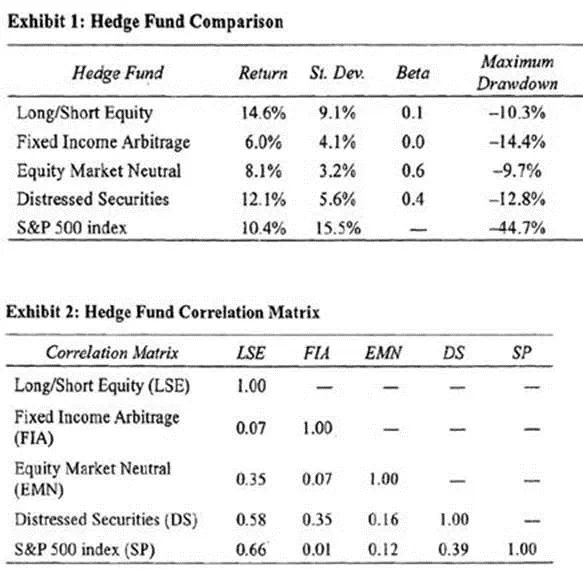
A client of Colby Nash, CFA, wants to add an alternative asset class to his portfolio. However, the client is concerned that any investment in hedge funds may be far riskier and generate lower returns than is generally expected. Nash believes the client's attitude toward hedge funds was influenced by negative press coverage regarding fraud perpetrated by a few funds. Nash decided to conduct his own research on the risk/reward characteristics of hedge funds. Nash generated a report (shown in Exhibit 1) comparing several hedge fund strategies and a traditional investment benchmark; the S&P 500 index. Each hedge fund strategy is represented by an individual fund, which is used to measure risk and return over a ten year period. Nash also created a correlation matrix between hedge funds and the S&P 500 index, shown in Exhibit 2.

In addition to the statistics presented in the exhibits above, Nash created a hedge fund index to evaluate each fund's performance. Nash recognized the fact that several shortcomings exist in creating an adequate hedge fund index. To that end, Nash created an index in which all the hedge funds included in the index agreed to provide data that can be verified by Nash. Nash also set up strict rules for inclusion and removal of hedge funds into and out of the hedge fund index.

As a further improvement to his research, Nash created a positive risk-free rate benchmark to evaluate each hedge fund. However, his review of academic research indicated thar the positive risk-free rate benchmark is only appropriate for a limited number of hedge fund strategies. The current risk-free rate is 4%.

Nash conducted a personal interview with the portfolio manager of the Fixed Income Arbitrage hedge fund. The portfolio manager disclosed that he exploited pricing inefficiencies between fixed income securities while hedging exposure to interest rate risk. The portfolio manager utilizes a convergence trading strategy, which assumes that the price difference between two similar assets will narrow in the future. The portfolio manager is willing to invest in illiquid bonds if the opportunity presents itself.

in reviewing the correlation matrix (Exhibit 2), Nash concluded that the Fixed Income Arbitrage hedge fund would be an ideal addition to his client's current traditional investment portfolio. Nash's rationale was that a low correlation between the hedge fund and the S&P 500 index will assure that the fund's returns will be positive when the returns of the index are negative.

After reviewing Nash's research, the Director of Research at his firm inquired why he did not examine the value at risk (VAR) measure for the various hedge fund strategies. Nash stated that VAR is an ineffective statistical measure of risk when a hedge fund has high turnover or frequent changes in its strategy. In addition, Nash stated his belief that when the only input is historical data, VAR does not provide a reliable estimate of future risk.

Rather than comparing hedge funds against the S&P 500 index, Nash believes a hedge fund index may be more appropriate. Which of the following is least likely to be a problem with the hedge fund index constructed by Nash?

Correct Answer: B. Selection bias.
Explanation:

Several problems exist with hedge fund index data. The problems include: hedge fund listing issues, exclusion of certain hedge funds, data verification issues, turnover, survivor bias, backfill bias, estimation bias due to the closing of funds to new investors, autocorrelation, and the short performance history of hedge funds. As discussed in the problem, Nash recognized and addressed two issues: data verification and hedge fund selection. Therefore, these issues would least likely be problems in this case. (Study Session 13, LOS 49.b)


Question 11

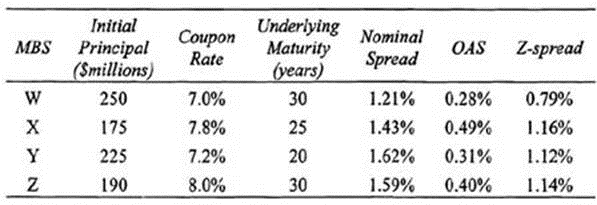
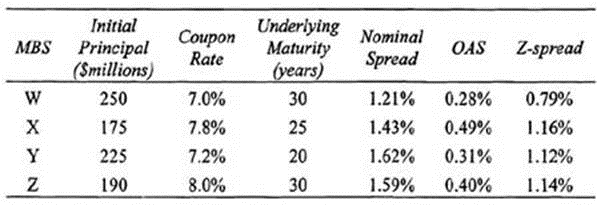
Christopher Robinson, chairman of the board of directors for a private endowment fund, believes that the endowment fund for which he is responsible has diverged too far from its stated objectives. Over several years the board has increased the size of the fund's equity position beyond the stated limits of the investment policy statement. In an effort to realign the fund's investments, Robinson has elected to choose a mortgage-backed security (MBS) for inclusion in the endowment's portfolio. After surveying the MBS market, Robinson has selected four MBS securities to present as potential investments at the next investment committee meeting. Details on the selected MBS securities are presented below:

At the investment committee meeting, a fellow board member raises his concerns over the potential MBS investments stating, "While we all agree that the fixed-income proportion of the endowment is much too small, I am not sure the suggested MBS securities will fulfill the cash flow requirements of the endowment. What risks are we taking on by allocating a portion of the portfolio to these investments? We cannot afford to end up with a timing mismatch between the cash needs of the endowment and the cash provided from its investments. Also, we have given no consideration to commercial mortgage backed securities (CMBS). Isn't our analysis incomplete if we fail to give proper discussion of potential CMBS investment opportunities?"

Robinson responded to his fellow board member by addressing the board member's concerns as follows:

"Since the cash requirements of the endowment fund fluctuate directly with interest rates, the cash flows provided from the MBS will provide adequate protection against cash shortfalls arising from differences in the timing of cash needs and cash sources. In addition, we can further reduce uncertainty surrounding the timing of cash flows by purchasing planned amortization class CMOs, which are securities issued against pools of MBS. CMBS were not presented due to the unacceptable risk profile of the comparable CMBS trading in the marketplace."

Assuming that the outstanding principal of MBS-Z is $183 million at the beginning of Month 20 and the total mortgage principal payment for the month is $0.42 million, the expected prepayment for Month 20 using 125 PSA is closest to:

Correct Answer: B. $0,785 million.
Explanation:

First, calculate the SMM at 125 PSA: = l-(l-0.05 =0.0043

Then use the following equation to find the prepayment amount for the current month:

prepaymen = SS x (beginning mortgage balanc - scheduled principal payment()

0.0043 x ($183 - $0.42) = $0.785 million

(Study Session 15, LOS 55.c)


Question 12

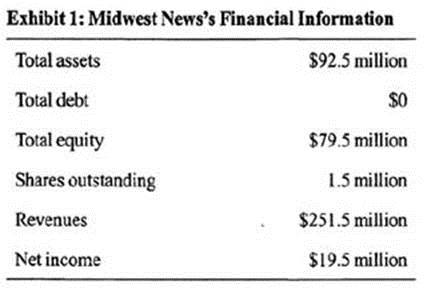
Sentinel News is a publisher of over 100 newspapers around the country, with the exception of the Midwestern states. The company's CFO, Harry Miller, has been reviewing a number of potential candidates (both public and private companies) that would provide Sentinel News entrance into the Midwestern market. Recently, the founder of Midwest News, a private newspaper company, passed away. The founder's family members are inclined to sell their 80% controlling interest. The family members are concerned that Midwest News's declining newspaper circulation is not cyclical, but rather permanent. The family members would reinvest the cash proceeds from the sale of Midwest News into a diversified portfolio of stocks and bonds. Miller's staff collects the financial information shown in Exhibit 1.

Miller noted that Midwest News does not pay a dividend, nor does the company have any debt. The most comparable publicly traded stock is Freedom Corporation. Freedom, however, has significant radio and television operations. Freedom's estimated beta is 0.90, and 40% of the company's capital structure is debt. Freedom is expected to maintain a payout ratio of 40%. Analysts are forecasting the company will earn S3.00 per share next year and grow their earnings by 6% per year. Freedom has a current market capitalization of S15 billion and 375 million shares outstanding. Freedom's current market value equals its intrinsic value.

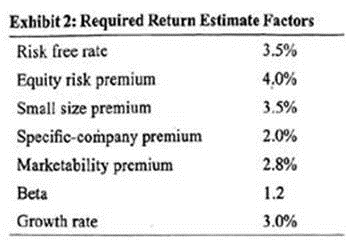
Miller's staff uses current expectations to develop the appropriate equity risk premium for Midwest News. The staff uses the Gordon growth model (GGM) to estimate Midwest's equity risk premium. The equity risk premium calculated by the staff is provided in Exhibit 2.

Miller believes the best method to estimate the required return on equity Midwest News is the build-up method. All relevant information to determine Midwest News's required relurn on equity is presented in Exhibit 2.

The specific-company premium reflects concerns about future industry performance and business risk in Midwest News. Miller makes two statements concerning the valuation methodology used to value Midwest News's equity.

Statement I: The required return estimate that is calculated from Exhibit 2 reflects all adjustments needed to make an accurate valuation of Midwest News.

Statement 2: It is better to use the free cash flow model to value Midwest News than a dividend discount model.

Miller considered two different valuation models to determine the price of Midwest News's equity: a single-stage free cash flow model and a single-stage residual income model.

Using Freedom Corporation as a comparable, the estimated beta for Midwest News is most likely:

Correct Answer: B. less than 0.90.
Explanation:

The calculation is not required if you understand the steps involved. Since Midwest News has no debt and Freedom's beta must be unlevered, the beta to be used must be less than 0.90 (Freedom's beta). (Study Session 10, LOS 35.e)


Question 13

Christopher Robinson, chairman of the board of directors for a private endowment fund, believes that the endowment fund for which he is responsible has diverged too far from its stated objectives. Over several years the board has increased the size of the fund's equity position beyond the stated limits of the investment policy statement. In an effort to realign the fund's investments, Robinson has elected to choose a mortgage-backed security (MBS) for inclusion in the endowment's portfolio. After surveying the MBS market, Robinson has selected four MBS securities to present as potential investments at the next investment committee meeting. Details on the selected MBS securities are presented below:

At the investment committee meeting, a fellow board member raises his concerns over the potential MBS investments stating, "While we all agree that the fixed-income proportion of the endowment is much too small, I am not sure the suggested MBS securities will fulfill the cash flow requirements of the endowment. What risks are we taking on by allocating a portion of the portfolio to these investments? We cannot afford to end up with a timing mismatch between the cash needs of the endowment and the cash provided from its investments. Also, we have given no consideration to commercial mortgage backed securities (CMBS). Isn't our analysis incomplete if we fail to give proper discussion of potential CMBS investment opportunities?"

Robinson responded to his fellow board member by addressing the board member's concerns as follows:

"Since the cash requirements of the endowment fund fluctuate directly with interest rates, the cash flows provided from the MBS will provide adequate protection against cash shortfalls arising from differences in the timing of cash needs and cash sources. In addition, we can further reduce uncertainty surrounding the timing of cash flows by purchasing planned amortization class CMOs, which are securities issued against pools of MBS. CMBS were not presented due to the unacceptable risk profile of the comparable CMBS trading in the marketplace."

Which of the following factors would most likely increase the rate of prepayments on any of the listed MBS securities?

Correct Answer: B. Annualized GDP growth, on an inflation adjusted basis, increases from last year.
Explanation:

Increased economic growth increases incomes and worker migration. In turn, higher incomes will lead some households to purchase more expensive houses. Workers who migrate to a new location because of increased job opportunities will also repay mortgages when they sell their homes. If the Fed increases reserve requirements, interest rates will increase as a result of the restrictive monetary policy and prepayments will decrease. If interest rates hit a low point a second time, prepayments will occur but at a significantly lower rate than when the first interest rate low occurred. (Study Session 15> LOS 55-0


Question 14

The New York-based Irwin Goldreich Schmidt (IGS) is a mid-sized private equity firm with $300 million capital raised from its investors. Amid a turbulent year, the firm has recently dropped its unsuccessful $100 million bid for a Norwegian media company and is now aggressively searching for new venture or buyout investments in the Eurozone. After several months of intense search IGS believes it identified two potential investments:

1. Sverig, a rapidly expanding Swedish start-up construction company.

2. L'Offre, a struggling French department store in existence since the late 19th Century.

Following several rounds of successful negotiations, IGS makes a $20 million investment in Sverig and a $100 million leveraged buyout investment in L'Offre, committing to an additional $100 million for possible future capital drawdowns. It retains all of Sverig's managers but replaces L'Offre's management team with experienced IGS managers, many of whom are former company senior executives.

IGS also sets up Sverig-L'Offre Private Equity Fund (SLPEF), a fund to manage both firms. The fund manager's compensation is set at 20% of profits net of fees. IGS also specifies that the manager's profits are calculated on the entire portfolio when portfolio value exceeds invested capital by 30%.

Despite the market's recent turbulence, Sverig's original founders are extremely optimistic and believe the firm could be sold for $400 million in six years. To achieve this, they speculate the firm needs another capital infusion of $40 million in four years in addition to the $20 million capital investment today. Given the high risk of the firm, SLPEFs private equity investors decide that a discount rate of 40% for the first four years and 30% for the last two years is appropriate. The founders of Sverig want to hold 5 million shares.

SLPEF's general partner's (GP's) share of fund profits, and management's right to buy an equity stake in the private equity firms, respectively, are called:

Profits to the GP Management's right to buy an equity stake

Correct Answer: C. Carried interest Tag-along, drag-along clause
Explanation:

The GP's share in profits is referred to as carried interest and is generally set at 20% of net profits after fees. A tag-along, drag-along clause would give management the right to buy an equity stake upon sale by the private equity owners.

Ratchet specifies the equity allocation between the limited partners (LPs) and management. Distribution waterfall specifies how profits will flow to the LPs and also the conditions under which the GP may receive carried interest. (Study Session 13, LOS 47.b)


Question 15

Maria Harris is a CFA Level 3 candidate and portfolio manager for Islandwide Hedge Fund. Harris is commonly involved in complex trading strategies on behalf of Islandwide and maintains a significant relationship with Quadrangle Brokers, which provides portfolio analysis tools to Harris. Recent market volatility has led Islandwide to incur record-high trading volume and commissions with Quadrangle for the quarter. In appreciation of Islandwide's business, Quadrangle offers Harris an all-expenses-paid week of golf at Pebble Beach for her and her husband. Harris discloses the offer to her supervisor and compliance officer and, based on their approval, accepts the trip.

Harris has lunch that day with C. K. Swamy, CFA, her old college roommate and future sister-in-law. While Harris is sitting in the restaurant waiting for Swamy to arrive, Harris overhears a conversation between the president and chief financial officer (CFO) of Progressive Industries. The president informs the CFO that Progressive's board of directors has just approved dropping the company's cash dividend, despite its record of paying dividends for the past 46 quarters. The company plans to announce this information in about a week. Harris owns Progressive's common stock and immediately calls her broker to sell her shares in anticipation of a price decline.

Swamy recently joined Dillon Associates, an investment advisory firm. Swamy plans to continue serving on the board of directors of Landmark Enterprises, a private company owned by her brother-in-law, for which she receives $2,000 annually. Swamy also serves as an unpaid advisor to the local symphony on investing their large endowment and receives four season tickets to the symphony performances.

After lunch, Alice Adams, a client, offers Harris a 1 -week cruise as a reward for the great performance of her account over the previous quarter. Bert Baker, also a client, has offered Harris two airplane tickets to Hawaii if his account beats its benchmark by more than 2% over the following year.

Juliann Clark, a CFA candidate, is an analyst at Dillon Associates and a colleague of Swamy's. Clark participates in a conference call for several analysts in which the chief executive officer at Dex says his company's board of directors has just accepted a tender offer from Monolith Chemicals to buy Dex at a 40% premium over the market price. Clark contacts a friend and relates the information about Dex and Monolith. The friend promptly contacts her broker and buys 2,000 shares of Dex's stock.

Ed Michaels, CFA, is director of trading at Quadrangle Brokers. Michaels has recently implemented a buy program for a client. This buy program has driven up the price of a small-cap stock, in which Islandwide owns shares, by approximately 5% because the orders were large in relation to the average daily trading volume of the stock. Michaels' firm is about to bring shares of an OTC firm to market in an

IPO. Michaels has publicly announced that, as a market maker in the shares, his trading desk will create additional liquidity in the stock over its first 90 days of trading by committing to minimum bids and offers of 5,000 shares and to a maximum spread of one-eighth.

Carl Park, CFA, is a retail broker with Quadrangle and has been allocated 5,000 shares of an oversubscribed IPO. One of his clients has been complaining about the execution price of a trade Park made for her last month, but Park knows from researching it that the trade received the best possible execution. In order to calm the client down. Park increases her allocation of shares in the IPO above what it would be if he allocated them to all suitable client accounts based on account size. He allocates a pro rata portion of the remaining shares to a trust account held at his firm for which his brother-in-law is the primary beneficiary.

According to Standard IV Duties to Employers, which of the following is most likely required of Swamy? Swamy must:

Which action by Park violated Standard III(B) Duties to Clients: Fair Dealing?

Correct Answer: C. Both actions are violations.
Explanation:

Standard III(B) Fair Dealing requires that shares of an oversubscribed IPO be prorated fairly to all subscribers. Arbitrarily increasing the allocation to the 'problem client' is a violation, as is the resulting underallocation to the remainder of the firm's clients. (Study Session 1, LOS 2.a)