
Question 1
How would the cost of recycling scrap be classified in an environmental costing system?
Correct Answer:
A. Environmental internal failure cost
How would the cost of recycling scrap be classified in an environmental costing system?
'A zero-based budgeting system involves establishing decision packages that are then ranked in order of their relative importance in meeting the organization's objectives'.
Which of the following is true regardinghe difficulties that a not-for-profit organization may experience when trying to rank decision packages.
Select ALL true statements.
References:
A company is considering whether to develop an overseas market for its products. The cost of developing the new market is estimated to be $250,000. There is a 70% probability that the development of the new market will succeed and a 30% probability that the development of the new market will fail and no further expenditure will be incurred.
If the market development is successful, the profit from the new market will depend on prevailing exchange rates. There is a 50% chance that exchange rates will be in line with expectations and a profit of $500,000 will be made. There is a 20% chance that exchange rates will be favorable and a profit of $630,000 will be made and a 30% chance that exchange rates will be adverse and a profit of $100,000 will be made.
The profit figures stated are before taking account of the development costs of $250,000.
Use a decision tree to decidewhether the company should develop an overseas market for its products.
Select one correct answer.
References:
A company is launching a new product.
The company accountant has constructed a payoff table to show the estimated profit at different levels of production and demand.
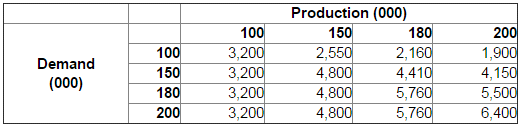
How many units should the company produce if the minimax regret criterion is applied?
GP is launching a new product. The annual forecast costs are as follows:
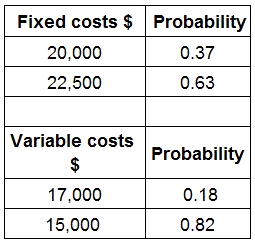
What is the expected value of the total costs?
Give your answer to the nearest whole $.
JL is preparing its cash budget for the next three quarters. The following data have
been extracted from the operational budgets:
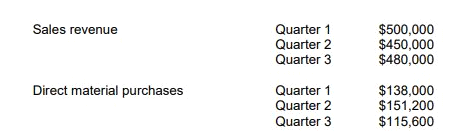
Additional information is available as follows:
* JL sells 20% of its goods for cash. Of the remaining sales value, 70% is received within the same quarter as sale and 30% is received in the following quarter. It is estimated that trade receivables will be $125,000 at the beginning of Quarter 1. No bad debts are anticipated.
* 50% of payments for direct material purchases are made in the quarter of purchase, with the remaining 50% in the quarter following purchase. It is estimated that the amount owing for direct material purchases will be $60,000 at the beginning of Quarter 1.
* JL pays labour and overhead costs when they are incurred. It has been estimated that labour and overhead costs in total will be $303,600 per quarter. This figure includes depreciation of $19,600.
* JL expects to repay a loan of $100,000 in Quarter 3.
* The cash balance at the beginning of Quarter 1 is estimated to be $49,400 positive.
Required:
Prepare a cash budget for each of the THREE quarters.
What will the closing balance of cash flows in quarter THREE be?
References:
GH manufactures a product using skilled labour and high quality materials. The company operates a standard costing system and a just-in-time (JIT) purchasing and production system. The standard selling price and variable costs for one unit of the product are as follows:
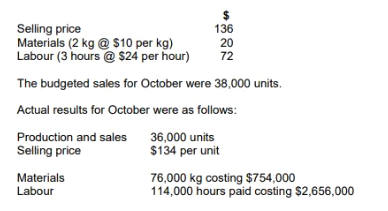
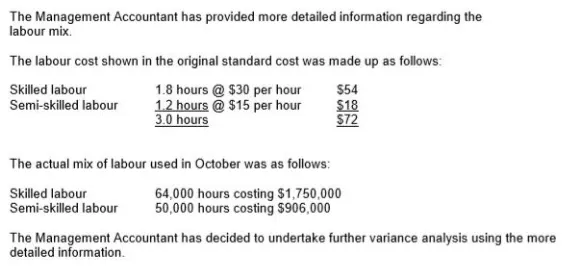
Calculate the following variances for October, taking account of the more detailed information regarding the labour mix:
(i) The total labour efficiency variance
(ii) The total labour mix variance
(iii) The total labour yield variance
Select the correct statements.
References:
PQR has recently introduced an activity-based costing system.
It manufactures three products, details of which are given below.
The budgeted production overhead costs for the year are shown in table below:
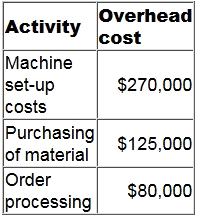
What is budgeted machine set-up cost per unit of Product J?
Give your answer to the nearest cent.
A manufacturing company is preparing the production budget for the forthcoming year.
The following budgeted information has already been obtained:
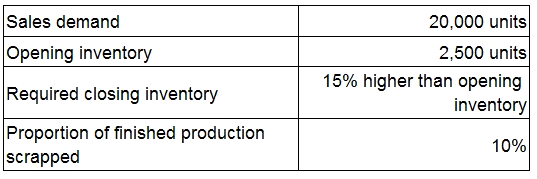
How many units will need to be produced for the forthcoming year?
Give your answer to the nearest whole number.
The term 'budgetary slack' refers to the:
References:
For the past year a manufacturing company has recorded the number of units produced (x) each week and the total production cost (y) for that week. The company intends to use this data to predict future costs.
For the circumstance described above, linear regression is more useful and accurate than the high-low method because:
1. It uses all the sets of data observed to calculate the line of best fit.
2. The coefficient of variation can estimate what percentage of x is due to a change in y.
3. Forecasts remain valid for values for x outside of the observed range.
Which of the above statements are true?
A company uses an activity based costing system. The company manufactures three products, details of which are given below:

References:
Which THREE of the following statements relating to fixed overhead variances are correct?
Which of the following managers is most likely to be responsible for an favourable labour efficiency variance?
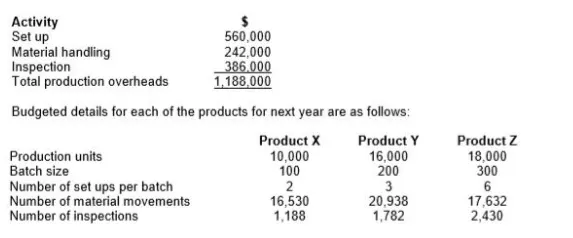
EF manufactures and sells three products, X, Y and Z. The following production overhead costs are budgeted for next year:
Required:
Calculate the total budgeted production overhead cost for each product using activity based budgeting.
References: