Limited-Time Offer: Enjoy 50% Savings! Ends in 00h 00m 00s Coupon code: 50OFF
Skip to content

Free CIMA P2 Advanced Management Accounting CIMAPRO19-P02-1 Exam Questions

Page: 1 / 14 Total 202 questions

Want more questions? Get Premium Access.

Question 1

K Supermarket spends $80,000 per year on checking and processing receipts of inventory. Annual warehouse costs are a further $70,000 per year. These costs are currently treated as fixed overheads in the company's costing system.

As an experiment, the company is preparing a direct profitability analysis of a small range of products, including fresh grapes.

K Supermarket receives a total of 3,600 deliveries every year. 20% of these deliveries are of perishable goods such as grapes. It takes twice as long to process a delivery of perishable goods compared to a normal delivery because perishable goods have to be checked more carefully.

Half of the warehouse costs are for the chilled store that is used to store perishable goods. At any time, the chilled store has 800 kilos of perishable goods in stock.

K Supermarket receives 150 deliveries of grapes every year. Each delivery is for 100 kilos of grapes. The grapes spend an average of two days in the chilled store before they are sold.

Calculate the total cost per kilo of checking, processing and storing grapes that should be taken into account in determining the profitability of grapes.

Give your answer to the nearest whole cent.
Correct Answer: A. 61 cents

Question 2

Which of the following statements are correct with regard to responsibility centres?

Select ALL that apply.

Correct Answer: A. Revenue centre managers have a lower level of decision-making authority than profit centre managers.; C. Profit centre managers and investment centre managers are responsible for the majority of operating costs incurred.; D. Investment centre managers have a higher level of managerial authority than profit centre managers.

Question 3

A company is considering investing $680,000 in a machine to manufacture a new product. A consultant has been appointed to advise on the investment and the company is committed to paying $10,000 to the consultant in year 1, even if the project does not go ahead.

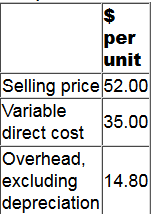
300,000 units of the new product will be produced and sold each year. Unit cost and revenue information based on this level of output is as follows.

60% of the overhead cost is variable. Of the remainder, 10% consists of allocated head office overheads.

The selling price will increase by 2% each year in line with inflation, beginning in year 2. Fixed price contracts mean that all unit costs will remain unaltered.

Taxation information:

* 100% first year allowance will be available for the purchase of the machinery.

* The taxation rate is 30% of taxable profits, payable in the year after that in which the liability arises.

For the purpose of deciding whether to proceed with the investment, what is the relevant cash flow in year 2?

Correct Answer: A. $1,102,320

Question 4

A company comprises several divisions.

One of these divisions was originally expected to earn an operating profit next year of $800,000 on net assets of $4 million.

However, the divisional manager is considering investing in a project that would generate a project return on investment (ROI) of 38% on additional net assets of $500,000.

What would be the divisional ROI next year if the project was implemented?

Give your answer to the nearest percentage.

Correct Answer: A. 22 %

Question 5

A positive net present value (NPV) has been calculated for a project to launch a new product. An additional calculation is required to identify the sensitivity of the NPV to changes in the forecast total sales volume.

The present value of which of the following would be used in the calculation?

Correct Answer: A. Contribution

Question 6

A company is comprised of two divisions, each of which manufactures a single product. Division A manufactures a product which can be sold in a perfect external market or transferred as an intermediate product to division B. Division B finishes the intermediate product and sells this in a perfect external market.

Due to company policy, internal transfers are recorded at the external market price. At this transfer price both divisions make a profit from their activities.

Which of the following will NOT be achieved by the company's transfer pricing policy?

Correct Answer: A. Divisional autonomy

Question 7

An investment centre is appraising a potential project that is expected to yield a Return on Investment (ROI) of 12%.

Without the project the investment centre expects to earn an ROI of 14%. The cost of capital is 10%.

What would be the impact on the investment centre's performance measures if the project is accepted?

Correct Answer: D. Residual Income would increase and ROI would decrease.

Question 8

A company's competitor has just launched a rival product at a selling price of $38 per unit. Until now the company's selling price of $41.60 per unit has achieved a 30% mark-up on the product's unit cost. The company proposes to use a target costing approach to pricing to remain competitive.

Management has decided to match the competitor's selling price and has set a target cost to achieve a 20% return on the target price.

What is the cost gap?

Correct Answer: A. $1.60

Question 9

SDF makes cars. Demand for one of SDF's most popular models has declined because of a long-running television program. SDF's car is driven by a villainous character in the program and that has created such a negative association that sales have declined so significantly that SDF is planning to discontinue production.

Which of the following statements is correct? Select ALL that apply.

Correct Answer: A. Business risks can arise from unexpected events.; B. The use of a product in a television program can create upside risks.; C. SDF should have considered the possibility that sales of this car could be affected by public perception, even though the car's practical attributes are unchanged.

Question 10

The performance report for the production manager of a company for the last month included the following.

1,000 direct labor hours were worked at a basic rate of pay of $10 per hour. 200 of these hours were worked during overtime for which a 30% overtime premium was paid. 80 of these overtime hours were to fulfill a customer order that had originally been planned for manufacture next month. The sales manager had agreed to bring forward the delivery of this order at the request of the customer. The remaining overtime hours were due to unexpected inefficiency of the workforce; this has been traced to poor supervision by a junior manager.

Material costs included the following:

$5,300 of material

Correct Answer: A, A

Question 11

A new product is being manufactured for the first time. The first unit required 600 minutes of labor to manufacture. It is expected that there will be a 90% learning curve for the first 20 units.

The learning index for a 90% learning curve is - 0.152.

Calculate the expected labor time to manufacture the 10th unit.

Your answer should be given to the nearest whole minute.

Correct Answer: A. 360 minutes, 361 minutes, 362 minutes

Question 12

The Chief Executive of a large manufacturing company has made the following comment.

"All of our competitors are using both just-in-time(JIT) and Total Quality Management (TQM) whereas we have never used either. Consequently we are lagging behind our competitors because their levels of inventory and quality costs are significantly below ours. I want to see JIT fully implemented, both for purchasing and for production, in 4 weeks' time and TQM fully implemented 4 weeks after that."

Which of the following provide appropriate advice to the Chief Executive?

Select ALL that apply.

Correct Answer: A. Full implementation of JIT is unlikely to be successful unless a TQM environment has first been established.; D. JIT offers the long run prospect of significantly reducing inventory.; E. It would be possible to implement TQM without implementing JIT.

Question 13

$30.328 million is to be invested in a project that will yield annual net cash inflows of $8 million for 5 years.

What is the project's internal rate of return (IRR)?

Give your answer to the nearest whole percentage.

Correct Answer: A. 9 %, 10 %, 11 %

Question 14

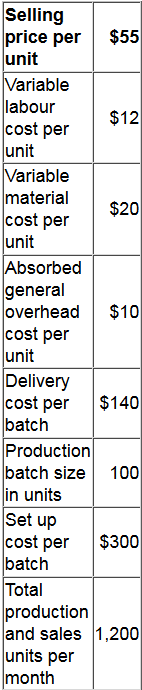
A large manufacturing company sells a range of products. Details of one of these products are as follows.

Each completed batch is delivered immediately in full to the one customer that purchases this product. The delivery vehicle is currently only 50% full when it makes these deliveries. The customer will accept deliveries of any size.

Managers are considering changing the production batch size to 150 units.

Increased material storage would be needed; this can be rented nearby at a cost of $1,500 per month.

The additional storage facility would enable an increase in the reorder quantity for the materials. As a result a 5% discount would be received on all materials purchased.

Using direct product profitability (DPP), what will be the monthly profit attributable to the product if the production batch size is changed to 150 units?

Give your answer to the nearest whole $.

Correct Answer: A. $23780

Question 15

The net present value of the cost of operating a machine for the next 4 years is 6,340. The discount rate used is 10%.

What is the equivalent annual cost and the present value of the cost in perpetuity of operating this machine?

Use discount factors to 3 decimal places.

Correct Answer: C. Equivalent annual cost = 2,000 Present value of cost in perpetuity = 20,000