Limited-Time Offer: Enjoy 50% Savings! Coupon code: 50OFF Use it at checkout
Skip to content

Free CIPS Innovation in Procurement and Supply L6M8 Exam Questions

Page: 1 / 12 Total 120 questions

Want more questions? Get Premium Access.

Question 1

Swift Manufacturing is currently seeking new suppliers to create a new product that will be launched next year. They are keen to enter a new market and expand their customer base and ensure the new product provides value for money to the customer. The procurement department is currently conducting market research which will inform upon possible designs for the new product.

Simultaneously they are also speaking with suppliers regarding the specification. Swift Manufacturing are keen to ensure the new product is as environmentally friendly as possible, so are researching different raw materials that can be used and their impact upon the environment.

When designing the tender process, Swift Manufacturing would like the successful supplier to have an environmental management system in place and will incorporate this as part of the 'essential criteria' of the specification and tested on the PQQ stage of the tender.

It is important for the CEO of Swift Manufacturing that the supplier hits the ground running on this contract as soon as it is signed, given the importance of the new product to the organisation's competitive advantage strategy. He is therefore keen to ensure that the procurement department include strict performance targets within the contract.

What approach is being taken with regards to the writing of the specification?

Correct Answer: C. ESI
Explanation:

This is ESI- Early Supplier Involvement. We know this because they are being engaged before the specification is written. See LO 1.2 if you're unsure on the difference between ESI, innovation councils and supplier forums. Concurrent engineering is from LO1.1

Domain: Scenario

Question 2

Francis is a Procurement Manager at XYZ Ltd. He has just been asked to join the company's Innovation Council. What is the main purpose of this group?

Correct Answer: D. maximising innovation through the supply chain
Explanation:

The correct answer is 4. An Innovation Council is a cross-functional team set up to co-ordinate and maximise innovation through the supply chain and organisation. This is from p.31. Option 1 is incorrect because an Innovation Council would have been signed off by Senior Leadership, meaning they don't need convincing of the importance of innovation (if senior leadership didn't care about innovation, they wouldn't have an Innovation Council in their organisation). Option 2 is incorrect because the organisation will already understand the benefits of innovation to have set up an Innovation Council. Option 3 is incorrect as integration can be both horizontal or vertical and the Innovation Council would support whichever form and level of integration best suits the organisation.

Domain: 1.2

Question 3

Company X is introducing a Joint Performance Appraisal system to use with Supplier Y. What are benefits this process could bring about for Company X? Select all that apply

Correct Answer: B. operational efficiency gains
Explanation:

The three benefits of this are 2, 3 and 4. This is from p.67 of the study guide. A Joint Performance Appraisal won't give better visibility over the supply chain as it only involves one supplier, you may have better visibility over them, but not over the whole supply chain. It also won't increase their dependency on you, it may affect the buyer-supplier relationship but not the power balance or dependency.

Domain: 1.4

Question 4

In order to achieve competitive advantage, it is important that an organisation with several suppliers asks all of its suppliers to innovate, as this will lead to new ideas and cost savings. Is this TRUE?

Correct Answer: C. no- only certain suppliers should be selected for this
Explanation:

3 is the correct response. You can't ask all suppliers to innovate- it's just not practical. You need to assess the relationship you have with the supplier, their ability to innovate and how well this would fit with your strategic objectives. For example an organisation may have a stationary supplier who provides pens for their offices. This supplier is not suitable for innovation. See p169 on 'selection'.

Domain: 2.3

Question 5

New product development is vital for organisations which operate in which type of marketplace?

Correct Answer: A. a marketplace with a high level of commoditisation
Explanation:

1 is the correct answer. From p. 18 "commoditisation of products, where competitors producing similar products and services and targeting the same customer base, means that new product development is necessary to ensure that the organisation is able to maintain competitive advantage". The other three options are incorrect- in a monopoly you're the only supplier so you don't have in innovate, similarly where there's low competitive rivalry; you don't have to make new products if you're not directly competing against others as you don't have to differentiate. If there are low barriers to exit, you don't have to develop new products as there is always an option to leave the marketplace rather than innovate.

Domain: 1.1

Question 6

Jonah is looking at the relationship his organisation has with various suppliers. He is keen to work with a supplier on an upcoming project which is of high risk and requires a high degree of supplier responsibility. For this he is looking to select the right supplier. What type of development is this?

Correct Answer: D. strategic development
Explanation:

Strategic Development is the correct answer. This questio n is based on Wynstra and Pierick's supplier involvement portfolio. High risk + high supplier responsibility = strategic. See p. 28-29 for the full matrix.

Domain: 1.2

Question 7

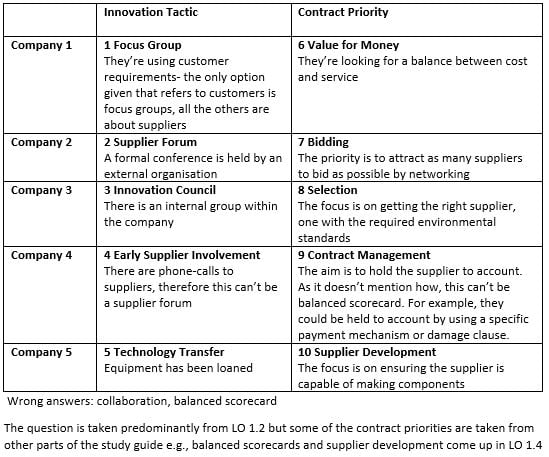
Below are details of 5 companies who are all embarking on the launch of a new product. For each company, you must decide which innovation tactic they are using and the priority for the new contract.

Company 1: The company aims to design the specification around customers' requirements. They are keen to ensure a balance between costs and the service provided.

Company 2: This company attends regular conferences held by a professional body and will use the information discussed to inform upon the specification. They are keen to ensure sufficient interest from the marketplace so are placing a priority on networking at the conferences.

Company 3: There is a small group of internal stakeholders who meet regularly at Company 3 who discuss supply chain and organisational integration. The priority for the group is to ensure that the supplier of the new product's raw materials meets the company's standards for environmental protection.

Company 4: This company has regular phone calls with suppliers discussing ideas for the new product. Once the product is launched, the focus will be on ensuring that the supplier is held to account.

Company 5: Equipment has been loaned to a supplier to produce a prototype of the new product. The aim of the project is to ensure the supplier is capable of producing the components required for the product before the contract is signed.

Complete the table below by listing the innovation tactic and contract priority for each company; focus group, innovation council, technology transfer, collaboration, supplier forum, early supplier involvement, supplier development, balanced scorecard, contract management, selection, value for money, bidding.

Which of the following will you put into box 3?

Correct Answer: B. innovation council
Explanation:

The correct answers are as follows:

Question 8

Below are details of 5 companies who are all embarking on the launch of a new product. For each company, you must decide which innovation tactic they are using and the priority for the new contract.

Company 1: The company aims to design the specification around customers' requirements. They are keen to ensure a balance between costs and the service provided.

Company 2: This company attends regular conferences held by a professional body and will use the information discussed to inform upon the specification. They are keen to ensure sufficient interest from the marketplace so are placing a priority on networking at the conferences.

Company 3: There is a small group of internal stakeholders who meet regularly at Company 3 who discuss supply chain and organisational integration. The priority for the group is to ensure that the supplier of the new product's raw materials meets the company's standards for environmental protection.

Company 4: This company has regular phone calls with suppliers discussing ideas for the new product. Once the product is launched, the focus will be on ensuring that the supplier is held to account.

Company 5: Equipment has been loaned to a supplier to produce a prototype of the new product. The aim of the project is to ensure the supplier is capable of producing the components required for the product before the contract is signed.

Complete the table below by listing the innovation tactic and contract priority for each company; focus group, innovation council, technology transfer, collaboration, supplier forum, early supplier involvement, supplier development, balanced scorecard, contract management, selection, value for money, bidding.

Which of the following will you put into box 10?

Correct Answer: A. supplier development
Explanation:

The correct answers are as follows:

Question 9

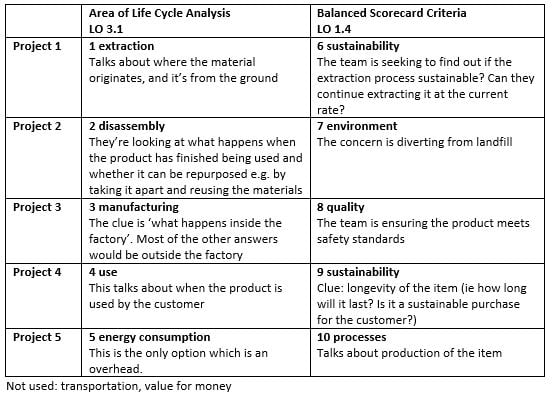
TGY Ltd is a manufacturing organisation which produces five major components for use in the transport sector. Each component is produced by a different Project Team. Below are details of the five projects.

Project 1: The team are looking at where the material originates and how much of this natural resource is left in the ground.

Project 2: The team are focused on what happens when the product is no longer required by the customer and whether the product can be repurposed to save it going to landfill.

Project 3: The team are keen to ensure the customer is happy with the product and that it meets safety standards. The focus of the Life Cycle Analysis is on what happens inside the factory.

Project 4: The team are looking at the longevity of the item once purchased by the customer.

Project 5: The team are exploring the additional overhead costs associated with the production of the item and the way in which the item is produced.

Complete the table below by listing the area of life cycle analysis being looked at, and the area of the Balanced Scorecard this relates to (some options may be used twice); energy consumption, use, disassembly, extraction, manufacturing, transportation, sustainability x2, quality, environment, value for money, processes.

Which of the following will you put into box 6?

Correct Answer: A. sustainability
Explanation:

The correct answers are as follows:

Question 10

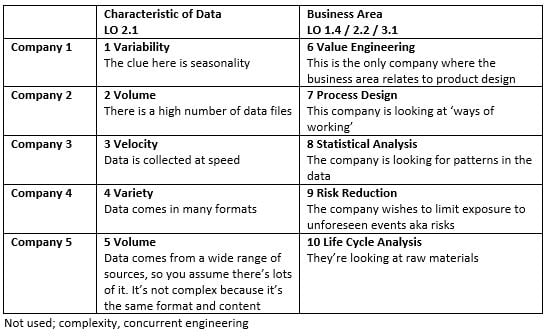
Below are details of five different companies and the data they collect. For each company, select the characteristic of the data collected and the business area it relates to.

Company 1: This company is collecting data which will assist in the designing of products- ensuring functionality at the lowest cost. The issue with the data is its seasonality.

Company 2: This company has a high number of data files. They are dismantling current ways of working to figure out if there is a more effective way to do things.

Company 3: Data collected by company 3 is collected at speed in real time. They are attempting to find any underlying patterns in the data to inform on better decision making.

Company 4: Company 4's objective is to reduce the risk of exposure of the company to unforeseen events. Data is being collected in many different formats.

Company 5: This data is similar in format and content but is collected from a wide range of sources. The data looks at the costs and implications of raw materials used in production.

Complete the table below by listing the characteristic of the data and the corresponding business area (some options may be used twice); volume (x2), variety, velocity, variability, complexity, concurrent engineering, process design, statistical analysis, life cycle analysis, risk reduction, value engineering.

Which of the following will you put into box 10?

Correct Answer: D. life cycle analysis
Explanation:

The correct answers are as follows: