Limited-Time Offer: Enjoy 50% Savings! Ends in 00h 00m 00s Coupon code: 50OFF
Skip to content

Free Cisco Certified Network Associate Exam 200-301 Exam Questions

Page: 1 / 83 Total 1243 questions

Want more questions? Get Premium Access.

Question 1

How do UTP and STP cables compare?

Correct Answer: D. STP cables are shielded and protect against electromagnetic interference and UTP lacks the same protection against electromagnetic interference.
Explanation:

STP cables are shielded and protect against electromagnetic interference and UTP lacks the same protection against electromagnetic interference.. Switching questions depend on MAC learning, VLAN membership, trunking, STP election, and EtherChannel behavior. Cisco CCNA 200-301 v1.1 includes this under Network Fundamentals, where the expected skill is selecting the feature that actually produces the requested network behavior. The wording normally gives the clue: protocol family, address scope, trunk state, route preference, security mode, API method, or controller role. Wrong answers misapply a Layer 2 rule or configure the wrong logical interface. In production, choosing the wrong option would typically cause failed client access, a broken route, insecure management, or an automation workflow that targets the wrong interface. The selected answer is the Cisco-consistent behavior for this item.
Question 2

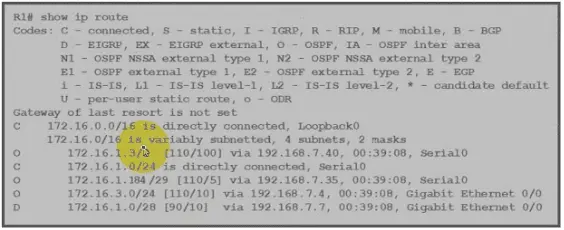
Refer to the exhibit.

Load-balanced traffic is coming in from the WAN destined to a host at 172.16.1.190. Which next-hop is used by the router to forward the request?

Correct Answer: B. 192.168.7.7
Explanation:

192.168.7.7. Cisco forwarding uses longest-prefix match first, then administrative distance and metric when multiple sources compete. Cisco CCNA 200-301 v1.1 includes this under IP Connectivity, where the expected skill is identifying the mechanism that actually satisfies the scenario. The wording usually gives the decisive clue: a protocol number, a route prefix, a control-plane role, a wireless security method, or a management command. Wrong choices either do not match the destination prefix, point to the wrong next hop, or fail to create the required primary or backup route. In a real network, selecting the wrong option would usually produce a failed adjacency, broken client connectivity, insecure management access, or an incorrect forwarding path. The selected answer matches the Cisco behavior and configuration model required by the question, so it is retained as the verified answer for this item.


Question 3

What is a function of an endpoint?

Correct Answer: A. It is used directly by an individual user to access network services
Explanation:

It is used directly by an individual user to access network services. Security questions require distinguishing authentication, authorization, encryption, secure management, malware protection, and physical controls. Cisco CCNA 200-301 v1.1 includes this under Network Fundamentals, where the expected skill is to identify the feature that actually creates the observed behavior or meets the configuration goal. The wording usually contains the decisive clue: a prefix length, a VLAN role, a protocol version, a wireless security standard, or a management-plane function. The wrong options apply the right security vocabulary to the wrong control or use weaker/deprecated protection. In an operational network, choosing the wrong option would typically cause failed connectivity, insecure management, poor wireless behavior, or incorrect forwarding. The selected answer matches the Cisco configuration model and is retained as the verified answer.


Question 4

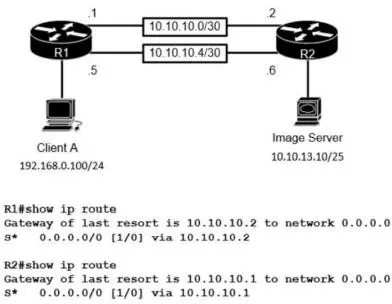
Refer to the exhibit.

The image server and client A are running an application that transfers an extremely high volume of data between the two. An engineer is configuring a dedicated circuit between R1 and R2. Which set of commands must the engineer apply to the routers so that only traffic between the image server and client A is forces to use the new circuit?

Correct Answer: D. R1(config)#ip route 10.10.13.10 255.255.255.255 10.10.10.2R2(config)#ip route 192.168.0.100 255.255.255.255 10.10.10.1
Explanation:

R1(config)#ip route 10.10.13.10 255.255.255.255 10.10.10.2R2(config)#ip route 192.168.0.100 255.255.255.255 10.10.10.1. Routing and redundancy questions are solved by applying longest-prefix match, administrative distance, metrics, and gateway-redundancy behavior in the correct order. Cisco CCNA 200-301 v1.1 includes this under IP Connectivity, where the expected skill is selecting the feature that actually produces the requested network behavior. The wording normally gives the clue: protocol family, address scope, trunk state, route preference, security mode, API method, or controller role. Incorrect choices point to the wrong next hop, choose the wrong route source, or confuse routing with Layer 2 behavior. In production, choosing the wrong option would typically cause failed client access, a broken route, insecure management, or an automation workflow that targets the wrong interface. The selected answer is the Cisco-consistent behavior for this item.

Question 5

What is the purpose of an SSID?

Correct Answer: D. It identifies a WLAN
Explanation:

It identifies a WLAN. Wireless operation depends on WLAN identity, AP mode, RF management, client authentication, and controller-based policy enforcement. Cisco CCNA 200-301 v1.1 includes this under Network Access, where the exam expects engineers to recognize the device behavior that actually produces the required outcome. The question is best solved by reading the operational clue rather than choosing a familiar acronym. The distractors confuse WLAN names, authentication, encryption, RF optimization, and controller management functions. In a production network, the wrong choice would normally create an outage, leave a management or security gap, or send troubleshooting toward the wrong subsystem. The selected answer is the one that matches the control-plane, data-plane, wireless, security, services, or automation mechanism described in the question. That is why it remains the verified answer for this item.


Question 6

Which two IPv6 addresses are used to provide connectivity between two routers on a shared link? (Choose two)

Correct Answer: B. 2001:701:1046:1111::1/64; D. 2002:5121:204b:1111::1/64
Explanation:

Answer B,D is correct: B. 2001:701:1046:1111::1/64; D. 2002:5121:204b:1111::1/64. For router-to-router IPv6 connectivity on a shared link, each router needs a usable unicast IPv6 address in the same link prefix. The global unicast-looking addresses in options B and D are the valid choices for that purpose. Multicast addresses such as FF02-based addresses identify groups, not individual router interfaces for normal source/destination connectivity. IPv4-mapped or malformed addresses do not meet the requirement. Cisco CCNA 200-301 v1.1 Network Fundamentals expects engineers to distinguish unicast, multicast, link-local, and special IPv6 address forms. A shared link between routers can use link-local addresses for some control-plane protocols, but for the addressing choices shown here, the usable unicast interface addresses are the correct selections. The corrected answer is B and D because those addresses can be assigned to router interfaces to support communication across the link.


Question 7

Which networking function occurs on the data plane?

Correct Answer: A. forwarding remote client/server traffic
Explanation:

forwarding remote client/server traffic. OSPF decisions depend on router IDs, area membership, matching timers, network type, interface state, and cost calculation rather than arbitrary route preference. Cisco CCNA 200-301 v1.1 includes this topic under Automation and Programmability, so the answer must be validated against normal Cisco device behavior and the operational wording of the scenario. The key is not simply recognizing a familiar acronym; it is identifying what the feature does, where it is configured, and what result it produces. Distractors that mention process IDs, unrelated metrics, or the wrong interface parameter do not satisfy OSPF neighbor or route-selection requirements. In a real network, selecting the wrong option would either leave the feature nonfunctional, create a forwarding or security gap, or send troubleshooting in the wrong direction. The selected answer is the only one that matches the stated requirement and the way Cisco switching, routing, services, security, wireless, or automation functions are expected to operate. This is why the verified answer remains the best technical choice for the question.


Question 8

In which way does a spine-and-leaf architecture allow for scalability in a network when additional access ports are required?

Correct Answer: D. A leaf switch is added with connections to every spine switch.
Explanation:

A leaf switch is added with connections to every spine switch.. Layer 2 switching behavior is driven by VLAN membership, MAC learning, trunk encapsulation, STP state, and EtherChannel negotiation. Cisco switches learn source MAC addresses on ingress, flood unknown unicasts within the same VLAN, and forward known unicasts only out the port associated with the destination MAC address. Trunk and EtherChannel questions must be solved on the logical interface and with the correct negotiation protocol: LACP uses active/passive, PAgP uses desirable/auto, and static mode uses on. STP and PortFast questions depend on whether the port is intended for an endpoint or part of the switched topology. The wrong choices usually apply the correct feature to the wrong port type or violate the required negotiation behavior. Cisco CCNA 200-301 v1.1 emphasizes these details because a single incorrect Layer 2 setting can create loops, VLAN leaks, or failed host connectivity. The selected answer matches Cisco switching operation.


Question 9

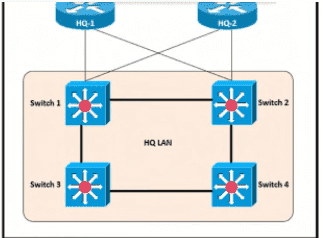
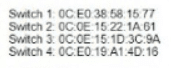
Refer to the exhibit.

After the election process what is the root bridge in the HQ LAN?

Correct Answer: C. Switch 3
Explanation:

The root bridge election is based on the lowest bridge ID. The bridge ID includes priority and MAC address, with priority compared first. If priority values are not provided or are equal, the lowest MAC address becomes the tie-breaker. In the HQ LAN exhibit, Switch 3 has the lowest bridge ID value after the election criteria are applied, so Switch 3 becomes the root bridge. Cisco CCNA 200-301 v1.1 Network Access tests this because STP root placement determines which switch becomes the logical center of the Layer 2 topology. Once the root is selected, all nonroot switches calculate their root ports and designated ports based on path cost and tie-breakers. The physical drawing position of a switch is irrelevant. The root is chosen by numerical bridge ID comparison. The correct answer is C.


Question 10

What is a DHCP client?

Correct Answer: B. a host that is configured to request an IP address automatically
Explanation:

A DHCP client is a host configured to request IP addressing information automatically. It sends DHCP messages to obtain an address lease and related options such as subnet mask, default gateway, DNS server, and lease duration. The server is the device that owns the address pool and assigns addresses. A workstation that requests a domain name for an IP address is using DNS behavior, not DHCP client behavior. A router can relay DHCP messages or host DHCP pools, but it is not described as a DHCP client unless its own interface is configured to obtain an address dynamically. Cisco CCNA 200-301 v1.1 IP Services expects candidates to separate DHCP client, DHCP server, and DHCP relay functions. In the DHCP exchange, the client initiates discovery because it needs configuration. Therefore, the correct definition is a host that is configured to request an IP address automatically.


Question 11

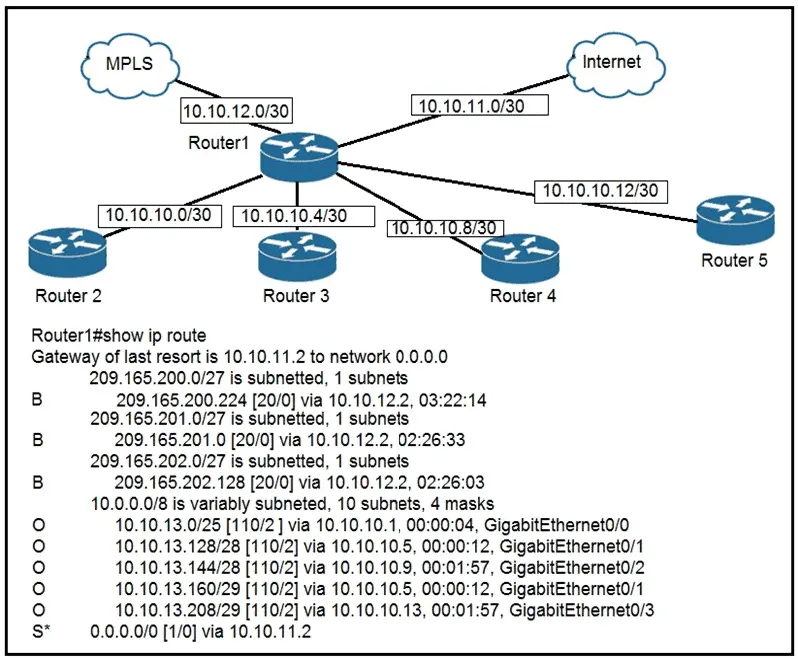
Refer to the exhibit.

To which device does Router1 send packets that are destined to host 10.10.13.165?

Correct Answer: B. Router3
Explanation:

Router3. The scenario should be solved by matching the described behavior to the Cisco feature that actually performs it. Cisco CCNA 200-301 v1.1 includes this topic under IP Connectivity, so the answer must be validated against normal Cisco device behavior and the operational wording of the scenario. The key is not simply recognizing a familiar acronym; it is identifying what the feature does, where it is configured, and what result it produces. The other options are real networking terms or plausible phrases, but they operate at a different layer, solve a different problem, or do not create the outcome described. In a real network, selecting the wrong option would either leave the feature nonfunctional, create a forwarding or security gap, or send troubleshooting in the wrong direction. The selected answer is the only one that matches the stated requirement and the way Cisco switching, routing, services, security, wireless, or automation functions are expected to operate. This is why the verified answer remains the best technical choice for the question.


Question 12

Which event has occurred if a router sends a notice level message to a syslog server?

Correct Answer: C. An interface line has changed status
Explanation:

An interface line has changed status. Cisco routing logic is deterministic: a router first matches the most specific destination prefix, then uses administrative distance when competing route sources advertise the same prefix, and finally evaluates the protocol metric when multiple paths remain inside the same routing protocol. First-hop redundancy protocols add a separate default-gateway resiliency function for hosts on a LAN. The other choices in this question either point to the wrong route-selection rule, confuse a protocol metric with administrative distance, or apply a Layer 2 concept where a Layer 3 forwarding decision is required. In production, that mistake would create blackholing, asymmetric routing, or a backup path that never activates. Cisco CCNA 200-301 v1.1 tests this because route selection is fundamental to troubleshooting reachability. The selected answer matches the behavior Cisco routers use when forwarding traffic or maintaining gateway redundancy.


Question 13

How does the dynamically-learned MAC address feature function?

Correct Answer: A. The CAM table is empty until ingress traffic arrives at each port
Explanation:

The CAM table is empty until ingress traffic arrives at each port. Automation questions require separating controller roles, API direction, data formats, HTTP behavior, and configuration-management tooling. Cisco CCNA 200-301 v1.1 includes this topic under Network Access, so the answer must be validated against normal Cisco device behavior and the operational wording of the scenario. The key is not simply recognizing a familiar acronym; it is identifying what the feature does, where it is configured, and what result it produces. The incorrect options mix northbound and southbound communication, confuse data serialization with transport, or describe traditional device-by-device management. In a real network, selecting the wrong option would either leave the feature nonfunctional, create a forwarding or security gap, or send troubleshooting in the wrong direction. The selected answer is the only one that matches the stated requirement and the way Cisco switching, routing, services, security, wireless, or automation functions are expected to operate. This is why the verified answer remains the best technical choice for the question.


Question 14

Which WAN topology provides a combination of simplicity quality, and availability?

Correct Answer: A. partial mesh
Explanation:

The verified answer is A. A partial-mesh WAN balances simplicity, link quality, and availability better than full mesh or pure hub-and-spoke. Critical sites can have direct redundant paths while less important sites avoid the cost and complexity of a full mesh. Cisco CCNA 200-301 v1.1 places this skill in Network Fundamentals, where the exam expects a working understanding of how the feature behaves on real Cisco networks, not just a memorized command. Point-to-point is simple but does not scale well, and hub-and-spoke can create a hub dependency. In production, this distinction matters because a misapplied command or design choice usually creates an outage, a security gap, or unnecessary troubleshooting noise. The correct choice matches the control-plane, data-plane, wireless, security, or services behaviour described in the scenario and should be preferred over options that merely sound related.


Question 15

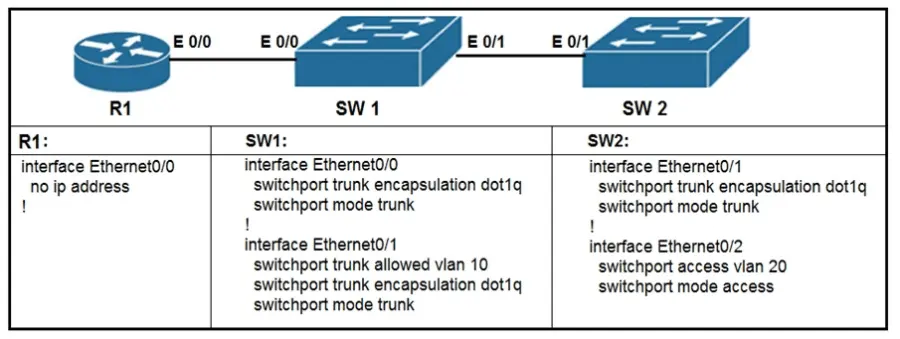
Refer to the exhibit.

What commands are needed to add a subinterface to Ethernet0/0 on R1 to allow for VLAN 20, with IP address 10.20.20.1/24?

Correct Answer: B. R1(config)#interface ethernet0/0.20R1(config)#encapsulation dot1q 20R1(config)#ip address 10.20.20.1 255.255.255.0
Explanation:

Router-on-a-stick inter-VLAN routing uses router subinterfaces, one logical subinterface per VLAN. For VLAN 20 on Ethernet0/0, the subinterface should be Ethernet0/0.20, followed by 802.1Q encapsulation for VLAN 20 and the gateway IP address for that VLAN. The physical interface normally remains without an IP address, while each subinterface receives its own VLAN-tagged configuration. The command encapsulation dot1q 20 tells the router to expect and send frames tagged for VLAN 20 on that subinterface. The IP address 10.20.20.1 255.255.255.0 then becomes the default gateway address for hosts in VLAN 20. Option A incorrectly configures encapsulation and IP addressing under the physical Ethernet0/0 interface. Option C misses the encapsulation command, so the router would not associate the subinterface with VLAN 20. Option D is only a plain routed interface configuration. Cisco CCNA 200-301 v1.1 includes this as a foundational VLAN routing pattern. The correct command set is option B.