Limited-Time Offer: Enjoy 50% Savings! Ends in 00h 00m 00s Coupon code: 50OFF
Skip to content

Free Cisco Conducting Forensic Analysis and Incident Response Using Cisco Technologies for Cybersecurity 300-215 Exam Questions

Page: 1 / 13 Total 184 questions

Want more questions? Get Premium Access.

Question 1

A cybersecurity analyst must evaluate files from an endpoint in an enterprise network. The antivirus software on the endpoint flagged a suspicious file during a routine scan On initial evaluation the file did not match any known signatures in the antivirus database, but exhibited unusual network behavior during dynamic analysis Which step should the analyst take next?

Correct Answer: A. Submit the file to a threat intelligence platform for further analysis and to identify potential lOCs.
Explanation:

Since the file did not match known signatures but exhibited unusual network behavior during dynamic analysis, the analyst should submit the file to threat intelligence feeds or malware repositories (such as VirusTotal) for further analysis. Alternatively, the analyst should escalate the file for advanced behavioral analysis or sandbox detonation to determine if it is a zero-day or variant malware. The next step could also involve reverse engineering the suspicious file to understand its functionality, or submitting it to the antivirus vendor for analysis if it represents a potential new threat. This approach helps identify emerging threats that traditional signature-based detection cannot catch.

Question 2

An analyst finds .xyz files of unknown origin that are large and undetected by antivirus. What action should be taken next?

Correct Answer: A. Isolate the files and perform a deeper heuristic analysis to detect potential unknown malware or data exfiltration payloads.
Explanation:

The safest and most effective approach is to isolate the files and subject them to heuristic and behavioral analysis. This can reveal obfuscated malware or unauthorized data storage techniques, even if signature-based antivirus fails to flag them.


Question 3

During a routine inspection of system logs, a security analyst notices an entry where Microsoft Word initiated a PowerShell command with encoded arguments. Given that the user's role does not involve scripting or advanced document processing, which action should the analyst take to analyze this output for potential indicators of compromise?

Correct Answer: D. Review the encoded PowerShell arguments to decode and determine the intent of the script.
Explanation:

According to the CyberOps Technologies (CBRFIR) 300-215 study guide curriculum, when analyzing suspicious behavior---especially when scripts or shell commands are executed from applications like Word (which is uncommon)---the encoded PowerShell payload must be decoded to determine if malicious intent is present. Deobfuscation is a critical step in identifying command-and-control behavior, persistence, or malware execution paths.

---


Question 4

An attacker embedded a macro within a word processing file opened by a user in an organization's legal department. The attacker used this technique to gain access to confidential financial data. Which two recommendations should a security expert make to mitigate this type of attack? (Choose two.)

Correct Answer: A. controlled folder access; C. signed macro requirements
Explanation:

To prevent macro-based attacks, the Cisco CyberOps study guide emphasizes the importance of limiting execution of unauthorized or unsigned macros. 'Requiring that all macros be digitally signed and limiting execution only to those that meet the required trust level is a key mitigation strategy against malicious macros.' Additionally, enabling features like Controlled Folder Access helps in protecting sensitive directories from unauthorized changes by untrusted applications, including those launched via malicious macros .

These two measures---enforcing signed macro policies and leveraging controlled folder access---directly help in mitigating the risk posed by embedded malicious macros in documents.


Question 5

A threat hunter must analyze the threat intelligence report on APT29 and identify whether the threat actor is on the Windows machines of the customer network. According to the report the user executes a malicious file on the victim machine that establishes a C? connection over port 53 Afterward, the attacker uses a CI.I to stage and exfiltrate business data. Which two types of logs enable the threat hunter to accomplish the task? (Choose two.)

Correct Answer: B. PowerShell togs; E. DNS logs

Question 6

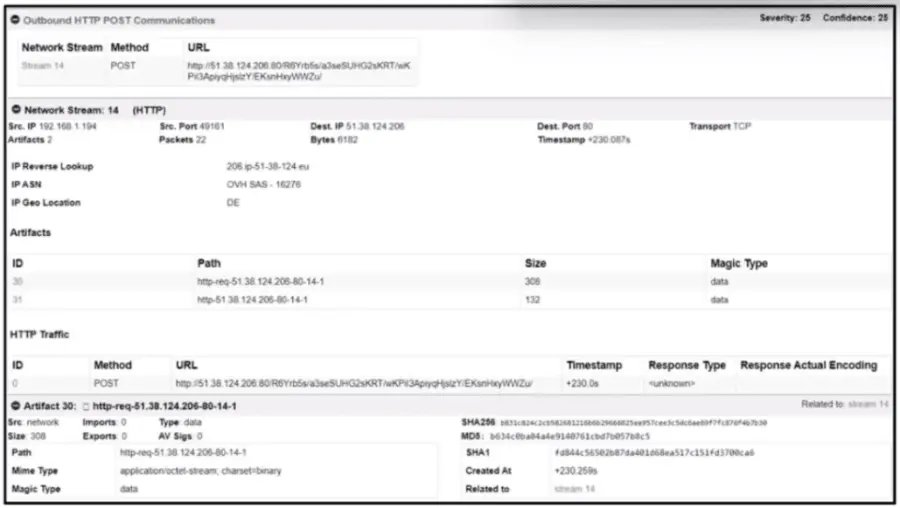
Refer to the exhibit.

Correct Answer: A. Destination IP 51.38.124.206 is identified as malicious
Explanation:

Comprehensive and Detailed

From the exhibit, Cisco Secure Malware Analytics (formerly Threat Grid) has captured outbound HTTP POST communication to the IP address 51.38.124.206 on port 80. This destination is highlighted in the analysis under ''Outbound HTTP POST Communications,'' indicating exfiltration behavior or command-and-control (C2) signaling.

Key indicators:

The report shows that binary data was POSTed to this IP.

The source system generated 22 packets and sent 6,192 bytes.

The system has flagged the behavior with a severity of 25 and confidence of 25---suggesting that this is an IoC worth acting on.

Therefore, the artifacts suggest that the destination IP 51.38.124.206 is involved in malicious activity, and the correct answer is:

Answe r: A . Destination IP 51.38.124.206 is identified as malicious.


Question 7

Refer to the exhibit.

What is occurring within the exhibit?

Correct Answer: B. Host 209.141.51.196 redirects the client request from /Lk9tdZ to /files/1.bin.
Explanation:

The Wireshark capture shows a series of HTTP requests and responses:

The client (10.1.21.101) sends a GET request for /Lk9tdZ.

The server (209.141.51.196) responds with HTTP/1.1 302 Found, which is a standard HTTP status code indicating a redirection.

The subsequent GET request from the client is for /files/1.bin, which indicates it followed the redirect.

This behavior confirms that the server is issuing an HTTP 302 redirect from the initial request path /Lk9tdZ to /files/1.bin. This is often observed in malware command-and-control behavior or file download staging.

Option A is incorrect: 302 is a status code, not a data size.

Option C is incorrect: port 49723 is a source/destination ephemeral port, not a redirect target.

Option D is incorrect: communication is over HTTP, not HTTPS (which would indicate encryption).


Question 8

What is an antiforensic technique to cover a digital footprint?

Correct Answer: B. obfuscation
Explanation:

Antiforensic techniques are methods attackers use to cover their tracks. According to the Cisco CyberOps curriculum, ''obfuscation'' refers to techniques such as encoding, encrypting, or otherwise disguising commands, payloads, or scripts to avoid detection and analysis. This is a standard antiforensic tactic used to prevent attribution and hinder forensic investigation.

Options like privilege escalation and authentication are part of attack vectors or access control and not antiforensic methods.


Question 9

A threat actor has successfully attacked an organization and gained access to confidential files on a laptop. What plan should the organization initiate to contain the attack and prevent it from spreading to other network devices?

Correct Answer: C. incident response
Explanation:

Once an incident has occurred, the appropriate course of action is to engage the organization's Incident Response (IR) plan. This is a structured approach to contain, analyze, and eradicate threats before they spread across the network.

The Cisco CyberOps Associate study guide emphasizes:

''Incident response and handling are essential within an organization... The main objective of implementing an incident handling process is to reduce the impact of a cyber-attack, ensure the damages caused are assessed, and implement recovery procedures''.

In particular, the containment phase of IR is focused on isolating the threat and preventing lateral movement or further compromise.

Options such as 'root cause' or 'attack surface' are relevant at later stages of analysis and mitigation, not immediate containment. Therefore, the correct answer is C.


Question 10

Refer to the exhibit.

An engineer received a ticket to analyze a recent breach on a company blog. Every time users visit the blog, they are greeted with a message box. The blog allows users to register, log in, create, and provide comments on various topics. Due to the legacy build of the application, it stores user information in the outdated MySQL database. What is the recommended action that an engineer should take?

Correct Answer: A. Validate input on arrival as strictly as possible.
Explanation:

The alert box in the screenshot ('HACKED BY 1337') is a classic sign of Cross-Site Scripting (XSS). This occurs when unvalidated input is executed as code in a browser.

To prevent this:

The Cisco CyberOps Associate guide recommends strict input validation as the primary defense against XSS and similar web-based injection attacks.


Question 11

What is a use of TCPdump?

Correct Answer: A. to analyze IP and other packets
Explanation:

TCPdump is a command-line packet analyzer used to capture and inspect network packets. As described in the study guide, 'tcpdump is a command-line interface tool that is used to capture packets on a network. It is a very powerful and popular network protocol analyzer'. The tool allows cybersecurity professionals to analyze headers and payloads of network traffic, making it valuable in forensic investigations and network diagnostics.


Question 12

A network host is infected with malware by an attacker who uses the host to make calls for files and shuttle traffic to bots. This attack went undetected and resulted in a significant loss. The organization wants to ensure this does not happen in the future and needs a security solution that will generate alerts when command and control communication from an infected device is detected. Which network security solution should be recommended?

Correct Answer: B. Cisco Secure Firewall Threat Defense (Firepower)
Explanation:

The Cisco Secure Firewall Threat Defense (Firepower) includes advanced capabilities such as intrusion prevention, URL filtering, and deep packet inspection. According to the CyberOps guide, it can detect and block C2 communications by analyzing traffic patterns and comparing them to threat intelligence data. The guide specifically states: 'Advanced solutions such as Firepower provide detection capabilities for command and control (C2) traffic by identifying unusual outbound connections and behavioral anomalies'.


Question 13

A scanner detected a malware-infected file on an endpoint that is attempting to beacon to an external site. An analyst has reviewed the IPS and SIEM logs but is unable to identify the file's behavior. Which logs should be reviewed next to evaluate this file further?

Correct Answer: C. Antivirus solution
Explanation:

If IPS and SIEM logs do not give enough insight into a file's behavior, the next logical step is to review the Antivirus solution logs. These logs often provide detailed behavior analytics such as:

File actions and access patterns

Registry modifications

File execution history

The Cisco CyberOps guide emphasizes AV logs as critical forensic artifacts for understanding endpoint-based infections, especially when beaconing or suspicious activity is suspected.


Question 14

What is the goal of an incident response plan?

Correct Answer: D. to contain an attack and prevent it from spreading
Explanation:

The goal of an incident response plan (IRP) is to provide structured procedures for responding to cybersecurity incidents in a way that limits damage, contains the threat, and ensures business continuity. As outlined in the NIST SP 800-61 and Cisco CyberOps Associate study guide, containment and minimizing the impact of incidents is the primary goal of an IRP.

---


Question 15

A security analyst receives a notification from SIEM that an internal host has active connections to Tor exit nodes. The analyst investigates SIEM events related to the workstation and identifies that the host scans networks for servers with an opened TCP port 1433 An antivirus scan of the workstation does not determine any suspicious activity Which two actions must the analyst take to mitigate this behavior? (Choose two.)

Correct Answer: A. Configure SIEM alert rules to perform quick response and mitigation; B. Block any connection to TCP port 1433 from external sources.