Limited-Time Offer: Enjoy 50% Savings! Ends in 00h 00m 00s Coupon code: 50OFF
Skip to content

Free Cisco Implementing Cisco Catalyst SD-WAN Solutions 300-415 Exam Questions

Page: 1 / 30 Total 446 questions

Want more questions? Get Premium Access.

Question 1

Refer to the exhibit.
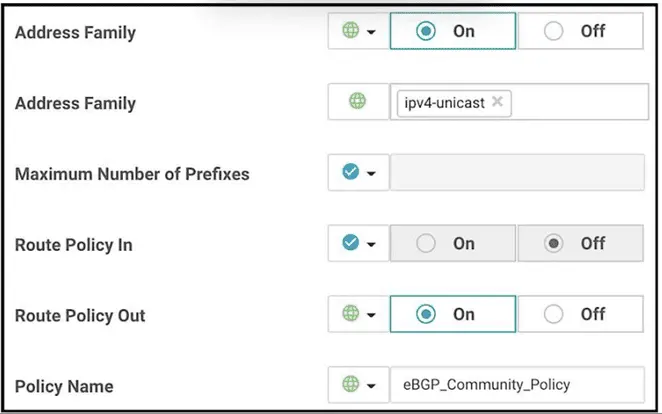
The engineer must assign community tags to 3 of its 74 critical server networks as soon as that are advertised to BGP peers. These server networks must not be advertised outside AS. Which configuration fulfill this requirement?

A)
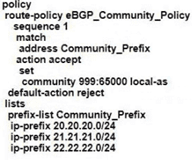
B)
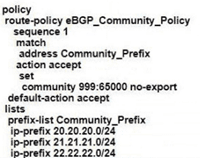
C)
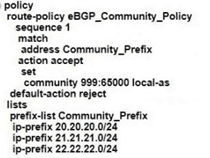
D)
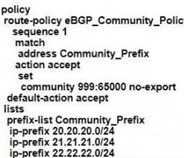
Correct Answer: D. Option D
Explanation:

To assign community tags to 3 critical server networks for BGP advertisement while preventing them from being advertised outside AS (Autonomous System), the configuration must:

  • Create Route Policies: Define route policies that match the 3 critical server networks
  • Assign Community Tags: Set BGP community tags on these routes using the route policy
  • Apply Export Policy: Use an export route policy to prevent these routes from leaving the AS by either not advertising to external peers or by filtering based on the community tags
  • Match Prefixes: Create a match clause that identifies the 3 server network prefixes (or their supernets)
  • Set Community Values: Apply appropriate BGP community values that identify these as internal-only routes

The correct configuration would show:

  • A route policy matching the 3 specific IPv4 prefixes
  • A set clause assigning one or more BGP community tags
  • An export policy that references these communities and restricts advertisement to external BGP peers

Without the specific options shown, this describes the structure needed to tag and locally contain the critical server networks within the AS.
Question 2

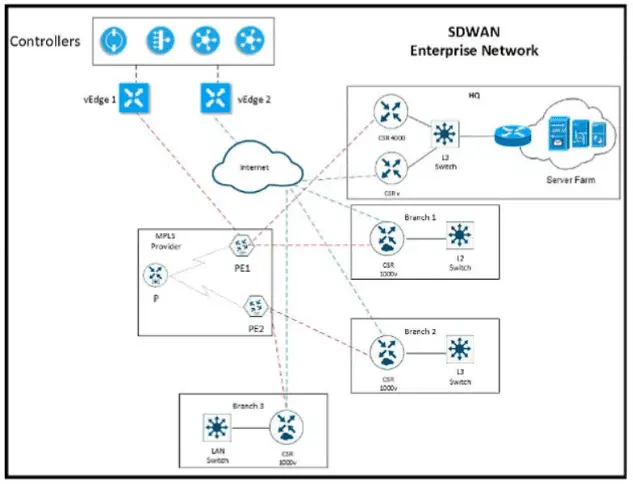
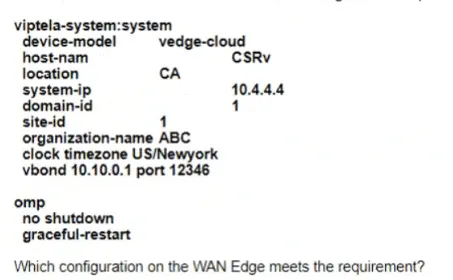
Refer to the exhibit.

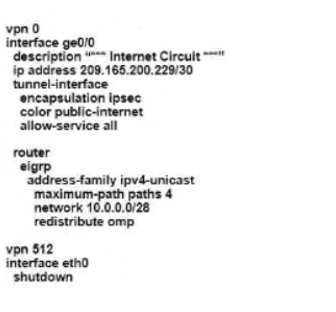
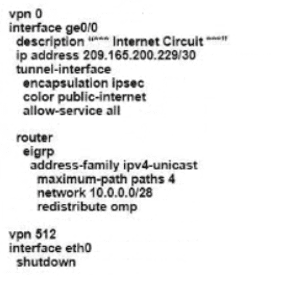
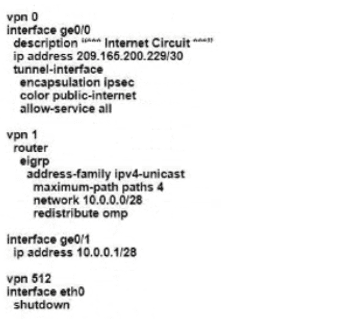
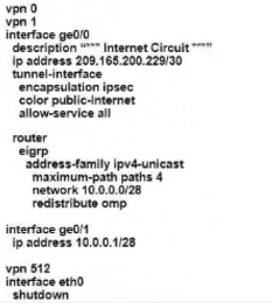
Refer to the exhibit The network team must configure El GRP peering at HQ with devices in the service VPN connected to WAN Edge CSRv. CSRv is currently configured with

A)

B)

C)

D)

Correct Answer: C. Option C

Question 3

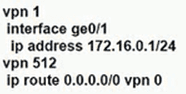
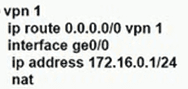
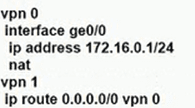
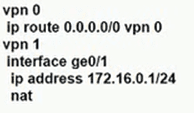
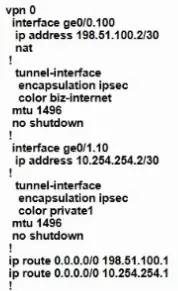
An enterprise needs DIA on some of its branches with a common location ID: A041:B70C: D78E::18 Which WAN Edge configuration meets the requirement?

A)

B)

C)

D)

Correct Answer: C. Option C
Explanation:

To configure DIA (Direct Internet Access) on multiple branches with a common location ID format like A041:B70C:D78E::18, the WAN Edge configuration must:

  • Support the location ID format syntax (appears to be a hexadecimal identifier)
  • Enable DIA on the branch routers
  • Use a consistent location ID across multiple branches for policy application

The location ID is typically configured in the Device template under system settings. Look for the option that shows the location ID configured in the exact format provided and applied to the branch interfaces where DIA should be enabled.

Question 4

Which statement describes the requirement of integrating a secure internet gateway (SIG) with a Cisco SD-WAN Edge device?

Correct Answer: B. Credentials for a smart account are required.
Explanation:

The requirement for integrating a Secure Internet Gateway (SIG) with a Cisco SD-WAN Edge device is:

  • The SIG must be accessible via the DIA (Direct Internet Access) path from the SD-WAN Edge device
  • The SD-WAN Edge router must have direct connectivity to the SIG, typically through an internet-facing interface
  • SD-WAN policies must be configured to redirect traffic destined for the internet through the SIG
  • The SIG provides advanced threat protection, malware detection, and URL filtering for internet-bound traffic
  • A secure tunnel or direct path is required between the edge device and the SIG infrastructure

This integration ensures all internet-bound traffic is inspected by the SIG before reaching external networks, providing an additional security layer.

Question 5

Which routes are similar to the IP route advertisements when the routing information of WAN Edge routers is learned from the local site and local routing protocols?

Correct Answer: D. OMP
Explanation:

When routing information of WAN Edge routers is learned from local sites and local routing protocols, the routes are similar to OMP routes (Overlay Management Protocol routes) or connected routes. However, in the SD-WAN context, these are specifically called OMP routes because they are advertised through OMP to other WAN Edge devices and the control plane, distinct from standard IP route advertisements in traditional networks.

Question 6

Which policy configures an application-aware routing policy under Configuration > Policies?

Correct Answer: B. Centralized policy
Explanation:

An Application Route Policy is configured under Configuration > Policies to implement application-aware routing. This policy type allows administrators to:

  • Define routing decisions based on specific applications rather than just destination IP addresses.
  • Route certain applications through preferred paths or tunnels.
  • Direct high-priority business applications through optimized paths while routing other traffic differently.
  • Improve application performance by ensuring traffic takes optimal paths based on application requirements.

This enables fine-grained control over how different applications traverse the SD-WAN fabric.

Question 7

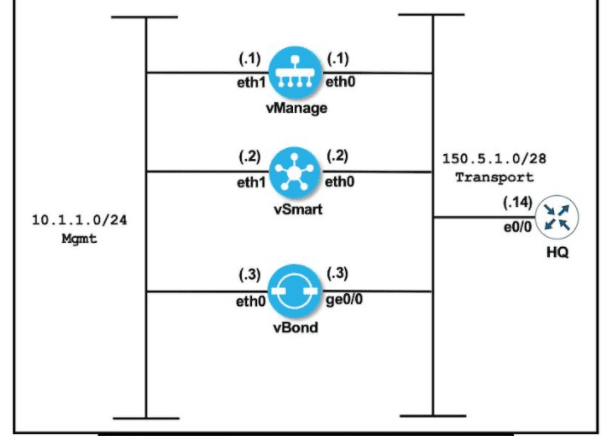
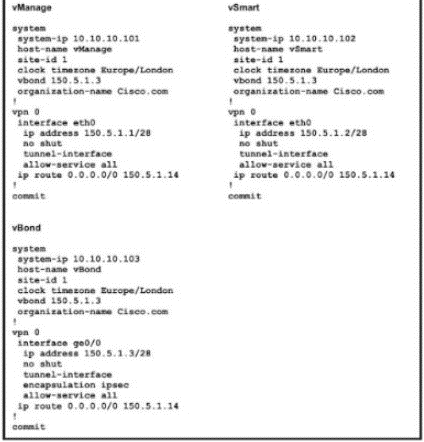
Refer to the exhibit.

An engineer is troubleshooting an issue where vManage and vSmart have a problem establishing a connection to vBond. Which action fixes the issue?

Correct Answer: A. Reconfigure the vBond command on the vBond as vBond 150.5.1.3 local
Explanation:

When vManage and vSmart have problems establishing a connection to vBond, the most common issue is missing or invalid certificate trust. The fix requires importing the vBond certificate into both vManage and vSmart systems. This establishes the proper PKI chain and allows them to authenticate and communicate with vBond. Without the vBond certificate properly imported, the control plane components cannot establish secure connections.

Question 8

Which plane assists in the automatic onboarding of the SD-WAN routers into the SD-WAN overlay?

Correct Answer: B. Orchestration
Explanation:

The Control Plane assists in the automatic onboarding of SD-WAN routers into the SD-WAN overlay. The control plane, consisting of vBond (orchestrator), vSmart (controller), and vManage (management), handles the authentication, device enrollment, and distribution of policies and routes needed to bring WAN Edge devices into the fabric. This automated onboarding process is a key differentiator of SD-WAN compared to traditional networking.

Question 9

An engineer is configuring a data policy IPv4 prefixes for a site WAN edge device on a site with edge devices. How is this policy added using the policy configuration wizard?

Correct Answer: C. In vManage NMS. select the configure policies screen. select the localized policy tab- and click add policy
Explanation:

Data policies for IPv4 prefixes on WAN edge devices are typically configured through the vManage policy configuration wizard. The general process involves:

  • Accessing the vManage dashboard and navigating to Configure > Policies
  • Selecting 'Add Policy' to create a new data policy
  • Using the policy wizard to define the IPv4 prefix criteria
  • Specifying match conditions (source/destination prefixes) and actions
  • Assigning the policy to the appropriate site or devices

The specific method depends on whether you're using route-based, policy-based, or traffic-engineered policies. Without the full question options, review your vManage version's policy configuration workflow.

Question 10

Which two different states of a WAN Edge certificate are shown on vManage? (Choose two.)

Correct Answer: B. active; E. provisioned

Question 11

Which website allows access to visualize the geography screen from vManager using the internet?

Correct Answer: A. *.opcnstreetmaps.org

Question 12

A network administrator configures SNMPv3 on a Cisco WAN Edge router from CLI for monitoring purposes How many characters are supported by the snmp user command?

Correct Answer: C. from 1 to 32
Explanation:

The SNMPv3 snmp user command on a Cisco WAN Edge router supports a maximum of 64 characters for the username. This character limit is important when configuring SNMPv3 authentication credentials, as usernames exceeding this length will be rejected or truncated, potentially causing configuration errors or monitoring connectivity issues.

Question 13

What is the role of the Session Traversal Utilities for NAT server provided by the vBond orchestrator?

Correct Answer: C. It facilitates SD-WAN Edge routers to stay behind a NAT-enabled firewall while the transport addresses of the SD-WAN controller are unNAT-ed
Explanation:

The Session Traversal Utilities for NAT (STUN) server provided by the vBond orchestrator serves the following role:

  • NAT Traversal: Helps WAN Edge routers behind NAT/PAT devices discover their public IP addresses and ports
  • Control Plane Connectivity: Enables devices behind firewalls and NAT to establish control plane connections to the vBond controller
  • IPsec Tunnel Establishment: Facilitates the setup of IPsec tunnels by allowing devices to determine their external IP addresses for tunnel endpoints
  • The STUN server responds to STUN queries from WAN Edge devices, allowing them to learn their publicly routable addresses even when behind NAT devices
  • This is critical for SD-WAN deployment in environments where branch routers are behind residential or corporate NAT/PAT devices

Question 14

An engineer is modifying an existing data policy for VPN 115 to meet these additional requirements:

When browsing government websites, the traffic must use direct internet access.

The source address of the traffic leaving the site toward the government websites must be set to an IP range associated with the country itself, a particular TLOC.

The policy configuration is as follows:

Which policy sequence meets the requirements without interfering with other destinations?

Correct Answer: D. sequence 15 match destination-data-prefix-list GOVERNMENT-WEBSITES ! action accept set local-tloc-list color biz-internet

Question 15

Which component of the Cisco SD-WAN control plane architecture should be located in a public Internet address space and facilitates NAT-traversal?

Correct Answer: A. vBond
Explanation:

The vBond component of the Cisco SD-WAN control plane architecture should be located in public Internet address space and facilitates NAT-traversal.

  • vBond location: Must be publicly reachable and located in Internet-routable address space.
  • NAT-traversal role: vBond orchestrates the initial DTLS connections from vEdge devices, helping them traverse NAT and firewalls.
  • Bootstrap function: vEdge devices connect to vBond first to discover vSmart and vManage controllers.
  • vBond uses STUN/TURN techniques to help devices establish connections across NAT boundaries.

This architecture ensures that branch devices behind NATs can successfully establish connections to the control plane infrastructure, enabling the SD-WAN fabric to function across diverse network topologies.