Question 1
Which difference must an engineer consider when choosing whether to implement OSPF or IS-IS as the routing protocol on the network?
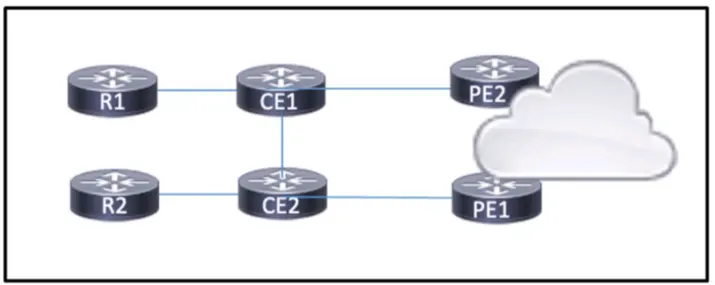
Refer to the exhibit.

BGP is running on the network, and CE1 currently prefers routes to the internet via PE 1 A network engineer must manipulate the BGP routes that CE1 receives from PE2 to be more desirable The engineer configured a route map using MED and applied it on CE1 outbound from PE2. However, after a BGP soft reset. PE1 is still preferred. Which action must the engineer take so that PE2 is chosen as the next hop?
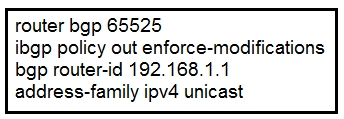
Refer to the exhibit.

Router 1 is a core ABR in a Cisco Unified MPLS environment. All of the router 1 BGP
peers are established, but traffic between customers is failing. Which BGP configuration must be added to the configuration?
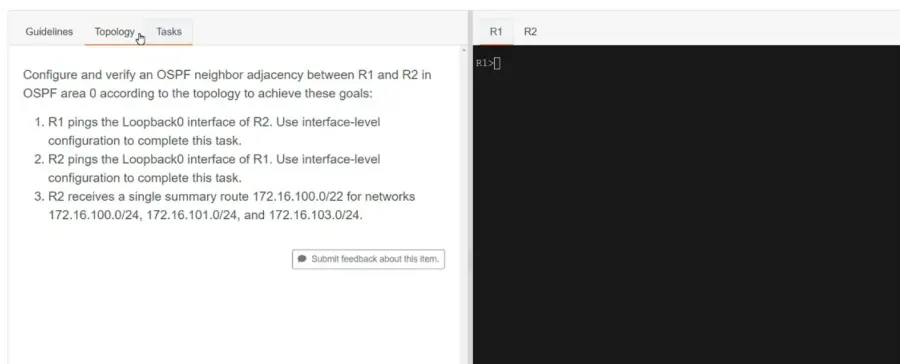
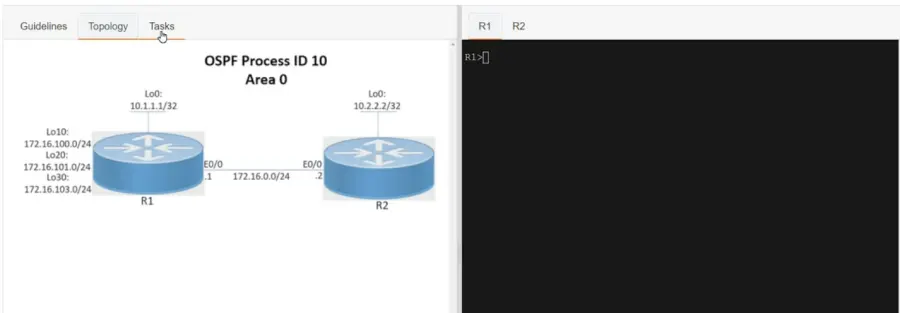
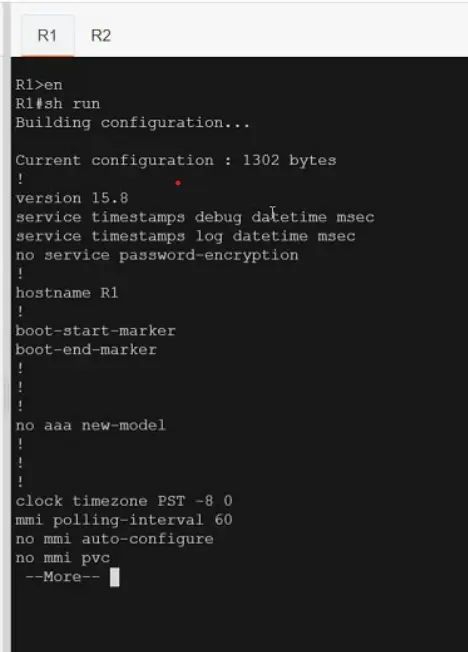
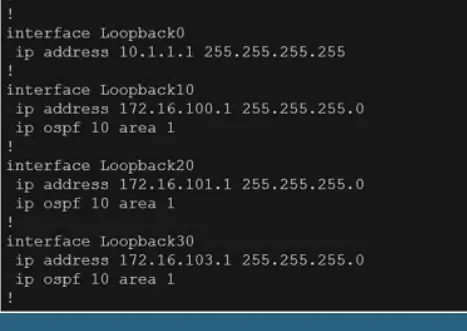
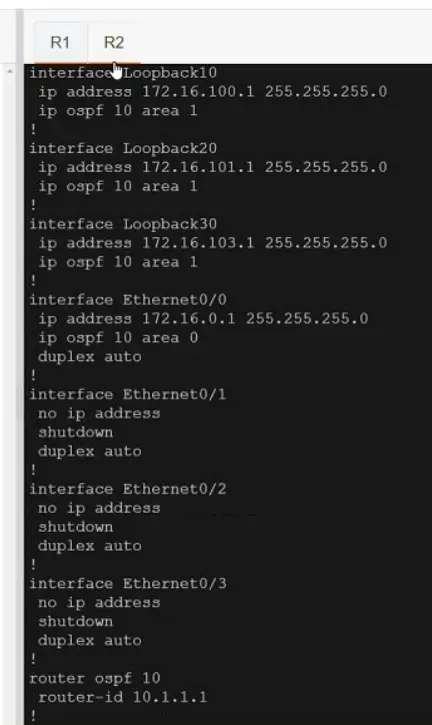
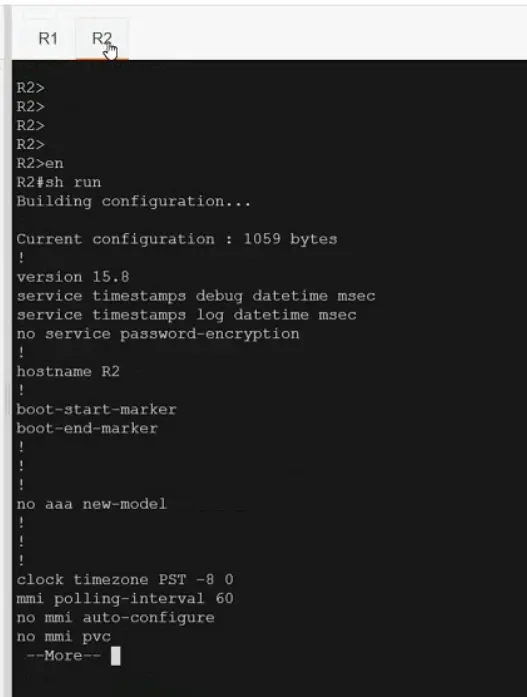
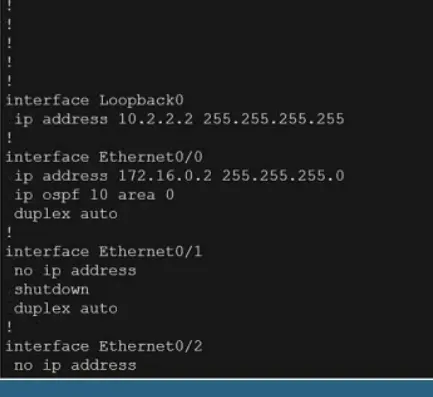
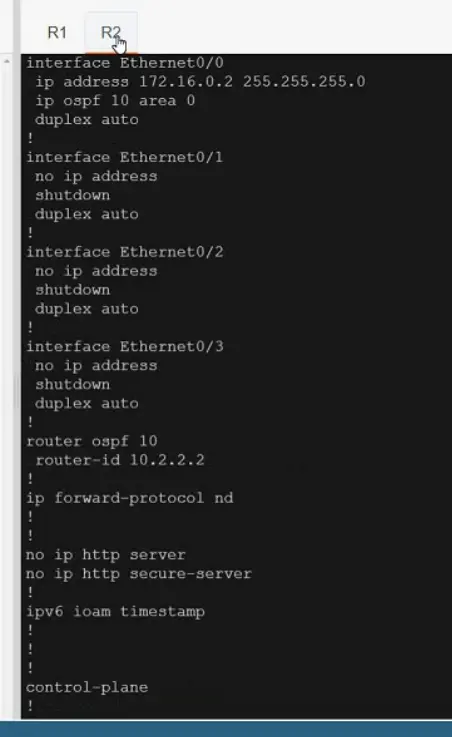
Refer to the exhibit.


R2


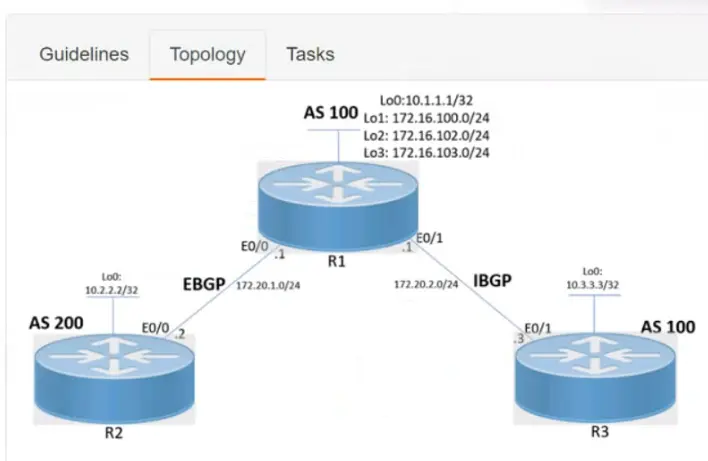
Solution:-
R1
Int loopback0
Ip ospf 10 area 0
Int loopback10
Ip ospf network point-to-point
Int loopback20
Ip ospf network point-to-point
Int loopback30
Ip ospf network point-to-point
Router ospf 10
Area 1 range 172.16.100.0 255.255.252.0
Copy run start
Verification: -

After you change the IP address on an IOS XR router, you cannot ping the new address.
Which step did you forget to complete?
Refer to the exhibit.

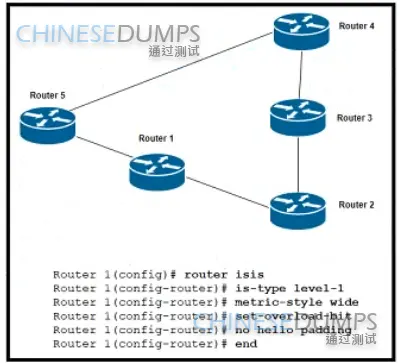
Refer to the exhibit. A network engineer commissioned Router 1, which connects lo Router 2 and Router 5 Router 1 participates in IS-IS routing with other routers, but it is not used for transit traffic. Traffic from Router 2 to Router 5 is expected to travel via Router 1 but the traffic is travelog via Router 3 and Router 4 Which action reserves this problem?
An engineer is working to implement segment routing protocol on the customer's core network. Which step should the engineer take before the segment routing is enabled and is running with BGP?
A network engineer recently deployed a wireless network for users at a new office to join video conferences wirelessly The existing network consists of routers that are configured for EIGRP and BGP. which are located at several data centers in different physical locations The engineer configured PIM-SSM within a single domain from a single source However, during the testing phase, the video conference failed to work for any of the users. The IPs are reachable and firewalls in the network are configured correctly to allow the traffic. Which action resolves the issue?
Refer to the exhibit.

While configuring router 2 with all the default values, a network engineer cannot see any route received in router 1. How should the engineer solve the issue?
Refer to the exhibit.


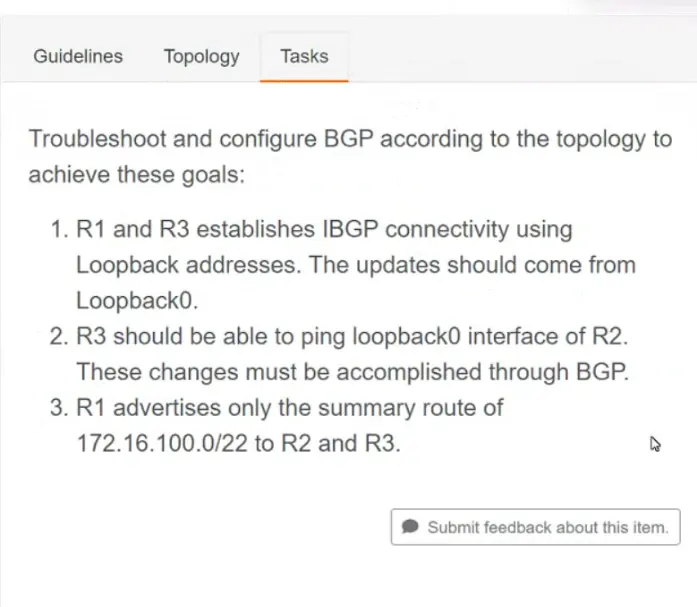
Solution :-
R1
Router bgp 100
Neigh 10.3.3.3 remote-as 100
Neigh 10.3.3.3 update-source loopback0
Address-family ipv4
Neigh 10.3.3.3 next-hop-self
Aggregate-address 172.16.100.0 255.255.252.0 summary-only
Copy run start
R3
Router bgp 100
Neigh 10.1.1.1 remote-as 100
Neigh 10.1.1.1 update-source loopback 0
Copy run start
Verification:-


Refer to the exhibit.

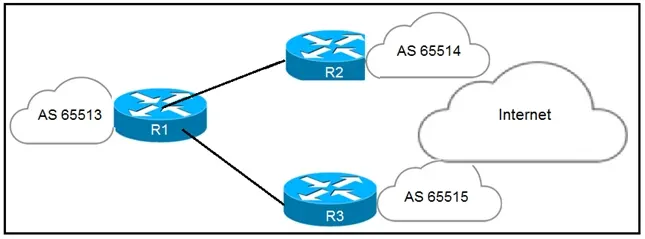
An engineer has successfully fixed BGP peering issue. R1 has an established eBGP
peering with R2 and R3. Which mechanism should the engineer apply in order to steer the traffic correctly?
Some level of load balancing is achieved by default as BGP prefers shortest AS_PATH for certain prefix (Cisco BGP path selection algorithm - rule 4) . If 1-7 rules gives no preference for certain prefix then with rule 8. Prefer lowest IGP metric to BGP next hop we can force traffic to R2 or R3 influencing load distribution.
Refer to the exhibit.

A service provider is running IS-IS in the core, and all routers use the default IS-IS configuration and reside in the same are
a. All routers maintain a different 6 bytes for the system ID. but the attached bits in the NET are the same. After an engineer added router R6 to the network. R3 and R5 began to experience CPU processing issues. Which action must the engineer take to resolve the issue?
Refer to the exhibit.

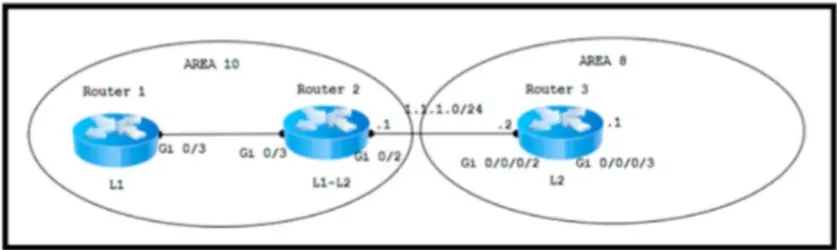
An engineer at a large ISP is troubleshooting suboptimal routing on a customer's IS-IS network with multiple Level 1-2 routers. The network consists of numerous routers that are configured for MPLS. When IS-IS picks the closest Level 1-2 router to exit the area, suboptimal routing occurs in Area 8 and Area 10. The other IGP protocols are running correctly, and the IS-IS adjacency between routers is established. Which action resolves the issue?
Refer to the exhibit.


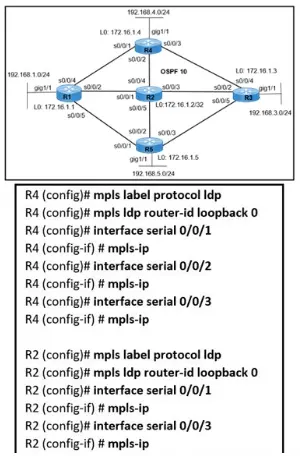
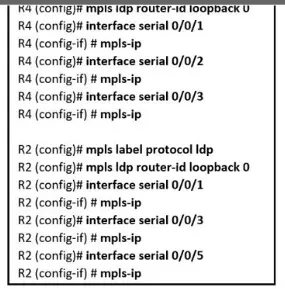
Refer to the exhibit. MPLS traffic from 192.168.4.0/24 to 192.168.5.0/24 is failing to pass over the link from R4 to R2. The engineer verified that:
Cisco Express Forwarding Is enabled on all routers.
All routers reach all networks via OSPF.
MPLS traffic from 192.168.1.0/24 to 192.168.3.0/24 is passing normally over the link from R1 to R2.
Which action resolves the issue?
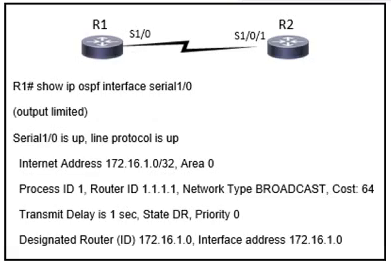
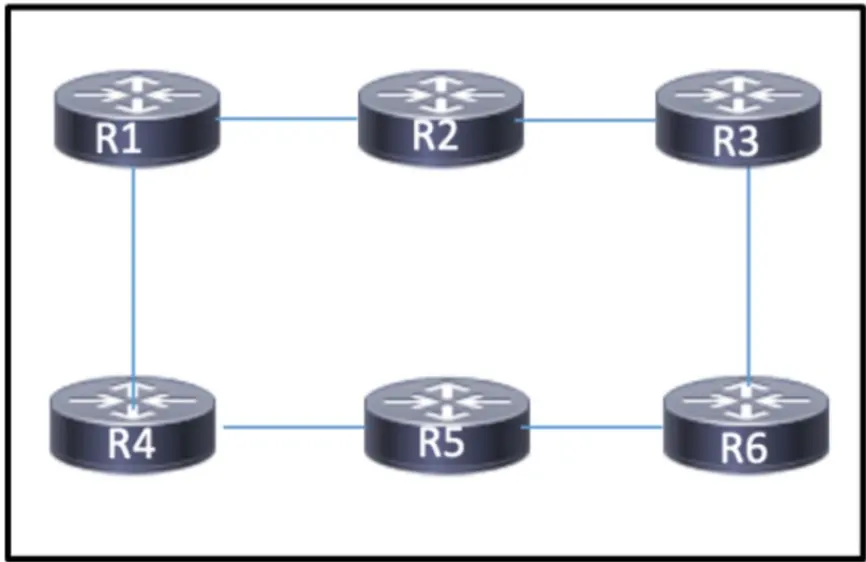
Refer to the exhibit.

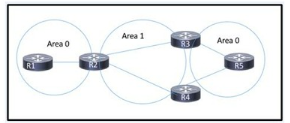
Refer to the exhibit. A network engineer just replaced five routers on this OSPF network. When the routing protocol is brought up, R5 cannot reach routes that originate on R1. The engineer verified that all connected links have established neighbor relationships. R5 reaches routes originating on R3 and R4. Which action resolves the issue?