Question 1
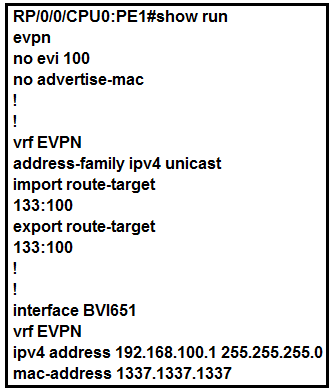
Refer to the exhibit.

A network operator is implementing EVPN IRB on PE1. Which two command placements enable the advertisement of Type 2 routes and what information do Type 2 routes contain? (Choose two.)
Refer to the exhibit.

A network operator is implementing EVPN IRB on PE1. Which two command placements enable the advertisement of Type 2 routes and what information do Type 2 routes contain? (Choose two.)
A network architect is troubleshooting the L2TPv3 tunneling security due to the untrusted nature of the underlaying network. Which two L2TPv3 features does the architect deploy to address the ongoing issues? (Choose two.)
An engineer is troubleshooting an ongoing network outage. Which command should he use that can display the live log files for a process or service running on a network device?
Which two BGP attributes prevent loops in a route reflector environment? (Choose two.)
You are troubleshooting ARP connectivity issues for an Ethernet interface on an IOS XR network that runs IS- IS. You verify that the IGP protocol is running, but an ARP entry has not yet been created.
Which action should you take?
A network engineer is implementing Layer 3 MPLS VPNs on Cisco IOS/IOS XE PE routers. Which PE-to-CE routing protocol requires a separate routing process to be created for each VRF?
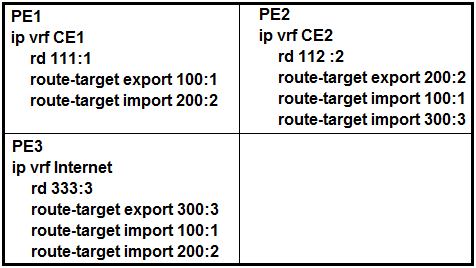
Refer to the exhibit.

PE1 and PE2 are exchanging VPNv4 routes for CE1 and CE2, and PE3 contains the default route to the internet. If the three devices are operating normally, which two conclusions describe this configuration? (Choose two.)
Topic 4, IPv6 VPNs
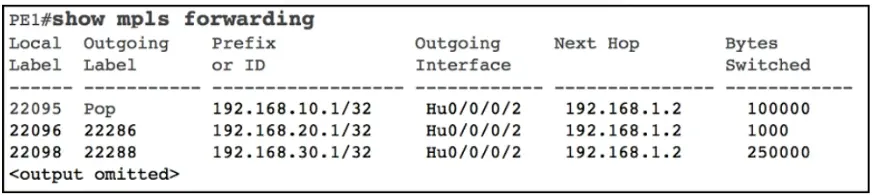
Refer to the exhibit.

What is shown in this output?
You try to configure MPLS VPN VRF Selection based on a source IP address on an interface that has VRF configured, but you receive an error.
Which action must you take to correct the problem?
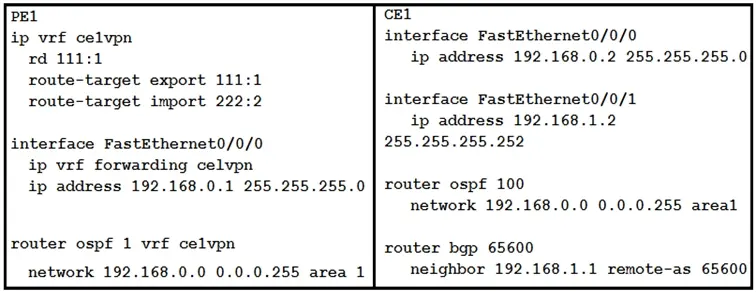
Refer to the exhibit.

If the two devices are operating normally, which two conclusions can you draw from this configuration? (Choose two.)