Question 1
During the process of starting a Python network telemetry collector, which command starts the Cisco bigmuddy-network-telemetry-collector from GitHub?
The commandtelemetry_receiver.py --ip-address
During the process of starting a Python network telemetry collector, which command starts the Cisco bigmuddy-network-telemetry-collector from GitHub?
The commandtelemetry_receiver.py --ip-address
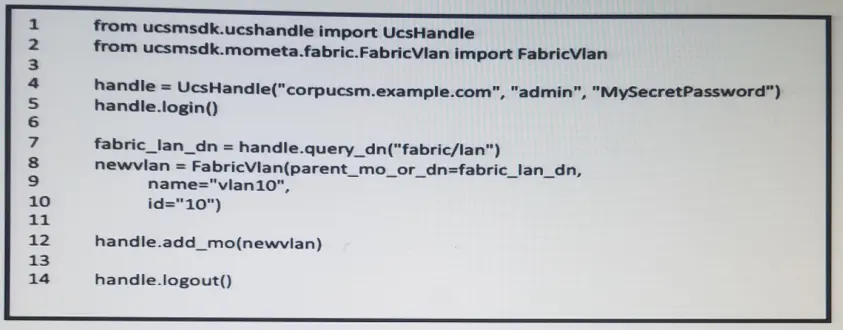
Refer to the exhibit.

Refer to the exhibit:
Which change allows the code to configure VLAN 10 in the Cisco UCS?
The code snippet is intended to configure VLAN 10 in Cisco UCS. After creating the VLAN object and adding it withhandle.add_mo(newvlan), it is essential to commit the changes to the UCS Manager for them to take effect. This is done by invokinghandle.commit(). Without this step, the changes will not be saved, and VLAN 10 will not be configured.
Cisco UCS Manager API Reference Guide
What are two main guiding principles of REST? (Choose two.)
REST, or Representational State Transfer, is an architectural style that is characterized by its stateless nature, meaning each request from a client to a server must contain all the information needed to understand and complete the request without relying on any stored context on the server. This increases reliability and scalability. However, 'stateful' is not a guiding principle of REST; instead, it is 'statelessness' that is a core principle.The other main guiding principles include a uniform interface, cacheability, and a layered system
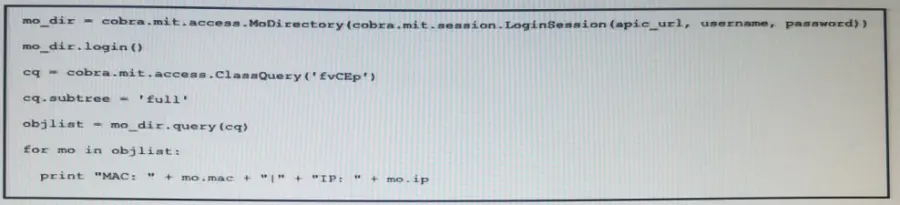
Refer to the exhibit

Which action does the execution of this ACI Cobra Python code perform?
The ACI Cobra SDK is a Python library provided by Cisco for interacting with the Application Centric Infrastructure (ACI). The code in the image uses this SDK to log into an APIC controller, which is the central management entity for the ACI fabric. After logging in, it creates a class query for 'fvCEp', which stands for Fabric Endpoint. This class contains information about endpoints within the ACI fabric, including their MAC and IP addresses.
The 'subtree' property set to 'full' indicates that the query will return all objects within this class's subtree, meaning it will retrieve detailed information about each endpoint. Themo_dir.query(cq)method executes this query against the APIC.
Finally, for each object returned by the query (each endpoint), it prints out two attributes: 'mac' and 'ip'. These attributes correspond to the MAC address and IP address of each endpoint in the ACI fabric. Therefore, option C is correct as this code prints all endpoint MAC and IP addresses.
Implementing Automation for Cisco Data Center Solutions (DCAUI)
Cisco Learning Network - Data Center Training Videos
Which authentication method is used when the REST API of the Cisco UCS Director is accessed?
Cannot provide answer without seeing the available authentication method options. However, when accessing the REST API of Cisco UCS Director, the standard authentication method is HTTP Basic Authentication (username and password encoded in Base64), though some deployments may support LDAP or other directory services integration. The credentials are typically passed in the Authorization header of HTTP requests. Please provide the specific options to confirm the correct answer.
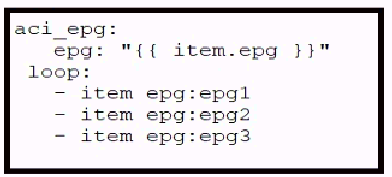
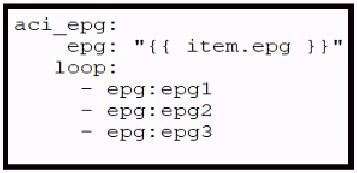
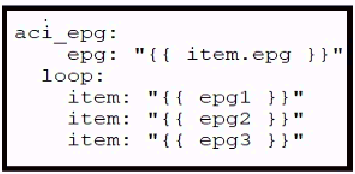
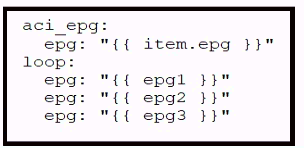
Which iteration creates three EPGs in Cisco ACI using an Ansible task? Some required aci_epg task attributes have been omitted for brevity.
A)

B)

C)

D)

The correct iteration for creating three EPGs in Cisco ACI using an Ansible task is found in option C. This task utilizes theaci_epgmodule, which is part of Ansible's suite of modules for managing Cisco ACI environments. The task includes a loop that iterates over a list of EPG names, creating each one in turn. This approach is efficient for automating the creation of multiple EPGs, reducing the need for repetitive task definitions.Reference:= For more information on automating Cisco Data Center solutions, including the use of Ansible for task automation, you can refer to the official Cisco documentation and training resources such as the Implementing Automation for Cisco Data Center Solutions (DCAUI) course.
Which two statements describe the authentication method used with Cisco Intersight REST API Requests? (Choose two.)
Cisco Intersight REST API uses HMAC for authentication, where the message content and headers are signed using an API Key ID (A), and the Cisco Intersight Web service verifies the signature with the RSA public key for the API Key ID . The SHA384 hash (B), RSA private key challenge (D), and SHA256 hash (E) are not described in the authentication method for Cisco Intersight REST API requests.
Which statement about synchronous and asynchronous API calls is true?
Synchronous API calls are blocking, meaning they hold up code execution until a response is returned from the server. This can lead to perceived latency or performance lag in an application if not managed properly.In contrast, asynchronous API calls do not block code execution; they allow the program to continue running and handle the response once it's available, typically through a callback function
Which two statements apply to authentication when using the Cisco Intersight API? (Choose two.)
When using the Cisco Intersight API, the Secret Key is only available at the time of API Key creation, which is why option B is correct. An API Key is indeed composed of a Key ID and Secret Key, making option C correct as well. The other options do not apply as per the standard practices for API authentication
What is the top level in the ACI Management Information Tree?
The top level in the ACI Management Information Tree ispolUni. This is the top-level class for all policy definition and resolution objects within the Cisco ACI Policy Model.It serves as the root for policy namespace in the Management Information Tree12.
Cisco ACI Policy Model Guide1
Understanding the Cisco Application Policy Infrastructure Controller2