
Limited-Time Offer: Enjoy 50% Savings! Ends in 00h 00m 00s Coupon code: 50OFF
Skip to content

Free Cisco Implementing and Operating Cisco Wireless Core Technologies 350-101 Exam Questions

Page: 1 / 11 Total 103 questions

Want more questions? Get Premium Access.

Question 1

An IT team is deploying Meraki APs at a remote branch and must ensure that they are automatically assigned to the correct network in the Meraki dashboard. The branch is scheduled to receive 20 new APs, and site connectivity to headquarters was set up. Before shipping the APs, the team must make sure that each one is claimed by the intended network for management and monitoring. Which deployment action must they take before physically connecting the APs?

Correct Answer: B. Add the AP serial numbers to the required network within the Meraki dashboard.
Explanation:

When deploying Meraki APs, it is essential to claim each AP in the Meraki dashboard to ensure that they are automatically assigned to the correct network and can be managed remotely. This process involves registering the APs with the Meraki cloud, which is done by adding the AP serial numbers to the network within the Meraki dashboard before physically installing them at the branch.

Option B: 'Add the AP serial numbers to the required network within the Meraki dashboard.'

This is the correct answer. Before the APs are physically connected, the administrator needs to log into the Meraki dashboard and add the serial numbers of the new APs to the intended network. This ensures that once the APs are powered on and connected, they automatically join the correct network and are ready for monitoring and management without requiring further configuration.

Option A: 'Activate mesh networking mode for all the new APs before installation.'

Mesh networking mode is used when APs need to communicate wirelessly to extend coverage, but it is not a requirement for the deployment and registration process. The APs should be connected normally for initial setup, and mesh mode can be enabled later if needed.

Option C: 'Preconfigure SSID names and VLAN tags on the local page of each AP in the Meraki dashboard.'

While configuring SSID and VLAN settings is essential, this is not the first action required for ensuring the APs are claimed by the correct network. The priority is to add the AP serial numbers to the Meraki dashboard for proper network assignment.

Option D: 'Create a separate DHCP scope for all the new APs on the local server.'

DHCP scope configuration is important for assigning IP addresses, but this is not the primary step for ensuring the APs are correctly registered in the Meraki dashboard. The APs can obtain IP addresses from an existing DHCP scope once they are connected and claimed in the dashboard.

Therefore, the best approach is Option B, as it ensures that the APs are correctly assigned to the intended network in the Meraki cloud, ready for management and monitoring once connected.
Question 2

In an RF environment, what does high interference result in?

Correct Answer: B. inconsistent channel performance
Explanation:

High interference in a wireless RF environment disrupts the predictable behavior of 802.11 channels. Interference comes from co-channel devices, neighboring APs, non-Wi-Fi sources like microwave ovens, cordless phones, or other electronic equipment operating in the same frequency band. When interference is present, the channel experiences fluctuating noise levels, increased frame collisions, and packet loss, all of which lead to inconsistent channel performance.

This inconsistency manifests as variable throughput, increased retransmissions, and irregular latency, directly impacting both client experience and AP scheduling decisions. While frame aggregation may fail under interference, the primary and systemic effect is the variability in channel quality, not the failure of aggregation alone. Scheduled contention access (option C) is an intentional protocol mechanism of EDCA or TXOP scheduling, which operates independently of interference levels. Extended coverage patterns (option D) are the result of antenna design or AP placement, not RF interference.

Cisco's Wireless Design Guide emphasizes that RF interference results in erratic channel behavior, requiring careful channel planning, power adjustment, and spectrum analysis using tools such as Cisco DNA Spaces or Spectrum Expert to restore consistent performance. Reference topic: RF Fundamentals --- Interference impacts, co-channel and adjacent-channel interference, and mitigation strategies.


Question 3

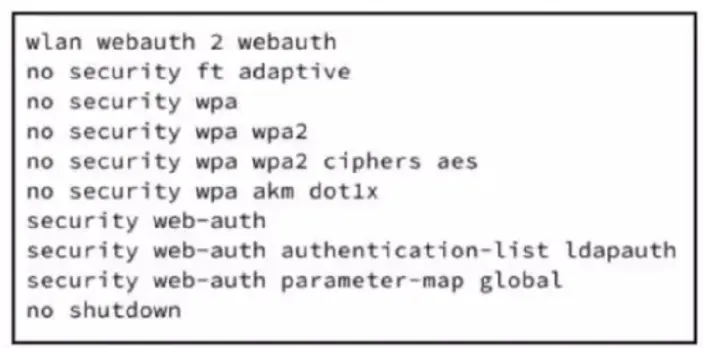
Refer to the exhibit.

Correct Answer: A. security web-auth
Explanation:

The command that enables web-based client authentication on the WLAN is security web-auth. Cisco's Catalyst 9800 Web-Based Authentication guide shows the WLAN configuration workflow: enter WLAN configuration mode, disable WPA security for the open Layer 2 guest WLAN, then ''Enable web authentication for WLAN'' using security web-auth. Cisco then applies the authentication list and parameter map with security web-auth authentication-list ... and security web-auth parameter-map ..., which refine the WebAuth method and portal behavior after WebAuth itself is enabled.

Cisco's LDAP authentication example mirrors the exhibit exactly: wlan webauth 2 webauth, removal of WPA/802.1X Layer 2 security, security web-auth, security web-auth authentication-list ldapauth, and security web-auth parameter-map global. Option B only creates or enters the WLAN profile with WLAN ID 2 and SSID name. Options C and D disable WPA2 and 802.1X AKM; they do not authenticate clients. Reference topics: Client Connectivity Configuration --- guest WLAN authentication, WebAuth, Layer 3 security, authentication lists, parameter maps, and Catalyst 9800 WLAN security configuration.


Question 4

A network administrator at a marketing company is deploying a Cisco Catalyst 9800 Series Wireless Controller running Cisco IOS XE 17.x. The corporate WLAN named XYZ-Guest supports visitor devices. To address intermittent connectivity issues due to client association limits and short session timeouts, the network administrator must optimize the WLAN to allow more client connections and extend session timeouts for the devices. The administrator must set the maximum number of clients for the XYZ-Guest WLAN to 50 and must set a session timeout to prevent frequent device disconnections. Which two commands must be configured on the controller? (Choose two.)

Correct Answer: C. wlan XYZ-Guest 1 XYZ-Guest client session timeout 2800; E. wlan XYZ-Guest 1 XYZ-Guest client association limit 50
Explanation:

On Cisco Catalyst 9800 Series WLCs running IOS XE 17.x, WLAN-specific client management parameters are configured under the wlan configuration context. To increase the number of client connections on the XYZ-Guest WLAN, the correct command is wlan XYZ-Guest 1 XYZ-Guest client association limit 50 (or client max-association 50 depending on IOS XE version), which explicitly sets the maximum number of clients allowed per AP on this WLAN. To extend session durations and prevent frequent disconnections, the client session timeout command is applied under the same WLAN context with the desired timeout in seconds, e.g., wlan XYZ-Guest 1 XYZ-Guest client session timeout 2800.

Profile-based session commands (options B and D) are part of wireless policy profiles, which define broader policy elements like QoS, radio settings, and security, but do not directly enforce client association limits or session timeouts on the WLAN itself. Configuring these parameters at the WLAN level ensures that all APs associated with this WLAN apply the limits and timeout settings consistently. This approach aligns with Cisco best practices for Client Connectivity Configuration --- WLAN client limits, session management, and IOS XE WLC optimization for guest networks.


Question 5

What is the main benefit of using AI Enhanced RRM on the Cisco Catalyst 9800 wireless controller?

Correct Answer: D. It uses machine learning and cloud analytics to proactively optimize RF parameters.
Explanation:

AI Enhanced RRM is not a static-threshold tuning feature and it is not designed to simply raise AP transmit power. Cisco defines AI Enhanced RRM as a radio resource management technology that applies artificial intelligence and machine learning to optimize RF environments, uses distributed data collection from Cisco wireless controllers with cloud-based analytics, and automates adaptive RF parameter tuning for Cisco wireless networks.

The operational model is telemetry-driven. RF telemetry is collected from APs by the Catalyst 9800 WLC, sent through Cisco Catalyst Center to the Cisco AI Analytics Cloud, analyzed by RRM algorithms, and then configuration-change information is returned through Catalyst Center toward the managed wireless infrastructure. Cisco's AI-Enhanced RRM deployment guide further identifies DCA, TPC, FRA, and DBS as examples of optimizations performed, meaning the feature enhances dynamic RF control rather than disabling it.

Therefore, option D is the only correct answer. Options A, B, and C describe either legacy/static behavior, harmful power-only logic, or a fixed RF design model that contradicts Cisco AI Enhanced RRM. Reference topics: Automation and AI --- AI/ML-driven RF optimization, Catalyst Center assurance, RRM telemetry, DCA, TPC, FRA, and DBS.


Question 6

What is the time taken for an RF signal to travel from the transmitter to the receiver known as?

Correct Answer: B. propagation delay
Explanation:

In RF communications, propagation delay refers to the finite time required for a signal to travel from the transmitter to the receiver over a given medium. This delay depends on the distance between the endpoints and the speed at which electromagnetic waves propagate through the medium, typically close to the speed of light in air (approximately 3 10 m/s). Propagation delay is fundamental in calculating network latency, timing synchronization in protocols, and designing wireless coverage, especially in large-scale enterprise networks.

Reflection (option A) occurs when RF waves encounter surfaces and bounce back, potentially causing multipath interference. Scattering (option C) refers to signal dispersion caused by small objects or irregularities in the medium, which affects signal quality but not the direct travel time. Link speed (option D) represents the maximum data rate supported by a wireless link and is unrelated to the time taken for the signal to propagate.

Cisco wireless design guides emphasize propagation delay considerations when planning high-density deployments, especially in large campuses or long-range point-to-point links, to ensure timing-sensitive applications (e.g., VoIP, video conferencing) maintain acceptable performance. Propagation delay must be factored into QoS and RF design decisions to minimize latency and optimize throughput. Reference topic: RF Fundamentals --- signal propagation, latency, multipath effects, and timing in wireless networks.


Question 7

What defines device sensitivity in a wireless environment?

Correct Answer: A. capability to process the signal
Explanation:

Device sensitivity in a wireless environment refers to receiver sensitivity: the minimum RF signal level a client or AP radio must receive to successfully detect, demodulate, and decode a transmission. Cisco defines receiver sensitivity as the minimum signal power level, expressed in dBm or mW, required for a receiver to accurately decode a given signal. Cisco RF design guidance further states that sensitivity indicates the lowest received power before the receiver considers the signal unintelligible.

Therefore, option A is correct because sensitivity is fundamentally about the radio's capability to process a received signal at low power levels. A more sensitive receiver can decode weaker frames, improving effective coverage and receive performance, provided the signal-to-noise ratio and interference conditions remain acceptable. Cisco also notes that individual device sensitivity determines how well a device can hear and demodulate RF energy, which directly affects contention behavior and WLAN performance in dense environments. Redundant gateways, beacon interval synchronization, and key refresh schedules are Layer 3 availability, 802.11 timing, and security-key management topics; they do not define RF receiver sensitivity. Reference topics: RF Fundamentals --- receiver sensitivity, RSSI, dBm, SNR, demodulation, and WLAN coverage behavior.


Question 8

Which wireless connection occurs when there are no physical obstacles between the receiver and transmitter?

Correct Answer: B. line-of-sight
Explanation:

The correct answer is line-of-sight. In RF terminology, line-of-sight describes a wireless path where the transmitting antenna and receiving antenna have an unobstructed visual or RF path between them. Cisco's RF power documentation defines this directly: antennas that can see each other without obstacles between them are considered to be in line of sight. This is especially important in outdoor, bridge, mesh, and point-to-point wireless designs, where buildings, terrain, foliage, or other obstructions can degrade or block the RF path.

The other options describe different RF behaviors. Attenuation is signal loss as RF energy travels through free space, cables, walls, or other materials. Reflection occurs when RF energy bounces off a surface such as metal, glass, or concrete, often contributing to multipath. Beamforming is an antenna/transmission technique that focuses RF energy toward a client or receiver to improve signal quality; it is not the condition of having no obstacles. Cisco mesh planning guidance also emphasizes verifying whether a wireless link has clear line of sight before deployment, reinforcing that LOS is a path condition, not a modulation or security feature. Reference topic: RF Fundamentals --- RF propagation, path loss, line-of-sight, obstruction effects, and wireless link planning.


Question 9

Which function does FRA use to optimize client experience and network coverage?

Correct Answer: B. Enhances roaming by redirecting the client to move to the appropriate AP
Explanation:

FRA (Flexible Radio Assignment) is a feature in Cisco wireless networks designed to optimize the client experience and enhance network coverage. FRA functions by managing roaming behavior and ensuring that clients are connected to the most appropriate access point (AP) based on signal quality and other factors. This helps in ensuring a seamless experience when clients move across coverage areas, by actively guiding them to the best AP.

The key functionality of FRA involves redirecting clients to the appropriate AP when they are experiencing suboptimal performance on the current AP, which is typically influenced by factors such as interference or distance. This optimization helps improve both coverage and user experience by making sure clients stay on the most optimal radio connection.

Option A, which refers to monitoring on the physical interface level, is not directly related to FRA but more to basic radio management. Option C, which mentions local data path control, refers to how data paths are managed locally within an AP but does not address the dynamic nature of client roaming. Option D, about dual-band radios, involves how radios are configured but does not directly describe FRA's function.

FRA is vital for dynamically enhancing wireless network performance, particularly in large, dense environments where clients are constantly moving.

YANG (Yet Another Next Generation) is a data modeling language primarily used in conjunction with the NETCONF (Network Configuration Protocol) to model configuration and operational data for network devices, including Cisco wireless controllers. YANG is a human-readable, hierarchical language designed to define the structure of data, allowing for consistent representation of configuration parameters, operational state, and notifications. It is extensively used in network automation and management systems to ensure standardized configuration management across various devices, making it easier for network administrators to automate and configure network devices using NETCONF.

NETCONF is the protocol that facilitates the transport of these data models (defined in YANG) between network devices and management systems. YANG's role is to define the structure and constraints of the data that NETCONF will configure or retrieve from devices. This allows administrators to configure network devices programmatically while adhering to a standardized data structure, which is essential for scalability, automation, and integration across various systems.

Options B, C, and D do not describe the actual purpose of YANG in the context of NETCONF and Cisco wireless controllers. Option B describes a security protocol (which could be TLS or SSH), Option C refers to protocols like RESTCONF, and Option D is incorrect because YANG is not a scripting language but a data modeling language.


Question 10

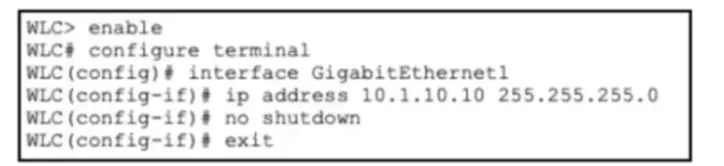
Refer to the exhibit.

Refer to the exhibit. A network engineer is deploying a new Cisco 9800 WLC and is performing the Day-0 setup. The IP address and subnet mask have been assigned to the management interface, and network connectivity between the WLC and the upstream switch has been verified. Which CLI command must the engineer use next to configure management access?

Correct Answer: D. ip route 0.0.0.0 0.0.0.0 10.1.10.1
Explanation:

After assigning an IP address to the management interface of a Cisco 9800 WLC, the next step in Day-0 deployment is configuring the default route to ensure management traffic can reach devices outside the local subnet. The correct command is ip route 0.0.0.0 0.0.0.0 <gateway>, which establishes a default route for all traffic destined for networks not explicitly known in the routing table. In this case, ip route 0.0.0.0 0.0.0.0 10.1.10.1 sets the upstream router at 10.1.10.1 as the default gateway, allowing the WLC to communicate with the broader network for management and client services. Option A, route add default gw, is Cisco IOS classic syntax but not valid in IOS XE WLC CLI. Option B is invalid syntax for default routing. Option C, ip default-gateway, is only used for Layer 2 management devices without routing capabilities, whereas a WLC requires a proper Layer 3 route. Configuring the default route ensures that remote administration, SNMP, syslog, and device registration functions operate correctly. Cisco Wireless Core Technologies recommend this step as part of initial WLC setup to establish full network reachability for management access. Reference topics: Wireless Network Implementation --- Day-0 WLC setup, management interface configuration, default route, IP routing in Cisco 9800 IOS XE.