Limited-Time Offer: Enjoy 50% Savings! Ends in 00h 00m 00s Coupon code: 50OFF
Skip to content

Free Cisco Implementing and Operating Cisco Service Provider Network Core Technologies 350-501 Exam Questions

Page: 1 / 37 Total 547 questions

Want more questions? Get Premium Access.

Question 1

A network engineer is testing an automation platform that interacts with Cisco networking devices via NETCONF over SSH. In accordance with internal security requirements:

NETCONF sessions are permitted only from trusted sources in the 172.16.20.0/24 subnet.

CLI SSH access is permitted from any source.

Which configuration must the engineer apply on R1?

Correct Answer: D. configure terminal hostname R1 ip domain-name mydomain.com crypto key generate rsa ip ssh version 2 access-list 1 permit 172.16.20.0 0.0.0.255 netconf ssh acl 1 line vty 0 4 transport input ssh end
Question 2

Why is the keyword none needed when implementing management plane security using TACACS?

Correct Answer: C. It allows authentication to succeed when the TACACS+ server is unreachable.
Explanation:

The keyword 'none' is essential in management plane security using TACACS to ensure that authentication can still succeed when the TACACS+ server is unreachable. This fallback mechanism allows network resources to remain accessible even if the TACACS+ server fails or becomes unreachable.Reference: Implementing and Operating Cisco Service Provider Network Core Technologies (SPCOR) - Management Plane Security section.


Question 3

How does TI-LFA reduce packet loss in Segment routing?

Correct Answer: C. It calculates loop-free backup paths that are rapidly implemented in case of a link failure.

Question 4

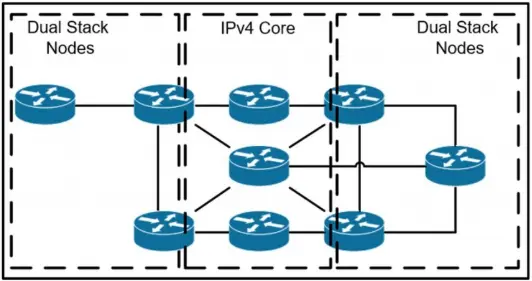
Refer to the exhibit.

A network operator has two IPv4 and IPv6 dual-stacked network on each side of the IPv4 core network. The operator must be able to provide connectivity between them while using specific assigned IPv6 space provided from the company IP administrator team. Which technology should the network operator use to accomplish this goal?

Correct Answer: B. NAT46
Explanation:

The network operator needs to provide connectivity between two IPv4 and IPv6 dual-stacked networks using specific assigned IPv6 space.NAT46(Network Address Translation 46) is the appropriate technology for this scenario. It allows translation between IPv4 and IPv6 addresses, enabling communication between the dual-stack networks. NAT46 maps IPv6 addresses to IPv4 addresses and vice versa, facilitating seamless communication across different address families.Reference: Implementing and Operating Cisco Service Provider Network Core Technologies


Question 5

A customer of an ISP requests support to setup a BGP routing policy. Which BGP attribute should be configured to choose specific BGP speakers as preferred exit points for the customer AS?

Question 6

Refer to the exhibit.

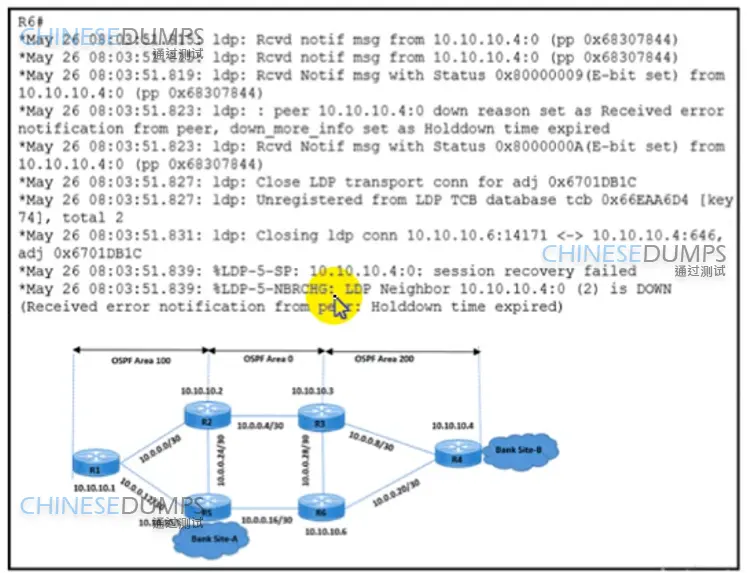
A network engineer is implementing an LDP-based MPLS solution to enable packet flow between the two bank sites The engineer was given two requirements

* LDP peering must stay up when there is a link failure between R3 and R6

* LDP peering must not flap when there is a link failure between R5 and R6

Which action meets these requirements?

Correct Answer: C. Configure LDP Session Protection on R4

Question 7

When implementing a REST API, how does an engineer mitigate security risks?

Correct Answer: D. by configuring rate limiting to reduce the risk of DOS and DDOS attacks against the system

Question 8

Refer to the exhibit.

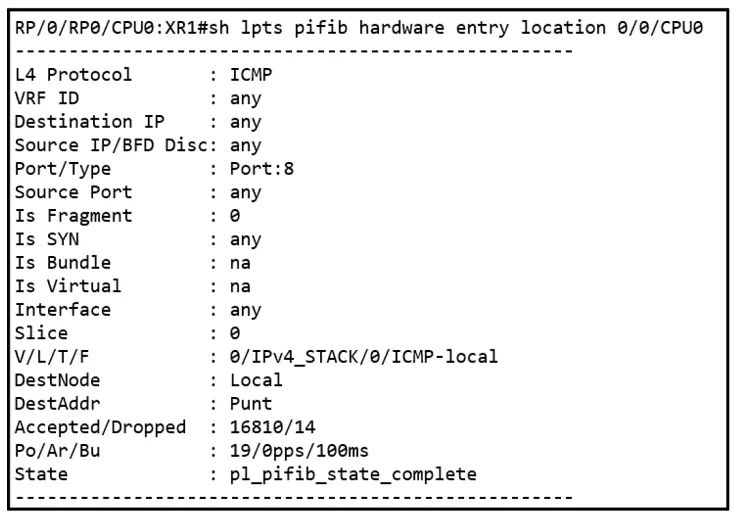
While troubleshooting the network, a network operator with an employee id: 3812:12:993 is trying to ping XR1. Which result should the operator expect when trying to ping to an XR1 local address?

Correct Answer: C. All ICMP traffic is dropped.
Explanation:

https://www.cisco.com/c/en/us/td/docs/routers/asr9000/software/asr9k-r6-5/ip-addresses/configuration/guide/b-ip-addresses-cg-asr9000-65x/m-implementing-lpts-asr9000-crs.html


Question 9

Question 10

A network operator needs to implement PIM-SSM multicast configuration on customer's network so that users in different domains are able to access and stream live traffic. Which two actions must the engineer perform on the network

to make the streaming work? (Choose two.)

Correct Answer: C. Enable PIM sparse mode on the device.; D. Enable IGMP version 3 at the interface level.
Explanation:

Remember that SSM is an extension of IP multicast where datagram traffic is forwarded only from explicitly joined multicast sources to receivers. It creates source-specific multicast distribution trees without shared trees.


Cisco PIM-SSM Configuration Example

Cisco IP Multicast: PIM Configuration Guide

Question 11

Refer to the exihibit.

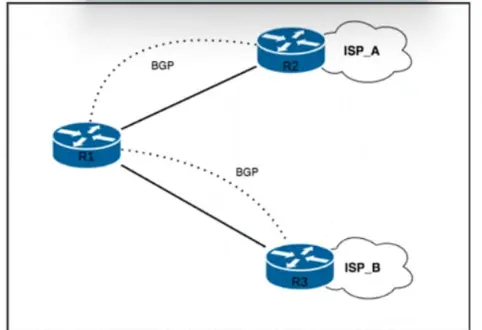
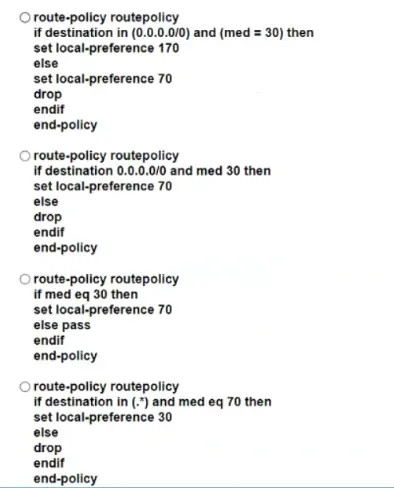
Refer to the exhibit. R1 has two upstream Tier 1 service providers. BGP is in use as the exterior routing protocol, and ISP_A and ISP_B are sending the full BGP table. A network engineer must assign local-preference 70 to all routes with multiple exit discriminator 30. Which configuration must the network engineer apply?

Correct Answer: C. Option C

Question 12

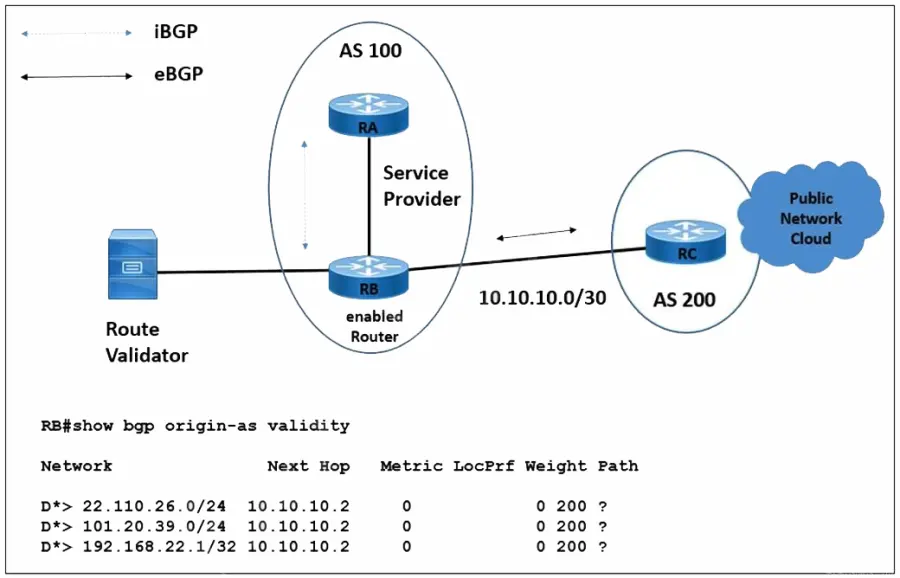
Refer to the exihibit.

Refer to the exhibit. A network engineer is configuring router RB to secure BGP advertisements against route hijacking activity. RB must validate all prefixes that it receives from origin AS 200 before installing them in the BGP route table. Which configuration meets the requirement?

Correct Answer: C. RB(config-bgp)# router bgp 100 RB(config-bgp)# bgp origin-as validation time off

Question 13

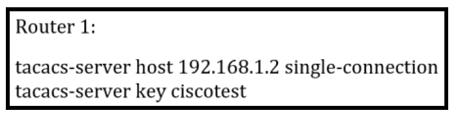
Refer to the exhibit.

What is the result of this configuration?

Correct Answer: C. Router 1 and the TACACS+ server maintain one open connection between them.
Explanation:

In the given configuration, ''tacacs-server host 192.168.1.2 single-connection'' indicates that Router 1 will maintain a single connection to the TACACS+ server at IP address 192.168.1.2 for multiple authorization requests instead of opening a new connection for each request. This can be efficient in scenarios where there are frequent authorization requests as it reduces the overhead associated with establishing a new TCP connection each time.


Question 14

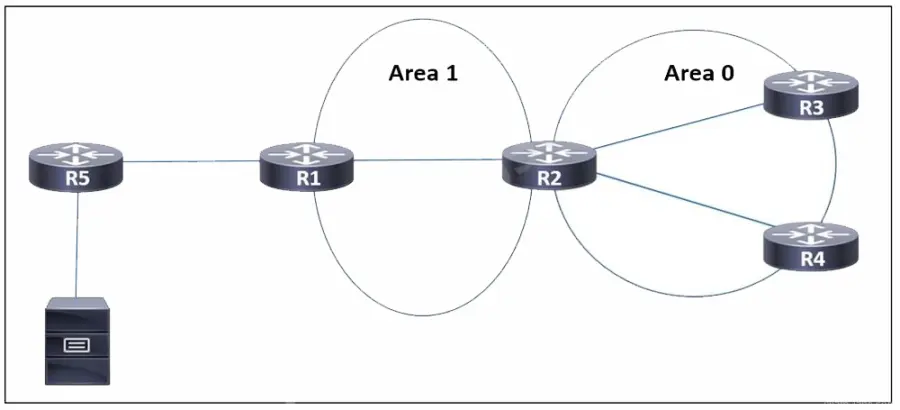
Refer to the exihibit.

Refer to the exhibit. EIGRP is running between routers R5 and R1, and OSPF is used in the rest of the network. Users in a network attached to router R3 need to access a server connected to R5. Which task must the engineer perform so that only the users attached to R3 are able to access the server, but no other network is shared to OSPF?

Correct Answer: A. Configure redistribution using route maps to filter the routes that are shared

Question 15

How does an untrusted interface at the boundary of an administrative domain handle incoming packets?

Correct Answer: A. It remarks all values to a CoS of 0.