Limited-Time Offer: Enjoy 50% Savings! Ends in 00h 00m 00s Coupon code: 50OFF
Skip to content

Free Cisco Implementing and Operating Cisco Data Center Core Technologies 350-601 Exam Questions

Page: 1 / 29 Total 422 questions

Want more questions? Get Premium Access.

Question 1

A network architect considers a Cisco HyperFlex design

solution for a company. The proposed solution is for a virtual environment that is not performance-sensitive, but the solution must have high storage capacity and a low cost. Which Cisco HyperFlex storage configuration should be used?

Correct Answer: B. Hybrid

Question 2

Which two actions are needed to configure a single Cisco APIC controller for a Cisco ACI fabric for the first time? (Choose two.)

Correct Answer: C. Register the switches that are discovered through LLDP.; D. Configure the first Cisco APIC controller.
Explanation:

The correct answers are C and D because of the standard Cisco ACI fabric bring-up workflow. When deploying a Cisco ACI fabric for the first time, the process begins with initial configuration of the first APIC controller. This includes assigning the fabric name, out-of-band management settings, and cluster parameters. Cisco documentation clearly defines this as the first mandatory step in fabric initialization, making option D correct.

After the APIC is configured and connected to the network, the fabric switches (leaf and spine) are automatically discovered using LLDP. Cisco ACI uses LLDP to detect connected devices and identify them as part of the fabric infrastructure. These discovered devices must then be manually registered (claimed) in the APIC GUI, which validates their role and integrates them into the fabric. This makes option C correct.

Option A is incorrect because APICs are not ''registered'' in that way; they are configured and clustered. Option B is incorrect because leaf switches do not require manual CLI configuration for APIC connectivity---they operate in ACI mode and are discovered automatically. Option E is incorrect because switches are not registered all at once blindly; they are registered after LLDP discovery.


Question 3

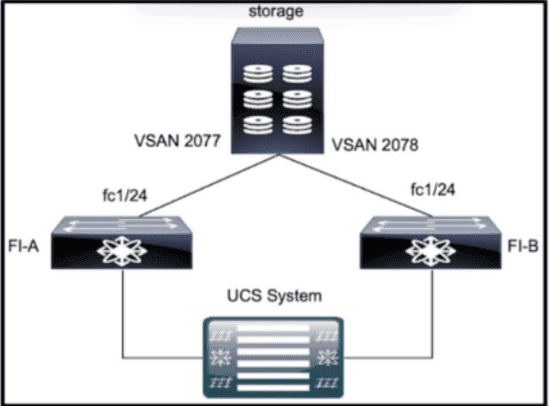
Refer to the exhibit.

Refer to the exhibit. VSAN 2077 has been configured as the primary path. Which configuration must be implemented to allow the Cisco UCS system to enable zoning while the device neighbor allows communication using port FC1/24 to the servers?

Correct Answer: D. Configure Fl in Fibre Channel end-host mode and port fd/24 as an appliance port.

Question 4

A network administrator must back up a Cisco Unified Computing System domain before a system upgrade. The backup must include both system and logical configuration settings. Which backup type must be used?

Correct Answer: C. All configuration
Explanation:

An all-configuration backup creates an XML file containing both system and logical configuration settings. System settings include elements such as usernames, roles, and locales, while logical settings include service profiles, VLANs, VSANs, pools, and policies. This directly satisfies the requirement to preserve both configuration categories before the upgrade. A full-state backup is a binary snapshot intended primarily for disaster recovery and system restoration, not a configuration import. A logical-configuration backup contains only logical objects and excludes administrative system settings. Conversely, a system-configuration backup includes administrative settings but excludes logical objects such as service profiles and connectivity policies. Cisco explicitly defines all configuration as the backup type that combines system and logical configuration information and permits those settings to be imported into the original or another fabric interconnect. Cisco UCS backup types


Question 5

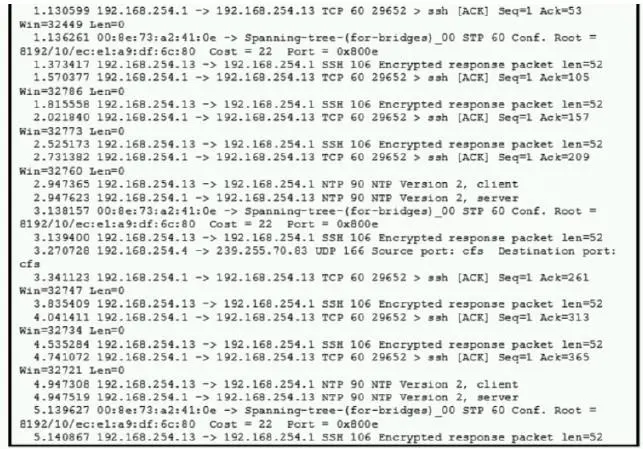
Refer to the exhibit.

Cisco Fabric Services is enabled in the network. Which type of IP address is used by the Cisco Fabric Services protocol?

Correct Answer: B. IPv4 multicast address

Question 6

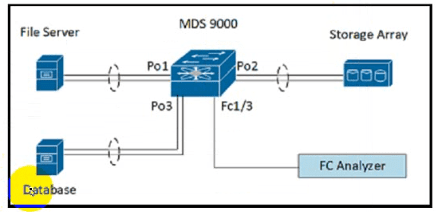
Refer to the exhibit.

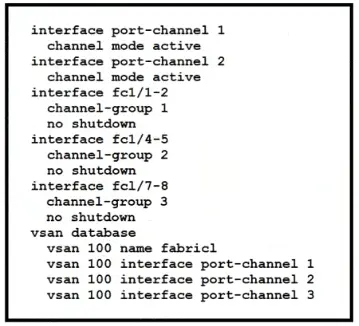
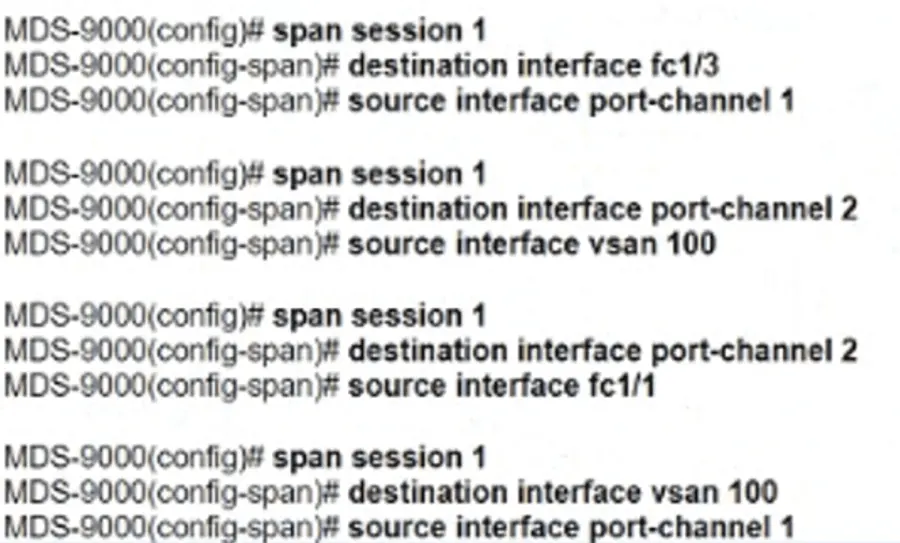
Refer to the exhibit. A storage engineer must monitor the traffic from the file server to the FC analyzer. The file server and the database use the same storage array. Which configuration must be applied to the Cisco MDS 9000 Series Switch to accomplish this goal?

Correct Answer: A. Option A

Question 7

Refer to the exhibit.

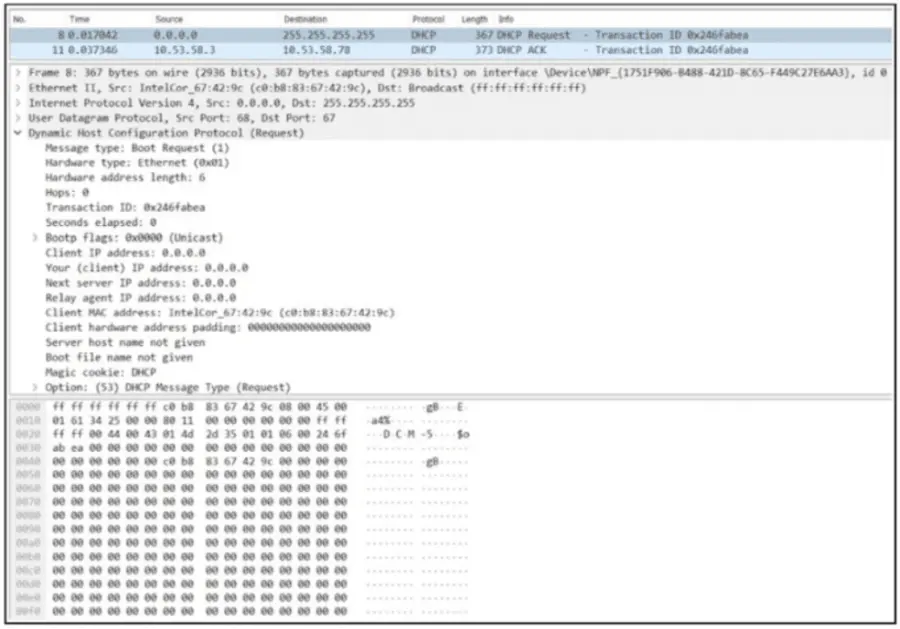
Refer to the exhibit An engineer analyzes a Wireshark packet flow between a PC and a DHCP server What occurs in the packet flow?

Correct Answer: A. The PC sends an anycast asking for an IP address

Question 8

An engineer must configure device aliases for a Cisco MDS 9000 Series switches-based SAN fabric. The configuration must meet these requirements:

* The engineer must be prompted before the changes are committed to the database.

* Pending changes must be explicitly displayed on the console.

Which command accomplishes this task?

Correct Answer: A. device-alias confirm-commit
Explanation:

The correct answer is A. On Cisco MDS 9000 Series switches, the command device-alias confirm-commit enables a confirmation step when committing the pending device-alias database. Cisco documentation states that when this command is enabled, issuing device-alias commit causes the switch to display the pending differences on the console and then prompt the user for confirmation (Yes or No) before the changes are actually committed. This matches both requirements in the question exactly: the engineer is prompted before commit, and the pending changes are explicitly shown.

Option C is incorrect because device-alias commit performs the commit action itself, but by itself it does not guarantee that the pending diff will be displayed and confirmed first. That behavior is specifically controlled by device-alias confirm-commit. Option B is incorrect because enhanced device-alias mode relates to how aliases are managed and distributed in the fabric, not to prompting or displaying pending differences during commit. Option D affects distribution behavior and optimization, not console confirmation. Therefore, the only command that satisfies the stated operational and visibility requirements is device-alias confirm-commit


Question 9

Refer to the exhibit.

Refer to the exhibit. A network engineer is using tcpdump to capture a

snapshot of OSPF-related traffic on a specific Cisco NX-OS switch port. For security reasons, the capture must be taken using an embedded container that is already deployed on the Cisco Nexus device. Which command completes the script?

Correct Answer: A. Guestshell

Question 10

Which cloud deployment model uses two or more private or public clouds for a single organization using a technology to connect the two clouds together?

Correct Answer: A. hybrid cloud
Explanation:

The correct answer is A. hybrid cloud.

A hybrid cloud is a cloud deployment model that combines two or more distinct cloud infrastructures, typically private cloud, public cloud, or a combination of both, that remain separate environments but are connected by technology that enables data and application portability. This definition directly matches the wording of the question, which describes a single organization using multiple clouds connected together.

In Cisco data center and cloud architecture discussions, hybrid cloud is commonly used when an organization wants to keep some workloads on-premises or in a private cloud while extending other workloads to a public cloud provider for flexibility, scalability, disaster recovery, or cost optimization. The important point is that the clouds are integrated and interoperable, not isolated.

The other options do not match. A private cloud is dedicated to one organization but does not inherently combine multiple clouds. A public cloud is owned and operated by a cloud provider for general use. A community cloud is shared by organizations with common requirements. Therefore, the only model that specifically describes connecting two or more clouds for one organization is hybrid cloud.


Question 11

An engineer must assign a device alias of Marketing to a Fibre Channel port that has a worldwide name of 21:00:00:00:11:11:22:22 on a Cisco MDS 9000 Series Switch. Which two commands accomplish this goal? (Choose two.)

Correct Answer: B. device-alias database; C. device-alias name Marketing pwwn 21:00:00:00:11:11:22:22
Explanation:

The correct answers are B and C. On Cisco MDS 9000 switches, device aliases are configured within the device-alias database configuration mode, which is entered using the command device-alias database. This is required before defining or modifying any device alias entries, making option B mandatory.

Once inside the device-alias database, the alias is created using the syntax:

device-alias name pwwn <WWN>

Here, pwwn (Port World Wide Name) is the correct identifier used for Fibre Channel endpoints. Therefore, the command

device-alias name Marketing pwwn 21:00:00:00:11:11:22:22

correctly maps the alias Marketing to the specified WWN, making option C correct.

Option D is incorrect because Cisco syntax specifically uses pwwn, not wwn, for device alias definitions. Option A is unrelated, as VSAN database configuration is used for VSAN settings, not device aliases. Option E is invalid because device-alias rename is not used to create a new alias.

Thus, the correct process is entering the device-alias database and then defining the alias using the pwwn keyword.


Question 12

An engineer is configuring a traffic-monitoring session on a Cisco Unified Computing System to analyze Fibre Channel over Ethernet traffic for performance tuning. The session must monitor traffic from a VSAN associated with the vHBA of a service profile. Which set of actions accomplishes this goal?

Correct Answer: D. Designate the VSAN as the SPAN source, configure an unconfigured physical Ethernet port as the destination, and activate the monitoring session for all traffic.
Explanation:

To monitor FCoE traffic associated with a vHBA, the corresponding VSAN should be selected as the traffic-monitoring source. This captures the relevant storage traffic without incorrectly selecting a vNIC, Ethernet port channel, or individual Fibre Channel uplink. Cisco UCS requires a dedicated, unconfigured physical Ethernet port as the monitoring destination so that copied frames can be delivered to an external analyzer. The session must also be enabled after defining its source and destination. Option A incorrectly uses a Fibre Channel port as the source and an active uplink as the destination. Option B uses Ethernet and vNIC components that do not represent the required VSAN traffic. Option C reverses the source and destination roles and attempts to send monitored traffic to an FC uplink, which is not the correct destination for an external Ethernet analyzer.

Question 13

An engineer must back up the Cisco UCS configuration. The backup job must meet these requirements:

* It must use the TCP protocol.

* Client identification must be verified before data is transmitted.

* The backup must contain all the system and logical configuration settings.

* The operations team requires that the backup file is in a human-readable format.

Which set of configurations must the engineer use?

Correct Answer: C. Type: All configurationProtocol: SCP
Explanation:

The correct answer is C because it is the only option that satisfies all four requirements at the same time. Cisco UCS Manager documentation states that an All configuration backup is an XML file containing all system and logical configuration settings. Because it is XML, it is human-readable, which matches the operations team requirement. By contrast, a Full state backup is a binary snapshot, so it is not human-readable, and System configuration or Logical configuration alone do not include both sets of settings.

For the transport requirement, SCP is correct because Cisco UCS supports backup transfer over FTP, TFTP, SCP, or SFTP, and SCP runs over SSH/TCP, providing authenticated, secure file transfer before the actual data copy occurs. TFTP is not valid here because it uses UDP and does not provide secure identity verification. Although SFTP also uses SSH/TCP, option D fails because Full state is binary, and option A fails because System configuration does not include all logical settings. Therefore, the only fully correct combination is All configuration + SCP.


Question 14

An engineer must integrate VMware vCenter with the Cisco ACI fabric and allow the network layer to be extended in the virtual domain. The VMware environment has these attributes:

* VMware vCenter 7.0

* vPC must connect to the leafs

* DVS 6.6

Which policy must the engineer configure to meet the requirements of the virtual domain?

Correct Answer: A. Enhanced LACP
Explanation:

The correct answer is A. Enhanced LACP.

In a Cisco ACI VMware VMM domain, the policy used for host uplink connectivity depends on how the ESXi hosts connect to the ACI leaf switches. The question states that vPC must connect to the leafs and the environment uses VMware Distributed Virtual Switch (DVS) 6.6. When hosts are dual-homed to ACI leaves using vPC, Cisco ACI uses Enhanced LACP as the preferred uplink policy because it provides active-active link utilization, fast convergence, and consistent forwarding behavior across both leaf switches.

MAC pinning is typically used when LACP is not available or not desired, but it does not provide the same standards-based port-channel negotiation and is not the best match when the requirement explicitly calls for vPC connectivity. Tag collection is related to VM attribute collection for policy mapping, not uplink formation. LLDP transmit helps with discovery and visibility, but it does not establish the host-to-leaf port-channel behavior.

Because the design specifically requires vPC attachment of VMware hosts through a supported DVS, the required ACI policy is Enhanced LACP.


Question 15

Which configuration statically assigns VSAN membership to a virtual Fibre Channel interface?

Correct Answer: D. Switch(config-vsan-db)# vsan 100 interface vfc 31