Limited-Time Offer: Enjoy 50% Savings! Ends in 00h 00m 00s Coupon code: 50OFF
Skip to content

Free Cisco Engineering Cisco Meraki Solutions 500-220 Exam Questions

Page: 1 / 8 Total 72 questions

Want more questions? Get Premium Access.

Question 1

The WAN connection of a Cisco Meraki MX security appliance is congested, and the MX appliance is buffering the traffic from LAN ports going to the WAN ports. High, normal, and low priority queue buffers are all full. Which proportion of the normal traffic is forwarded compared to the other queues?

Question 2

Where should a network admin navigate to investigate wireless mesh information between Meraki APs?

Question 3

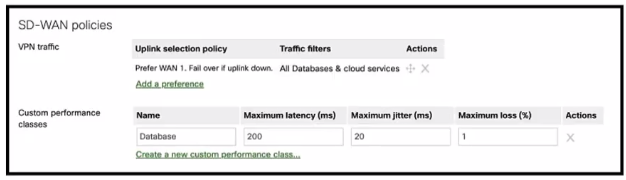
Refer to the exhibit.

Which condition or conditions will cause the "All Databases & cloud services" SD-WAN traffic to be routed via a VPN2 tunnel on WAN2?

Correct Answer: B. WAN1 tunnel latency is 20 ms or more, and WAN2 tunnel meets the configured performance criteria.
Explanation:

This is because the SD-WAN policy for ''All Databases & cloud services'' has the following settings:

Uplink selection policy: Prefer WAN1, Fail over if down

Traffic filters: Custom performance classes

Custom performance classes: Database

Database performance criteria: Maximum latency 200 ms, Maximum jitter 20 ms, Maximum loss 1%

This means that the SD-WAN traffic will be routed via WAN1 by default, unless WAN1 is down or fails to meet the database performance criteria. In that case, the traffic will be routed via WAN2, if WAN2 meets the database performance criteria. Therefore, the condition that will cause the traffic to be routed via WAN2 is when WAN1 tunnel latency is 20 ms or more (which exceeds the maximum jitter of 20 ms), and WAN2 tunnel meets the configured performance criteria (maximum latency 200 ms, maximum jitter 20 ms, maximum loss 1%).

Question 4

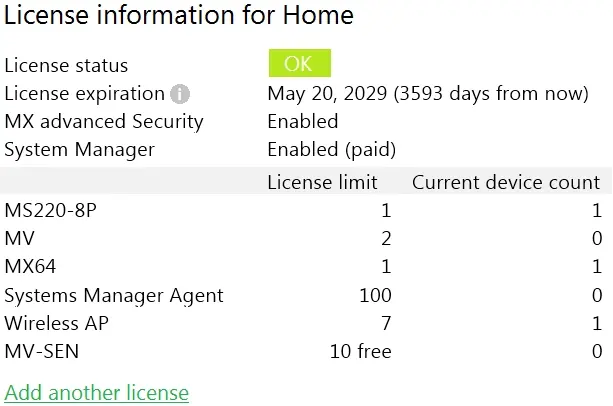
Refer to the exhibit.

This Dashboard organization uses Co-Termination licensing model.

What happens when an additional seven APs are claimed on this network without adding licenses?

Question 6

Which information is used to calculate whether a WAN link has high usage?

Question 7

Question 8

An organization requires that BYOD devices be enrolled in Systems Manager before they gain access to the network. Part of the enrollment includes pushing out the corporate SSID preshared key, corporate email settings, and some business-sensitive PDFs. When a user leaves the organization, which Systems Manager feature allows the removal of only the MDM-delivered content from the user's device?

Question 9

What are two methods of targeting and applying management profiles to System Manager clients? (Choose two.)

Correct Answer: B. by defining the scope; D. by using device tags
Explanation:

The correct answer is B and D. These are the two methods of targeting and applying management profiles to System Manager clients, according to the [System Manager: Getting Started] article. The article explains that:

Defining the scope: This method allows you to target devices based on their network, tag, or owner. You can define the scope of a profile from the Systems Manager > Manage > Settings page or from the Systems Manager > Monitor > Overview page.

Using device tags: This method allows you to target devices based on their attributes, such as OS, model, location, or user. You can use device tags to create dynamic groups of devices that share common characteristics. You can apply device tags from the Systems Manager > Monitor > Devices page or from the Systems Manager > Manage > Tags page.


Question 10

There will be 100 concurrent users streaming video to their laptops. A 30/70 split between 2.4 Ghz and 5 Ghz will be used. Roughly how many APs (rounded to the nearest whole number) are needed based on client count?

Correct Answer: C. 4
Explanation:

This is the approximate number of APs that are needed based on client count, assuming that each AP can support up to 25 concurrent video streaming users. This can be calculated by using the formula:

Number of APs = (Number of Users x Percentage of Users on a Band) / Number of Users per AP on that Band

Where Number of Users is 100, Percentage of Users on 2.4 Ghz is 30%, Percentage of Users on 5 Ghz is 70%, Number of Users per AP on 2.4 Ghz is 15, and Number of Users per AP on 5 Ghz is 30. Therefore,

Number of APs = (100 x 0.3 / 15) + (100 x 0.7 / 30) Number of APs = (3.33) + (2.33) Number of APs = 5.66

Rounding to the nearest whole number, the number of APs is4.

This question is related to the topic ofWireless Capacity Planningin the Cisco Meraki documentation. You can find more information about this topic in the [Wireless Capacity Planning] article or the [Best Practice Design - MR Wireless] page.