
Limited-Time Offer: Enjoy 50% Savings! Ends in 00h 00m 00s Coupon code: 50OFF
Skip to content

Free Cisco Supporting Cisco Devices for Field Technicians 800-150 Exam Questions

Page: 1 / 10 Total 100 questions

Want more questions? Get Premium Access.

Question 1

Which command is used to download a copied configuration file from a TFTP server to merge it with the running configuration of a replacement Cisco device?

Correct Answer: C. copy tftp: running-config
Explanation:

The command copy tftp: running-config is used to retrieve a configuration file from a TFTP server and merge it with the current running configuration of a Cisco device. This operation is additive, meaning it integrates the new configuration commands into the existing running configuration without removing any pre-existing commands unless explicitly overridden.

This method is particularly useful when restoring configurations to a replacement device, as it allows for the seamless integration of necessary settings without disrupting the current operational state.

In contrast, using copy tftp: startup-config would overwrite the startup configuration file, which could lead to unintended consequences upon the next device reload. The options load tftp: running-config and merge tftp: running-config are not valid Cisco IOS commands.

Question 2

Which two components are accessed by removing the chassis cover on Cisco Catalyst 8000 Series Edge platforms? (Choose two.)

Correct Answer: C. DIMMs; D. SSDs
Explanation:

On Cisco Catalyst 8000 Series Edge platforms, removing the chassis cover provides access to internal components such as DIMMs (Dual In-line Memory Modules) and SSDs (Solid-State Drives). These components are located internally and require the removal of the chassis cover for maintenance or replacement.

DIMMs are used for system memory and are essential for the router's operation.

SSDs provide storage for system software and configurations.

Other components like Network Interface Modules (NIMs) and transceivers are typically accessible externally and do not require chassis cover removal.


Question 3

Which management option is best suited for standalone Cisco Secure Firewall deployments?

Correct Answer: D. Cisco Secure Firewall Device Manager
Explanation:

For standalone Cisco Secure Firewall deployments, the Cisco Secure Firewall Device Manager (FDM) is the most appropriate management option. FDM is a browser-based, on-box management tool that allows administrators to configure and manage a single firewall device without the need for external management infrastructure. It provides an intuitive interface for basic configurations, policy management, and monitoring.

In contrast:

Cisco Secure Firewall Management Center (FMC) is designed for centralized management of multiple firewall devices.

Cisco Defense Orchestrator (CDO) is a cloud-based solution for managing security policies across various devices.

Cisco Security Manager is an older platform primarily used for managing ASA devices.


Question 4

Which two actions are typically performed in ROMMON mode during the password recovery process? (Choose two.)

Correct Answer: A. Change the configuration register.; E. Reboot the device.
Explanation:

During the password recovery process on Cisco devices, ROMMON (ROM Monitor) mode is utilized to perform specific actions that facilitate the recovery. Two critical actions typically performed in ROMMON mode are:

Change the Configuration Register: The configuration register is modified to instruct the device to ignore the startup configuration during the next boot. This is commonly achieved by setting the configuration register to 0x2142. This action prevents the device from loading the saved configuration, allowing access without requiring the existing passwords.

Reboot the Device: After changing the configuration register, the device is rebooted to apply the new settings. This reboot enables the device to bypass the startup configuration, facilitating the password recovery process.

These steps are essential in the password recovery procedure, allowing administrators to regain access to the device without erasing the existing configuration.


Question 5

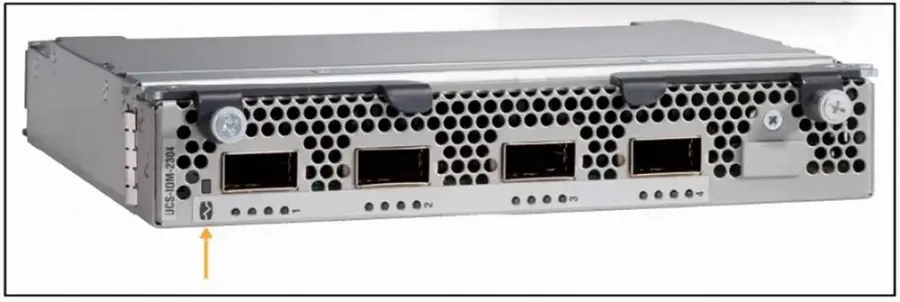
Refer to the exhibit.

Refer to the exhibit. Which component is highlighted on the Cisco I/O module image?

Correct Answer: B. chassis connections LED
Explanation:

The highlighted component on the Cisco I/O module is the chassis connections LED, which indicates the status of connectivity between the I/O module and the chassis.

In the exhibit, the orange arrow points to a small rectangular LED indicator located to the left side of the I/O module (Cisco UCS-IOM-2304). This specific LED is not aligned with the ports, fans, or screws, which helps identify it correctly.

Chassis connections LED (B) is responsible for indicating the status of uplink/downlink communication between the I/O module and the chassis.

Green usually indicates a healthy link.

Amber or off may indicate a problem or no connection.

Why the other answers are incorrect:

A . Captive screw These are at the far corners, not where the arrow points.

C . Fan module LED This IOM doesn't have user-visible fan LEDs at the front face.

D . Fixed port These are the large rectangular SFP ports clearly visible in the middle, not near the arrow.

This identification is important when troubleshooting chassis-to-IOM connectivity or verifying module status LEDs during field maintenance.


Question 6

Which two devices are most commonly used in a WAN environment? (Choose two.)

Correct Answer: B. Optical fiber converters; C. Modems
Explanation:

In the context of Wide Area Networks (WANs), the key objective is to connect geographically separated networks using service provider infrastructure. The FLDTEC course emphasizes that WAN environments typically involve devices that can handle different physical transmission mediums and protocols.

Modems:

Modulate and demodulate analog signals to digital signals.

Used in WAN environments to connect over analog lines like DSL or leased lines.

Essential for interfacing between digital routers and analog telephone networks.

Optical Fiber Converters:

Also known as media converters, they are used to convert electrical signals to optical signals (and vice versa) for fiber transmission.

Common in WAN scenarios where long-distance high-speed transmission over fiber is required.

Incorrect Options:

A . Hubs: Obsolete Layer 1 devices used in LANs, not suitable for WANs.

D . Network Interface Cards (NICs): Used in end devices for LAN connectivity.

E . Wireless Access Points: Typically used in WLANs within local premises, not WAN infrastructure.

This aligns with Cisco's WAN architecture fundamentals as highlighted in FLDTEC under ''Cisco Equipment and Related Hardware.''


Question 7

Which operating system powers the Cisco Nexus series of switches and is optimized for modern data center deployments?

Correct Answer: D. NX-OS
Explanation:

Cisco NX-OS is the operating system specifically developed for Cisco Nexus series switches, which are widely used in modern data centers. NX-OS is optimized for scalability, high availability, and virtualization features.

It differs from IOS and IOS XE (used in traditional routers and switches) and IOS XR (used in carrier-grade platforms). NX-OS includes advanced features such as Virtual Port Channels (vPC), FabricPath, and integrated Layer 2/3 capabilities tailored for data center networks.


Question 8

Why is a Cisco Nexus switch typically deployed in a network?

Correct Answer: B. In data centers for high-performance, low latency switching
Explanation:

Cisco Nexus switches are specifically designed for deployment in data centers, where they provide high-performance, low-latency switching to support modern workloads, virtualization, and cloud computing environments.

Nexus switches operate using NX-OS, a purpose-built operating system optimized for data center needs. These switches support technologies like virtual port channels (vPC), FabricPath, and Application Centric Infrastructure (ACI), which are essential for scalable and highly available data center networks.

They are not typically used in branch offices, as wireless access points, or as edge routers.


Question 9

Which command is used to copy the startup configuration of a device to a USB file system when transferring files to a Cisco device?

Correct Answer: C. Router# copy startup-config usbflash0:[filename]
Explanation:

To back up the startup configuration of a Cisco device to a USB drive, the command copy startup-config usbflash0:[filename] is used. This command copies the contents of the startup configuration file stored in NVRAM to a specified file on the USB flash drive. This is particularly useful for creating backups before performing upgrades or replacements. Option A: Copies the startup configuration to a TFTP server, not a USB drive.

Option B: Attempts to copy from the USB drive to the startup configuration, which is the reverse of the desired operation.

Option D: Copies the running configuration, not the startup configuration, to the USB drive.


Question 10

Which two actions ensure a smooth transition to the new hardware when replacing a Cisco UCS C-Series Rack-Mount Server? (Choose two.)

Correct Answer: B. Back up the server configuration using Cisco Integrated Management Controller.; D. Decommission the server if it is integrated in a Cisco UCS domain.
Explanation:

To ensure a smooth replacement of a Cisco UCS C-Series Rack-Mount Server, two critical actions are:

Back up the server configuration using the Cisco Integrated Management Controller (CIMC): This preserves all configuration data such as BIOS settings, RAID setup, and network configuration. After replacing the hardware, this configuration can be restored to minimize setup time.

Decommission the server if it is integrated in a Cisco UCS domain: Before physically replacing the server, decommissioning it ensures the UCS Manager properly releases it from the inventory, preventing configuration conflicts or orphaned profiles.

Other options, like reconfiguring DHCP or disabling firewalls, are not required procedures for a UCS C-Series hardware swap.