
Limited-Time Offer: Enjoy 50% Savings! Ends in 00h 00m 00s Coupon code: 50OFF
Skip to content

Free CompTIA SecurityX Certification Exam CAS-005 Exam Questions

Page: 1 / 23 Total 345 questions

Want more questions? Get Premium Access.

Question 1

Company A acquired Company B and needs to determine how the acquisition will impact the attack surface of the organization as a whole. Which of the following is the best way to achieve this goal? (Select two).

Implementing DLP controls preventing sensitive data from leaving Company B's network

Correct Answer: A. Documenting third-party connections used by Company B; B. Reviewing the privacy policies currently adopted by Company B
Explanation:

To determine how the acquisition of Company B will impact the attack surface, the following steps are crucial:

A . Documenting third-party connections used by Company B: Understanding all external connections is essential for assessing potential entry points for attackers and ensuring that these connections are secure.

E . Performing an architectural review of Company B's network: This review will identify vulnerabilities and assess the security posture of the acquired company's network, providing a comprehensive understanding of the new attack surface.

These actions will provide a clear picture of the security implications of the acquisition and help in developing a plan to mitigate any identified risks.


CompTIA SecurityX Study Guide: Emphasizes the importance of understanding third-party connections and conducting architectural reviews during acquisitions.

NIST Special Publication 800-37, 'Guide for Applying the RiskManagement Framework to Federal Information Systems': Recommends comprehensive reviews and documentation of third-party connections.

'Mergers, Acquisitions, and Other Restructuring Activities' by Donald DePamphilis: Discusses the importance ofsecurity assessments during acquisitions.
Question 2

Which of the following is the security engineer most likely doing?

Correct Answer: A. Assessing log inactivities using geolocation to tune impossible Travel rate alerts
Explanation:

In the given scenario, the security engineer is likely examining login activities and their associated geolocations. This type of analysis is aimed at identifying unusual login patterns that might indicate an impossible travel scenario. An impossible travel scenario is when a single user account logs in from geographically distant locations in a short time, which is physically impossible. By assessing login activities using geolocation, the engineer can tune alerts to identify and respond to potential security breaches more effectively.


Question 3

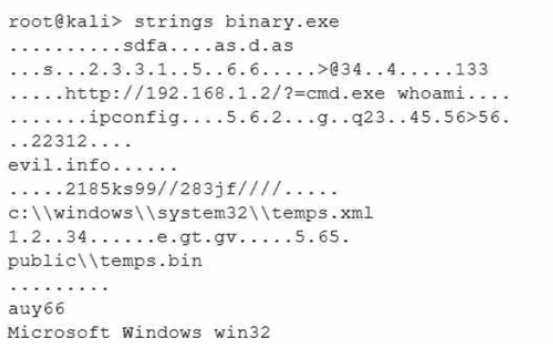
After a cybersecurity incident, a security analyst was able to collect a binary that the attacker used on the compromised server. Then the analyst ran the following command:

Which of the following options describes what the analyst is trying to do?

Correct Answer: B. To extract loCs from the binary used on the attack
Explanation:

The strings utility extracts human-readable text from binary files. Security analysts use it to identify Indicators of Compromise (IoCs) such as URLs, IP addresses, filenames, and commands embedded in the malware.

Option A (reconstructing timeline) would require event logs or forensic timeline tools.

Option C (replicating the attack) involves execution in a sandbox, not static string extraction.


Question 4

An endpoint security engineer finds that a newly acquired company has a variety of non-standard applications running and no defined ownership for those applications. The engineer needs to find a solution thatrestricts malicious programs and software from running in that environment, while allowing the non-standard applications to function without interruption. Which of the following application control configurations should the engineer apply?

Correct Answer: C. Audit mode
Explanation:

Step-by-Step

Option A: Deny list

Deny lists block specific applications or processes identified as malicious.

This approach is reactive and mayinadvertently block the non-standard applications that are currently in use without proper ownership.

Option B: Allow list

Allow lists permit only pre-approved applications to run.

While secure, this approach requires defining all non-standard applications, which may disrupt operations in an environment where ownership is unclear.

Option C: Audit mode

Correct Answer.

Audit mode allows monitoring and logging of applications without enforcing restrictions.

This is ideal in environments with non-standard applications and undefined ownership because it enables the engineer to observe the environment and gradually implement control without interruption.

Audit mode provides critical visibility into the software landscape, ensuring that necessary applications remain functional.

Option D: MAC list

Mandatory Access Control (MAC) lists restrict access based on classification and clearance levels.

This does not align with application control objectives in this context.

CompTIA CASP+ Study Guide - Chapters on Endpoint Security and Application Control.

CASP+ Objective 2.4: Implement appropriate security controls for enterprise endpoints.


Question 5

A software engineer is creating a CI/CD pipeline to support the development of a web application The DevSecOps team is required to identify syntax errors Which of the following is the most relevant to the DevSecOps team's task'

Correct Answer: A. Static application security testing
Explanation:

Static Application Security Testing (SAST) involves analyzing source code or compiled code for security vulnerabilities without executing the program. This method is well-suited for identifying syntax errors, coding standards violations, and potential security issues early in the development lifecycle.

A . Static application security testing (SAST): SAST tools analyze the source code to detect syntax errors, vulnerabilities, and other issues before the code is run. This is the most relevant task for the DevSecOps team to identify syntax errors and improve code quality.

B . Software composition analysis: This focuses on identifying vulnerabilities in open-source components and libraries used in the application but does not address syntax errors directly.

C . Runtime application self-protection (RASP): RASP involves monitoring and protecting applications during runtime, which does not help in identifying syntax errors during the development phase.

D . Web application vulnerability scanning: This involves scanning the running application for vulnerabilities but does not address syntax errors in the code.


CompTIA Security+ Study Guide

OWASP (Open Web Application Security Project) guidelines on SAST

NIST SP 800-95, 'Guide to Secure Web Services'

Top of Form

Bottom of Form

Question 6

A financial technology firm works collaboratively with business partners in the industry to share threat intelligence within a central platform This collaboration gives partner organizations the ability to obtain and share data associated with emerging threats from a variety of adversaries Which of the following should the organization most likely leverage to facilitate this activity? (Select two).

Correct Answer: D. STIX; E. TAXII
Explanation:

D . STIX (Structured Threat Information eXpression): STIX is a standardized language for representing threat information in a structured and machine-readable format. It facilitates the sharing ofthreat intelligence by ensuring that data is consistent and can be easily understood by all parties involved.

E . TAXII (Trusted Automated eXchange of Indicator Information): TAXII is a transport mechanism that enables the sharing of cyber threat information over a secure and trusted network. It works in conjunction with STIX to automate the exchange of threat intelligence among organizations.

Other options:

A . CWPP (Cloud Workload Protection Platform): This focuses on securing cloud workloads and is not directly related to threat intelligence sharing.

B . YARA: YARA is used for malware research and identifying patterns in files, but it is not a platform for sharing threat intelligence.

C . ATT&CK: This is a knowledge base of adversary tactics andtechniques but does not facilitate the sharing of threat intelligence data.

F . JTAG: JTAG is a standard for testing and debugging integrated circuits, not related to threat intelligence.


CompTIA Security+ Study Guide

'STIX and TAXII: The Backbone of Threat Intelligence Sharing' by MITRE

NIST SP 800-150, 'Guide to Cyber Threat Information Sharing'

Question 7

Third partiesnotified a company's security team about vulnerabilities in the company's application. The security team determined these vulnerabilities were previously disclosed in third-party libraries. Which of the following solutions best addresses the reported vulnerabilities?

Correct Answer: D. Integrating a SASI tool as part of the pipeline
Explanation:

The best solution to address reported vulnerabilities in third-party libraries is integrating a Static Application Security Testing (SAST) tool as part of the development pipeline. Here's why:

Early Detection: SAST tools analyze source code for vulnerabilities before the code is compiled. This allows developers to identify and fix security issues early in the development process.

Continuous Security: By integrating SAST tools into the CI/CD pipeline, the organization ensures continuous security assessment of the codebase, including third-party libraries, with each code commit and build.

Comprehensive Analysis: SAST tools provide a detailed analysis of the code, identifying potential vulnerabilities in both proprietary code and third-party dependencies, ensuring that known issues in libraries are addressed promptly.


CompTIA Security+ SY0-601 Study Guide by Mike Chapple and David Seidl

OWASP Static Analysis Security Testing (SAST) Cheat Sheet

NIST Special Publication 800-53: Security and Privacy Controls for Information Systems and Organizations

Question 8

Which of the following best explains the business requirement a healthcare provider fulfills by encrypting patient data at rest?

Correct Answer: D. Protecting privacy while supporting portability.
Explanation:

Encrypting patient data at rest is a critical requirement for healthcare providers to ensure compliance with regulations such as the Health Insurance Portability and Accountability Act (HIPAA). The primary business requirement fulfilled by this practice is the protection of patient privacy while supporting the portability of medical information. By encrypting data at rest, healthcare providers safeguard sensitive patient information from unauthorized access, ensuring that privacy is maintained even if the storage media are compromised. Additionally, encryption supports the portability of patient records, allowing for secure transfer and access across different systems and locations while ensuring that privacy controls are in place.


CompTIA SecurityX Study Guide: Emphasizes the importance of data encryption for protecting sensitive information and ensuring compliance with regulatory requirements.

HIPAA Security Rule: Requires healthcare providers to implement safeguards, including encryption, to protect patient data.

'Health Informatics: Practical Guide for Healthcare and Information TechnologyProfessionals' by Robert E. Hoyt: Discusses encryption as a key measure for protecting patient data privacy and supporting data portability.

Question 9

A company detects suspicious activity associated with external connections Security detection tools are unable tocategorize this activity. Which of the following is the best solution to help the company overcome this challenge?

Correct Answer: D. implement UEBA
Explanation:

User and Entity Behavior Analytics (UEBA) is the best solution to help the company overcome challenges associated with suspicious activity that cannot be categorized by traditional detection tools. UEBA uses advanced analytics to establish baselines of normal behavior for users and entities within the network. It then identifies deviations from these baselines, which may indicate malicious activity. This approach is particularly effective for detecting unknown threats and sophisticated attacks that do not match known indicators of compromise (IoCs).


Question 10

A threat hunter is identifying potentially malicious activity associated with an APT. When the threat hunter runs queries against the SIEM platform with a date range of 60 to 90 days ago, the involved account seems to be typically most active in the evenings. When the threat hunter reruns the same query with a date range of 5 to 30 days ago, the account appears to be most active in the early morning. Which of the following techniques is the threat hunter using to better understand the data?

Correct Answer: B. User behavior analytics
Explanation:

User behavior analytics (UBA)detectsanomalousactivityby analyzing historical patterns and comparing them to recent behavior. The time shift in account activity suggestspotential compromise or misuse.

TTP-based inquiries (A)focus on known attack tactics, techniques, and procedures but do not involve behavior tracking.

Adversary emulation (C)simulates attacks but does not analyze real data trends.

OSINT analysis (D)gathers intelligence from public sources, which is unrelated to internal account behavior analysis.


Question 11

After several companies in the financial industry were affected by a similar incident, they shared information about threat intelligence and the malware used for exploitation. Which of the following should the companies do to best indicate whether the attacks are being conducted by the same actor?

Correct Answer: A. Apply code stylometry.
Explanation:

Determining if attacks are from the same actor requires unique attribution. Let's analyze:

A . Code stylometry:Analyzes coding style to identify authorship, the best method for linking malware to a specific actor per CAS-005's threat intelligence focus.

B . Common IOCs:Indicates similar attacks but not necessarily the same actor.

C . IOCextractions:Similar to B, lacks specificity for attribution.


Question 12

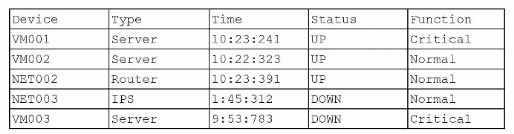
A company SIEM collects information about the log sources. Given the following report information:

Which of the following actions should a security engineer take to enhance the security monitoring posture?

Correct Answer: C. Perform a non-reporting device assessment to collect missing log sources.
Explanation:

The SIEM report shows that some devices, such as VM003 (Critical server) and NET003 (IPS), are DOWN and therefore not reporting logs. In security monitoring, the absence of log data from critical systems creates dangerous blind spots. If logs are missing, attacks can proceed undetected, or investigations may lack the data needed for incident response.

The most effective action is to perform a non-reporting device assessment (C). This means identifying and correcting issues where devices fail to send logs, whether due to outages, misconfigurations, or integration gaps. Ensuring all critical devices, especially servers and intrusion prevention systems, consistently send logs to the SIEM strengthens overall visibility and monitoring posture.

Option A (time calibration) is important for correlation accuracy but does not address missing log feeds. Option B (centralized use case library) enhances detection but only works if the SIEM is receiving complete data. Option D (resiliency plan) helps protect log retention but is irrelevant if logs are never received in the first place.

Therefore, fixing non-reporting log sources is the highest priority to improve monitoring effectiveness.


Question 13

A company developed a new solution that needs to track any changes to the data, and the changes need to be quickly identified. If any changes are attempted without prior approval, multiple events must be triggered, such as:

Raising alerts

Blocking the unapproved changes

Quickly removing access to the data

Which of the following solutions best meets these requirements?

Correct Answer: B. Implementing a file integrity monitoring tool and integrating it via orchestration and automation with other security tools

Question 14

A senior security engineer flags the following log file snippet as having likely facilitated an attacker's lateral movement in a recent breach:

qry_source: 19.27.214.22 TCP/53

qry_dest: 199.105.22.13 TCP/53

qry_type: AXFR

| in comptia.org

------------ directoryserver1 A 10.80.8.10

------------directoryserver2 A 10.80.8.11

------------ directoryserver3 A 10.80.8.12

------------ internal-dns A 10.80.9.1

----------- www-int A 10.80.9.3

------------ fshare A 10.80.9.4

------------ sip A 10.80.9.5

------------ msn-crit-apcs A 10.81.22.33

Which of the following solutions, if implemented, would mitigate the risk of this issue reoccurring?

Correct Answer: A. Disabling DNS zone transfers
Explanation:

The log shows an AXFR (zone transfer) query, which exposed internal DNS records, aiding lateral movement. Let's evaluate:

A . Disabling DNS zone transfers:AXFR allows full DNS zone data to be transferred. Disabling it externally prevents attackers from mapping internal networks, directly mitigating this issue per CAS-005's security operations focus.

B . Restricting to UDP/53:AXFR uses TCP/53, so this wouldn't stop it.

C . DNSmasking:Obscures records but isn't a standard term for this fix.


Question 15

A security analyst is performing threat modeling for a new AI chatbot. The AI chatbot will be rolled out to help customers develop configuration information within the company's SaaS offering. Which of the following issues would require involvement from the company's internal legal team?

Correct Answer: D. User consent is not being collected before training models on customer data.