
Limited-Time Offer: Enjoy 50% Savings! Ends in 00h 00m 00s Coupon code: 50OFF
Skip to content

Free CompTIA Cybersecurity Analyst (CySA+) Exam CS0-003 Exam Questions

Page: 1 / 34 Total 506 questions

Want more questions? Get Premium Access.

Question 1

A Chief Information Security Officer (CISO) is concerned that a specific threat actor who is known to target the company's business type may be able to breach the network and remain inside of it for an extended period of time.

Which of the following techniques should be performed to meet the CISO's goals?

Correct Answer: B. Adversary emulation
Explanation:

The correct answer is B. Adversary emulation.

Adversary emulation is a technique that involves mimicking the tactics, techniques, and procedures (TTPs) of a specific threat actor or group to test the effectiveness of the security controls and incident response capabilities of an organization1. Adversary emulation can help identify and address the gaps and weaknesses in the security posture of an organization, as well as improve the readiness and skills of the security team. Adversary emulation can also help measure the dwell time, which is the duration that a threat actor remains undetected inside the network2.

The other options are not the best techniques to meet the CISO's goals. Vulnerability scanning (A) is a technique that involves scanning the network and systems for known vulnerabilities, but it does not simulate a real attack or test the incident response capabilities. Passive discovery is a technique that involves collecting information about the network and systems without sending any packets or probes, but it does not identify or exploit any vulnerabilities or test the security controls. Bug bounty (D) is a program that involves rewarding external researchers or hackers for finding and reporting vulnerabilities in an organization's systems or applications, but it does not focus on a specific threat actor or group.
Question 2

The security analyst received the monthly vulnerability report. The following findings were included in the report

* Five of the systems only required a reboot to finalize the patch application.

* Two of the servers are running outdated operating systems and cannot be patched

The analyst determines that the only way to ensure these servers cannot be compromised is to isolate them. Which of the following approaches will best minimize the risk of the outdated servers being compromised?

Correct Answer: A. Compensating controls
Explanation:

Compensating controls are the best approach to minimize the risk of the outdated servers being compromised, as they can provide an alternative or additional layer of security when the primary control is not feasible or effective. Compensating controls are security measures that are implemented to mitigate the risk of a vulnerability or an attack when the primary control is not feasible or effective. For example, if the servers are running outdated operating systems and cannot be patched, a compensating control could be to isolate them from the rest of the network, or to implement a firewall or an intrusion prevention system to monitor and block any malicious traffic to or from the servers. Compensating controls can help reduce the likelihood or impact of an exploit, but they do not eliminate the risk completely. Therefore, the security analyst should also consider upgrading or replacing the outdated servers as soon as possible.


Question 3

A security analyst provides the management team with an after-action report for a security incident. Which of the following is the management team most likely to review in order to correct validated issues with the incident response processes?

Correct Answer: B. Lessons learned
Explanation:

The lessons learned phase is a formal step in the incident response process where teams review what went wrong, what worked, and how to improve future responses. Management uses this to adjust policies, procedures, and controls based on real incident experiences.

Tabletop (A) is a simulated discussion, not post-incident.

Root cause analysis (C) finds technical origins but doesn't focus on process improvement.

Forensics (D) supports investigation but not process revision.

Reference:

CS0-003 Domain 3.0 -- Post-Incident Activities

Chapple & Seidl -- Study Guide, Chapter 11: Containment and Recovery


Question 4

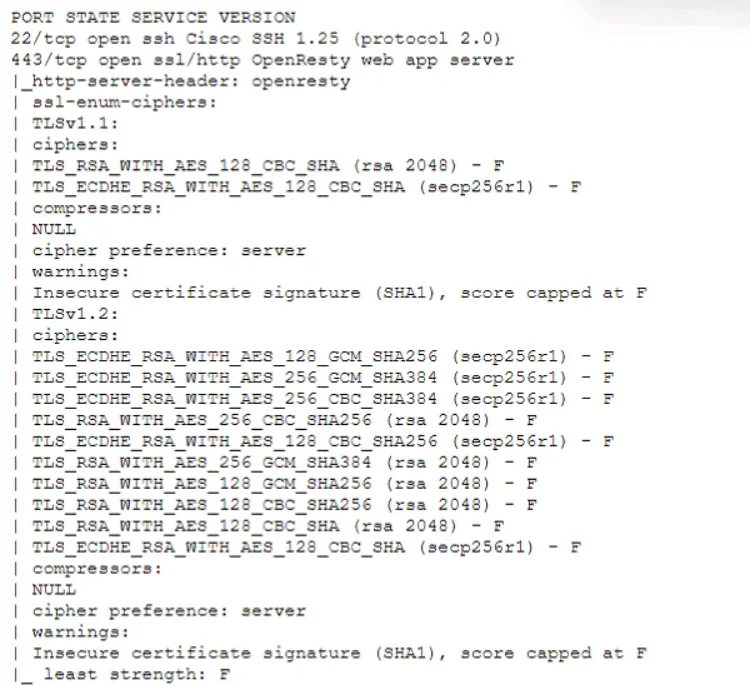
A technician is analyzing output from a popular network mapping tool for a PCI audit:

Which of the following best describes the output?

Correct Answer: C. The host is allowing insecure cipher suites.
Explanation:

The output shows the result of running the ssl-enum-ciphers script with Nmap, which is a tool that can scan web servers for supported SSL/TLS cipher suites. Cipher suites are combinations of cryptographic algorithms that are used to establish secure communication between a client and a server. The output shows the cipher suites that are supported by the server, along with a letter grade (A through F) indicating the strength of the connection. The output also shows the least strength, which is the strength of the weakest cipher offered by the server. In this case, the least strength is F, which means that the server is allowing insecure cipher suites that are vulnerable to attacks or have been deprecated. For example, the output shows that the server supports SSLv3, which is an outdated and insecure protocol that is susceptible to the POODLE attack. The output also shows that the server supports RC4, which is a weak and broken stream cipher that should not be used. Therefore, the best description of the output is that the host is allowing insecure cipher suites. The other descriptions are not accurate, as they do not reflect what the output shows. The host is not up or responding is incorrect, as the output clearly shows that the host is up and responding to the scan. The host is running excessive cipher suites is incorrect, as the output does not indicate how many cipher suites the host is running, only which ones it supports. The Secure Shell port on this host is closed is incorrect, as the output does not show anything about port 22, which is the default port for Secure Shell (SSH). The output only shows information about port 443, which is the default port for HTTPS.


Question 5

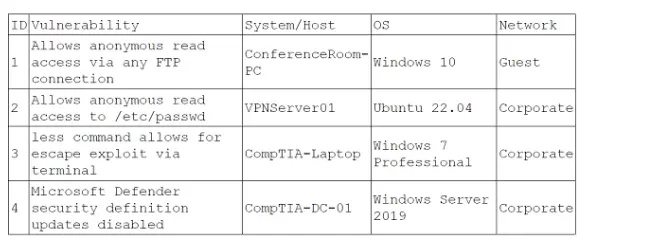
During a training exercise, a security analyst must determine the vulnerabilities to prioritize. The analyst reviews the following vulnerability scan output:

Which of the following issues should the analyst address first?

Correct Answer: A. Allows anonymous read access to /etc/passwd
Explanation:

Allowing anonymous read access to /etc/passwd is a critical vulnerability because it can expose user account details, aiding attackers in password cracking and privilege escalation.

Option B (Anonymous FTP access) is a risk, but /etc/passwd exposure is more critical as it directly affects user authentication.

Option C (Defender updates disabled) is important, but it does not present an immediate attack vector like credential exposure.

Option D (less escape exploit) is significant, but it requires user interaction, making it less immediate than a global credential leak.

Thus, A is the correct answer, as it represents an immediate, high-impact security risk.


Question 6

While reviewing web server logs, an analyst notices several entries with the same time stamps, but all contain odd characters in the request line. Which of the following steps should be taken next?

Correct Answer: B. Determine what attack the odd characters are indicative of
Explanation:

Determining what attack the odd characters are indicative of is the next step that should be taken after reviewing web server logs and noticing several entries with the same time stamps, but all contain odd characters in the request line. This step can help the analyst identify the type and severity of the attack, as well as the possible source and motive of the attacker. The odd characters in the request line may indicate that the attacker is trying to exploit a vulnerability or inject malicious code into the web server or application, such as SQL injection, cross-site scripting, buffer overflow, or command injection. The analyst can use tools and techniques such as log analysis, pattern matching, signature detection, or threat intelligence to determine what attack the odd characters are indicative of, and then proceed to the next steps of incident response, such as containment, eradication, recovery, and lessons learned. Official Reference:

https://partners.comptia.org/docs/default-source/resources/comptia-cysa-cs0-002-exam-objectives

https://www.comptia.org/certifications/cybersecurity-analyst

https://www.comptia.org/blog/the-new-comptia-cybersecurity-analyst-your-questions-answered


Question 7

A cybersecurity analyst is reviewing SIEM logs and observes consistent requests originating from an internal host to a blocklisted external server. Which of the following best describes the activity that is

taking place?

Correct Answer: D. Beaconing
Explanation:

Beaconing is the best term to describe the activity that is taking place, as it refers to the periodic communication between an infected host and a blocklisted external server. Beaconing is a common technique used by malware to establish a connection with a command-and-control (C2) server, which can provide instructions, updates, or exfiltration capabilities to the malware. Beaconing can vary in frequency, duration, and payload, depending on the type and sophistication of the malware. The other terms are not as accurate as beaconing, as they describe different aspects of malicious activity. Data exfiltration is the unauthorized transfer of data from a compromised system to an external destination, such as a C2 server or a cloud storage service. Data exfiltration can be a goal or a consequence of malware infection, but it does not necessarily involve blocklisted servers or consistent requests. Rogue device is a device that is connected to a network without authorization or proper security controls. Rogue devices can pose a security risk, as they can introduce malware, bypass firewalls, or access sensitive data. However, rogue devices are not necessarily infected with malware or communicating with blocklisted servers. Scanning is the process of probing a network or a system for vulnerabilities, open ports, services, or other information. Scanning can be performed by legitimate administrators or malicious actors, depending on the intent and authorization. Scanning does not imply consistent requests or blocklisted servers, as it can target any network or system.


Question 8

A security administrator is tasked with modifying the vulnerability scan process to reduce the network traffic but maintain thorough checks. Which of the following scanning approaches should be implemented?

Correct Answer: D. Agent-based scans
Explanation:

Agent-based scans are run locally on hosts via installed agents, which significantly reduces network traffic while allowing in-depth visibility and accurate scanning. They're ideal for bandwidth-limited or sensitive networks.

Credentialed scans (A) still transmit data over the network.

Individual scans (B) is ambiguous and not a standard term.

Baseline scans (C) focus on policy compliance, not reducing traffic.

? Reference:

Chapple & Seidl -- Vulnerability Management, Chapter 6: Scanning Techniques

CS0-003 Domain 2.1 -- Vulnerability Scanning Methods


Question 9

A user is flagged for consistently consuming a high volume of network bandwidth over the past week. During the investigation, the security analyst finds traffic to the following websites:

Date/Time

URL

Destination Port

Bytes In

Bytes Out

12/24/2023 14:00:25

youtube.com

80

450000

4587

12/25/2023 14:09:30

translate.google.com

80

2985

3104

12/25/2023 14:10:00

tiktok.com

443

675000

105

12/25/2023 16:00:45

netflix.com

443

525900

295

12/26/2023 16:30:45

grnail.com

443

1250

525984

12/31/2023 17:30:25

office.com

443

350000

450

12/31/2023 17:35:00

youtube.com

443

300

350000

Which of the following data flows should the analyst investigate first?

Correct Answer: D. grnail.com
Explanation:

D ('grnail.com') is a suspicious domain that resembles 'gmail.com.'

The high 'bytes out' value (525,984 bytes) indicates potential data exfiltration.

Attackers often use typosquatting (e.g., 'grnail.com' instead of 'gmail.com') to trick users into visiting malicious sites.

Why Not Other Options?

A (Netflix, B YouTube, C TikTok) Large downloads, but expected behavior for streaming sites.

E (Google Translate) Low data volume, no exfiltration risk.

F (Office.com) Microsoft service, no indication of malicious activity.


Question 10

When undertaking a cloud migration of multiple SaaS application, an organizations system administrator struggled ... identity and access management to cloud-based assets. Which of the following service models would have reduced the complexity of this project?

Correct Answer: A. CASB
Explanation:

A Cloud Access Security Broker (CASB) would have reduced the complexity of identity and access management in cloud-based assets. CASBs provide visibility into cloud application usage, data protection, and governance for cloud-based services.


Question 11

After a risk assessment, a server was found hosting a vulnerable legacy system that has the following characteristics:

* There is no patch or official fix available from the vendor.

* There is no official support provided by the vendor.

* Customers consider the system mission critical.

Which of the following actions will best decrease the risk posed by the legacy system?

Correct Answer: D. Apply compensating controls, including isolation, restricted access, and continuous monitoring.
Explanation:

Comprehensive and Detailed Explanation From Exact Extract:

Because the system is mission critical and there is no patch and no vendor support, the best risk-reduction approach is to implement compensating controls. Compensating controls are specifically recommended when immediate remediation is not possible, and for legacy systems where patches may not exist.

The Sybex CySA+ Study Guide states this directly:

Exact extract (Sybex Study Guide): ''Legacy systems may not have patches available, meaning that compensating controls may be the only option available.''

Secbay Press also explains that legacy systems may lack vendor support/updates and that mitigation strategies like compensating controls or isolation are essential to reduce risk:

Exact extract (Secbay Press): ''Legacy systems may lack vendor support and updates, making mitigation strategies essential... Implement specific mitigation strategies for legacy systems, such as compensating controls or isolation.''

And Secbay provides a legacy-system compensating control case study showing exactly the kinds of controls mentioned in option D---segmentation/isolation, access controls, and enhanced monitoring/continuous monitoring:

Exact extract (Secbay Press): ''Selected compensating controls, such as network segmentation, intrusion detection systems, and enhanced monitoring, to mitigate the risks...''

Why the other options are not ''best'' given the constraints:

A (Decommission immediately): may be ideal long-term, but conflicts with ''mission critical'' (and ''immediately'' is often unrealistic for business operations).

B (Block inbound/allow outbound): helps somewhat but is incomplete and can still allow command-and-control or exfiltration outbound; also doesn't address restricted admin access/monitoring comprehensively.

C (WAF): useful only if this is specifically a web application exposure; the scenario says ''legacy system'' broadly. Compensating controls are the most complete and universally applicable choice.

Reference (CompTIA CySA+ CS0-003 documents / study guides used):

Chapple/Seidl, CompTIA CySA+ Study Guide (CS0-003): legacy systems may have no patches; compensating controls may be the only option

Secbay Press, CompTIA CySA+ Exam Prep Guide (CS0-003): legacy systems lack support/updates; use compensating controls or isolation


Question 12

During an incident, analysts need to rapidly investigate by the investigation and leadership teams. Which of the following best describes how PII should be safeguarded during an incident?

Correct Answer: B. Ensure permissions are limited in the investigation team and encrypt the data.
Explanation:

The best option to safeguard PII during an incident is to ensure permissions are limited in the investigation team and encrypt the data. This is because limiting permissions reduces the risk of unauthorized access or leakage of sensitive data, and encryption protects the data from being read or modified by anyone who does not have the decryption key. Option A is not correct because closing the data may hinder the investigation process and prevent collaboration with other parties who may need access to the data. Option C is not correct because deleting data that is no longer needed may violate legal or regulatory requirements for data retention, and may also destroy potential evidence for the incident. Option D is not correct because opening permissions to the company may expose the data to more people than necessary, increasing the risk of compromise or misuse.


CompTIA CySA+ Study Guide: Exam CS0-002, 2nd Edition : CompTIA CySA+ Certification Exam Objectives Version 4.0.pdf)

Question 13

A security analyst needs to mitigate a known, exploited vulnerability related not

tack vector that embeds software through the USB interface. Which of the following should the analyst do first?

Correct Answer: C. Check configurations to determine whether USB ports are enabled on company assets.
Explanation:

USB ports are a common attack vector that can be used to deliver malware, steal data, or compromise systems. The first step to mitigate this vulnerability is to check the configurations of the company assets and disable or restrict the USB ports if possible. This will prevent unauthorized devices from being connected and reduce the attack surface. The other options are also important, but they are not the first priority in this scenario.


CompTIA CySA+ CS0-003 Certification Study Guide, page 247

What are Attack Vectors: Definition & Vulnerabilities, section ''How to secure attack vectors''

Are there any attack vectors for a printer connected through USB in a Windows environment?, answer by user ''schroeder''

Question 14

An analyst has been asked to validate the potential risk of a new ransomware campaign that the Chief Financial Officer read about in the newspaper. The company is a manufacturer of a very small spring used in the newest fighter jet and is a critical piece of the supply chain for this aircraft. Which of the following would be the best threat intelligence source to learn about this new campaign?

Correct Answer: A. Information sharing organization
Explanation:

An information sharing organization is a group or network of organizations that share threat intelligence, best practices, or lessons learned related to cybersecurity issues or incidents. An information sharing organization can help security analysts learn about new ransomware campaigns or other emerging threats, as well as get recommendations or guidance on how to prevent, detect, or respond to them. An information sharing organization can also help security analysts collaborate or coordinate with other organizations in the same industry or region that may face similar threats or challenges.


Question 15

While configuring a SIEM for an organization, a security analyst is having difficulty correlating incidents across different systems. Which of the following should be checked first?

Correct Answer: B. NTP configuration on each system
Explanation:

The NTP configuration on each system should be checked first, as it is essential for ensuring accurate and consistent time stamps across different systems. NTP is the Network Time Protocol, which is used to synchronize the clocks of computers over a network. NTP uses a hierarchical system of time sources, where each level is assigned a stratum number. The most accurate time sources, such as atomic clocks or GPS receivers, are at stratum 0, and the devices that synchronize with them are at stratum 1, and so on. NTP clients can query multiple NTP servers and use algorithms to select the best time source and adjust their clocks accordingly1. If the NTP configuration is not consistent or correct on each system, the time stamps of the logs and events may differ, making it difficult to correlate incidents across different systems. This can affect the security analysis and correlation of events, as well as the compliance and auditing of the network23. Reference: How the Windows Time Service Works, Time Synchronization - All You Need To Know, What is SIEM? | Microsoft Security