Limited-Time Offer: Enjoy 50% Savings! Ends in 00h 00m 00s Coupon code: 50OFF
Skip to content

Free CompTIA Cloud+ (V4) CV0-004 Exam Questions

Page: 1 / 17 Total 254 questions

Want more questions? Get Premium Access.

Question 1

Which of the following refers to the idea that data should stay within certain borders or territories?

Correct Answer: C. Data sovereignty
Explanation:

Data sovereignty refers to the concept that data is subject to the laws and governance structures within the nation it is collected or stored. It implies that regardless of where a company's data is stored, the data must comply with the laws of the country where it is physically located.

: The principle of data sovereignty is a critical consideration in international cloud services and is included in the governance, risk, and compliance domain of CompTIA Cloud+.


Question 2

An on-call cloud engineer receives a critical alert about an e-commerce web server being unresponsive. Which of the following steps should the engineer take first?

Correct Answer: A. Triage
Explanation:

In CompTIA Cloud+ (CV0-004) objectives covering operations, incident response, and troubleshooting, the first action after receiving a critical alert is triage. Triage is the rapid initial assessment that confirms the alert is real, determines the scope and impact (single host vs. entire service), identifies immediate risks (customer impact, revenue loss, security implications), and prioritizes the response. During triage, the engineer checks key indicators such as health checks, uptime monitors, recent deployments, system metrics (CPU, memory, disk, network), and logs to establish what is failing and how widespread it is. This step guides the most effective next actions and prevents wasting time on incorrect assumptions.

Remediation (B) comes after triage because you need enough facts to choose the correct fix (restart service, fail over, scale out, roll back, etc.). Escalation (C) may be required, but it is typically based on triage findings---severity, ownership, and whether additional expertise is needed. Monitoring (D) is ongoing and supports detection and validation, but it is not the first step once an incident has already been detected. Therefore, triage is the correct first step.


Question 3

A customer relationship management application, which is hosted in a public cloud laaS network, is vulnerable to a remote command execution vulnerability. Which of the following is

the best solution for the security engineer to implement to prevent the application from being exploited by basic attacks?

Correct Answer: D. WAF
Explanation:

A Web Application Firewall (WAF) is the best solution to implement for a public cloud IaaS hosted customer relationship management application vulnerable to remote command execution attacks. WAFs are designed to monitor, filter, and block malicious HTTP/S traffic to and from a web application to protect against various application layer attacks, including remote command execution. References: CompTIA Cloud+ Study Guide (Exam CV0-004) - Chapter on Security in the Cloud


Question 4

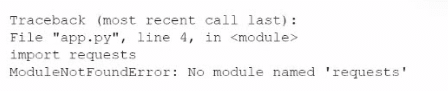
A developer is building a new application version using a CI/CD pipeline. The developer receives the following error message log when the build fails:

Which of the following is the most likely cause of this failure?

Correct Answer: D. Dependency issue
Explanation:

The error message indicates that the 'requests' module, which is a dependency, is not found. The failure is most likely due to the 'requests' library not being installed or not included in the environment where the application is running.

: Dependency management is a crucial part of maintaining a CI/CD pipeline, a topic included in the CompTIA Cloud+ examination objectives.


Question 5

A cloud solutions architect wants to deploy a three-tier web application that requires the minimum amount of operational overhead. Which of the following is the best template given these requirements?

Correct Answer: B. object_storage: name: front-end staticWebContent: enabled serverless_function: name: app runtime: nodejs memorySize: 2G code: git repository: backend-repo relational_database: engine: postgreSQL clusterNode: enabled
Explanation:

Comprehensive and Detailed 150 to 200 words of Explanation from CompTIA Cloud CV0-004 Study guide and objectives:

Template B is the best fit because it uses the most cloud-native, fully managed building blocks across all three tiers, which directly minimizes operational overhead---an emphasis area in CompTIA Cloud+ (CV0-004) when selecting architectures that reduce administrative effort. The presentation tier is implemented using object storage with static website hosting, eliminating web server provisioning, patching, and scaling tasks. The application tier uses a serverless function (Node.js), which offloads OS management, runtime scaling, and much of capacity planning to the provider. The data tier is a managed relational database (PostgreSQL) with clustering enabled, which reduces overhead through managed HA, patching, backups, and operational tooling compared with running a database on a VM.

By comparison, A, C, and D rely on virtual machines for either the web/app tier or database tier, increasing responsibilities such as OS hardening, patch management, middleware installation, monitoring, and scaling configuration. Therefore, B provides the lowest ongoing operational burden while still representing a standard three-tier application design.

Question 6

Which of the following models will best reduce the cost of running short-term, non-critical workloads?

Correct Answer: B. Spot Instance

Question 7

A software engineer at a cybersecurity company wants to access the cloud environment. Per company policy, the cloud environment should not be directly accessible via the internet. Which of the following options best describes how the software engineer can access the cloud resources?

Correct Answer: B. Bastion host
Explanation:

A bastion host is the best option described for accessing cloud resources without direct internet access. It acts as a secure gateway to access internal networks from external sources and is often used in conjunction with other security measures such as SSH for secure connections.

: The use of bastion hosts as a secure access point to cloud resources is a security best practice covered in the CompTIA Cloud+ certification's domain on cloud security.


Question 8

A cloud engineer needs to deploy a new version of a web application to 100 servers. In the past, new version deployments have caused outages. Which of the following deployment types should the cloud engineer implement to prevent the outages from happening this time?

Correct Answer: C. Canary
Explanation:

A canary deployment is a pattern that reduces the risk of introducing a new software version in production by slowly rolling out the change to a small subset of users before rolling it out to the entire infrastructure. It's an effective strategy to prevent outages since it allows for monitoring and quick rollback if issues arise without affecting all users.

: Canary releases are part of deployment strategies that can help mitigate the risk of outages during updates, a concept included in the CompTIA Cloud+ curriculum.


Question 9

An DevOps engineer is receiving reports that users can no longer access the company's web application after hardening of a web server. The users are receiving the following error:

ERR_SSLJ/ERSION_OR_CIPHER_MISMATCH.

Which of the following actions should the engineer take to resolve the issue?

Correct Answer: B. Configure TLS 1.2 or newer.
Explanation:

To resolve the ERR_SSL_VERSION_OR_CIPHER_MISMATCH error after hardening a web server, the engineer should configure the server to use TLS 1.2 or newer. This error often occurs when the server or client supports an outdated version of SSL/TLS or incompatible cipher suites. Updating to a modern, secure version of TLS ensures compatibility and enhances security.

: The CompTIA Cloud+ certification includes governance, risk, compliance, and security for the cloud, emphasizing the importance of implementing up-to-date security protocols like TLS to protect data in transit and ensure secure communications in cloud environments.


Question 10

Five thousand employees always access the company's public cloud-hosted web application on a daily basis during the same time frame. Some users have been reporting performance issues while attempting to connect to the web application Which of the following is the best configuration approach to resolve this issue?

Correct Answer: B. Scale horizontally based on a schedule
Explanation:

For a web application accessed by a large number of employees daily during the same time frame, the best configuration approach to resolve performance issues is to scale horizontally based on a schedule. This means adding more server instances to handle the load during known peak times.

: Cloud resource scaling strategies, including scheduled horizontal scaling, are discussed in the CompTIA Cloud+ curriculum under cloud management and optimization.


Question 11

Users report being unable to access an application that uses TLS 1.1. The users are able to access other applications on the internet. Which of the following is the most likely

reason for this issue?

Correct Answer: B. Changes were made on the web server to address vulnerabilities.
Explanation:

If users are unable to access an application that uses TLS 1.1 but can access other internet applications, it is likely that changes were made on the web server to address vulnerabilities, such as disabling outdated and less secure protocols like TLS 1.1. References: CompTIA Cloud+ Study Guide (Exam CV0-004) - Chapter on Cloud Security


Question 12

A cloud engineer needs to integrate a new payment processor with an existing e-commerce website. Which of the following technologies is the best fit for this integration?

Correct Answer: C. REST API over HTTPS
Explanation:

The best technology for integrating a new payment processor with an existing e-commerce website is a REST API over HTTPS. This method is widely used for web services, allowing secure communication over the internet and a standardized way for applications to communicate with each other. References: CompTIA Cloud+ Study Guide (Exam CV0-004) - Chapter on Cloud Integration


Question 13

Which of the following is true of SSDs?

Correct Answer: C. SSDs can be used for high-IOP applications.
Explanation:

SSDs (Solid State Drives) are known for their high performance and can handle a high number of input/output operations per second (IOPS). This makes them ideal for applications and workloads that require rapid access to storage, such as databases and high-performance computing applications. References: CompTIA Cloud+ Study Guide (Exam CV0-004) - Chapter on Cloud Storage Options


Question 14

A company operates a website that allows customers to upload, share, and retain full ownership of their photographs. Which of the following could affect image ownership as the website usage expands globally?

Correct Answer: A. Sovereignty
Explanation:

Data sovereignty refers to the legal implications of storing data in a country, subject to that country's laws. As the website's usage expands globally, data sovereignty becomes a critical concern because laws governing data ownership, privacy, and rights can vary significantly from one jurisdiction to another, potentially affecting the users' ownership rights over their photographs.


Question 15

Which of the following types of releases best describes the update made to a code repository production release when it changes from version 1.0 to version 1.1?

Correct Answer: C. Minor
Explanation:

Comprehensive and Detailed Step-by-Step

Alpha (A): Refers to pre-release software that is still in the early testing phase.

Beta (B): Indicates pre-release software that is feature-complete but requires testing.

Minor (C): Updates from version 1.0 to 1.1 signify incremental improvements or minor feature additions without significant changes.

Major (D): Involves substantial changes, often indicated by a change in the primary version number (e.g., 1.x to 2.x).