
Limited-Time Offer: Enjoy 50% Savings! Ends in 00h 00m 00s Coupon code: 50OFF
Skip to content

Free CompTIA Linux+ V8 Exam XK0-006 Exam Questions

Page: 1 / 15 Total 149 questions

Want more questions? Get Premium Access.

Question 1

A systems administrator receives reports from users who are having issues while trying to modify newly created files in a shared directory. The administrator sees the following outputs:
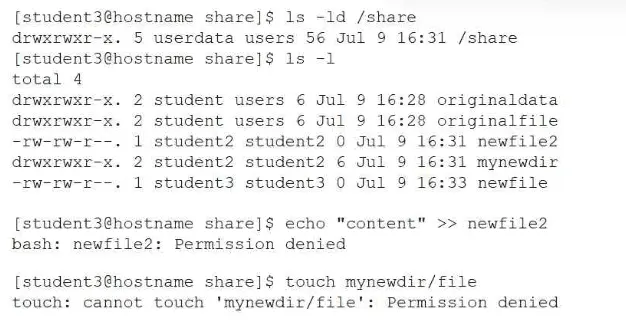
Which of the following provides the best resolution to this issue?

Correct Answer: D. Adding a setgid bit to the group in the shared folder
Explanation:

This scenario involves shared directory collaboration, which is a common system management task covered in the CompTIA Linux+ V8 objectives. The key issue is that users can create files in the shared directory, but other users in the same group cannot modify those files. This behavior is directly related to group ownership inheritance.

By default, when a user creates a file or directory, it is owned by the user and assigned the user's primary group, not necessarily the group of the parent directory. As shown in the output, files inside /share are owned by different groups (student, student2, student3), which prevents other group members from modifying them, even though the parent directory is group-writable.

The correct solution is to set the setgid (set group ID) bit on the shared directory, making option D correct. When the setgid bit is applied to a directory, all newly created files and subdirectories inherit the group ownership of the parent directory, rather than the creator's primary group. This ensures consistent group ownership and allows all members of the shared group to collaborate effectively.

The other options are incorrect or poor practice. Option A (setuid) is intended for executables, not directories. Option B requires constant manual intervention and does not scale. Option C weakens security by granting write access to all users, violating the principle of least privilege.

Linux+ V8 documentation explicitly recommends using the setgid bit on shared directories to manage collaborative access securely and efficiently.


Question 2

Which of the following can reduce the attack surface area in relation to Linux hardening?

Correct Answer: D. Enforcing password strength and complexity
Explanation:

Comprehensive and Detailed Explanation From Exact Extract:

Reducing the attack surface area in Linux hardening refers to limiting possible points of unauthorized access. According to the CompTIA Linux+ Official Study Guide (Exam XK0-006), enforcing strong password policies is a critical aspect of security hardening. This practice ensures that user accounts are protected by passwords that are difficult to guess or crack, thus minimizing the risk of successful brute-force attacks. Implementing password complexity requirements (such as minimum length, use of uppercase, lowercase, numbers, and special characters) directly addresses one of the primary vectors for unauthorized access.

Other options do not have a direct impact on reducing the attack surface:

A . Customizing the log-in banner serves as a legal notification and does not affect system vulnerabilities.

B . Reducing the number of directories created is not related to hardening or access control.

C . Extending the SSH startup timeout period may give attackers more time to attempt a connection and does not increase security.


CompTIA Linux+ Study Guide: Exam XK0-006, Sybex, Chapter 11: 'Securing the System', Section: 'Implementing Password Policies'

CompTIA Linux+ XK0-006 Exam Objectives, Domain 3.0: Security

Question 3

A systems administrator needs to check access to all company servers. The administrator uses the following script, which does not complete:

for i in $(cat /home/user1.file)

do

echo $i

ssh $i uptime

Which of the following is missing from the script?

Correct Answer: D. done
Explanation:

Shell scripting is a primary method for automating repetitive tasks in Linux. According to the CompTIA Linux+ V8 scripting objectives, administrators must understand the syntax for various control structures, including loops.

A for loop in Bash and other POSIX-compliant shells has a specific required structure:

The for statement (to define the iteration).

The do keyword (to start the block of commands).

The loop body (the commands to execute).

The done keyword (to terminate the loop block).

In the script provided, the administrator has correctly initiated the loop with for i in ... and opened the execution block with do. However, the script lacks the concluding done token. Without done, the shell interpreter will continue waiting for more input or return a syntax error because it does not know where the loop ends. This is why the script 'does not complete' or run correctly.

The other options are related to different control structures. fi (Option A) is the closing token for an if statement, not a for loop. else (Option B) is an optional branch within an if statement. while (Option C) is a different type of loop entirely and is not a required token for a for loop.

Therefore, the missing token is verified as done.


Question 4

Which of the following best describes PEP 8?

Correct Answer: B. A set of coding conventions for Python code
Explanation:

The correct answer is B. A set of coding conventions for Python code. PEP 8 stands for Python Enhancement Proposal 8, and it defines the official style guide for writing clean, readable, and consistent Python code. In Linux system administration, particularly within automation and scripting tasks, Python is widely used, and adhering to PEP 8 ensures that scripts are maintainable and understandable by other administrators.

PEP 8 covers a broad range of coding standards, including naming conventions, indentation, spacing, line length, import organization, and general code layout. For example, it recommends using four spaces per indentation level, limiting lines to 79 characters, and using descriptive variable and function names. These guidelines help improve code readability and reduce errors when scripts are shared or maintained across teams.

Option A is incorrect because PEP 8 does not list built-in Python modules; instead, it focuses on how code should be written. Option C is incorrect because PEP 8 is not a name for standard Python libraries but rather a style guide applicable to all Python code. Option D is incorrect because PEP 8 is not a data structure; it is purely a documentation standard.

From a Linux+ perspective, understanding PEP 8 is important in the context of scripting and automation. Administrators frequently write Python scripts to automate system tasks such as log analysis, configuration management, and monitoring. Following PEP 8 ensures consistency across scripts, making collaboration easier and reducing troubleshooting time. Properly formatted code also improves long-term maintainability, which is critical in production environments where scripts may be reused or modified over time.


Question 5

Which of the following is a characteristic of Python 3?

Correct Answer: B. It is extensible through modules.
Explanation:

Python 3 characteristics are part of Linux+ V8 scripting objectives. One of Python's most important features is its modular and extensible architecture.

Option B is correct because Python 3 supports extensibility through modules and packages. Python includes a large standard library and allows developers to extend functionality using third-party modules or custom code. This makes Python highly adaptable for automation, system management, and DevOps tasks.

The other options are incorrect. Python is open source, not closed source. Python 3 is not fully backwards compatible with Python 2, which is a major distinction emphasized in Linux+ V8. Python is also not binary compatible with Java.

Linux+ V8 documentation highlights Python's extensibility as a key reason it is widely used in Linux automation. Therefore, the correct answer is B.


Question 6

A Linux administrator needs to add a new HTTP service on the server. Which of the following commands allows other systems to communicate with the service after the system is restarted?

Correct Answer: C. firewall-cmd --add-service=http --permanent
Explanation:

The correct answer is C. firewall-cmd --add-service=http --permanent because it ensures that the firewall rule allowing HTTP traffic remains in effect even after a system reboot. In Linux systems using firewalld, rules can be applied in two modes: runtime and permanent.

By default, when a rule is added using firewall-cmd --add-service=http (Option D), it is applied only to the runtime configuration. This means the rule will allow HTTP traffic immediately, but it will be lost once the system is restarted or the firewall service is reloaded.

The --permanent flag ensures that the rule is written to the persistent configuration files, so it survives reboots. After adding a permanent rule, administrators typically run firewall-cmd --reload to apply the changes to the runtime environment as well.

Option A is incorrect because while it reloads the firewall, it does not specify the rule as permanent, so the configuration will not persist after reboot.

Option B is incorrect because --add-port=http is not valid syntax (ports must be specified numerically, e.g., 80/tcp), and --complete-reload is not appropriate here.

Option D is incorrect because it only applies the rule temporarily (runtime only).

From a Linux+ security perspective, managing firewall rules persistently is essential for maintaining secure and consistent network access. Using the --permanent option ensures services like HTTP remain accessible across system restarts while still being controlled by firewall policies.


Question 7

A Linux administrator wants to make the enable_auth variable set to 1 and available to the environment of subsequently executed commands. Which of the following should the administrator use for this task?

Correct Answer: D. export ENABLE_AUTH=1
Explanation:

Environment variables in Linux can exist either locally within a shell or be exported to child processes. CompTIA Linux+ V8 emphasizes the distinction between shell variables and environment variables, as this affects how applications inherit configuration values.

Option D, export ENABLE_AUTH=1, is the correct choice because it both assigns the variable and marks it for export to the environment. Once exported, the variable becomes available to all subsequently executed commands and child processes spawned from the current shell. This behavior is required when applications or scripts rely on environment variables for configuration.

Option B, ENABLE_AUTH=1, only sets a shell-local variable. While it is accessible within the current shell session, it is not inherited by child processes unless explicitly exported. Option A, let ENABLE_AUTH=1, performs arithmetic evaluation and does not export the variable. Option C incorrectly assigns the output of a command substitution and does not set the desired value.

Linux+ V8 documentation highlights export as the correct mechanism for making variables available system-wide within a user session. Therefore, the correct answer is D.


Question 8

Which of the following best describes a use case for playbooks in a Linux system?

Correct Answer: A. To provide a set of tasks and configurations to deploy an application
Explanation:

In the context of Linux automation and orchestration, playbooks are most commonly associated with configuration management tools such as Ansible, which is explicitly referenced in the CompTIA Linux+ V8 objectives. Playbooks are written in YAML and are designed to define a series of tasks, configurations, and desired system states that should be applied to one or more Linux systems in a repeatable and automated manner.

A primary use case for playbooks is application deployment and system configuration automation. Playbooks allow administrators to specify tasks such as installing packages, configuring services, managing users, setting permissions, deploying application files, and starting or enabling services. This aligns directly with option A, which accurately describes playbooks as a method to provide a set of tasks and configurations required to deploy an application consistently across environments.

The remaining options are not accurate representations of playbook functionality. Option B refers to version control implementation, which is handled by tools like Git and is not the purpose of playbooks themselves, although playbooks may be stored in version control systems. Option C describes container security information, which is typically managed through container runtime configurations, secrets, or security policies rather than playbooks. Option D refers to storage volume information for a pod, which is specific to Kubernetes manifests and not a general Linux playbook use case.

According to Linux+ V8 documentation, automation tools and playbooks help reduce human error, improve consistency, and support Infrastructure as Code (IaC) practices. Playbooks are a key mechanism for orchestrating multi-step operations across multiple systems, making them essential for modern Linux system administration.

Therefore, the correct answer is A, as it best describes the practical and documented use case for playbooks in a Linux system.


Question 9

A Linux administrator observes low network throughput. The administrator gathers the following output:

$ ip link show eth0

eth0: mtu 9000 ...

$ ping -s 1472 -M do 192.168.10.2

PING 192.168.10.2(192.168.10.2) 1472(1500) bytes of data.

From 10.10.9.72 icmp_seq=1 frag needed and DF set

Which of the following is the cause of the low network throughput?

Correct Answer: D. MTU mismatch
Explanation:

Network throughput issues are often caused by Maximum Transmission Unit (MTU) mismatches. MTU defines the largest packet size (in bytes) that can be sent over a network interface. According to CompTIA Linux+ V8 networking objectives, a standard Ethernet MTU is 1500 bytes. Larger values, such as 9000, are known as 'Jumbo Frames' and must be supported by every device in the network path (switches, routers, and the destination host).

In this scenario, the output of ip link show eth0 reveals that the local interface is configured for an MTU of 9000. However, when the administrator runs a ping test with a payload of 1472 bytes (which, with headers, equals a 1500-byte packet) and the 'Don't Fragment' (-M do) flag, the system returns an error: 'frag needed and DF set'.

This error message indicates that a device somewhere in the network path has a smaller MTU (likely the standard 1500) and cannot handle the 9000-byte packets the server wants to send. Since the 'Don't Fragment' bit is set, the device cannot break the packet down and instead drops it. This results in packet loss, retransmissions, and significantly lower throughput as the protocol tries to adapt.

Options A, B, and C are not supported by the provided evidence. A duplex mismatch (Option C) would typically show collisions or CRC errors in ifconfig or ip -s link. Driver or hardware issues would manifest as interface flaps or total connectivity loss. The explicit 'frag needed' message is a definitive indicator of an MTU mismatch.

The resolution would be to either ensure Jumbo Frames are enabled throughout the network or lower the local MTU to 1500.


Question 10

Which of the following is a protocol for accessing distributed directory services containing a hierarchy of users, groups, machines, and organizational units?

Correct Answer: C. LDAP
Explanation:

Directory services are a key part of enterprise Linux environments and are covered under the Security domain in Linux+ V8. The Lightweight Directory Access Protocol (LDAP) is specifically designed to access and manage distributed directory information.

LDAP directories store structured, hierarchical data such as users, groups, computers, and organizational units. Linux systems commonly use LDAP for centralized authentication, authorization, and identity management. LDAP is also the foundation for services like Active Directory and FreeIPA.

The other options are incorrect. SMB is a file and printer sharing protocol. TLS is an encryption protocol used to secure communications. Kerberos (KRB-5) is an authentication protocol often used alongside LDAP but does not store directory information itself.

Linux+ V8 documentation highlights LDAP as the primary protocol for directory-based identity services. Therefore, the correct answer is C.