
Limited-Time Offer: Enjoy 50% Savings! Ends in 00h 00m 00s Coupon code: 50OFF
Skip to content

Free Databricks Certified Machine Learning Associate Exam Databricks-Machine-Learning-Associate Exam Questions

Page: 1 / 8 Total 74 questions

Want more questions? Get Premium Access.

Question 1

A machine learning engineer has created a Feature Table new_table using Feature Store Client fs. When creating the table, they specified a metadata description with key information about the Feature Table. They now want to retrieve that metadata programmatically.

Which of the following lines of code will return the metadata description?

Correct Answer: C. fs.get_table('new_table').description
Explanation:

To retrieve the metadata description of a feature table created using the Feature Store Client (referred here as fs), the correct method involves calling get_table on the fs client with the table name as an argument, followed by accessing the description attribute of the returned object. The code snippet fs.get_table('new_table').description correctly achieves this by fetching the table object for 'new_table' and then accessing its description attribute, where the metadata is stored. The other options do not correctly focus on retrieving the metadata description. Reference:

Databricks Feature Store documentation (Accessing Feature Table Metadata).

Question 2

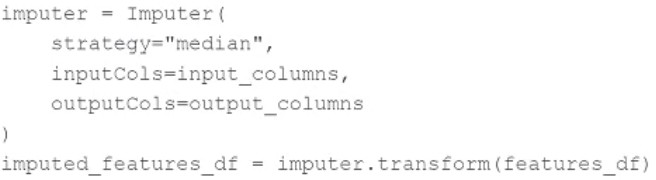
A data scientist wants to use Spark ML to impute missing values in their PySpark DataFrame features_df. They want to replace missing values in all numeric columns in features_df with each respective numeric column's median value.

They have developed the following code block to accomplish this task:

The code block is not accomplishing the task.

Which reasons describes why the code block is not accomplishing the imputation task?

Correct Answer: D. It does not fit the imputer on the data to create an ImputerModel.
Explanation:

In the provided code block, the Imputer object is created but not fitted on the data to generate an ImputerModel. The transform method is being called directly on the Imputer object, which does not yet contain the fitted median values needed for imputation. The correct approach is to fit the imputer on the dataset first.

Corrected code:

imputer = Imputer( strategy='median', inputCols=input_columns, outputCols=output_columns ) imputer_model = imputer.fit(features_df) # Fit the imputer to the data imputed_features_df = imputer_model.transform(features_df) # Transform the data using the fitted imputer


PySpark ML Documentation

Question 3

A data scientist is using Spark SQL to import their data into a machine learning pipeline. Once the data is imported, the data scientist performs machine learning tasks using Spark ML.

Which of the following compute tools is best suited for this use case?

Correct Answer: B. Standard cluster
Explanation:

For a data scientist using Spark SQL to import data and then performing machine learning tasks using Spark ML, the best-suited compute tool is a Standard cluster. A Standard cluster in Databricks provides the necessary resources and scalability to handle large datasets and perform distributed computing tasks efficiently, making it ideal for running Spark SQL and Spark ML operations.


Databricks documentation on clusters: Clusters in Databricks

Question 4

A data scientist learned during their training to always use 5-fold cross-validation in their model development workflow. A colleague suggests that there are cases where a train-validation split could be preferred over k-fold cross-validation when k > 2.

Which of the following describes a potential benefit of using a train-validation split over k-fold cross-validation in this scenario?

Correct Answer: E. Fewer models need to be trained when using a train-validation split
Explanation:

A train-validation split is often preferred over k-fold cross-validation (with k > 2) when computational efficiency is a concern. With a train-validation split, only two models (one on the training set and one on the validation set) are trained, whereas k-fold cross-validation requires training k models (one for each fold).

This reduction in the number of models trained can save significant computational resources and time, especially when dealing with large datasets or complex models.


Model Evaluation with Train-Test Split

Question 5

What is the name of the method that transforms categorical features into a series of binary indicator feature variables?

Correct Answer: C. One-hot encoding
Explanation:

The method that transforms categorical features into a series of binary indicator variables is known as one-hot encoding. This technique converts each categorical value into a new binary column, which is essential for models that require numerical input. One-hot encoding is widely used because it helps to handle categorical data without introducing a false ordinal relationship among categories. Reference:

Feature Engineering Techniques (One-Hot Encoding).


Question 6

A data scientist is attempting to tune a logistic regression model logistic using scikit-learn. They want to specify a search space for two hyperparameters and let the tuning process randomly select values for each evaluation.

They attempt to run the following code block, but it does not accomplish the desired task:

Which of the following changes can the data scientist make to accomplish the task?

Correct Answer: A. Replace the GridSearchCV operation with RandomizedSearchCV
Explanation:

The user wants to specify a search space for hyperparameters and let the tuning process randomly select values. GridSearchCV systematically tries every combination of the provided hyperparameter values, which can be computationally expensive and time-consuming. RandomizedSearchCV, on the other hand, samples hyperparameters from a distribution for a fixed number of iterations. This approach is usually faster and still can find very good parameters, especially when the search space is large or includes distributions.

Reference

Scikit-Learn documentation on hyperparameter tuning: https://scikit-learn.org/stable/modules/grid_search.html#randomized-parameter-optimization


Question 7

A data scientist is wanting to explore the Spark DataFrame spark_df. The data scientist wants visual histograms displaying the distribution of numeric features to be included in the exploration.

Which of the following lines of code can the data scientist run to accomplish the task?

Correct Answer: E. dbutils.data.summarize (spark_df)
Explanation:

To display visual histograms and summaries of the numeric features in a Spark DataFrame, the Databricks utility function dbutils.data.summarize can be used. This function provides a comprehensive summary, including visual histograms.

Correct code:

dbutils.data.summarize(spark_df)

Other options like spark_df.describe() and spark_df.summary() provide textual statistical summaries but do not include visual histograms.


Databricks Utilities Documentation

Question 8

Which of the Spark operations can be used to randomly split a Spark DataFrame into a training DataFrame and a test DataFrame for downstream use?

Correct Answer: E. DataFrame.randomSplit
Explanation:

The correct method to randomly split a Spark DataFrame into training and test sets is by using the randomSplit method. This method allows you to specify the proportions for the split as a list of weights and returns multiple DataFrames according to those weights. This is directly intended for splitting DataFrames randomly and is the appropriate choice for preparing data for training and testing in machine learning workflows. Reference:

Apache Spark DataFrame API documentation (DataFrame Operations: randomSplit).


Question 9

A data scientist has produced three new models for a single machine learning problem. In the past, the solution used just one model. All four models have nearly the same prediction latency, but a machine learning engineer suggests that the new solution will be less time efficient during inference.

In which situation will the machine learning engineer be correct?

Correct Answer: D. When the new solution requires that each model computes a prediction for every record
Explanation:

If the new solution requires that each of the three models computes a prediction for every record, the time efficiency during inference will be reduced. This is because the inference process now involves running multiple models instead of a single model, thereby increasing the overall computation time for each record.

In scenarios where inference must be done by multiple models for each record, the latency accumulates, making the process less time efficient compared to using a single model.


Model Ensemble Techniques

Question 10

An organization is developing a feature repository and is electing to one-hot encode all categorical feature variables. A data scientist suggests that the categorical feature variables should not be one-hot encoded within the feature repository.

Which of the following explanations justifies this suggestion?

Correct Answer: E. One-hot encoding is a potentially problematic categorical variable strategy for some machine learning algorithms.
Explanation:

One-hot encoding transforms categorical variables into a format that can be provided to machine learning algorithms to better predict the output. However, when done prematurely or universally within a feature repository, it can be problematic:

Dimensionality Increase: One-hot encoding significantly increases the feature space, especially with high cardinality features, which can lead to high memory consumption and slower computation.

Model Specificity: Some models handle categorical variables natively (like decision trees and boosting algorithms), and premature one-hot encoding can lead to inefficiency and loss of information (e.g., ordinal relationships).

Sparse Matrix Issue: It often results in a sparse matrix where most values are zero, which can be inefficient in both storage and computation for some algorithms.

Generalization vs. Specificity: Encoding should ideally be tailored to specific models and use cases rather than applied generally in a feature repository.

Reference

'Feature Engineering and Selection: A Practical Approach for Predictive Models' by Max Kuhn and Kjell Johnson (CRC Press, 2019).
