
Limited-Time Offer: Enjoy 50% Savings! Ends in 00h 00m 00s Coupon code: 50OFF
Skip to content

Free EC-Council Certified SOC Analyst 312-39 Exam Questions

Page: 1 / 14 Total 200 questions

Want more questions? Get Premium Access.

Question 1

A mid-sized financial institution's SOC is overwhelmed by thousands of daily alerts, many based on Indicators of Compromise (IoCs) such as suspicious IPs, hashes, and domains. These alerts lack context about whether they truly pose a threat. Analysts waste time on low-priority incidents while severe threats may be missed. The team lacks tools and intelligence to correlate IoCs with real-world threats, making prioritization difficult and causing alert fatigue. Which poses the greatest challenge in this environment?

Correct Answer: D. Distinguishing IoC from CTI
Explanation:

The core problem described is that the SOC is treating raw indicators (IoCs) as if they are actionable intelligence (CTI), without enough context to prioritize. IoCs are often low-context, high-volume, and time-sensitive; many are noisy, shared infrastructure, or already outdated. CTI (cyber threat intelligence) adds context---adversary, campaign, intent, targeting, confidence, and recommended actions---so analysts can decide what matters for their environment. The scenario explicitly states the alerts ''lack critical context'' and the team ''lacks tools and intelligence to correlate IoCs with real-world threats,'' which is fundamentally a failure to distinguish IoC data from intelligence. Information overload is a symptom, but the underlying challenge is that the organization is ingesting IoCs without intelligence enrichment and prioritization logic. Budget/skill can contribute, but the question asks for the greatest challenge given the described conditions. From a SOC perspective, solving this requires enrichment (TI platforms, reputation + context), correlation with internal telemetry, scoring based on relevance, and focusing on behaviors and impact rather than indicator volume alone. Therefore, distinguishing IoC from CTI is the best answer.

Question 2

Which of the following command is used to view iptables logs on Ubuntu and Debian distributions?

Correct Answer: B. $ tailf /var/log/kern.log
Explanation:

In Ubuntu and Debian distributions, the command to view iptables logs is$ tailf /var/log/kern.log. This command allows you to follow the end of the kernel log file in real-time. It is useful for monitoring the logs as they are updated. Thetailfcommand is similar totail -f, and it displays the last ten lines of the file by default and then outputs appended data as the file grows.

References: The answer is verified according to the EC-Council's Certified SOC Analyst (CSA) course materials and study guides, which cover the practical aspects of security operations and incident handling, including the monitoring of systems and logs123.


Question 3

You are part of a team of SOC analysts in a multinational organization that processes large volumes of security logs from various sources, including firewalls, IDS, and authentication servers. Your team is having difficulty detecting incidents because logs from different systems are analyzed in isolation, making it harder to link related events. What approach should you implement for future investigations to automatically match related log events based on predefined rules?

Correct Answer: C. Log correlation
Explanation:

Log correlation is the capability that links related events from different sources into a coherent narrative based on predefined rules, logic, and time windows. In SOC operations, incidents rarely appear as a single log line; they are sequences---failed logons followed by a successful logon, then privilege changes, then suspicious process execution, then outbound connections. Correlation rules connect these across data sources (firewall, IDS, authentication, endpoint) using strong keys such as user, host, IP address, session identifiers, and tightly bounded timestamps. This reduces analyst workload, increases detection fidelity, and shortens investigation time by presenting connected evidence rather than isolated alerts. Log collection simply gathers logs; it does not relate them. Log normalization ensures consistent fields and formats, which improves correlation effectiveness, but it is not the linking step itself. Log transformation is a broader term that can include parsing and enrichment, but it does not inherently perform the rule-driven linking of related events. Because the question explicitly asks for ''automatically match related log events based on predefined rules,'' log correlation is the correct approach.


Question 4

Identify the event severity level in Windows logs for the events that are not necessarily significant, but may indicate a possible future problem.

Correct Answer: B. Warning
Explanation:

In the context of Windows logs, the event severity level that indicates events that are not necessarily significant but may point to a possible future problem is classified as a ''Warning.'' This level is used to log events that are not immediately harmful, such as an impending disk space shortage or other conditions that could potentially cause problems if not addressed.

References:The EC-Council's Certified SOC Analyst (CSA) program covers the fundamentals of SOC operations, including log management and correlation, which would encompass understanding the severity levels of events in Windows logs1.Additionally, the discussion on the ExamTopics website corroborates that the answer to this question is 'Warning'2.Further general information on Windows event logging can be found in resources like Sumo Logic's guide to Windows Event Logging3and other incident response guides that discuss the importance of monitoring event severity levels within a SOC4.


Question 5

Properly applied cyber threat intelligence to the SOC team help them in discovering TTPs.

What does these TTPs refer to?

Correct Answer: A. Tactics, Techniques, and Procedures
Explanation:

TTPs in the context of cybersecurity and SOC (Security Operations Center) refer to the patterns of activities or methods associated with a specific threat actor or group of threat actors. Understanding TTPs is crucial for the SOC team as it allows them to identify, prepare, and respond to potential threats more effectively. Here's a breakdown of the term:

Tactics:The adversary's overall strategy or the 'what' they are trying to accomplish.

Techniques:The general methods the adversary uses to achieve their tactical goals.

Procedures:The specific, detailed methods the adversary employs, which can include tools, scripts, commands, and sequences of actions.

By analyzing TTPs, SOC teams can develop a more proactive defense posture, anticipate likely attack methods, and implement appropriate countermeasures.

References:The EC-Council's Certified SOC Analyst (CSA) program covers the fundamentals of SOC operations, including the identification and validation of intrusion attempts, which would involve understanding TTPs12.This program is designed for current and aspiring Tier I and Tier II SOC analysts to achieve proficiency in performing entry-level and intermediate-level operations, where the knowledge of TTPs is essential12.


Question 6

Peter, a SOC analyst with Spade Systems, is monitoring and analyzing the router logs of the company and wanted to check the logs that are generated by access control list numbered 210.

What filter should Peter add to the 'show logging' command to get the required output?

Correct Answer: C. show logging | include 210
Explanation:

To filter the output of the 'show logging' command to include entries related to a specific access control list, Peter should use the 'include' keyword followed by the access list number. The correct command would be 'show logging | include 210'. This command will display all log entries that contain the string '210', which is the number of the access control list he wants to monitor.

References:The use of the 'include' keyword in Cisco router commands is a standard method for filtering show command outputs to display only lines that contain a specified string or pattern.This is covered in Cisco's documentation and training materials related to router commands and access control list management12.


Question 7

During routine monitoring, the SIEM detects an unusual spike in outbound data transfer from a critical database server. The typical outbound traffic for this server is around 5 MB/hour, but in the past 10 minutes, it has sent over 500 MB to an external IP address. No predefined signatures match this activity, but the SIEM raises an alert due to deviations from the server's normal behavior profile. Which detection method is responsible for this alert?

Correct Answer: D. Anomaly-based detection
Explanation:

This alert is generated because the activity deviates significantly from the server's established baseline, which is the hallmark of anomaly-based detection. The SIEM is not matching a known signature (so it is not signature-based), and the prompt emphasizes ''deviations from normal behavior profile,'' which typically means statistical profiling, baselining, or behavior analytics detecting outliers in volume, timing, destination, or frequency. While rule-based detections can also trigger on thresholds, the question explicitly frames the logic as ''normal behavior profile,'' which implies adaptive baselines rather than a fixed rule alone. Heuristic detection refers to generalized patterns or suspicion scoring, but here the core mechanism is abnormality versus historical norms (5 MB/hour typical vs 500 MB in 10 minutes). From a SOC triage perspective, anomaly alerts require quick validation: confirm the external destination reputation/ownership, verify whether the transfer aligns with authorized jobs, check change tickets, and correlate with authentication/process activity on the database host. Anomaly-based detection is especially valuable for data exfiltration because attackers can avoid known signatures, but they often struggle to mimic normal data movement patterns at scale.


Question 8

Which of the following attack can be eradicated by filtering improper XML syntax?

Correct Answer: D. Web Services Attacks
Explanation:

Web services attacks can be mitigated by filtering improper XML syntax because these attacks often exploit vulnerabilities in web services that accept XML input. XML filtering ensures that only properly formatted XML data is processed by the web service. This can prevent various forms of XML-related attacks, such as XML injection or XML External Entity (XXE) attacks, where attackers attempt to interfere with the processing of XML data.

References:The EC-Council's Certified SOC Analyst (CSA) program covers the fundamentals of SOC operations, including the identification and validation of intrusion attempts, and the use of SIEM solutions for enhanced threat detection.The program emphasizes the importance of understanding the various types of attacks and the appropriate defensive measures, including the filtering of improper XML syntax to protect against web services attacks12.


Question 9

A Security Operations Center (SOC) analyst receives a high-priority alert indicating unusual user activity. An employee account is attempting to access company resources from a different country and outside of their normal working hours. This behavior raises concerns about potential account compromise or unauthorized access. To automate the initial response and quickly restrict access while further investigating the incident, which SOAR playbook would be relevant to adapt and implement?

Correct Answer: B. Deprovisioning Users SOAR Playbook
Explanation:

When there is a strong indication of account compromise (impossible travel, unusual geography, out-of-hours access to sensitive resources), the priority is to reduce attacker dwell time by immediately restricting the account's ability to authenticate and access data. A ''Deprovisioning Users'' playbook aligns best with this objective because it is focused on access removal actions such as disabling the user, revoking active sessions, resetting credentials, invalidating refresh tokens, removing risky group memberships, and blocking sign-in until verification is complete. Alert enrichment is valuable, but it does not stop the threat; it only adds context. Malware containment is oriented toward endpoint isolation and malicious file/process containment, not identity-based risk. Phishing investigations is appropriate when the primary entry vector is suspected phishing and the goal is to analyze messages, URLs, and affected recipients, but it still may not provide the immediate identity lockdown needed. In SOC operations, identity compromise often demands rapid containment through account restriction first, followed by investigation to confirm legitimacy, determine scope, and safely restore access with stronger controls such as MFA and conditional access.


Question 10

A security analyst in a multinational corporation's Threat Intelligence team is tasked with enhancing detection of stealthy malware infections. During an investigation, the analyst observes an unusually high volume of DNS requests directed toward domains that follow patterns commonly associated with Domain Generation Algorithms (DGAs). Recognizing that these automated domain queries could indicate malware attempting to establish communication with command-and-control (C2) infrastructure, the analyst realizes existing detection may be insufficient. The security team needs to define intelligence requirements, including identifying critical data sources, refining detection criteria, and improving monitoring strategies. Which stage of the Cyber Threat Intelligence (CTI) process does this align with?

Correct Answer: B. Requirement analysis
Explanation:

This scenario aligns with requirement analysis because the team is defining what intelligence is needed and how it should be collected and used. The analyst has observed a problem (possible DGA-based malware activity) and recognizes gaps in current detection. The next step in a CTI lifecycle is to translate that concern into actionable intelligence requirements: which telemetry sources are necessary (DNS logs, proxy logs, endpoint telemetry, threat intel on DGA families), what questions must be answered (which hosts, what domains, what patterns, what time windows), and what success criteria look like (detection thresholds, false positive tolerance, enrichment needs). This is the ''direction'' phase of CTI, where priorities are set and collection needs are specified to ensure intelligence efforts align to threats that matter. ''Filtering CTI'' would be about reducing noise in collected intelligence or refining feeds after collection. ''Intelligence buy-in'' is stakeholder alignment and program support, not the analytic definition of requirements. ''Automated tool'' is not a CTI lifecycle stage. From a SOC perspective, requirement analysis is critical to turn observations into structured detection and hunting objectives that can be measured and improved.


Question 11

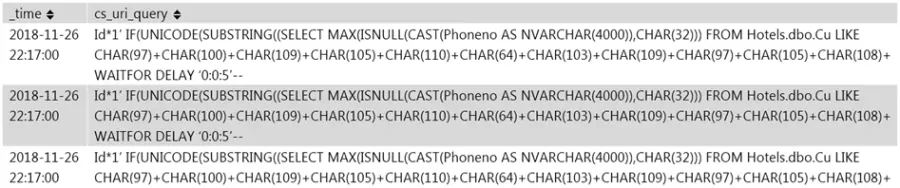
Jony, a security analyst, while monitoring IIS logs, identified events shown in the figure below.

What does this event log indicate?

Correct Answer: D. SQL Injection Attack
Explanation:

The IIS log events indicate a SQL Injection Attack. This is evident from the complex SQL queries present in the log, which include functions like ''UNICODE'', ''SUBSTRING'', and ''MAX''. These functions are being used in a manner that suggests manipulation of strings and extraction of data, which are common tactics in SQL injection attacks. The use of specific characters like CHAR(97) and CHAR(108) within the queries is a technique often employed to bypass security mechanisms during such attacks.

References:For further study and verification, the EC-Council's Certified SOC Analyst (CSA) course materials and study guides provide extensive information on identifying and responding to various types of cyber attacks, including SQL Injection. These resources are essential for any security analyst to understand the intricacies of log analysis and attack identification.


Question 12

You are working as a SOC analyst for a cloud-based service provider that relies on PostgreSQL databases to store critical customer data. During a security review, you discover that logs are not being generated for failed authentication attempts, slow queries, or database errors. This lack of visibility is making it difficult to detect threats and investigate suspicious activity. To ensure PostgreSQL captures and stores logs for centralized monitoring and forensic analysis, which configuration parameter should you enable?

Correct Answer: B. log_collector
Explanation:

In PostgreSQL, the configuration parameter that enables writing logs to files via the logging collector process is log_collector. When enabled, PostgreSQL can collect stderr output from backend processes and route it into log files, which is foundational for centralized log shipping and retention. From a SOC standpoint, turning on log collection is necessary but not sufficient: you typically also need to configure what gets logged (authentication failures, statement duration thresholds for slow queries, and error verbosity), define log line prefixes for consistent parsing, and set rotation/retention to meet operational and compliance needs. However, the question specifically asks which parameter should be enabled to ensure PostgreSQL captures and stores logs, and log_collector is the correct parameter name and casing. The other options include incorrect naming or formatting. Once enabled, the SOC team can forward PostgreSQL logs to the SIEM to correlate database activity with identity, endpoint, and network signals---critical for detecting brute force attempts, suspicious administrative actions, and anomalous query behavior.


Question 13

Juliea a SOC analyst, while monitoring logs, noticed large TXT, NULL payloads.

What does this indicate?

Correct Answer: B. DNS Exfiltration Attempt
Explanation:

Juliea, the SOC analyst, noticed large TXT and NULL payloads in the logs. This is indicative of a DNS exfiltration attempt. DNS exfiltration is a type of cyber attack where an attacker uses the DNS protocol to sneak data out of a network undetected. It typically involves the use of large TXT records, which can be used to carry data out of the network. NULL payloads can be used in this context to pad the DNS queries and make them less suspicious or to bypass security controls that inspect the content of DNS queries.

The steps involved in DNS exfiltration include:

The attacker compromises a system within the target network.

Malware on the compromised system encodes the data it wants to exfiltrate.

The encoded data is split into chunks that fit into DNS query sizes.

These chunks are sent as data in DNS queries or responses, often using TXT records.

An external attacker-controlled server receives the DNS queries and decodes the data.

References:

EC-Council's Certified SOC Analyst (CSA) course material and study guides provide detailed information on various types of cyber attacks, including DNS exfiltration.

Online resources and practice questions for the Certified SOC Analyst (CSA) exam also cover this topic and can be used to verify the answer123.

Additional information on DNS exfiltration techniques and detection methods can be found in security blogs and articles that discuss the subject in depth456.


&url=https%3A%2F%2Fconf.splunk.com%2Fsession%2F2014% 2Fconf2014_FredWilmotSanfordOwings_Splunk_Security.pdf&usg=AOvVaw3ZLfzGqM-VUG7xKtze67ac

Question 14

What does Windows event ID 4740 indicate?

Correct Answer: A. A user account was locked out.
Explanation:

Event ID 4740 is a security audit event in Windows that indicates a user account has been locked out. This event is generated every time the system locks out a user account due to repeated logon failures, which are typically caused by incorrect password entries. The event is logged on domain controllers, member servers, and workstations where the lockout occurred. It includes details such as the account name, domain, and the computer from which the lockout originated.

References:The information is verified as per Microsoft's official documentation and learning resources related to security auditing and user account management.Specifically, the Microsoft Learn page on security auditing provides comprehensive details on Event ID 47401.Additionally, resources like Ultimate Windows Security offer in-depth explanations of this event and its implications for security monitoring2.


Question 15

Charline is working as an L2 SOC Analyst. One day, an L1 SOC Analyst escalated an incident to her for further investigation and confirmation. Charline, after a thorough investigation, confirmed the incident and assigned it with an initial priority.

What would be her next action according to the SOC workflow?

Correct Answer: D. She should formally raise a ticket and forward it to the IRT
Explanation:

Once an L2 SOC Analyst like Charline confirms an incident, the SOC workflow dictates that the incident must be formally documented. This involves raising a ticket in the incident management system. The ticket should include all relevant details from the investigation, such as the nature of the incident, the affected systems, and the initial priority assigned. After raising the ticket, the L2 Analyst should forward it to the Incident Response Team (IRT). The IRT will then take over the incident to conduct a deeper analysis, perform containment measures, eradicate the threat, and recover systems to normal operation.

References:

Certified SOC Analyst Training | CSA Certification - EC-Council1

Managing the SOC and Responding to Incidents Effectively - EC-Council2

Crafting an Effective Incident Report: A Guide for SOC Analysts3

Certified SOC Analyst - CERT - EC-Council4