Limited-Time Offer: Enjoy 50% Savings! Ends in 00h 00m 00s Coupon code: 50OFF
Skip to content

Free Ericsson Certified Associate - IP Networking ECP-206 Exam Questions

Page: 1 / 6 Total 60 questions

Want more questions? Get Premium Access.

Question 1

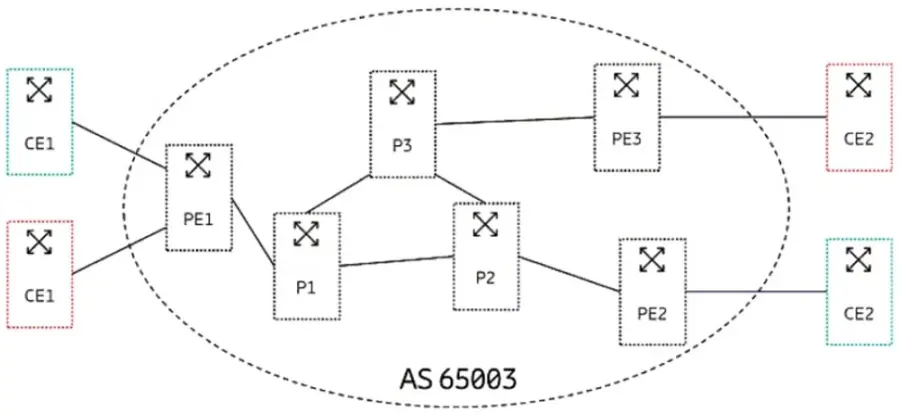
P routers forward packets based on the ______.

Correct Answer: C. C. LSP label
Explanation:

P routers forward packets based on the LSP label. The LSP label is the label that corresponds to the label-switched path (LSP) that is established between two PE routers in an MPLS network. The LSP label is also called the outer label or the transport label, because it is used to transport packets across the MPLS core network. P routers are also called LSRs (label switch routers) or transit routers, because they switch packets based on their labels or remove the labels. P routers do not need to look at the IP header or any other information in the packet, except for the top label in the label stack. P routers perform one of three possible operations on labels: swap, pop, or PHP (penultimate hop popping). In a swap operation, the label is swapped with a new label, and the packet is forwarded along the path associated with the new label. In a pop operation, the label is removed from the packet, and the packet is forwarded based on its IP header or another label in the stack. In a PHP operation, the label is removed from the packet at the last P router before reaching the egress PE router, and the packet is forwarded without any label to the egress PE router.

The LSP label is different from other types of labels that may be used in MPLS networks, such as VPN labels or service labels. These labels are used to identify different VPNs or services that run over MPLS networks, such as Layer 2 VPNs, Layer 3 VPNs, traffic engineering, or QoS. These labels are also called inner labels or payload labels, because they are related to the payload of the packet. These labels are not used by P routers for forwarding decisions, but only by PE routers for delivering packets to their destinations.

Therefore, the answer is C.

Question 2

Question 3

Question 4

Question 5

Which two statements are true about link-state routing protocols? (Choose two.)

Correct Answer: A. The advertisement exchange is mainly triggered by a change in the network.; B. Each router uses a reliable update mechanism to exchange topology information with its neighbors. C Link-state routing protocols mainly use hop-counts to determine the link cost
Explanation:

Link-state routing protocols are one of the two main classes of routing protocols used in packet switching networks for computer communications, the other being distance-vector routing protocols. Examples of link-state routing protocols include Open Shortest Path First (OSPF) and Intermediate System to Intermediate System (IS-IS). The basic concept of link-state routing is that every node constructs a map of the connectivity to the network, in the form of a graph, showing which nodes are connected to which other nodes. Each node then independently calculates the next best logical path from it to every possible destination in the network. Each collection of best paths will then form each node's routing table.

Two statements that are true about link-state routing protocols are:

The advertisement exchange is mainly triggered by a change in the network. Link-state routing protocols use a flooding mechanism to distribute information about the network topology to all routers in the same area or domain. This information is encapsulated in link-state packets (LSPs) or link-state advertisements (LSAs), which contain information about the router, its directly connected links, and the state of those links. LSPs or LSAs are sent only when there is a change in the topology, such as a link failure or recovery, or when a periodic refresh timer expires. This way, link-state routing protocols can quickly adapt to network changes and maintain an accurate and consistent view of the network.

Each router uses a reliable update mechanism to exchange topology information with its neighbors. Link-state routing protocols use a reliable update mechanism to ensure that all routers receive and acknowledge the LSPs or LSAs sent by their neighbors. This mechanism involves sending hello messages to establish and maintain adjacencies with neighbors, sending acknowledgment messages to confirm the receipt of LSPs or LSAs, and requesting missing or outdated LSPs or LSAs from neighbors. This mechanism ensures that all routers have a synchronized database of LSPs or LSAs, which is used to build a complete network connectivity map and to calculate the shortest path to destinations.


Question 6

Question 7

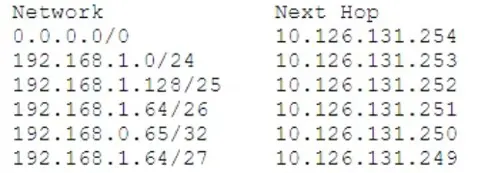
Review the exhibit.

Given the routing table shown in the exhibit, what is the next-hop to reach the host 192.168.1.129?

Question 8

Which two statements are true regarding the LSP? (Choose two.)

Correct Answer: B. The LSP refers to a sequence of routers that add. remove, or change label values along the path.; C. The LSP refers to a sequence of routers that forward the MPLS packet based on labels.

Question 9

Which two statements are true about priority queuing (PQ)? (Choose two.)

Question 10

An IS-IS router has been assigned the NSAP address: 49.00F0.0100.5012.3010.00.

What is the Area ID to which the router belongs?

Correct Answer: B. 49.00F0.0100
Explanation:

The Area ID to which the router belongs is 49.00F0.0100. The Area ID is a variable-length field in the NSAP address that identifies the area to which the router belongs. The Area ID can be between 1 and 13 bytes long, but it must start and end with an octet (8 bits). The NSAP address is composed of three parts: the authority and format identifier (AFI), the area ID, and the system ID. The AFI is a one-octet field that indicates the format and authority of the rest of the address. The system ID is a fixed-length field of six octets that uniquely identifies the router within an area. The NSAP address also has a network selector (NSEL) field, which is a one-octet field that identifies the network layer service to which a packet should be sent. For IS-IS routers, the NSEL must always be 00.

In this question, the NSAP address is 49.00F0.0100.5012.3010.00. This means that:

The AFI is 49, which indicates a private address.

The Area ID is 00F0.0100, which is four octets long and starts and ends with an octet.

The system ID is 5012.3010, which is six octets long and identifies the router within the area.

The NSEL is 00, which indicates IS-IS.

Therefore, the answer is B.