Question 1
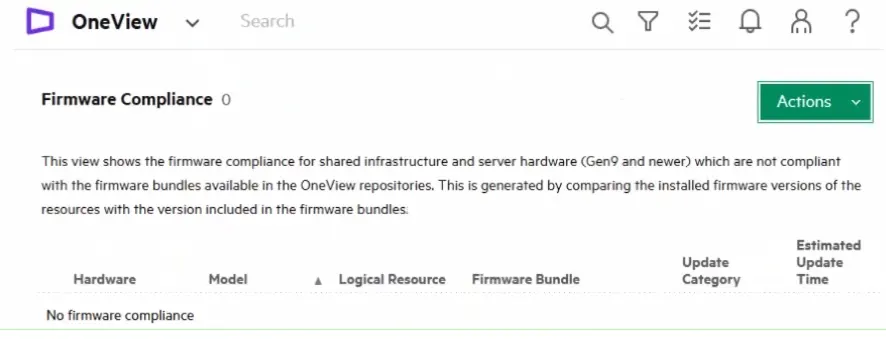
Refer to the exhibit.

A customer complains that firmware compliance is empty. The customer confirmed that Synergy Service Pack is uploaded to the HPE OneView repository. How should you respond?
Refer to the exhibit.

A customer complains that firmware compliance is empty. The customer confirmed that Synergy Service Pack is uploaded to the HPE OneView repository. How should you respond?
Your customer wants to deploy HPE OneVlew appliance to manage HPE ProLiant servers. Customer reports that they nave only KVM available What can you tell this customer?
as a hypervisor.
The HPE OneView appliance can be deployed to KVM, in addition to VMware ESXi and Microsoft Hyper-V. HPE provides support for deploying the OneView virtual appliance on KVM hypervisors, allowing customers with KVM environments to use OneView for managing their infrastructure.
Option A (Correct): KVM is a supported hypervisor for HPE OneView appliance deployment.
Option B: Incorrect, as KVM is supported.
Option C/D: Workarounds like nested virtualization are unnecessary since KVM is supported.
HPE OneView Support Matrix: Lists KVM as a supported hypervisor platform for the appliance.
HPE OneView Installation and Support: Details on supported deployment platforms.

You ate implementing an HPE Synergy solution with multiple frames in one management ring. Image Streamer is not a part of this solution. How can an IPv4 address pool defined by the administrator be used In HPE OneView?
Which REST API method can be used to create a resource?
In the context of RESTful APIs, the POST method is used to create a new resource on the server. When interacting with the HPE OneView REST API, you use the POST method to create new resources such as server profiles, networks, or volumes. This method sends data to the server to create a new subordinate of the resource identified by the URI.
GET is used to retrieve information about resources.
PUT is typically used to update or replace an existing resource.
DELETE is used to remove a resource.
HPE OneView REST API Reference Guide: Describes the use of HTTP methods in the API, specifying that POST is used for creating resources.
HPE OneView API Methods: Outlines how different HTTP methods interact with HPE OneView resources.
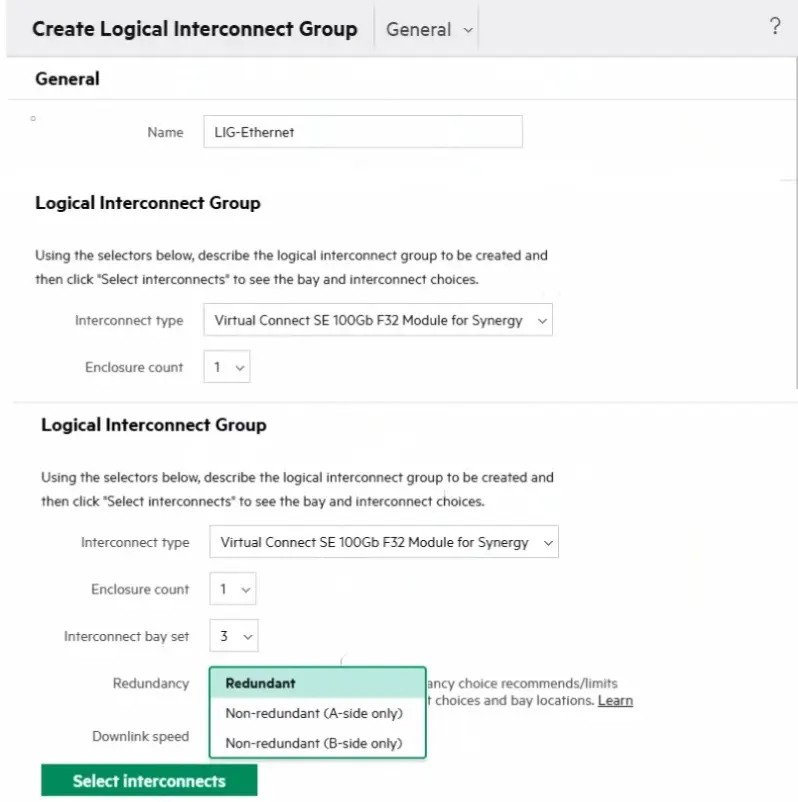
Refer to the exhibit.

Your customer wants to define a Logical Interconnect Group (UG) and set the redundancy of the master modules to highly available, but this option is not available. What is a possible reason?
You want to update the firmware for only two HPE Synergy Virtual Connect SE 32Gb FC Modules of a large environment. From which level must this procedure be initiated?
What can De defined in a server profile for HPE Superdome Flex?
In a server profile for HPE Superdome Flex, you can define the nPartition configuration. HPE OneView allows administrators to manage nPartitions (nPars), which are hardware-based partitions providing electrical isolation between different partitions of the Superdome Flex server. This includes defining partition boundaries, assigning resources like CPUs and memory, and configuring boot options.
Option B: While BMC settings are important, nPartition configurations are more specific to Superdome Flex profiles.
Option C: Firmware baselines can be applied but are not unique to Superdome Flex server profiles.
Option D: Ethernet connections are typically defined for standard servers, but nPartitioning is a key feature for Superdome Flex.
HPE OneView User Guide for Superdome Flex: Details how to configure nPartitions within server profiles.
HPE Superdome Flex Management: Explains the capabilities of HPE OneView in managing Superdome Flex servers.
Which parameters can be defined in a server profile template for HPE Synergy Compute Modules? (Select two.)
Which statement about RoCE network restrictions is true?
Your customer built a sever profile for HPE Synergy Gen 10 server and configured boot mode to Legacy BIOS. Which feature Is not available for this Compute Module?