
Limited-Time Offer: Enjoy 50% Savings! Ends in 00h 00m 00s Coupon code: 50OFF
Skip to content

Free HP HPE Network Switching Associate Exam HPE6-A86 Exam Questions

Page: 1 / 10 Total 98 questions

Want more questions? Get Premium Access.

Question 1

On a switched infrastructure using Spanning Tree, what entity defines the best path for traffic in an HPE Aruba Networking CX environment?

Correct Answer: A. Root bridge
Explanation:

The correct answer is A. Root bridge. In a switched infrastructure using Spanning Tree Protocol, the root bridge is the central reference point for calculating the loop-free Layer 2 topology. HPE Aruba Networking AOS-CX documentation explains that device roles, such as root bridge or leaf node, should be planned by adjusting spanning tree instance priority. It also notes that the placement of root bridges is important in a Layer 2 network domain because deterministic root and secondary root bridges provide predictability and protection. Switches calculate their best path toward the root bridge based on spanning tree information such as bridge priority, path cost, and port roles. This calculation determines which ports forward and which ports block to prevent loops. Option B is incorrect because a designated bridge or designated port forwards traffic for a segment but does not define the overall topology reference point. Option C is incorrect because ''alternative bridge'' is not the entity that defines best path selection. Option D is incorrect because ''common bridge'' is not the correct STP role.
Question 2

You are planning a 40Gbps link between two sites 35 km apart.

What type of cable will be required?

Correct Answer: B. Single-mode fiber
Explanation:

The correct answer is B. Single-mode fiber. A 35 km connection between two sites is a long-distance optical link, and single-mode fiber is the appropriate cable type for long-haul communication. HPE Aruba Networking transceiver documentation describes single-mode fiber as having a small core size and being suitable for long-haul communication because it transmits light in one mode and suffers less intermodal dispersion than multi-mode fiber. Multi-mode fiber is used for shorter-distance links inside buildings or data centers and is not the correct choice for a 35 km site-to-site connection. UTP copper cabling cannot support a 40Gbps Ethernet connection over 35 km. ZTP is Zero Touch Provisioning, not a cable type. HPE Aruba transceiver guidance also lists long-distance optical transceivers, such as 40 km single-mode fiber options, reinforcing that long-distance high-speed links require SMF rather than MMF or copper. Therefore, for a 40Gbps link between sites 35 km apart, the required cabling is single-mode fiber. (arubanetworking.hpe.com)


Question 3

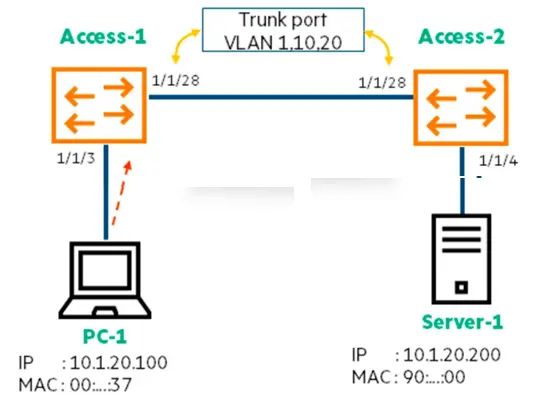
Refer to the diagram below.

After a recent network change, the helpdesk reports that some users could not connect to the print server, Server-1, which is in VLAN 20. After further investigation, you find that only devices directly connected to Access-2 are affected.

Which part of the network should you investigate?

Correct Answer: D. Allowed VLANs between access switches.
Explanation:

The correct answer is D. Allowed VLANs between access switches. The diagram shows Server-1 connected to Access-2 in VLAN 20 and PC-1 connected to Access-1. The inter-switch link between Access-1 and Access-2 is shown as a trunk carrying VLANs 1, 10, and 20. If users on Access-1 cannot reach Server-1 in VLAN 20 after a recent change, while devices directly connected to Access-2 are not affected, the most likely issue is that VLAN 20 is not being correctly carried across the trunk between the access switches. HPE Aruba Networking AOS-CX documentation states that vlan trunk allowed defines which VLAN traffic is allowed across a trunk interface. It also explains that allowed VLANs are the VLANs that can be transported by the trunk; if a required VLAN is missing from the allowed list, that VLAN's traffic will not traverse the trunk. Option A is less likely because devices directly connected to Access-2 can access Server-1, indicating Server-1's local VLAN placement is probably correct. Option B is unlikely because a down trunk would affect more VLANs than just access to VLAN 20. Option C is not supported by the symptom pattern.


Question 4

A technician installed a new HPE Aruba Networking 550 Series access point, which is cabled back to an HPE Aruba Networking CX 6000 Series switch. However, there are no lights on the access point.

What could cause this?

Correct Answer: B. PoE is disabled on the interface.
Explanation:

The correct answer is B. PoE is disabled on the interface. If there are no lights on the access point, the first issue to investigate is whether the AP is receiving power. HPE Aruba Networking 550 Series installation documentation identifies Power over Ethernet as a supported power source for the AP, including IEEE 802.3bt or 802.3at PoE. HPE Aruba Networking AOS-CX documentation for the CX 6000/6100 PoE command shows that per-interface power distribution can be enabled with power-over-ethernet and disabled with no power-over-ethernet. If PoE is disabled on the switch interface, the AP will not receive power from the Ethernet cable and therefore may show no LEDs. Option A is incorrect because a missing STP configuration would not prevent the AP from powering on. Option C is incorrect because failure to reach HPE Aruba Networking Central would occur after the AP is powered and network-connected. Option D is also incorrect because a wrong VLAN can prevent management or provisioning, but it would not normally stop the AP LEDs from turning on.


Question 5

A security auditor asks whether you use any insecure management protocols to configure your HPE Aruba Networking CX 6200 switches from their factory-default state.

What can you tell them?

Correct Answer: C. No, SSH and HTTPS are enabled by default.
Explanation:

The correct answer is C. No, SSH and HTTPS are enabled by default. HPE Aruba Networking AOS-CX hardening documentation states that, in the factory-default state, AOS-CX switches have SSH enabled on TCP port 22 and Web UI/read-write REST API enabled on TCP port 443. For the CX 6200 switch series, these services are enabled on both the default and management VRFs. These are secure management protocols because SSH encrypts CLI sessions and HTTPS encrypts web-management sessions. The same HPE Aruba guidance also notes that connections to TCP port 80 are automatically redirected to TCP port 443, which means HTTP is not used as the insecure management method. Option A is incorrect because Telnet is insecure and is not the correct default secure management protocol. Option B is incorrect because Telnet is not the default management method. Option D is incorrect because HTTP connections are redirected to HTTPS. (arubanetworking.hpe.com)


Question 6

With HPE Aruba Networking CX switches, which key feature is a fundamental concept of Zero Trust Security and SASE frameworks?

Correct Answer: D. Dynamic Segmentation
Explanation:

The correct answer is D. Dynamic Segmentation. HPE Aruba Networking describes Dynamic Segmentation as an identity-based access control solution for Zero Trust and SASE security from edge to cloud. Dynamic Segmentation applies policy based on the identity and role of users and devices, rather than relying only on physical network location, VLAN placement, or static port configuration. This is important in Zero Trust because no user, device, or network segment should be automatically trusted. Access should be continuously controlled and limited to only the resources required. HPE Aruba Networking documentation also explains that Dynamic Segmentation establishes least-privilege access by segmenting traffic based on identity and associating consistent role-based access policies across wired, wireless, and WAN networks. The other options are not the best answer. Virtual Switching Framework and Virtual Switching Extension are resiliency or virtualization technologies, not the core Zero Trust/SASE policy feature. Network Analytics Engine is useful for monitoring, automation, and troubleshooting, but Dynamic Segmentation is the security framework feature directly tied to Zero Trust and SASE.


Question 7

When multiple routes exist to the same destination, which would be installed in the routing table?

Correct Answer: C. Lowest administrative distance
Explanation:

The correct answer is C. Lowest administrative distance. When a switch learns multiple possible routes to the same destination, it must select the preferred or best route to install and use for forwarding. HPE Aruba Networking documentation explains that administrative distance is one of the main criteria used to determine the preferred route when multiple paths exist to the same destination. The route with the lower administrative distance takes precedence. This is why connected routes, static routes, and dynamically learned routes can be preferred differently depending on their administrative distance values. Option A is incorrect because a default route is used only when no more specific route exists. Option B is incorrect because a static route is not automatically selected merely because it is static; it is preferred only if its administrative distance and route specificity make it the best candidate. Option D is incorrect because the highest administrative distance is less preferred, not more preferred.


Question 8

Which statement is true given the IP address 10.64.0.240 and subnet mask 255.255.254.0?

Correct Answer: B. There are more than 8 bits in the host portion.
Explanation:

The correct answer is B. There are more than 8 bits in the host portion. The subnet mask 255.255.254.0 converts to a /23 prefix because the first two octets, 255.255, represent 16 network bits, and the third octet value 254 represents seven more network bits. That gives 23 network bits total. IPv4 addresses are 32 bits long, so 32 minus 23 leaves 9 host bits. Since 9 is more than 8, option B is correct. HPE Aruba Networking documentation uses prefix length as CIDR subnet-mask notation and supports IPv4 prefix lengths from 1 to 32, matching the /23 interpretation. Option A is incorrect because ''10.64'' alone is not the full network portion for a /23 network. The actual network range is 10.64.0.0/23. Option C is incorrect because the broadcast address for 10.64.0.0/23 is 10.64.1.255, not 10.64.0.240. Option D is incorrect because 255.255.254.0 is /23, not /25.


Question 9

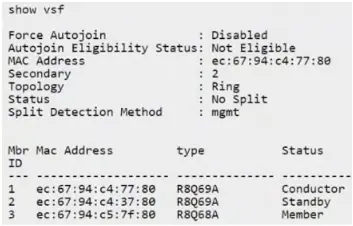
Based on the example below:

show vsf

Force Autojoin : Disabled

Autojoin Eligibility Status : Not Eligible

MAC Address : ec:67:94:c4:77:80

Secondary : 2

Topology : Ring

Status : No Split

Split Detection Method : mgmt

Mbr Mac Address Type Status

ID

--- ------------------- ------- ----------

1 ec:67:94:c4:77:80 R8Q69A Conductor

2 ec:67:94:c4:37:80 R8Q69A Standby

3 ec:67:94:c5:7f:80 R8Q68A Member

What happens to the member status state if member 1 reboots?

Correct Answer: B. Member 2 becomes Conductor
Explanation:

The correct answer is B. Member 2 becomes Conductor. In the shown VSF stack, member 1 is currently the Conductor, member 2 is the Standby, and member 3 is a regular Member. HPE Aruba Networking VSF documentation explains that the Conductor runs the control plane for the VSF stack, while the Standby keeps a synchronized copy of the Conductor's configuration database. If the Conductor fails or reboots, the Standby takes over the Conductor role to maintain stack operation. Since the output explicitly shows member 2 as the Standby, member 2 is the member expected to become the new Conductor when member 1 reboots. Option A is incorrect because member 2 is already Standby before the reboot. Option C is incorrect because member 3 is only a normal Member and would not take over while a Standby exists. Option D is not the best answer because the immediate role transition asked by the question is the Standby becoming Conductor.


Question 10

The customer requires the highest speed available using a single-port link between an HPE Aruba Networking CX 6200 and an HPE Aruba Networking CX 8100 over a distance of 3 meters, or 9 feet.

Which is the correct validated connectivity option for a single port?

Correct Answer: A. 10G-DAC
Explanation:

The correct answer is A. 10G-DAC. The limiting device in this connection is the CX 6200. HPE Aruba Networking CX 6200 models use built-in high-speed uplinks, and the CX 6200 product listings identify models with 4SFP+ uplinks. SFP+ uplinks support 10G, not 25G, 50G, or 100G single-port connectivity. HPE Aruba Networking transceiver guidance also notes that CX 6200 switches support split-side SFP connections only in available 10G-capable SFP ports, and that 50G transceivers can only be used in ports capable of 50G speeds, such as SFP56-capable ports. Therefore, even though the CX 8100 supports higher-speed connectivity options, the shared validated single-port option between the two switch families is 10G over DAC for a short 3-meter connection. Option B is incorrect because the CX 6200 does not have 100G ports. Option C is incorrect because 25G-LR is not the best validated 3-meter option and exceeds the CX 6200 SFP+ port capability. Option D is incorrect because 50G-DAC requires 50G-capable ports.