Free HP Aruba Certified Campus Access Professional Exam HPE7-A01 Exam Questions
Page: 1 / 11Total 155 questions
Want more questions? Get Premium Access.
Question 1
A company recently deployed new Aruba Access Points at different branch offices Wireless 802.1X authentication will be against a RADIUS server in the cloud. The security team is concerned that the traffic between the AP and the RADIUS server will be exposed.
What is the appropriate solution for this scenario?
Correct Answer:D. Configure RadSec on the AP and the RADIUS server
You are setting up a customer's 150 headless loT devices that do not support 802.1 X. What should you use?
Correct Answer:A. Multiple Pre-Shared Keys (MPSK) Local
Explanation:
For 150 headless IoT devices that do not support 802.1X authentication, you should use:
MAC-based authentication or MPSK (Multiple Pre-Shared Key).
Comparison of options:
MAC-based Authentication - The device's MAC address is used for authentication against a ClearPass or local database. Simple but less secure and prone to MAC spoofing
MPSK (Multiple Pre-Shared Key) - Multiple pre-shared keys are configured, each mapped to different device groups, roles, and VLANs. Provides better segmentation than a single PSK
MPSK Local - PSKs and policies are stored locally on the AP/gateway rather than on a central server, reducing latency and external dependencies
Captive Portal - Could be used for limited device support but typically requires a UI
For 150 devices without 802.1X support, MPSK Local is typically the best choice as it provides role-based segmentation without requiring external servers while maintaining reasonable security and scalability for the device count.
Question 3
Due to a shipping error, five (5) Aruba AP-515S and one (1) Aruba CX 6300 were sent directly to your new branch office You have configured a new group persona for the new branch office devices in Central, but you do not know their MAC addresses or serial numbers The office manager is instructed via text message on their smartphone to onboard all the new hardware into Aruba Central
What application must the office manager use on their phone to complete this task?
How do you allow a new VLAN 200 for downstream access switch with VSX pair using VSX LAG?
Correct Answer:C. vlan trunk allowed all in LAG 1 multi-chassis
Explanation:
To allow a new VLAN 200 for downstream access switches connected to a VSX pair using VSX LAG:
Configure VLAN 200 on both VSX switches and add it to the VSX LAG interface that connects to the downstream switch.
The steps are:
Create VLAN 200 on both primary and secondary VSX switches
Ensure the VLAN is tagged on the VSX LAG interface connecting to the downstream switch
Configure the downstream switch port to accept the VLAN as tagged
Optionally configure STP on VLAN 200 to prevent loops
Since the VSX LAG appears as a single logical link to the downstream switch, configuring the VLAN on the LAG ensures it's simultaneously available on both VSX members without requiring redundant configurations on each switch independently.
Question 5
You are working on a network where the customer has a dedicated router with redundant Internet connections Tor outbound high-importance real-time audio streams from their datacenter All of this traffic.
* originates from a single subnet
* uses a unique range of UDP ports
* is required to be routed to the dedicated router
All other traffic should route normally The SVI for the subnet containing the servers originating the traffic is located on the core routing switch in the datacenter What should be configured?
Correct Answer:C. Configure Policy Based Routing (PBR) on the core routing switch for the VRF with the servers' SVI
Explanation:
The reason is that PBR allows you to route packets based on policies that match certain criteria, such as source or destination IP addresses, ports, protocols, etc. PBR can also be used to set metrics, next-hop addresses, or tag traffic for different routes.
Question 6
Your manufacturing client is deploying twenty headless scanners in their warehouse. These new devices do not support 802.1X authentication.
How does the gateway determine the device's role and VLAN derivation-rules when using MPSK Local?
Correct Answer:A. From the Type-Length-Value based on the Aruba-MPSK-Key-Name.
Explanation:
When using MPSK (Multiple Pre-Shared Key) Local for headless devices that don't support 802.1X:
The gateway determines the device's role and VLAN derivation through MAC address matching against locally configured MPSK policies.
Specifically:
The client connects using a pre-shared key (PSK)
The gateway captures the client's MAC address
The MAC address is matched against a local database of MPSK entries
Each MPSK entry is associated with specific roles and VLAN assignment rules
The corresponding role and VLAN are applied to the device
This approach allows the gateway to provision multiple pre-shared keys locally, each mapped to different device profiles, roles, and VLANs without requiring external authentication servers. MPSK Local is ideal for IoT and headless devices that cannot perform certificate-based or EAP authentication.
Question 7
Which Aruba AP mode is sending captured RF data to Aruba Central for waterfall plot?
The customer needs a network hardware refresh to replace an aging Aruba 5406R core switch pair using spanning tree configuration with Aruba CX 8360-32YC switches What is the benefit of VSX clustering with the new solution?
Correct Answer:D. dual control plane provides better resiliency
Explanation:
VSX clustering is a feature that allows two Aruba CX switches to operate as a single logical device, providing high availability, scalability, and simplified management. VSX clustering has several benefits over spanning tree configuration, such as:
Dual control plane provides better resiliency. Unlike stacking, where switches share a single control plane, VSX switches have independent control planes that synchronize their states over an inter-switch link (ISL). This means that if one switch fails or reboots, the other switch can continue to operate without affecting traffic flows or network services.
Active-active forwarding provides better performance. Unlike spanning tree, where some links are blocked to prevent loops, VSX switches use all available links for forwarding traffic, providing load balancing and increased bandwidth utilization.
Multichassis LAG provides better redundancy. Unlike single-chassis LAG, where all member ports belong to one switch, VSX switches can form multichassis LAGs with downstream or upstream devices, where member ports are distributed across both switches. This provides link redundancy and seamless failover in case of switch or port failure.
Question 10
What is used to retrieve data stored in a Management Information Base (MIS)?
SNMPv3
DSCP
TLV
CDP
Correct Answer:A. SNMPv3.
SNMPv3 is a protocol that is used to retrieve data stored in a Management Information Base (MIB), which is a database of managed objects in a network. SNMPv3 provides security and access control features that are not available in earlier versions of SNMP. SNMPv3 can also use encryption to protect the data from unauthorized access or modification.
According to the Aruba Certified Professional -- Campus Access document1, one of the skills that this certification validates is:
Implement and Analyze the output from common network monitoring tools
Configure Port Mirroring to collect PCAPs
Configure NAE agents 9.4
Configure UXI sensors for internal and external tests
Describe how API scan be used to configure, manage, monitor, and troubleshoot your network
The document also mentions that the candidate should have a distinguished understanding of different protocols across vendors, which implies that they should be familiar with SNMPv3 and how it can be used to access MIB data.
Explanation:
The correct answer is
Question 11
Which feature supported by SNMPv3 provides an advantage over SNMPv2c?
A customer has a large number of food-producing machines
* All machines are connected via Aruba CX6200 switches in VLANs 100.110. and 120
* Several external technicians are maintaining this special equipment
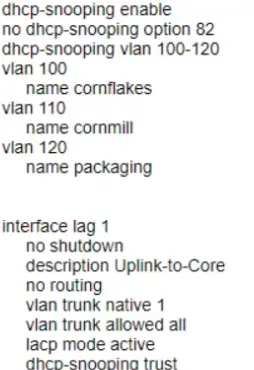
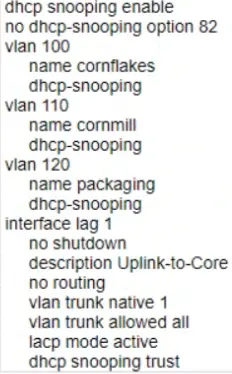
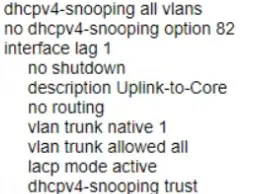
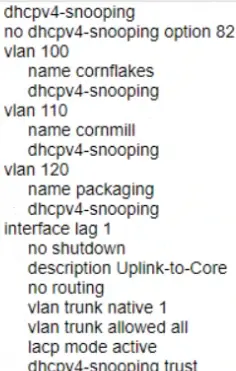
What are the correct commands to ensure that no rogue DHCP server will impact the network?
A)
B)
C)
D)
Correct Answer:B. Option B
Explanation:
configures DHCP snooping on the switch and enables it for VLANs 100, 110, and 120. It also specifies the IP address of the authorized DHCP server and sets the ports connected to the server as trusted. This prevents any unauthorized DHCP server from providing invalid configuration data to the clients on those VLANs. Option B also enables DHCP option-82, which adds information about the switch port and VLAN to the DHCP packets, allowing for more granular control and logging of DHCP transactions.
Question 15
A customer has a site with 200 AP-515 access points 75AP-565 access points installed. The customer is rolling out new mobile phones with Wi-Fi-calling. 802.1X is in use for authentication
What should be enabled to ensure the best roaming experience?
Wi-Fi calling is a feature that allows you to make or receive voice calls over Wi-Fi instead of cellular network. Wi-Fi calling can provide better voice quality and reliability in areas with poor or no cellular coverage.