Limited-Time Offer: Enjoy 50% Savings! Ends in 00h 00m 00s Coupon code: 50OFF
Skip to content

Free HP Aruba Certified Campus Access Mobility Expert Written Exam HPE7-A07 Exam Questions

Page: 1 / 7 Total 70 questions

Want more questions? Get Premium Access.

Question 1

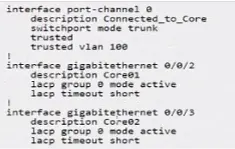
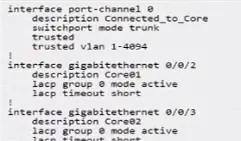
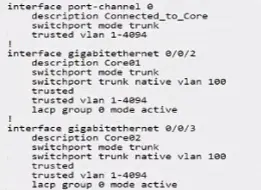
A campus topology uses VSX with a collapsed core topology. The customer added redundant SFP+ transceivers and reconfigured their mobility gateways from a single link to an aggregate Link. You are asked to verify the CLI output for the link aggregation configuration for one of the mobility gateway cluster members below.
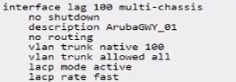
What is a valid configuration?

A)
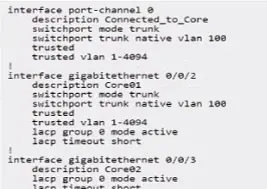
B)
C)
D)
Correct Answer: A. Option A
Explanation:

The configuration shown in Option A is a valid configuration for a multi-chassis link aggregation (MC-LAG) setup. It specifies the use of LACP (Link Aggregation Control Protocol) with a fast rate of LACP PDUs exchange, which is appropriate for creating a resilient and high-throughput link aggregation. The 'vlan trunk allowed all' command allows all VLANs across the trunk, and 'vlan trunk native 100' sets VLAN 100 as the native VLAN for untagged traffic.

Question 2

Your customer's employees connected to a wired network are complaining about a poor user experience. The customer has UXI sensors deployed on their premises. These sensors nave been running for multiple months. They are testing both the wired network (using the wired Interface of each sensor) and the wireless networks. Your customer used the UXI dashboard to find the reason for the poor user experience to find more details, the customer asked you to check the packet captures that have been downloaded from the sensors using the UXI dashboard.

From the zip file downloaded from the UXI sensors, you checked the "datagrams" .pcap file, but you were not able to find any issues How can you explain this?

Correct Answer: A. The 'datagrams- pcap file only contains me successful tests Failed tests are contained in the 'datagrams-failed' .pcap file
Explanation:

It is a common practice to separate successful and failed test results into different files for ease of troubleshooting. If the 'datagrams.pcap' file shows no issues, it's likely because it only contains successful test data, and the failed tests that could explain the poor user experience would be in a different file, such as 'datagrams-failed.pcap.'


Question 3

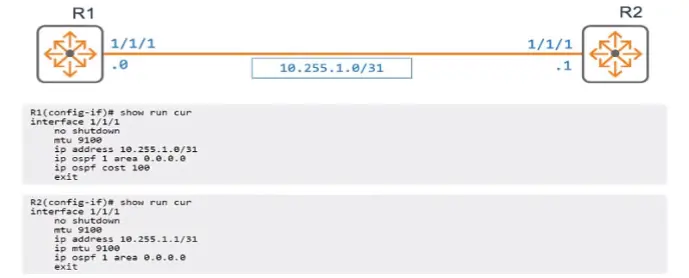
Exhibit.

An engineer has applied the above configuration to R1 and R2 However the routers OSPF adjacency never progresses past the "EXSTART-DR" slate as shown below.

Which configuration action on either router will allow R1 and R2 to progress past the "EXSTART/DR" state?

Correct Answer: A. Change R1 and R2 to a network type of point-to-point.
Explanation:

In OSPF, the 'EXSTART/DR' state indicates that the routers are trying to establish an adjacency but are unable to progress. This can happen if the OSPF network type is incorrectly configured for the type of connection between the routers. Given that R1 and R2 are connected via a point-to-point link (as suggested by the /31 subnet), setting the network type to point-to-point on both routers will remove the need for DR/BDR election, which is unnecessary on a point-to-point link, and allow OSPF to progress past the 'EXSTART' state and form a full adjacency.


Question 4

A customer's infrastructure is set up to use both primary and secondary gateway clusters on the SSID profile cased on best practices. Why do they have an equal split of their 120 APs across the primary and secondary gateway clusters?

Correct Answer: D. The primary and secondary gateway clusters are up. but the cluster preemption Is not enabled
Explanation:

When cluster preemption is not enabled, access points (APs) will not automatically fail back to the primary gateway cluster once it is up again after having failed over to the secondary. This would result in an equal split of APs across primary and secondary clusters if both clusters are operational. Without preemption, there's no automatic rebalancing of APs back to the primary cluster, leading to the current distribution.


Question 5

A customer would like to allow their IT Helpdesk to configure loT devices to connect lo a single SSID using a unique PSK that other devices cannot use. Which solution would you recommend?

Correct Answer: D. MPSK AES with ClearPass
Explanation:

Multi-Pre-Shared Key (MPSK) with ClearPass is the recommended solution for a scenario where the IT Helpdesk needs to configure IoT devices to connect to a single SSID using unique PSKs. MPSK allows for the use of different PSKs on the same SSID, and ClearPass enables the management of these unique keys efficiently.


Question 6

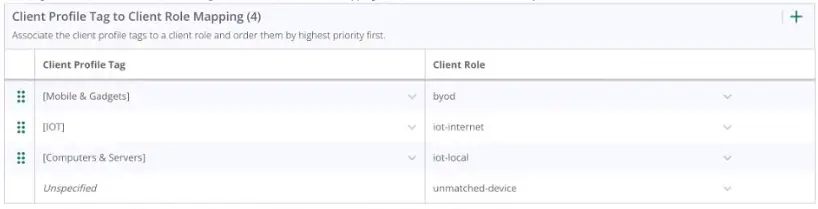
You configured a WPA3-SAE with the following MAC Authentication Role Mapping in Cloud Authentication and Policy:

With further default settings assume a new Android phone is connected to the network. Which role will the client be assigned after connecting for the first time?

Correct Answer: D. unmatched-device
Explanation:

The configuration shown in the third exhibit details a client role mapping that associates different client profile tags with specific client roles. When a new device, such as an Android phone, connects to the network, it will be profiled and assigned a role based on the mappings defined. If the device does not match any predefined profiles, it would be assigned the 'unmatched-device' role. This is under the assumption that default settings are in place and the client does not match the criteria for any of the specific roles like 'byod', 'iot-internet', or 'iot-local'. Therefore, an Android phone connecting for the first time and not matching any specific profile tag would be assigned to the 'unmatched-device' role.


Question 7

A customer's infrastructure is set up to use Doth primary and secondary gateway clusters on the SSID profile What is a valid reason for the AP to failover to the secondary gateway cluster?

Correct Answer: A. The primary gateway cluster is up. out the AP is unable to reach the primary gateway cluster.
Explanation:

In Aruba's infrastructure, the Access Points (APs) are configured with primary and secondary gateway clusters to ensure connectivity and resiliency. The APs will failover to the secondary gateway cluster if they are unable to reach the primary gateway cluster, even if the primary cluster is operational. This mechanism ensures that the APs maintain connectivity to the network infrastructure for continuous service delivery.


Question 8

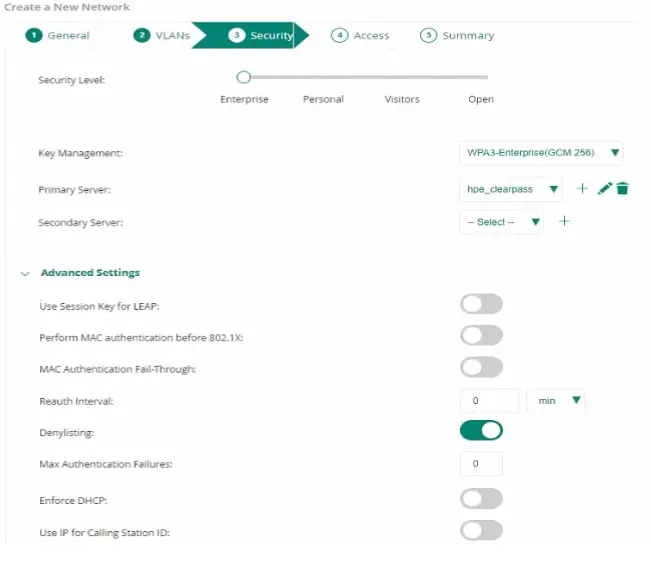
You created a new SSID with the security settings shown in the exhibit.

Some, but not all users complain that client devices are unable to connect to this SS1D. What is the reason for this?

Correct Answer: C. MAC authentication after a failed 802. ix authentication is not possible as the option 'MAC Authentication Fall-Through' is disabled.
Explanation:

If some users are unable to connect to an SSID configured with WPA3-Enterprise GCM-256, and the 'MAC Authentication Fall-Through' is disabled, it means that devices which fail 802.1X authentication will not attempt MAC authentication. If these client devices are configured to use MAC authentication as a backup method, they will fail to connect, explaining the issue faced by some users.


Question 9

A university owns a campus with several buildings segmented into east and west wings, which are L3 separated. The east wing has 1600 APs. and the west wing has 1200 Aps. Each wing has a single gateway cluster managed by HPE Aruba Networking Central. Each cluster contains one 7210 mobility gateway The gateways are configured with DHCP relay and route all client VLANs. A new business-critical faculty real-time application requires users to roam within wings but not across wings without disconnections or delay increments.

Which changes must the network administrator make lo successfully meet the requirement without performance degradation matching best practices? (Select two.)

Correct Answer: B. Add a single 7210 mobility gateway to each cluster.; E. Run L2 for all SSIDs and permit the users' VLANs in the gateway's uplinks.
Explanation:

To support a business-critical faculty real-time application that requires seamless roaming within wings without cross-wing roaming, it's essential to ensure high availability and sufficient capacity. Adding an additional 7210 mobility gateway to each cluster would provide the required redundancy and capacity. Running L2 for all SSIDs and permitting user VLANs on gateway uplinks would facilitate the necessary traffic flow without L3 segmentation issues, thus supporting seamless roaming within each wing.


Question 10

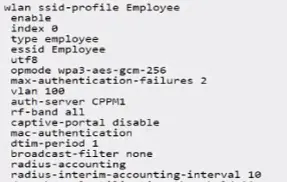
A customer is planning to add loT devices that connect wirelessly to the existing 802.1X SSlD. The customer will use ClearPass to authenticate the IoT devices by MAC address but other devices will still need to authenticate by only 802 1X

Exhibit.

The customer provided the current configuration and reported their non-loT 802. IX devices are no longer able to connect. Which configuration change can be made to fix the issue?

Correct Answer: C. Remove mac-authentication from the WLAN configuration
Explanation:

The existing configuration for the WLAN ssid-profile has enabled MAC authentication which, while suitable for IoT devices that may not support 802.1X, can interfere with the normal 802.1X authentication process for other devices. By removing the mac-authentication directive from the WLAN configuration, the non-IoT 802.1X devices should be able to connect without issues as the authentication process will not be disrupted by MAC authentication checks. This adjustment ensures that the WLAN ssid-profile is correctly aligned with the authentication requirements for both IoT and non-IoT devices within the network environment, conforming to the best practices for mixed-device WLAN configurations.