Question 1
Which of the following statements is false about point-to-point calls?
Alerting is part of the H.225 call-signaling sequence, not the RAS interface, so it is not used over the RAS channel.
Which of the following statements is false about point-to-point calls?
Alerting is part of the H.225 call-signaling sequence, not the RAS interface, so it is not used over the RAS channel.
Which of the following statements are true about the SC cluster reconstruction deployment scenario? (Choose all that apply.)
When SIP endpoints greatly outnumber H.323 endpoints, you deploy an SC cluster to serve the SIP devices while leaving a standalone SC for the H.323 endpoints.
If SIP registrations are much fewer than H.323 registrations, clustering the SC for SIP isn't recommended, as the scale doesn't justify the added complexity.
A proxy SC supports up to 2,000 external soft-client registrations; if you exceed this, you should rebuild it as a proxy-SC cluster to handle the extra load.

In the encrypted conference scenario, the SIP transmission type must be set to TLS on both the MCU and endpoint.
To secure SIP signaling in an encrypted conference, both the MCU and endpoints must use TLS as the transport for SIP messages.
Which of the following MCU debugging commands is used to display detailed information about a specified conference?
The generic conf get [confNum] command retrieves comprehensive details for the specified conference, whereas the other commands show only specific aspects (IAU resources, stream info, or channel info).
Which of the following permissions are granted to an SMC system administrator? (Choose all that apply.)
The System Administrator role grants full privileges for system configuration tasks and for managing administrator user accounts; it does not include conference or room management functions.
Which of the following is the maximum number of cascaded conference levels supported by the SMC?
Huawei's SMC supports cascading up to four conference levels for multi-level conferencing, ensuring efficient management and control across up to four tiers.
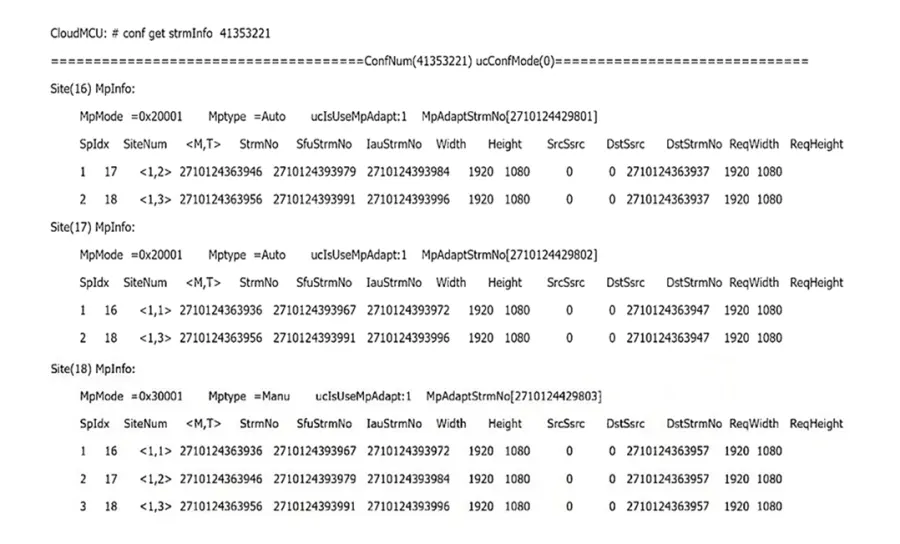
An AVC conference is scheduled on the CloudMCU (working in SFU mode) and VP9850 (working in IAU mode). After the conf get strmInfo 41353221 command is executed on the CloudMCU, the following information is displayed:

Which of the following is the video stream number generated after the IAU decodes and re-encodes the three video streams of Site (16), Site (17), and Site (18)?
In SFU+IAU mode, the IAU's re-encoded (decoded and encoded) streams are identified by the MpAdaptStrmNo value under Site(18). In the output, MpAdaptStrmNo[2710124429803] is the stream number carrying all three re-encoded video channels.
Which of the following statements are true about the multi-level protection of the collaboration hardware platform? (Choose all that apply.)
The collaboration hardware platform implements full redundancy: network ports, fans, power supplies, and disks (RAID) - to ensure high availability and fault tolerance.
In a SIP multipoint conference, if BFCP Trans Type is set to TCP on the MCU, the BFCP communication protocol must be set to TCP on the endpoint.
BFCP transport must match between the MCU and endpoints; if the MCU is configured for TCP, endpoints must also use TCP for BFCP.
In the collaboration solution architecture, which of the following network elements are deployed at the media processing layer? (Choose all that apply.)
The media processing layer handles core media functions such as audio/video encoding, decoding, mixing, recording, and streaming. The VP9860 is Huawei's MCU media server - deployed precisely in this media processing (media switching) layer to provide high-density encoding/decoding and mixing capabilities. CloudRSE (Cloud Recording & Streaming Engine) delivers recording and streaming services, which are also key media processing functions within this layer.