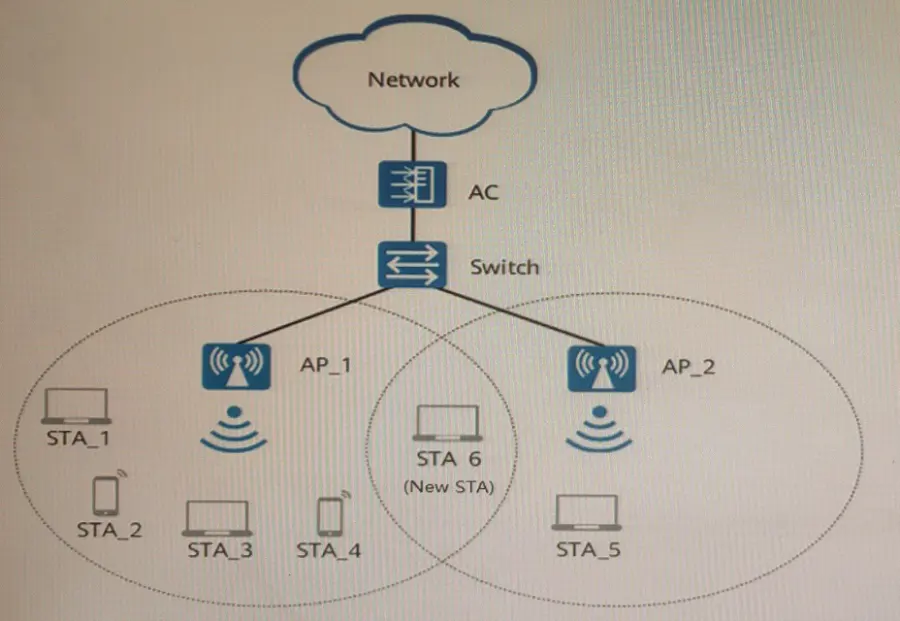
As shown in the figure, STA_1 through STA_4 are associated with AP_1, and STA_5 is associated with AP_2. Assuming that the load balancing threshold is 2, the load difference threshold is 25%, and API and AP2 support a maximum of 10 STAs, which of the following statements are true? (Select All that Apply)
Correct Answer:A. The load percentage of AP_1 is 40%, and that of AP_2 is 10%.; B. The load balancing mechanism needs to be enabled. Then some STAs are steered from AP_1 to AP__2.
Explanation:
The load percentage of an AP is calculated by dividing the number of associated STAs by the maximum number of STAs supported by the AP. In this case, the load percentage of AP_1 is 4/10 = 40%, and that of AP_2 is 1/10 = 10%. The load balancing mechanism needs to be enabled to balance the load between AP_1 and AP_2. Then some STAs are steered from AP_1 to AP_2 based on the load balancing threshold and the load difference threshold.
Question 2
Which of the following user access authentication modes are supported In Huawel's CloudCampus Solution? (Select All that Apply)
Correct Answer:A. 802. IX authentication; B. MAC address authentication; C. Portal authentication
Explanation:
Huawei's CloudCampus Solution supports three user access authentication modes: 802.1X authentication, MAC address authentication, and Portal authentication.
Question 3
Which of the following statements about the home agent are true? (Select All that Apply)
Correct Answer:B. The home agent communicates with the gateway on the STAs' home network at Layer 3.; D. A home WAC can function as a home agent of STAs.
Explanation:
The home agent is a device that communicates with the gateway on the STAs' home network at Layer 3 and maintains the binding entries of STAs' home addresses and care-of addresses. A home WAC can function as a home agent of STAs, while a home AP cannot.
Question 4
With protocol trace, iMaster NCE-Campuslnsight displays protocol-level Interaction details at the phases for wireless users. (Enter the acronyms in capital letters.)
Correct Answer:A. APWACandAC
Explanation:
With protocol trace, iMaster NCE-CampusInsight displays protocol-level interaction details at theAP,WAC, andACphases for wireless users.
Question 5
Either of the two APs that have established a mesh connection can send a Mesh Peering Close frame to the other AP to tear down the
mesh connection.
Correct Answer:A. True
Explanation:
A mesh connection can be torn down by either of the two APs that have established it by sending a Mesh Peering Close frame to the other AP. This frame indicates that the sender no longer wants to maintain the mesh connection.
Question 6
On a campus network, which of the following problems may occur when you manually create a static VXLAN tunnel? (Select All that Apply)
Correct Answer:A. Although the static VXLAN tunnel mode supports the distributed gateway scenario, the configuration involves a heavy workload and is complex to adjust.; C. If N devices need to establish VXLAN tunnels, you need to manually configure the ingress replication list up to N x (N-l)/2 times.
Explanation:
B is false because a static VXLAN tunnel does not use any protocols on the control plane, saving device resources.
Question 7
Which of the fallowings is not an IPv6 address type?
Correct Answer:C. Broadcast address
Explanation:
Broadcast address is not an IPv6 address type. IPv6 does not support broadcast addressing, but uses multicast addressing instead. The other options are valid IPv6 address types. Unicast address identifies a single interface, multicast address identifies a group of interfaces, and anycast address identifies multiple interfaces but delivers packets to only one of them.
Question 8
Which of the following statements about attack defense is true?
Correct Answer:B. Attack defense allows APs to analyze the contents and behaviors of incoming packets on ports to determine whether packets have attack characteristics. The APs then take defense measures on the packets that have attack characteristics.
Explanation:
Attack defense is a feature that allows APs to analyze the contents and behaviors of incoming packets on ports to determine whether packets have attack characteristics. The APs then take defense measures on the packets that have attack characteristics, such as discarding them or limiting their rate. Attack defense can defend against spoofing packet attacks, malformed packet attacks, fragmentation attacks, and flood attacks.
Question 9
Which of the following statements are true about the WLAN site survey In different typical scenarios? (Select All that Apply)
Correct Answer:A. In a classroom scenario. If the walls are made of reinforced concrete, the signal attenuation Is high. In this case, you are advised to test the attenuation during the site survey. Additionally, pay attention to the locations of ELV rooms in the teaching building.; B. In an office scenario, the load-bearing columns and partitions affect the signal coverage. If an integrated ceiling is used, deploy APs near maintenance entrances. If a metal ceiling is used, mount APs on the ceiling or wall.; C. In a ward-round scenario, high requirements are posed on the coverage field strength, roaming effect, and bandwidth. Determine the interference of medical equipment and the areas where Wi-Fi signals are not allowed.; D. In a stadium scenario, the onsite environment is complex and cabling is difficult. Therefore, confirm with the property management company about ELV rooms and cabling. If the transmission distance is too long, consider deploying more switches. During the survey, focus on the interference between APs and AP mounting modes.
Explanation:
Only: All statements are true about the WLAN site survey in different typical scenarios.
Question 10
Which of the following statements are true about data collection of IMaster NCE-Campuslnslght? (Select All that Apply)
Correct Answer:A. iMaster NCE-Campuslnsight uses telemetry to Implement efficient data collection.; C. To collect data from WLAN devices, ensure that WACs can communicate with the southbound IP address of iMaster NCE-Campuslnsight. APs do not need to communicate with the southbound IP address of iMaster NCE-Campuslnsight.
Explanation:
B is false because calculated data can be displayed on iMaster NCE-CampusInsight without loading a license on the device management page. The license only affects the number of devices that can be managed by iMaster NCE-CampusInsight.
D is false because the UTC time of iMaster NCE-CampusInsight does not need to be the same as that of its managed devices. However, it is recommended that they use the same time zone to avoid confusion.