
Limited-Time Offer: Enjoy 50% Savings! Ends in 00h 00m 00s Coupon code: 50OFF
Skip to content

Free Huawei HCIA-Datacom V1.0 H12-811_V1.0 Exam Questions

Page: 1 / 21 Total 304 questions

Want more questions? Get Premium Access.

Question 1

Which of the following commands can switch a view from the system view to the user view?

Correct Answer: C. Quit
Explanation:

Comprehensive Explanation= The quit command is used to return from the system view to the user view in Huawei's VRP (Versatile Routing Platform). This command allows users to exit the current configuration mode and revert to the default user view. For example, when you are in the system view and you want to return to the user view, typing quit takes you back to the initial prompt without saving the current configuration.

Question 2

In a broadcast address, all host bits are set to 1, and a broadcast address can be used as a host address.

Correct Answer: B. FALSE
Explanation:

A broadcast address, with all host bits set to 1, is used for broadcasting messages to all devices within a network segment. It cannot be assigned to a specific host, as its purpose is to reach every device in the subnet. Therefore, it is reserved for broadcast communication and cannot serve as an individual host address.


Question 3

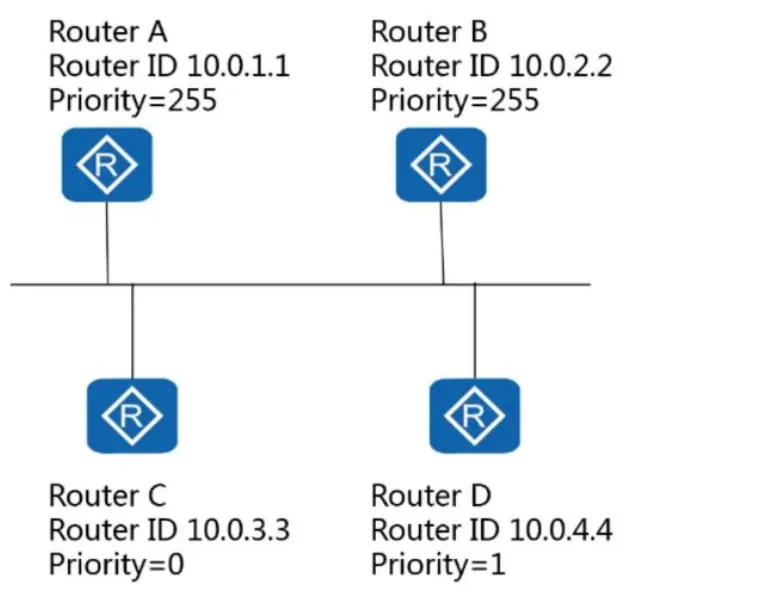
Assuming that OSPF has been enabled on all routers in the following figure, which router is the BDR on this network?

Correct Answer: C. Router D
Explanation:

In OSPF, the Backup Designated Router (BDR) is selected based on the highest priority and, in case of a tie, the highest router ID. Given that Router D has the appropriate settings, it is designated as the BDR, providing backup for the DR (Designated Router) in this network configuration.


Question 4

Which of the following statements about hybrid interfaces is true?

Correct Answer: A. Hybrid interfaces can remove VLAN tags from some outgoing VLAN frames.
Explanation:

Comprehensive Explanation= Hybrid interfaces are capable of carrying both tagged and untagged VLAN frames. They can remove VLAN tags from certain VLANs when sending data frames, depending on the configuration. The command port hybrid untagged vlan x allows a hybrid interface to transmit data frames for VLAN x without a tag, while still tagging other VLANs as required. Hybrid interfaces are flexible and can be used for trunking, but unlike pure trunk ports, they do not always require VLAN tags.


Question 5

When a host uses the IP address 192.168.1.2 to access the Internet, NAT must be performed.

Correct Answer: A. TRUE
Explanation:

Private vs Public IPs:

192.168.1.2 belongs to the private IP range (192.168.0.0/16).

Private IP addresses cannot be routed on the Internet and must be translated.

Network Address Translation (NAT):

NAT converts private IP addresses to a public IP so that the device can access the Internet.

Conclusion:

NAT is required to access the Internet from a private IP, making the statement TRUE.


Question 6

Which of the following packets are exchanged between STAs and an AP to obtain the AP's SSID before association with the AP?

Correct Answer: A. Probe Request; C. Probe Response; D. Beacon
Explanation:

Probe Request: Sent by the client to detect nearby APs.

Probe Response: Sent by APs in response to the client's request.

Beacon: Periodically broadcast by APs to announce their presence and SSID. The Discovery packet type does not exist in the 802.11 standard.

(Reference: HCIA-WLAN Training Material, WLAN Packet Types)


Question 7

Which of the following statements is true about root bridge election in STP?

Correct Answer: C. The device with the smallest bridge priority becomes the root bridge.
Explanation:

In STP, the root bridge is elected based on the lowest bridge priority. If there is a tie in bridge priority, the device with the lowest MAC address is selected as the root bridge. This process ensures a stable, predictable root bridge selection in the network.


Question 8

Which of the following mask lengths is recommended for device interconnection IP addresses during campus network planning?

Correct Answer: A. 30
Explanation:

Device Interconnection Requirements:

Device interconnection (such as point-to-point links) requires only two IP addresses: one for each device.

A subnet mask of /30 (255.255.255.252) provides four total addresses (2 usable, 1 network, 1 broadcast).

Efficiency:

Using a /30 subnet avoids wasting IP addresses, making it ideal for point-to-point links.

Why Other Options Are Incorrect:

B (32): /32 is used for single-host IP addresses, not links.

C (24): /24 is excessive for point-to-point links, providing 254 usable addresses.

D (16): /16 provides 65,534 addresses, which is highly inefficient.


Question 9

Which of the following is not a type of OSPF LSA?

Correct Answer: A. LSA
Explanation:

LSAs (Link-State Advertisements) are the fundamental OSPF messages used to convey network topology information. LSU (Link-State Update), LSR (Link-State Request), and LSACK (Link-State Acknowledgment) are all types of messages related to OSPF's operations, but 'LSA' alone is not a valid OSPF message type.


Question 10

What is the length range of an Ethernet_II frame that contains an Ethernet header?

Correct Answer: A. 64-1518 bytes
Explanation:

An Ethernet II frame has a standard length range of 64 to 1518 bytes, including the Ethernet header. This range accounts for both the minimum frame size (to prevent collisions) and the maximum frame size (to avoid excessive delay). This specification is in line with IEEE 802.3 standards for Ethernet frames.


Question 11

Which of the following methods is not used for logging in to the VRP system?

Correct Answer: B. Netstream
Explanation:

Comprehensive Explanation= Netstream is a protocol for flow-based network traffic analysis, not a method for logging into a VRP system. The valid methods for accessing the VRP system include Telnet, Web, and SSH, which are used for remote management and configuration of network devices


Question 12

Fit APs can provide wireless services independently of an AC.

Correct Answer: B. FALSE
Explanation:

Comprehensive Explanation= Fit APs (Access Points) are designed to work in conjunction with an Access Controller (AC). They rely on the AC for configuration, management, and control of their wireless services. Without an AC, a Fit AP cannot function independently or provide wireless services. This is in contrast to Fat APs, which have their own management capabilities and can operate independently.


Question 13

UDP does not guarantee data transmission reliability and does not provide packet sorting and traffic control functions. It is suitable for the traffic that has low requirements for data transmission reliability, but high requirements for the transmission speed and delay.

Correct Answer: A. TRUE
Explanation:

UDP (User Datagram Protocol) is a connectionless protocol that does not provide reliability, packet sequencing, or traffic control. These features are usually managed by TCP, which is used for applications requiring reliable data transmission. UDP's design makes it suitable for real-time applications, such as video streaming or VoIP, where speed and low latency are prioritized over reliability. (Reference: HCIA-Datacom Training Material, UDP Characteristics)


Question 14

A switch receives a unicast data frame with a VLAN tag but cannot find the destination MAC address of the data frame in its MAC address table. In this case, which action will the switch take?

Correct Answer: B. The switch broadcasts the data frame on all interfaces (except that on which it was received) in the VLAN to which the data frame belongs.
Explanation:

Switch Forwarding Behavior:

If the destination MAC is not found in the MAC address table, the switch floods the frame.

Broadcasting Within VLANs:

VLAN tagging ensures the frame remains within its designated VLAN.

The frame is not sent to all interfaces but only within the VLAN.

Why Other Options Are Incorrect:

A: Does not consider VLAN segmentation.

C: Switches do not discard unknown unicast frames unless configured to do so.

D: Includes access interfaces only, but flooding happens on all VLAN interfaces.

Conclusion:

The switch floods the frame within the VLAN, making the correct answer B.


Question 15

When a switch receives a unicast data frame, if the destination MAC address of the data frame can be found in the MAC address table of the switch, the data frame is definitely forwarded through the port corresponding to the MAC address.

Correct Answer: B. FALSE
Explanation:

While a switch will typically forward a unicast frame based on its MAC address table, certain scenarios like port security or VLAN restrictions may prevent the frame from being forwarded even if a MAC entry exists. (Reference: HCIA-Datacom Training Material, MAC Address Table and Frame Forwarding)