Limited-Time Offer: Enjoy 50% Savings! Ends in 00h 00m 00s Coupon code: 50OFF
Skip to content

Free Huawei HCIA-Datacom V2.0 H12-811_V2.0 Exam Questions

Page: 1 / 11 Total 103 questions

Want more questions? Get Premium Access.

Question 1

You can enter a question mark (?) in the CLI of a Huawei switch to obtain online help. Which of the following statements is true about the meaning of in the output of the command sysname SW1?

[HUAWEI] sysname SW1?

Correct Answer: B. There is no keyword or parameter in that position.
Explanation:

In the Huawei command-line interface, the question mark ? provides real-time command help based on the current input. When the output shows <cr>, it means that the command can end at that point by pressing Enter. In other words, there is no additional keyword or parameter required in that position. Therefore, option B is correct.

In the example sysname SW1?, the device interprets SW1 as a complete and valid hostname parameter for the sysname command. Since nothing else is required after the hostname, the CLI displays <cr> to indicate command completion is allowed. This behavior is common in Huawei devices and is important for daily operation and troubleshooting because it helps engineers understand whether a command is complete, whether more arguments are needed, or whether optional parameters are available. Options about incorrect keywords or incomplete commands do not apply here, because the entered command syntax is already valid. Understanding <cr> is a basic but important CLI skill in HCIA-Datacom operations.

Question 2

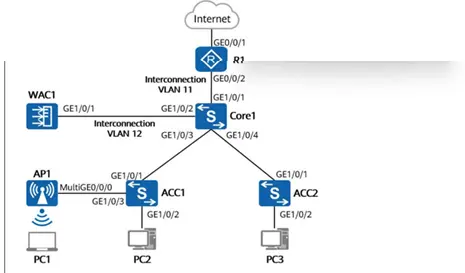
On the campus network shown in the figure below, the core switch Core1 functions as a Layer 3 gateway and as a DHCP server to dynamically assign IP addresses to AP1, PC1, PC2, and PC3. The network below Core1 is a Layer 2 network. WAC1 and R1 are connected to Core1 at Layer 3. AP1 goes online through VLAN 100. The wireless service VLAN is VLAN 101, and the wired service VLANs for PC2 and PC3 are VLAN 102 and VLAN 103, respectively. Additionally, the direct forwarding mode is used for wireless traffic forwarding. If no additional VLANs are allowed on device interfaces, which of the following VLANs must be allowed on GE1/0/1 of ACC1? (Select all that apply)

Correct Answer: A. VLAN 100; B. VLAN 101; C. VLAN 102
Explanation:

According to the original topology and service-planning question, the required VLANs are VLAN 100, VLAN 101, and VLAN 102, so options A, B, and C are correct. In HCIA-Datacom campus design questions, VLAN planning is usually based on service separation, such as user services, voice services, wireless services, management services, or specific departmental segmentation. Each service type is assigned an appropriate VLAN so that broadcast domains are separated and policies can be applied more effectively.

The reason option D is not selected is that it does not match the service requirements shown in the original figure. VLAN planning must follow the actual service design rather than arbitrary numbering. HCIA-Datacom emphasizes that campus VLAN planning should align with traffic isolation, gateway design, security policy deployment, and future scalability. Proper VLAN assignment helps simplify troubleshooting, reduce unnecessary broadcasts, and support service-based policy enforcement. This question tests the ability to read a service topology and identify which VLANs are actually required by the depicted design rather than choosing extra VLANs that are not part of the planned campus solution.


Question 3

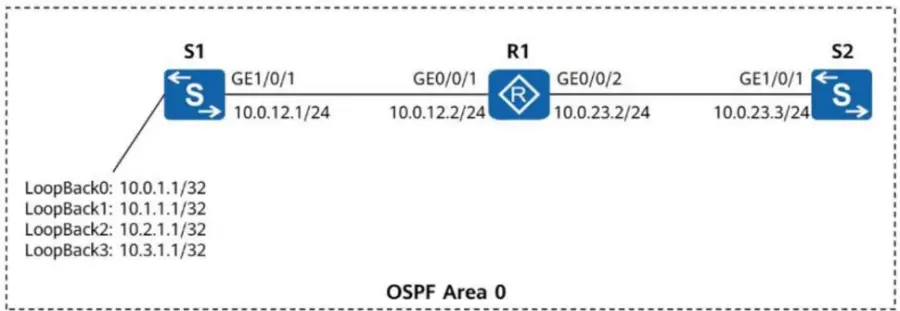
On the OSPF network shown in the figure, all IP addresses can communicate with each other. Then the following configurations are added on R1:

[R1] acl 3000

[R1-acl4-advance-3000] rule deny ip source 10.0.1.1 0.0.0.0

[R1-acl4-advance-3000] rule deny ip source 10.1.1.1 0.0.0.0

[R1-acl4-advance-3000] rule permit ip source 10.3.1.1 0.0.0.0

[R1-acl4-advance-3000] rule permit ip

[R1-acl4-advance-3000] quit

[R1] traffic classifier test

[R1-classifier-test] if-match acl 3000

[R1-classifier-test] quit

[R1] traffic behavior test

[R1-behavior-test] permit

[R1-behavior-test] quit

[R1] traffic policy test

[R1-trafficpolicy-test] classifier test behavior test

[R1-trafficpolicy-test] quit

[R1] interface GE 0/0/1

[R1-GE0/0/1] traffic-policy test outbound

[R1-GE0/0/1] quit

Which IP addresses of S1 can successfully ping 10.0.23.3? (Select all that apply)

Correct Answer: A. 10.3.1.1; B. 10.2.1.1; C. 10.0.1.1; D. 10.1.1.1
Explanation:

All four addresses can successfully ping 10.0.23.3, so the correct answer is A, B, C, D.

The key point is that the traffic policy is applied outbound on GE0/0/1 of R1, which is the interface facing S1. When S1 pings 10.0.23.3, the echo request travels from S1 to R1 and then to S2. The return echo reply from 10.0.23.3 comes back to R1 and is then sent outbound on GE0/0/1 toward S1. Therefore, the traffic policy examines the reply packets, not the original ping request packets.

In those reply packets, the source IP address is 10.0.23.3, and the destination is one of S1's loopback addresses. The ACL rules denying 10.0.1.1 and 10.1.1.1 as source addresses do not match these reply packets, because those addresses appear as destination addresses, not source addresses. In addition, the ACL contains rule permit ip, which permits all remaining IP traffic. As a result, replies to all four S1 addresses are forwarded successfully, so every listed address can ping 10.0.23.3.


Question 4

With the development of data centers, a large number of services are deployed on virtual machines (VMs). The original VLAN isolation solution cannot achieve isolation between so many VMs. VXLAN uses VXLAN Network Identifiers (VNIs) to provide a larger range than VLAN IDs, so that a larger number of VMs can be isolated.

Correct Answer: A. TRUE
Explanation:

This statement is true. Traditional VLANs use a 12-bit VLAN ID, which means that only about 4094 usable VLANs are available. In modern data centers, especially in cloud and virtualization environments, that scale is often insufficient because a very large number of tenants, services, and virtual machines need isolated network segments.

VXLAN addresses this limitation by introducing the VNI (VXLAN Network Identifier), which is 24 bits long. This allows support for up to about 16 million logical segments, greatly expanding the number of isolated Layer 2 networks that can be created across an IP underlay. Because of this, VXLAN is widely used in modern data centers to provide scalable tenant isolation, flexible service deployment, and large Layer 2 extension across physical boundaries. HCIA-Datacom highlights VXLAN as a key overlay technology that solves the VLAN scale problem in virtualized data center environments. It allows a much larger number of VMs and tenants to be isolated than traditional VLAN-based solutions can support, making it essential for modern cloud-oriented and large-scale data center networking.


Question 5

In the WAC + Fit AP networking, an AP fails to go online. The output of the display ap all command run on the WAC is shown below. According to the command output, which of the following is the possible cause of the AP's failure to go online?

Correct Answer: C. The AP's software version does not match the WAC's software version.
Explanation:

The correct answer is C. In the command output, the AP state is shown as ver-mismatch. This state directly indicates a version mismatch between the AP and the WAC. In Huawei WLAN deployment, a Fit AP must use a software version that is compatible with the WAC version. If the versions do not match, the AP may be discovered by the WAC and appear in the AP list, but it cannot successfully complete the online process.

Option A is incorrect because blacklist-related failures are displayed with blacklist-related status information, not ver-mismatch. Option B is also incorrect because authentication failures normally generate authentication-related fault indications. Option D is incorrect because configuration initialization failure would not be identified by the specific ver-mismatch state.

HCIA-Datacom troubleshooting knowledge emphasizes reading AP online states carefully. Common causes of AP online failure include IP address acquisition failure, CAPWAP tunnel establishment failure, insufficient licenses, authentication problems, and version mismatch. When the state explicitly shows ver-mismatch, the troubleshooting direction is clear: check AP and WAC software compatibility and upgrade or align the software version as needed.


Question 6

DAD enables a node to detect whether an IPv6 address is already in use by another node before assigning it to an interface. This ensures that duplicate unicast addresses do not exist on a network. Which of the following packets are used for DAD? (Select all that apply)

Correct Answer: A. NS; D. NA
Explanation:

Duplicate Address Detection (DAD) is an IPv6 mechanism used to verify that a unicast address is not already in use before the address is assigned to an interface. DAD is implemented using Neighbor Solicitation (NS) and Neighbor Advertisement (NA) messages, which are part of the ICMPv6 Neighbor Discovery protocol. Therefore, options A and D are correct.

When a host wants to verify a tentative IPv6 address, it sends an NS message for that address. If another node on the link is already using that address, that node responds with an NA message, indicating the address is duplicated and cannot be assigned. If no NA is received within the required period, the host assumes the address is unique and can use it. Options B and C are incorrect because Router Solicitation (RS) and Router Advertisement (RA) are used for router discovery, prefix advertisement, and stateless address autoconfiguration, not for DAD itself. HCIA-Datacom emphasizes the distinction between Neighbor Discovery functions, including address resolution, next-hop reachability, router discovery, and duplicate address detection in IPv6 networks.


Question 7

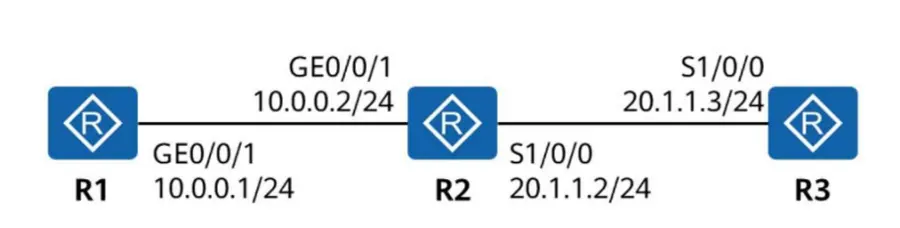
Which of the following configurations can enable connectivity between interfaces on R1 and R3? (Select all that apply)

Correct Answer: A. [R1] ip route-static 20.1.1.0 24 10.0.0.2; D. [R3] ip route-static 10.0.0.0 24 20.1.1.1
Explanation:

For two directly connected edge networks to communicate through intermediate routing, each end router must have a route to the remote destination network pointing to the correct next hop on the transit link. Since 10.0.0.0/24 is directly connected to R1 and 20.1.1.0/24 is directly connected to R3, R1 needs a route to 20.1.1.0/24, and R3 needs a route to 10.0.0.0/24.

Option A is correct because it configures on R1 a static route to the remote network 20.1.1.0/24 using next hop 10.0.0.2, which is the neighbor toward the transit path. Option D is correct because it configures on R3 a static route to the remote network 10.0.0.0/24 using next hop 20.1.1.1, which is the proper adjacent forwarding address in that direction. Option B is incorrect because a router cannot use a next hop that belongs to the remote destination network but is not directly reachable as a valid immediate forwarding address in this topology. Option C is also incorrect because the specified next hop is not the correct adjacent next-hop address for R3. HCIA-Datacom stresses that static routes must always point to a reachable next hop or outbound interface.


Question 8

After the root bridge is elected on an STP network, which of the following parameters may be compared by ports on non-root bridge nodes to elect the root port? (Select all that apply)

Correct Answer: A. PID of a port on the local device; B. Root path cost (RPC); C. BID of the device that sends BPDUs; D. PID of a port on the device that sends BPDUs
Explanation:

On a non-root bridge, the root port is the port that receives the best BPDU toward the root bridge. STP selects the root port by comparing several parameters in order. The first important parameter is the root path cost (RPC), so option B is correct. If multiple ports have the same RPC, the switch then compares the bridge ID (BID) of the upstream device sending the BPDU, making option C correct. If those are still equal, the switch compares the port ID (PID) of the upstream sending port, so option D is also correct.

If all of those values remain identical from the switch's perspective, the device can finally compare the local port ID to determine which local interface becomes the root port, so option A is also correct. HCIA-Datacom teaches this comparison logic as part of STP election rules. The process ensures deterministic selection of a single root port on every non-root switch. Understanding the comparison sequence is essential for predicting STP topology behavior and for influencing port roles through path cost tuning or bridge-priority adjustments during campus network design and troubleshooting.


Question 9

According to the following routing table, it can be inferred that the IP address of VLANIF 2 on R1 is 10.0.12.1/24.

[R1] display ip routing-table

Proto: Protocol Pre: Preference

Route Flags: R - relay, D - download to fib, T - to vpn-instance, B - black hole route

Routing Table : public

Destinations : 10 Routes : 10

Destination/Mask Proto Pre Cost Flags NextHop Interface

10.0.12.0/24 Direct 0 0 D 10.0.12.1 Vlanif2

10.0.12.1/32 Direct 0 0 D 127.0.0.1 Vlanif2

10.0.12.255/32 Direct 0 0 D 127.0.0.1 Vlanif2

10.0.21.0/24 Direct 0 0 D 10.0.21.1 Vlanif3

10.0.21.1/32 Direct 0 0 D 127.0.0.1 Vlanif3

10.0.21.255/32 Direct 0 0 D 127.0.0.1 Vlanif3

Correct Answer: A. TRUE
Explanation:

This statement is true. From the routing table, the entry 10.0.12.0/24 Direct ... NextHop 10.0.12.1 Interface Vlanif2 indicates that the network 10.0.12.0/24 is directly connected through Vlanif2, and the local interface address associated with that directly connected network is 10.0.12.1.

This conclusion is further supported by the host route 10.0.12.1/32 Direct ... 127.0.0.1 Vlanif2, which represents the local IP address of the interface itself. On Huawei devices, when an IP address is configured on an interface, the routing table commonly generates a direct route to the connected network, a host route to the interface IP itself, and sometimes a host route to the broadcast address where applicable in IPv4. Therefore, from the displayed entries, it can indeed be inferred that VLANIF 2 has the IP address 10.0.12.1/24. HCIA-Datacom uses these routing-table characteristics to help learners identify connected interfaces, local addresses, and route origins during troubleshooting and route analysis on routers and Layer 3 switches.


Question 10

Four links between two switches establish an Eth-Trunk in manual mode, and the bandwidth of each link is 1 Gbit/s. One of the links fails. Which of the following statements are true about this scenario? (Select all that apply)

Correct Answer: A. The Eth-Trunk interfaces on the switches are still in the Up state.; B. The available link bandwidth between the switches is 3 Gbit/s.
Explanation:

In an Eth-Trunk working in manual mode, multiple physical member links are bundled into one logical interface to provide higher bandwidth and link redundancy. If one of four 1 Gbit/s member links fails, the Eth-Trunk does not go down as long as at least one valid member link remains active. Therefore, statement A is correct. Since one link has failed and three member links remain available, the total available bandwidth becomes 3 Gbit/s, so statement B is also correct.

Statement C is incorrect because the traffic originally hashed to the failed link is not permanently stopped. Instead, after the link failure is detected, traffic is redistributed across the remaining active member links according to the trunk load-balancing mechanism. Statement D is also incorrect because Eth-Trunk provides link-level redundancy. Existing upper-layer sessions such as TCP are not necessarily interrupted and re-established simply because one member link fails. HCIA-Datacom emphasizes that Eth-Trunk improves reliability and bandwidth utilization by allowing traffic to continue across surviving links when a single member fails. This is one of the main advantages of link aggregation in campus and data center switching networks.