In special scenarios, when advertising routes to an IBGP peer, a BGP device needs to set the next hop to its IP address to prevent blackhole routes. Which of the following commands can be run in this case?
Correct Answer:A. peer next-hop-local
Explanation:
Comprehensive and Detailed Step-by-Step
Blackhole Route Issue in BGP:
In IBGP, the next hop of a route learned from an EBGP peer is not changed by default. If an IBGP peer cannot reach the next hop, blackhole routes may occur.
To prevent this, the peer next-hop-local command is used to set the next hop to the local router's IP address.
Other Commands:
peer mpls-local-ifnet: Used in MPLS networks to set the next hop as the local interface address.
peer private-nexthop: Allows advertising private IP addresses as the next hop.
peer next-hop-invariable: Ensures the next hop is not modified during route advertisement, which is the opposite of what is required here.
HCIA-Datacom Study Guide, Chapter: BGP Next Hop Behavior
Huawei BGP Configuration Commands
Question 2
Which of the following statements regarding the firewall zone security level is false?
Correct Answer:A. The configured security level cannot be changed.
Explanation:
In Huawei firewalls, the security level of a zone can be reconfigured by an administrator, making the statement that it cannot be changed false. Other statements accurately describe security level restrictions or defaults .
Question 3
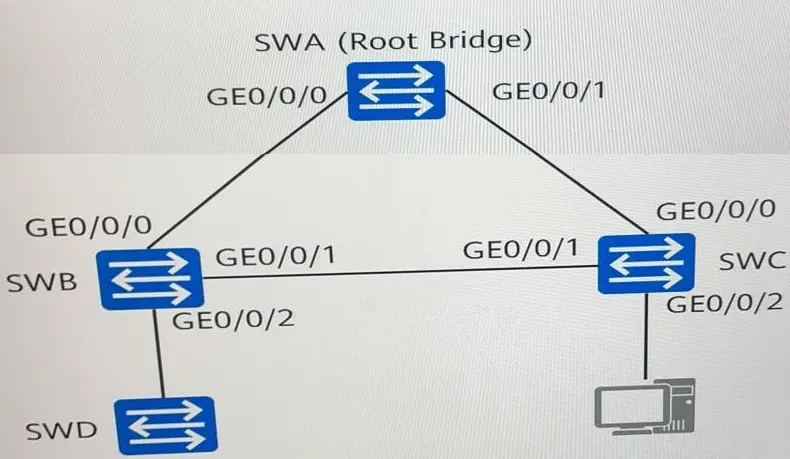
As shown in the figure, SWA, SWB, SWC, and SWD run the Rapid Spanning Tree Protocol (RSTP). Which of the following statements are true?
Correct Answer:B. After a port is Configured as an edge port, the port can quickly enter the Forwarding state.; C. You can enable the edge port on SWD's GEO/0/2 connected to the terminal so that this port can quickly enter the Forwarding state.; D. You can enable the edge port on SWC's GE0/0/2 connected to the terminal so that this port can quickly enter the forwarding state.
Explanation:
Edge ports are used in RSTP to bypass the spanning tree calculation for ports connected to end devices. By configuring ports like SWD's GE0/0/2 and SWC's GE0/0/2 as edge ports, they transition directly to the Forwarding state upon activation, ensuring faster convergence. Statement A is incorrect because receiving BPDU invalidates the edge port status .
Question 4
Which of the following attacks is not the network layer attack?
Correct Answer:D. ARP spoofing attack
Explanation:
ARP spoofing is a Layer 2 attack, as it targets ARP tables in switches or end devices. All other attacks, including IP spoofing, ICMP attacks, and Smurf attacks, are network layer (Layer 3) attacks .
Question 5
See the command output of a router below. Which of the following statements is true?
The output shows that the router with the IP 10.0.12.2 is the Backup Designated Router (BDR), as indicated in the State: BDR field. The router ID is 10.0.2.2, the interface cost is 1, and the IP address of the interface is 10.0.12.2. Hence, C is the correct answer .
Question 6
In IGMPv1, querier selection depends on a multicast routing protocol, such as PIM. In IGMPv2 and IGMPv3, the interface with the largest IP address acts as the querier.
Correct Answer:A. TRUE
Explanation:
Comprehensive and Detailed Step-by-Step
IGMPv1 Querier Selection:
In IGMPv1, there is no built-in querier election mechanism. Querier selection depends on the multicast routing protocol (e.g., PIM).
IGMPv2 and IGMPv3 Querier Selection:
In IGMPv2 and IGMPv3, the router interface with the largest IP address in the multicast group is selected as the querier.
Correct Statement:
The statement accurately describes the querier selection mechanisms in IGMP versions.
HCIA-Datacom Study Guide, Chapter: IGMP Querier Mechanism
Huawei Multicast Protocol Comparison
Question 7
When a routing policy is used to filter routes, which of the following route prefixes will be denied by the IP prefix below?
Correct Answer:B. 1.1.1.2/16; D. 1.1.1.1/24
Explanation:
The prefix list permits the prefix 1.1.1.1/24 with a mask length greater than or equal to /26 and less than or equal to /32. This means only prefixes with the base 1.1.1.1 and mask lengths between /26 and /32 will be permitted. Routes like 1.1.1.2/16 and 1.1.1.1/24 do not meet the mask length criteria, so they will be denied. Conversely, routes like 1.1.1.1/26 and 1.1.1.1/32 satisfy the condition and will be permitted .
Question 8
Which of the following attributes must be carried when BGP sends route update messages?
Correct Answer:B. Next_Hop; C. AS_Path
Explanation:
Mandatory BGP Attributes
Next_Hop: Specifies the next hop to reach the destination.
AS_Path: Lists the autonomous systems traversed, crucial for loop prevention and route selection.
Optional Attributes
MED (Multi-Exit Discriminator) and Local_Preference are optional attributes that aid in route preference but are not mandatory.
HCIP-Datacom-Core Reference
BGP attribute behavior and classifications are detailed in BGP path selection principles.
Question 9
Fill in the blanks
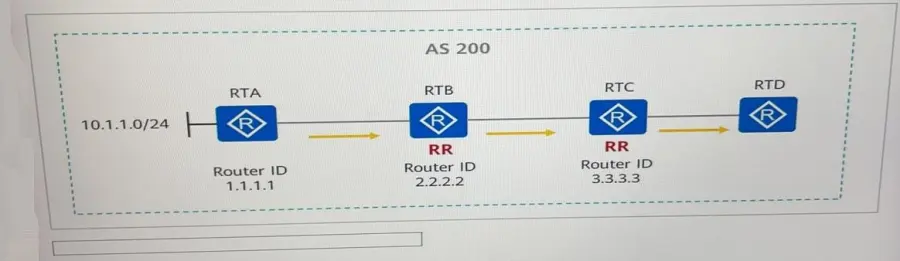
See the following figure. RTA, RTB, RTC, and RTD are in the same AS and establish IBGP peer relationships through direct links. RTB an RTC are route reflectors (RRs), RTA and RTC are the RR clients of RTB, and RTB and RTD are the RR clients of RTC. If RTA advertises the route 10.1.1.0/24 to the BGP process, the Originator ID of the BGP route received by RTD is------------------.
Correct Answer:A. 1.1.1.1
Explanation:
The Originator ID in a BGP route represents the Router ID of the device that originally advertised the route into the BGP domain. Since RTA originates the route 10.1.1.0/24 into the BGP process, the Originator ID in the route received by RTD will be set to 1.1.1.1 .
Question 10
IGMP has three versions. Different versions support different features. Which of the following features is supported by all versions?
Correct Answer:C. Report message
Explanation:
Comprehensive and Detailed Step-by-Step
Overview of IGMP Versions:
IGMPv1: The simplest version, supports basic group membership management using Report messages but lacks Leave messages.
IGMPv2: Adds features like Leave messages and Group-Specific Queries.
IGMPv3: Supports specifying multicast sources for Source-Specific Multicast (SSM).
Feature Supported by All Versions:
Report messages are fundamental to IGMP functionality and are supported in all three versions.
Features Not Supported by All Versions:
Group-Specific Queries (A): Supported in IGMPv2 and IGMPv3.
Leave Messages (B): Introduced in IGMPv2.
Specifying Multicast Sources (D): Introduced in IGMPv3.
HCIA-Datacom Study Guide, Chapter: IGMP Overview
Huawei Multicast Protocol Details
Question 11
A campus network uses OSPF for network communication. The display ospf peer command is run on a router, and the command output is as follows:
vbnet
Copy
Edit
display ospf peer
OSPF Process 1 with Router ID 10.0.2.2
Area 0.0.0.0 interface 10.0.235.2 (GigabitEthernet0/0/1)'s neighbors
Router ID: 10.0.5.5 Address: 10.0.235.5
State: Full Mode: Nbr is Master Priority: 1
DR: 10.0.235.5 BDR: 10.0.235.3 MTU: 0
Dead timer due in 40 sec
Area 0.0.0.0 interface 10.0.24.2 (Serial1/0/1)'s neighbors
Router ID: 10.0.4.4 Address: 10.0.24.4
State: Full Mode: Nbr is Master Priority: 1
DR: None BDR: None MTU: 0
Dead timer due in 35 sec
Which of the following statements are true about the device?
Correct Answer:A. The IP address of the DR on the network where R2 and its neighbor 10.0.5.5 reside is 10.0.235.5.; B. R2 has established adjacencies with 10.0.5.5 and 10.0.4.4.; D. Router IDs of the two OSPF neighbors of R2 are 10.0.5.5 and 10.0.4.4.
Explanation:
Comprehensive and Detailed Step-by-Step
Analysis of the OSPF Neighbor State:
Router ID 10.0.5.5:
On interface 10.0.235.2 (GigabitEthernet0/0/1), the neighbor state is Full, indicating that adjacency is established.
The Designated Router (DR) is 10.0.235.5, which is the same as the neighbor's address.
Router ID 10.0.4.4:
On interface 10.0.24.2 (Serial1/0/1), the neighbor state is also Full, meaning adjacency is established.
The DR/BDR election status shows None, indicating that the interface is on a point-to-point link where DR/BDR election does not apply.
Validation of Each Option:
Option A: Correct. The DR IP address is explicitly shown as 10.0.235.5.
Option B: Correct. The neighbor state for both 10.0.5.5 and 10.0.4.4 is Full, confirming adjacency is established.
Option C: Incorrect. DR/BDR elections are irrelevant on point-to-point links like Serial1/0/1.
Option D: Correct. The Router IDs of R2's neighbors are explicitly listed as 10.0.5.5 and 10.0.4.4.
HCIA-Datacom Study Guide, Chapter: OSPF Neighbor Relationships
Huawei OSPF Neighbor and Adjacency Details
Question 12
The Internet Assigned Numbers Authority (IANA) allocates Class D addresses to IPv4 multicast. An IPv4 address is 32 bits long, and the four most significant bits of a Class D address are 1110.
Correct Answer:A. TRUE
Explanation:
Comprehensive and Detailed Step-by-Step
IPv4 Address Classes:
Class D: Reserved for multicast and defined by the first four bits as 1110.
Address range: 224.0.0.0 to 239.255.255.255.
Structure:
Class D does not include a network/host division, as it is designed for group communication rather than device identification.
HCIA-Datacom Study Guide, Chapter: IPv4 Address Classes
Huawei Multicast Configuration Guidelines
Let me continue with the next set of questions!
Question 13
Which of the following LSAs are advertised only within a single area?
Correct Answer:A. Network LSA; B. Router LSA
Explanation:
Router LSAs (Type 1) and Network LSAs (Type 2) are advertised only within a single OSPF area, as they describe the topology within the area. In contrast, Summary LSAs (Type 3) and AS External LSAs (Type 5) are used for inter-area and external routing, respectively .
Question 14
The Origin attribute is used to define the origin of BGP path information. There are three types of Origin attributes. Which of the following lists the Origin attributes in descending order of priority?
Correct Answer:A. IGP > EGP > Incomplete
Explanation:
Comprehensive and Detailed Step-by-Step
BGP Origin Attribute Priority:
The Origin attribute determines the source of the route and affects the selection of the best path.
The priority order is as follows:
IGP (i): Highest priority. Routes injected using the network command.
EGP (e): Lower priority. Routes learned from the EGP protocol.
Incomplete (?): Lowest priority. Routes redistributed into BGP from other protocols.
Correct Option:
A: IGP > EGP > Incomplete is the correct order of priority.
HCIA-Datacom Study Guide, Chapter: BGP Path Selection
Huawei BGP Routing Rules
Question 15
Which of the following statements about stack split is false?
Correct Answer:A. After a stack splits, the MAC addresses of the two stacks change immediately.
Explanation:
When a stack splits, the MAC addresses of the newly formed stacks do not change immediately. Instead, they retain their original MAC addresses until new ones are reassigned during topology updates. This delayed update prevents immediate conflicts and allows MAD (Multiple Active Detection) to handle any resulting issues .