Limited-Time Offer: Enjoy 50% Savings! Ends in 00h 00m 00s Coupon code: 50OFF
Skip to content

Free Huawei HCIP-Datacom-Advanced Routing & Switching Technology V1.0 H12-831_V1.0 Exam Questions

Page: 1 / 11 Total 156 questions

Want more questions? Get Premium Access.

Question 1

On a stable network that requires fast route convergence, you can change the value of the interval at which OSPF LSAs are updated to 0 so that topology or route changes can be immediately advertised on the network through LSAs, which speeds up route convergence.

Correct Answer: A. TRUE

Question 2

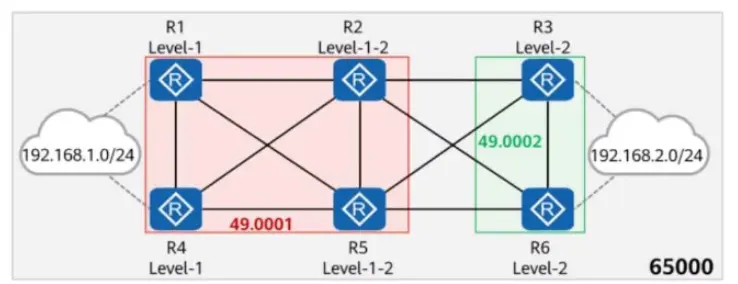
On the network shown in the figure, IS-IS runs on R1, R2, R4, and R5, and the area ID is 49.0001. IS-IS runs on R3 and R6, and the area ID is 49.0002. The import-route isis level-2 into level-1 command is configured on R2 and R5. In AS 65000, R1, R3, R4, and R6 each establish IBGP peer relationships with R2 and R5. R2 and R5 are RRs, and R1, R4, R3, and R6 are clients. The IBGP peer relationships are established using Loopback0. The IP address of Loopback0 on each router is 10.0.X.X/32, and the router ID is 10.0.X.X, where X is the number of the router. R1 and R4 import the external route 192.168.1.0/24 to BGP through the import-route command, and R3 and R6 import the external route 192.168.2.0/24 to BGP through the import-route command. Which of the following statements are true?

Correct Answer: B. The route 192.168.2.0/24 in the routing table of R4 has two different outbound interfaces.; C. The routing table of R1 contains the route 192.168.2.0/24.

Question 3

MPLS supports nesting of multiple labels. After receiving an MPLS packet, a device first processes the label next to the Layer 2 header, that is, the top MPLS label.

Correct Answer: A. TRUE

Question 4

If the display ospfv3 peer verbose command is run to check OSPFv3 neighbor information, the command output contains information such as the peer router ID, global unicast address of the peer interface, and neighbor status.

Correct Answer: A. TRUE

Question 5

BGP allows you to use the filter-policy acl-number import command to filter received routes. The value of ad-number ranges from 2000 to 3999.

Correct Answer: A. TRUE

Question 6

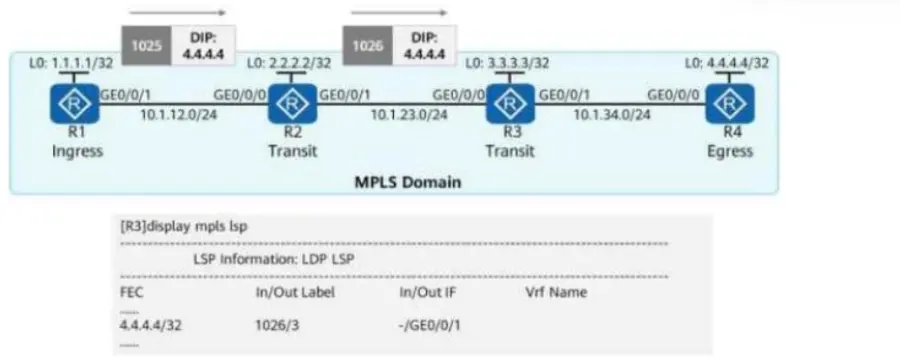
R1 forwards a packet with the destination IP address of 4.4.4.4 on an MPLS network.

Some LSP (Label Switched Path) information of R3 is shown in the figure.

During packet transmission, which of the following devices perform MPLS label operations?

Correct Answer: B. R2; C. R1; D. R3
Explanation:

Comprehensive and Detailed In-Depth

To determine which devices perform MPLS label operations, we need to analyze MPLS forwarding behavior based on the roles of each router in the MPLS domain.

1. Understanding MPLS Label Operations

MPLS label switching involves three main operations:

Label Push (Ingress LSR - Label Imposition): The ingress router (R1) assigns an MPLS label to the packet.

Label Swap (Transit LSR - Label Forwarding): The transit routers (R2, R3) swap the label for the next-hop router.

Label Pop (Egress LSR - Label Disposition): The egress router (R4) removes the MPLS label before forwarding the packet to its final destination.

2. Examining MPLS Roles of Each Router

R1 (Ingress LSR) Performs Label PUSH

R1 adds an MPLS label (1025) to the IP packet and forwards it to R2.

Operation: Push MPLS Label (Label Imposition).

R1 performs MPLS label operations.

R2 (Transit LSR) Performs Label SWAP

R2 receives a labeled packet (1025) from R1, swaps it with label 1026, and forwards it to R3.

Operation: Swap MPLS Label (Transit Label Forwarding).

R2 performs MPLS label operations.

R3 (Transit LSR) Performs Label SWAP

R3 receives label 1026 and swaps it with label 3, then forwards it to R4.

Operation: Swap MPLS Label (Transit Label Forwarding).

R3 performs MPLS label operations.

R4 (Egress LSR) Does NOT Perform MPLS Operations

R4 is the egress router and does not forward the packet further using MPLS.

The last router removes the MPLS label (Pop) and forwards the plain IP packet.

R4 is NOT performing MPLS label switching (swap or push), only popping the label before delivering the packet.

R4 does NOT perform MPLS label operations.


Question 7

The device operating environment is crucial for stable device operating, including the equipment room, power supply, and heat dissipation. Maintenance personnel must be on site to maintain the device operating environment.

Correct Answer: B. FALSE

Question 8

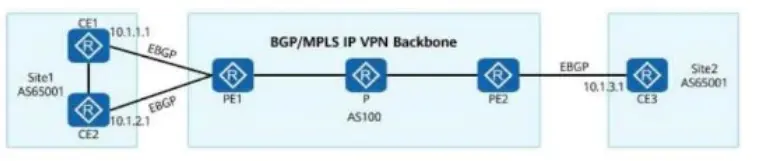
On an enterprise network shown in the figure, EBGP is deployed between CEs and PEs.

CE1 sends a VPN route to PE1.

Which of the following statements are false?

Options:

Correct Answer: A. To enable CE3 to receive the route, run the command peer 10.1.1.1 soo 200:1 on PE1.; B. If the commands peer 10.1.1.1 soo 200:1 and peer 10.1.2.1 soo 200:1 are run on PE1, CE2 accepts the route.
Explanation:

Comprehensive and Detailed In-Depth

1. Understanding Site of Origin (SoO) in MPLS VPNs

SoO (Site of Origin) is used in MPLS VPNs to prevent loops in multi-homed CE scenarios.

Routes with the same SoO value are not advertised back to the same site.

2. Analysis of Each Answer Choice

A . 'To enable CE3 to receive the route, run the command peer 10.1.1.1 soo 200:1 on PE1.' ( False)

SoO is used to prevent loops by tagging routes that belong to the same site.

Applying SoO (200:1) on PE1 for CE1 means that any other PE (such as PE2) receiving the route will not advertise it back to the same site (CE1).

This statement is false because applying SoO here does not directly enable CE3 to receive the route. Instead, CE3 must accept routes with SoO values properly configured.

B . 'If the commands peer 10.1.1.1 soo 200:1 and peer 10.1.2.1 soo 200:1 are run on PE1, CE2 accepts the route.' ( False)

SoO ensures that a route received from one CE is not sent back to another CE in the same site.

If SoO (200:1) is assigned to CE1 and CE2, routes will be blocked because they share the same SoO tag.

Thus, CE2 will not accept the route, making this statement false.

C . 'If the command peer 10.1.3.1 substitute-as is run on PE2, CE3 accepts the route.' ( True)

substitute-as allows a router to replace the received AS number in the AS_PATH with another AS number, ensuring that routes are accepted even when AS_PATH filtering is in place.

This prevents CE3 from rejecting the route due to AS-Path loop prevention.

Thus, this statement is true.

D . 'If no additional action is taken, CE3 discards the route.' ( True)

By default, CE3 will discard the route because of BGP loop prevention (same AS in the AS_PATH).

To allow CE3 to receive the route, the allowas-in or substitute-as command must be configured on PE2.

Thus, this statement is true.

3. Evaluating the Answer Choices

Option

Correct?

Reasoning

A

False

Applying SoO does not directly enable CE3 to receive the route.

B

False

If both CE1 and CE2 have the same SoO value, CE2 will reject the route.

C

True

Substitute-AS allows CE3 to accept the route by modifying the AS-Path.

D

True

Without additional configuration, CE3 will discard the route due to AS-Path loop prevention.

Correct Answe r : A and B are false.

Final Conclusion:

SoO prevents routing loops in MPLS VPN multi-homing.

CE2 will reject the route if it has the same SoO as CE1.

CE3 requires the substitute-as or allowas-in command to accept the route.

Thus, statements A and B are false.


HCIP-Datacom-Advanced Routing & Switching Technology V1.0 -- BGP SoO and AS-Path Loop Prevention

Huawei Official HCIP-Datacom Study Guide -- MPLS VPN Route Control

Huawei Documentation on BGP SoO and AS_PATH Filtering

Question 9

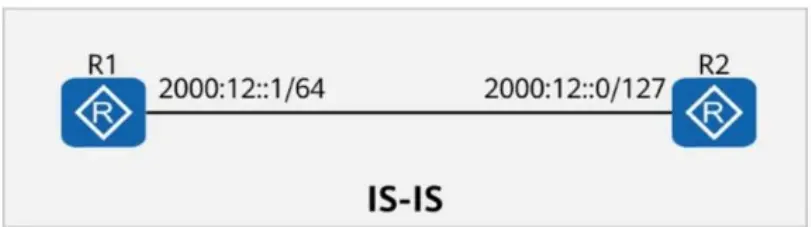
On the IS-IS IPv6 network shown in the figure, after the network becomes stable:

R1 can ping 2000:12::0, and

The display ipv6 neighbors command can be used to display the MAC address corresponding to 2000:12::0.

Is this statement TRUE or FALSE?

Correct Answer: B. FALSE
Explanation:

Comprehensive and Detailed In-Depth

Understanding the IPv6 Addressing and IS-IS Network

IPv6 Addressing in the Figure:

R1 has the address: 2000:12::1/64

R2 has the address: 2000:12::0/127

The link between them is using a /127 subnet (2000:12::0/127).

Behavior of IPv6 /127 Subnet Mask

In IPv6, a /127 prefix is commonly used on point-to-point links to avoid the issue of subnet-router anycast (::0).

RFC 6164 recommends using /127 instead of /64 for point-to-point links to reduce unnecessary anycast behavior.

2000:12::0 is the network address (first address in the subnet) and is not assigned to an interface.

Analyzing the Two Statements in the Question

Statement 1: 'R1 can ping 2000:12::0' (Incorrect)

In IPv6, the first address (::0) in a /127 subnet is typically reserved as a network address and not assigned to any router.

R1 cannot ping 2000:12::0 because it is not assigned to R2 as an active IP.

Correct ping targets would be:

R1 pinging R2's actual address (2000:12::1 or 2000:12::2 depending on numbering).

Statement 2: 'display ipv6 neighbors command can be used to display the MAC address corresponding to 2000:12::0' (Incorrect)

The display ipv6 neighbors command is used to show the MAC address of an active neighbor (i.e., a reachable device).

Since 2000:12::0 is not assigned to a specific router, it will not have a MAC address in the neighbor table.

Final Conclusion:

R1 cannot ping 2000:12::0 because it is the network address in a /127 subnet.

The display ipv6 neighbors command cannot show a MAC address for 2000:12::0 because it is not assigned to a router.

Thus, the correct answer is: B. FALSE.


HCIP-Datacom-Advanced Routing & Switching Technology V1.0 -- IPv6 Addressing and IS-IS for IPv6

Huawei Official HCIP-Datacom Study Guide -- IPv6 Neighbor Discovery and Point-to-Point Links

RFC 6164 -- Using 127-Bit IPv6 Prefixes on Inter-Router Links

Question 10

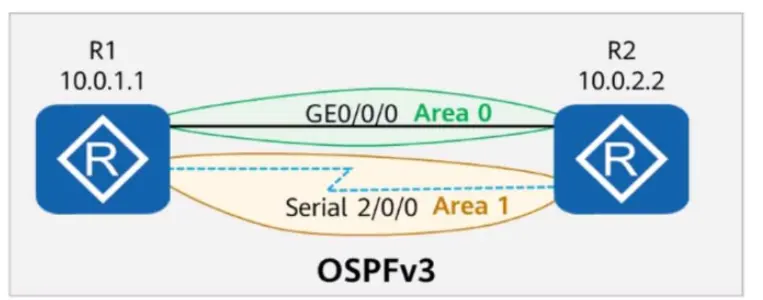
On the OSPFv3 network shown in the figure, area 1 is a stub are

a. Which of the following statements are true?

Correct Answer: A. Default routes exist in the routing tables of R1 and R2.; D. Both R1 and R2 generate Intra-Area-Prefix-LSAs.

Question 11

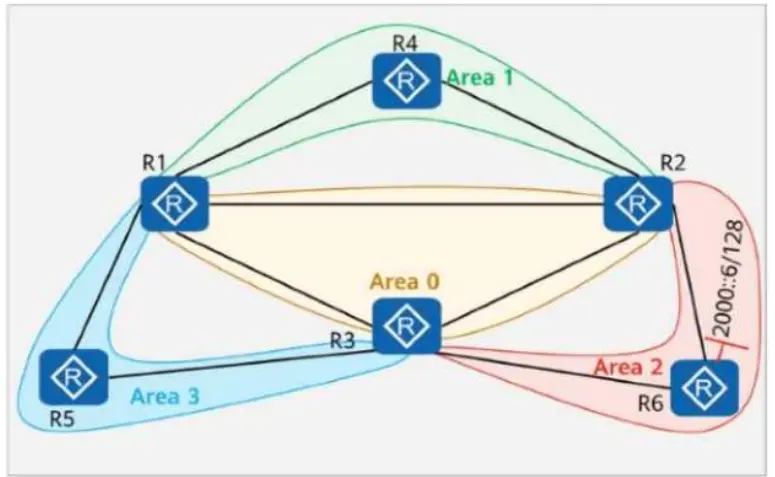
On the OSPFv3 network shown in the figure:

Area 1 is a stub area

Area 2 is a common area

Area 3 is an NSSA

The IPv6 address of Loopback0 on R6 is 2000::6/128.

The router ID of each router is 10.0.X.X, where X is the router number.

Which of the following statements are true?

Correct Answer: A. The Inter-Area-Prefix-LSA that is generated by R1 and describes 2000::6/128 exists in Area 0.; D. The Inter-Area-Prefix-LSA that is generated by R3 and describes 2000::6/128 exists in Area 2.
Explanation:

Comprehensive and Detailed In-Depth

To determine the correct answers, we need to analyze OSPFv3 behavior and Inter-Area-Prefix LSAs (Type 3 LSAs).

1. Understanding OSPFv3 Inter-Area-Prefix LSAs (Type 3 LSAs)

Type 3 LSAs (Inter-Area-Prefix LSAs) are generated by an ABR (Area Border Router) to advertise networks between areas.

If a router in one area learns a prefix from another area, it generates a Type 3 LSA to advertise it further.

Stub areas (Area 1) do not allow external LSAs, including Type 3 LSAs for external routes.

NSSA areas (Area 3) accept external routes but redistribute them as Type 7 LSAs before being converted to Type 5 LSAs by an NSSA ABR.

2. Analyzing Each Answer Option:

A. 'The Inter-Area-Prefix-LSA that is generated by R1 and describes 2000::6/128 exists in Area 0.' TRUE

R6 has 2000::6/128 in Area 2.

R2 is the ABR that brings this prefix into Area 0 as a Type 3 LSA.

R1, being in Area 0, learns this LSA from R2.

Thus, this statement is correct.

B. 'The Inter-Area-Prefix-LSA that is generated by R1 and describes 2000::6/128 exists in Area 3.' FALSE

R1 is not an ABR for Area 3, so it does not generate an LSA for 2000::6/128 in Area 3.

Instead, R3 (the ABR between Area 0 and Area 3) would be responsible for propagating routes.

This statement is false.

C. 'The Inter-Area-Prefix-LSA that is generated by R2 and describes 2000::6/128 exists in Area 1.' FALSE

Area 1 is a stub area and does not accept external LSAs (including Type 3 LSAs from other areas).

R2 cannot generate and send a Type 3 LSA for 2000::6/128 into Area 1.

This statement is false.

D. 'The Inter-Area-Prefix-LSA that is generated by R3 and describes 2000::6/128 exists in Area 2.' TRUE

R3 is an ABR and learns 2000::6/128 from R2 (which originally learned it from R6 in Area 2).

Since Area 2 is a normal (non-stub, non-NSSA) area, Type 3 LSAs are allowed.

R3 generates and advertises this Inter-Area-Prefix-LSA for 2000::6/128 into Area 2.

Thus, this statement is correct.


Question 12

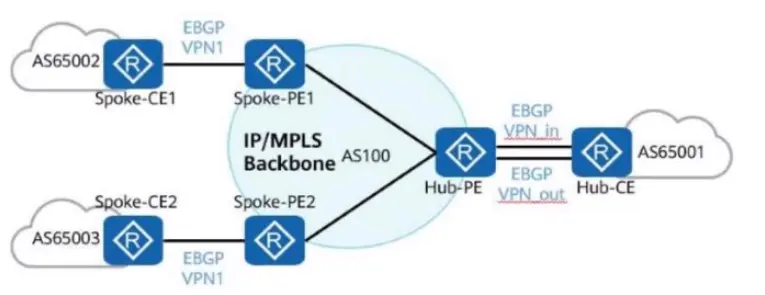
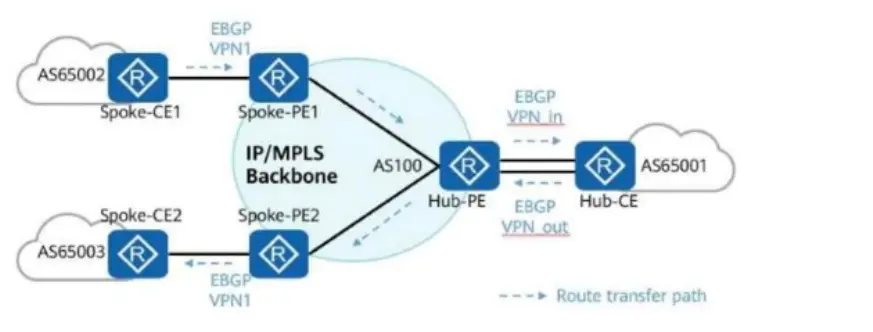
In the hub-spoke networking shown in the figure, the Hub-PE can be configured to allow repetitive local AS numbers for correct route transmission.

Correct Answer: A. TRUE

Question 13

In the hub-spoke networking shown in the figure, which of the following commands must be configured on the Hub-PE to ensure correct route transmission?

Correct Answer: C. [Hub-PE-bgp-VPN_in] peer x.x.x.x soo 200:1
Explanation:

Comprehensive and Detailed In-Depth

1. Understanding the Hub-Spoke Network Model in MPLS VPN

Hub-Spoke (or Route Reflector) topology is used in MPLS Layer 3 VPNs where multiple spoke sites communicate through a central hub.

The Hub-PE acts as an intermediate BGP speaker and redistributes routes between spokes.

The challenge is preventing routing loops when exchanging routes between spokes.

2. Understanding the Role of Site of Origin (SoO) in BGP/MPLS VPNs

BGP Site of Origin (SoO) is a route attribute used to prevent routing loops in scenarios where a hub redistributes routes between spokes.

If a route originating from a spoke is advertised back to the same site, SoO prevents it from being re-learned.

The SoO value (e.g., 200:1) ensures that a site does not accept its own previously advertised prefixes.

3. Analyzing the Answer Choices

A. [Hub-PE-bgp-VPN_out] peer x.x.x.x allow-as-loop (Incorrect)

The allow-as-loop command allows BGP to accept routes with its own AS number in the AS path.

This is NOT needed in a Hub-Spoke VPN because BGP routes are not being looped through the same AS.

This is unnecessary for preventing loops in a Hub-Spoke VPN.

B. [Hub-PE-bgp-VPN_in] peer x.x.x.x allow-as-loop (Incorrect)

Again, allow-as-loop is used when a router needs to accept its own AS number in the BGP AS path.

This is NOT the mechanism used for preventing loops in Hub-Spoke VPNs; SoO is used instead.

This is not required in this scenario.

C. [Hub-PE-bgp-VPN_in] peer x.x.x.x soo 200:1 (Correct Answer)

The correct way to prevent spoke routes from looping through the hub is to apply the Site of Origin (SoO) attribute.

This command ensures that if a route with SoO 200:1 is received, it is not advertised back to the same spoke.

This is the correct answer.

D. [Hub-PE-bgp-VPN_out] peer x.x.x.x soo 200:1 (Incorrect)

Applying SoO on outgoing routes is NOT effective because the hub should mark received routes and prevent loops when re-advertising them.

SoO should be applied on the inbound (received) routes at the Hub-PE, not outbound.

This is not the correct implementation of SoO.

Final Conclusion:

Correct Answe r : C. [Hub-PE-bgp-VPN_in] peer x.x.x.x soo 200:1

A. allow-as-loop is unnecessary in a Hub-Spoke MPLS VPN.

B. allow-as-loop is not relevant here.

D. SoO should be applied inbound, not outbound.

Thus, the correct answer is: C. [Hub-PE-bgp-VPN_in] peer x.x.x.x soo 200:1.


HCIP-Datacom-Advanced Routing & Switching Technology V1.0 -- MPLS VPN Hub-Spoke Design and SoO Configuration

Huawei Official HCIP-Datacom Study Guide -- Route Loop Prevention in Hub-Spoke VPNs

Huawei Documentation on Site of Origin (SoO) in MPLS VPN

Question 14

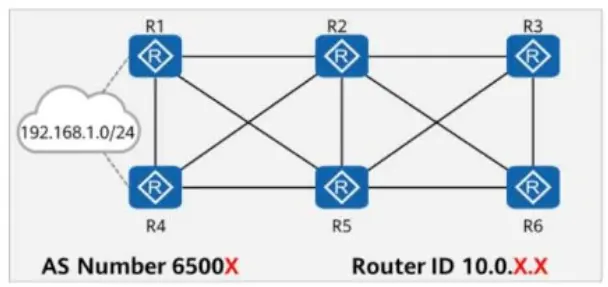
On the network shown in the figure, EBGP peer relationships are established between neighboring routers through directly connected interfaces.

The router ID of each router is 10.0.X.X, and the AS number is 6500X, where X is the number of the router.

Both R1 and R4 have static routes to 192.168.1.0/24, which are imported to BGP through the import-route command.

Which of the following statements are true?

Correct Answer: A. The path for traffic from R6 to 192.168.1.0/24 is R6 R5 R4.; B. The path for traffic from R5 to 192.168.1.0/24 is R5 R4.; C. The path for traffic from R2 to 192.168.1.0/24 is R2 R1.; D. The path for traffic from R3 to 192.168.1.0/24 is R3 R2 R1.
Explanation:

Comprehensive and Detailed In-Depth

Understanding the BGP Network Topology in the Questio n:

EBGP Peering

Each router forms EBGP peer relationships with directly connected neighbors.

This is a fully meshed topology, meaning each router exchanges BGP routes with its adjacent routers.

Routing Information for 192.168.1.0/24

R1 and R4 import the static route 192.168.1.0/24 into BGP.

Since BGP prefers the shortest AS path, traffic to 192.168.1.0/24 will follow the shortest path to R1 or R4.

Route Analysis for Each Statement:

Statement A: R6 R5 R4 (Correct)

R6 does not have a direct route to 192.168.1.0/24, so it must rely on BGP advertisements from its EBGP neighbors.

R5 learns the route to 192.168.1.0/24 from R4.

Therefore, R6 forwards traffic to R5, and then R5 sends it to R4.

Correct path: R6 R5 R4

Statement B: R5 R4 (Correct)

R5 is directly connected to R4, and since R4 advertises the 192.168.1.0/24 route via BGP,

R5 will forward traffic directly to R4 as the shortest AS path.

Correct path: R5 R4

Statement C: R2 R1 (Correct)

R2 is directly connected to R1 and learns the 192.168.1.0/24 route from R1 via BGP.

Since R1 advertises the static route, R2 forwards traffic directly to R1.

Correct path: R2 R1

Statement D: R3 R2 R1 (Correct)

R3 is directly connected to R2 and learns the 192.168.1.0/24 route from R2 via BGP.

Since R2 prefers R1 as the shortest AS path to 192.168.1.0/24,

R3 will send traffic to R2, and R2 will send it to R1.

Correct path: R3 R2 R1

Final Conclusion:

A . The path for traffic from R6 to 192.168.1.0/24 is R6 R5 R4.

B . The path for traffic from R5 to 192.168.1.0/24 is R5 R4.

C . The path for traffic from R2 to 192.168.1.0/24 is R2 R1.

D . The path for traffic from R3 to 192.168.1.0/24 is R3 R2 R1.

Thus, the correct answers are: A, B, C, D .


HCIP-Datacom-Advanced Routing & Switching Technology V1.0 -- BGP Best Path Selection and AS Path Preferences

Huawei Official HCIP-Datacom Study Guide -- EBGP Route Advertisement and Static Route Import into BGP

Huawei Documentation on BGP Route Selection and Path Preference Mechanisms

Question 15

After port isolation is configured on a switch, hosts in the same VLAN cannot communicate with each other at Layer 2 or Layer 3 by default.

Correct Answer: A. TRUE