
Limited-Time Offer: Enjoy 50% Savings! Ends in 00h 00m 00s Coupon code: 50OFF
Skip to content

Free Huawei HCIE-Storage (Written) V3.0 H13-629_V3.0 Exam Questions

Page: 1 / 6 Total 60 questions

Want more questions? Get Premium Access.

Question 1

During the LUN data migration using Huawei Migration Director for SAN, which of the following operations need to be performed in the migration task configuration phase?

Correct Answer: A. Obtaining source storage information; B. Adding service hosts; C. Planning the target storage
Explanation:

Huawei identifies MigrationDirector for SAN as the dedicated migration tool for SAN storage migration. Before migration execution, the migration environment must be defined: the source storage must be identified, the relevant service host must be known, and the target storage/resources must be prepared.

The Lab Guide's workflow places Creating a Service Host, Configuring the Source Storage, and Preparing the Target Storage before the actual Data Migration phase. A SmartVirtualization migration lab follows the same structure: production/service-host preparation and target-storage preparation precede takeover and data migration.

This makes A, B, and C configuration/preparation activities.

Option D belongs later in migration execution. Huawei's migration delivery sequence explicitly places target-storage configuration and migration preparation before stopping services, taking over the source storage, recovering applications, and migrating data.

Therefore, service takeover is an implementation/cutover activity rather than information entered during migration-task configuration.

Study Guide Topics: Data Migration Solution MigrationDirector for SAN Migration Task Configuration Source Storage Service Host Target Storage Planning Cutover.

Question 2

In Huawei OceanStor Pacific storage, the SmartEqualizer feature is implemented by configuring the service network. Which of the following statements about this feature are true?

Correct Answer: B. The general DNS domain name resolution function is configured on the DNS server of the dient to forward domain name requests for accessing OceanStor Pacific to the system's DNS service. However, the delegation and forwarding functions are not supported.; C. When the storage cluster receives a new mount request from a client, SmartEqualizer selects a node to process the request based on the load balancing policy.; D. The DNS server IP address of the client is configured as the DNS IP address of OceanStor Pacific, in order to directly access the system's DNS service. The delegation and forwarding functions are supported.
Explanation:

Huawei states: ''SmartEqualizer calculates the load based on the configured load policy and returns the IP address of a proper node to the client so that the client can access the storage system using the standard protocol.''

This directly supports C. SmartEqualizer performs access-layer load balancing when clients resolve and access storage services. It does not rely on all cluster nodes continuously pushing their load information to one designated ''primary SmartEqualizer node'' in the manner described in A; therefore A is incorrect.

The SmartEqualizer service integrates with DNS-based client access. Huawei supports two DNS deployment approaches: client-side DNS can forward the required OceanStor Pacific domain-resolution request to the storage system's DNS service, or a client can use the OceanStor Pacific DNS address directly. These operating approaches correspond to B and D.

This DNS-based mechanism is important because the IP returned to a new client is selected according to the configured balancing policy, allowing new access sessions to be distributed across suitable nodes instead of concentrating service traffic on one storage node.

Study Guide Topics: Data Storage Technology Presentation OceanStor Pacific SmartEqualizer Intelligent Load Balancing Access-Layer Load Balancing DNS.


Question 3

When using Huawei OceanStor BCManager eReplication DR management software to implement DR protection, you can perform DR drills periodically. Which of the following operations are required during DR drills?

Correct Answer: A. Start a DR application.; B. Switch the replication relationship.; D. Synchronize incremental data.
Explanation:

Huawei defines the DR-drill procedure as: stop the production application and unmap hosts/LUNs synchronize incremental data switch the replication relationship map a LUN start DR applications test whether applications start successfully.

Therefore, A, B, and D are the required operations.

Incremental synchronization ensures that the DR copy has the latest protected changes before the service transition. The replication relationship is then switched so the DR-side storage resources can assume the required service role. After the target LUNs are mapped, DR applications are started and tested to confirm that the recovery environment can actually carry the business workload.

Option C is different. A recovery plan must already be defined as part of BCManager DR configuration and orchestration; formulating the recovery plan is not an execution step performed every time a DR drill runs. The course separately describes eReplication configuration as creating protection groups and recovery plans before recovery operations are executed.

A DR drill therefore validates an existing DR design and recovery plan rather than redesigning that plan during each test.

Study Guide Topics: Data Protection Solution OceanStor BCManager eReplication DR Management Recovery Plan DR Drill Planned Service Migration.


Question 4

A bank uses DME to manage OceanStor Dorado 8000 and OceanProtect X9000. When the administrator creates a block storage service level and enables resource tuning, which of the following licenses needs to be imported on the storage device if Provisioning Type is set?

Correct Answer: D. SmartThin
Explanation:

The Huawei flash-storage feature table defines SmartThin as ''Intelligent thin provisioning.'' Therefore, when the provisioning type is configured for thin provisioning, the associated feature is SmartThin.

The DME Storage course separately states that block-storage service levels support resource-tuning policies for Thin/Thick mode, deduplication and compression, and SmartTier. These are separate resource-tuning dimensions.

SmartTier concerns data placement among storage tiers, SmartCompression performs data reduction by compression, and SmartDedupe eliminates duplicate data. None of those features defines whether a LUN is thinly or thickly provisioned. SmartThin is specifically the capacity-allocation technology that exposes a logical capacity while allocating physical storage according to actual consumption.

Thus, among the four choices, SmartThin is the license/feature corresponding to the requested provisioning type.

The retrieved course material clearly maps SmartThin to intelligent thin provisioning and DME to Thin/Thick resource tuning; the exact licensing dialog wording is not separately reproduced in the parsed Training/Lab pages.

Study Guide Topics: Data Storage Management and O&M DME Storage Block Storage Service Level Resource Tuning Thin Provisioning SmartThin.


Question 5

eDME centrally manages software and hardware in virtualization scenarios. It can connect to customers' existing O&M platforms, cloud management platforms, servers, switches, and storage devices. Which of the following protocols are used for the interconnection?

Correct Answer: A. IPMI; C. RESTful; D. Redfish
Explanation:

The correct selections are IPMI, RESTful, and Redfish.

Huawei describes DME as ''the unified management software integrating software and hardware for data centers'' and states that it controls, manages, and analyzes VMs, datastores, databases, servers, switches, and storage devices.

For API-oriented integration, RESTful is explicitly part of Huawei's DME architecture. The storage-management course states that the open southbound system manages storage, switch, and host resources through management protocols including RESTful.

IPMI and Redfish provide the hardware-management interfaces required when the management platform interacts with server/BMC infrastructure. Redfish supplies a modern REST-oriented hardware-management model, while IPMI provides established out-of-band platform-management functions.

Telnet is not selected. It is a legacy plaintext terminal protocol and is not an appropriate protocol for the hardware/API interconnection functions being tested in this DME management architecture.

Study Guide Topics: Data Storage Management and O&M DME/eDME Unified Data Center Management Southbound Interconnection Server Hardware Management.


Question 6

When deploying Huawei OceanStor BCManager eReplication, an engineer uses SSH/SFTP to avoid insecure network communication. Which of the following layers of system security does the preceding configuration belong to?

Correct Answer: D. Network layer
Explanation:

The correct security layer is the Network layer.

Huawei defines SFTP as Secure File Transfer Protocol and SSH as Secure Shell in the course terminology. Both protocols protect communications carried between systems over the network rather than implementing application-data protection or storage-resource access logic.

The BCManager eReplication architecture also shows communication among the eReplication Server, Agents, browsers, storage systems, virtualization platforms, and DR management systems through network protocols such as HTTPS, REST, SOAP, and storage-management interfaces.

Using SSH replaces insecure remote terminal access with encrypted secure-shell communication, while SFTP protects file transfer through a secure channel. Their purpose in this context is therefore protection of management communication while information crosses the network.

Consequently, this control belongs to network-layer security, rather than the application, management-function, or operating-system layers.

The retrieved Training Materials define SSH/SFTP and the eReplication communications architecture, although the four-choice security-layer taxonomy itself is not reproduced as a separate table in the parsed material.

Study Guide Topics: Data Protection Solution BCManager eReplication Security Secure Communications SSH/SFTP Network Layer.


Question 7

During data migration using SmartMigration of Huawei flash storage, LUN information exchange changes the mapping between LUNs and data volumes. Which of the following statements about the mapping are true?

Correct Answer: A. After LUN information is exchanged, the host uses the source LUN ID to identify the target data volume.; B. After the pair is split, the host I/O data is written only to the target LUN, and dual-write is not performed.; C. Before LUN information is exchanged, the host uses the source LUN ID to identify the source LUN.; D. During LUN information exchange, the LUN IDs remain unchanged, and the data volume IDs of the source and target LUNs are exchanged.
Explanation:

Huawei states: ''LUN information exchange refers to the mapping between LUNs and data volumes. That is, when the LUN IDs of the source LUN and target LUN remain unchanged, the data volume IDs of the source data volume and target data volume are exchanged.''

Therefore, A, B, C, and D are all correct.

Before the exchange, the source LUN ID points to its original source data volume, which validates C. During the information exchange, the logical LUN identifiers remain stable but their associated physical data-volume IDs are exchanged, validating D. Consequently, after the exchange, the source LUN ID---the identity already known by the host---now references the target data volume, validating A.

During synchronization before the swap, SmartMigration uses dual-write and DCL technologies to keep the target LUN consistent while host services continue. Once synchronization is complete, space is exchanged and the migration relationship is interrupted/split. At that stage, normal host writes continue against the migrated target data rather than maintaining the previous dual-write synchronization relationship, which validates B.

Study Guide Topics: Data Migration Solution SmartMigration Data Synchronization LUN Information Exchange Data Volume ID Exchange Pair Split.


Question 8

A company has deployed multiple block service applications on a Huawei scale-out storage system. An administrator finds that these applications consume a large number of resources in a specific period of time and will affect other services if this situation occurs during working hours. The administrator configures SmartQoS to limit the resources consumed by these applications, preventing production services from being affected. In this scenario, which of the following performance indicators should the administrator limit?

Correct Answer: A. Latency; C. Bandwidth; D. IOPS
Explanation:

The SmartQoS section explicitly states that upper-limit control can ''limit the IOPS, bandwidth, and latency.'' Therefore, A, C, and D are correct.

IOPS controls the number of I/O operations that a workload can issue within a given period. Bandwidth controls the quantity of data transferred per unit of time. Latency control provides an I/O response-time objective so that resource contention can be managed while protecting service quality.

For OceanStor Pacific block services, Huawei implements distributed SmartQoS with volume I/O queues and token buckets. The course explains that when IOPS is restricted, one I/O consumes one token; when bandwidth is restricted, one byte consumes one token. The token rate is coordinated among VBS nodes to enforce the overall performance objective of a volume.

Option B, OPS, is not identified as one of the SmartQoS performance-control indicators in this section. The defined indicators are IOPS, bandwidth, and latency.

Study Guide Topics: Data Storage Technology Presentation OceanStor Pacific SmartQoS Block Service Distributed Traffic Control IOPS/Bandwidth/Latency.


Question 9

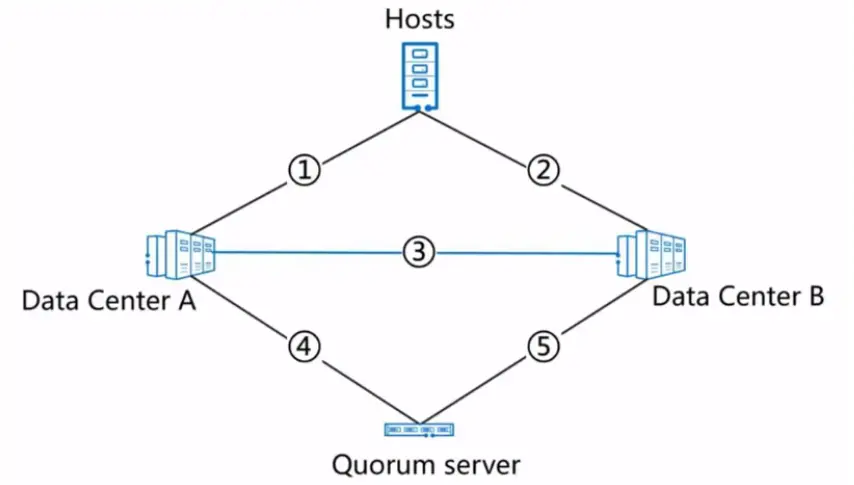
The following figure shows the network diagram of the Huawei flash storage active-active DR solution for an enterprise. Data center A is the preferred site, and data center B is the non-preferred site. The administrator checks the storage system and finds that the HyperMetro pair is in the to-be-synchronized state, the LUNs in data center A are running services, and the LUNs in data center B stop providing services. In this scenario, the fault point is______. (Enter a number in the figure.)

Correct Answer: A. 3
Explanation:

Huawei states that when communication between the two HyperMetro storage systems is interrupted, ''the preferred site continues to provide services while the other site stops providing services.'' In static-priority arbitration, the preset preferred site wins arbitration and continues service delivery. The arbitration table makes the scenario even more explicit. For a HyperMetro pair in To be synchronized state, it states: ''If DC A is the preferred site, the LUN in DC A continues providing services while the LUN in DC B stops.'' These symptoms identify interruption of the HyperMetro communication/replication connection between the two storage arrays. In the topology, that connection is fault point 3. A host-access link failure would affect host connectivity rather than produce this exact arbitration state. A quorum-link-only failure also does not match the combination of To-be-synchronized status and one-site service suspension. Therefore, the failed component is the inter-storage HyperMetro link represented by 3.

Study Guide Topics: Data Protection Solution HyperMetro Arbitration Mechanism Quorum Server Mode Static Priority Mode Link Failure Scenarios.


Question 10

On Huawei all-flash storage, the secondary LUN of remote replication is read-only by default after remote replication is configured. When a disaster occurs, the primary site fails, and the remote replication link between the primary and secondary LUNs is disconnected. In this case, the administrator needs to manually set the read/write permissions of the secondary LUN to writable mode to implement service switchover.

Correct Answer: A. TRUE
Explanation:

Huawei states that after a remote replication pair is configured, ''the secondary LUN is read-only by default.'' If the primary LUN fails, the administrator can cancel write protection and make the secondary LUN writable so that the secondary storage system takes over host services.

Therefore, the statement is TRUE.

The default read-only behavior protects the DR copy from independent host modifications while normal replication is maintained. In a disaster situation, however, the secondary storage may need to become the active service provider. Removing secondary-LUN write protection enables DR-side hosts to perform both reads and writes against the protected copy.

Huawei specifically identifies this function as useful when a conventional primary/secondary switchover cannot be executed normally after failure of the production array. Once the secondary LUN has accepted new production writes, those changes are tracked so that subsequent incremental synchronization can support recovery and switchback.

This design shortens recovery time while preserving the normal protection model: read-only during ordinary replication, manually writable when DR takeover is required.

Study Guide Topics: Data Protection Solution HyperReplication Secondary LUN Write Protection DR Takeover Failover and Switchback.