Limited-Time Offer: Enjoy 50% Savings! Ends in 00h 00m 00s Coupon code: 50OFF
Skip to content

Free IIBA Certified Business Analysis Professional CBAP Exam Questions

Page: 1 / 34 Total 497 questions

Want more questions? Get Premium Access.

Question 1

A business analyst (BA) has been coordinating several meetings with stakeholders to reach consensus regarding the solution design to implement a global currency exchange system for an international bank. Consensus has not been reached yet, although BA has great communication skills and is trusted by all stakeholders. The stakeholders formally approved the business need initially.

Why is there disagreement?

Correct Answer: A. The requirements are interpreted differently by each stakeholder.
Explanation:

One of the possible reasons for the disagreement among the stakeholders is that they have different interpretations of the requirements, which may lead to conflicting expectations, assumptions, and preferences. The BA should use various techniques to elicit, analyze, validate, and communicate the requirements clearly and consistently to all the stakeholders, and to resolve any ambiguities or discrepancies. The BA should also ensure that the requirements align with the business need and the solution scope that were formally approved by the stakeholders at the beginning of the project.


Question 2

You are the business analyst for your organization and are training Tracy on business analysis duties. You are explaining to Tracy how it's important for a business analyst to generate new ideas to approaching problems, solving problems, and to generate alternative solutions. You stress that it's important for the business analyst to generate new ideas and innovative concepts.

What type of analytical thinking are you describing for Tracy?

Correct Answer: C. Creative thinking
Explanation:

Creative thinking is a type of analytical thinking that involves generating new ideas and innovative concepts to approach problems, solve problems, and generate alternative solutions. Creative thinking helps the business analyst to find novel and original ways to address the needs and expectations of the stakeholders, overcome the challenges and constraints of the project, and add value to the solution. Creative thinking also helps the business analyst to explore different perspectives, challenge assumptions, and experiment with different possibilities. The other options are not types of analytical thinking, but rather techniques or skills that can be used to enhance creative thinking. Lateral thinking is a technique that involves using logic and reasoning to find unconventional or unexpected solutions. Brainstorming is a technique that involves generating a large number of ideas in a group setting. Decision making is a skill that involves choosing the best option among several alternatives based on criteria and evidence.Reference:

9.1 Analytical Thinking and Problem Solving, paragraph 1

Top 11 Most Effective Business Analysis Techniques | 2024, paragraph 2

6 business analysis techniques to use in your strategic plans, paragraph 2

What is analytical thinking ? -- The Functional BA, paragraph 2

Business Analysis Blog | Systems Thinking -- An Analyst's Essential ..., paragraph 2


Question 3

A utility company found mat its current billing system charges customers 'or tie r usage, but does so incorrectly when the system estimates reads on meters rather than performs actual reads. Company stakeholders would i*e to improve this aspect of the system but are hesitant to make changes because they are otherwise pleased with the system A business analyst (BA) has completed a current state diagram and would like to start discussions on what the future state may look like. What information can the BA determine by having a current slate diagram?

Question 4

You are the business analyst for your organization and have many solutions available to an identified problem. You would like a way to quickly and fairly determine which solution is the best choice for your organization.

Which of the following approaches would allow you to determine the top-rated solutions for your organization?

Correct Answer: A. Scoring system

Question 5

You are the business analyst for your organization. Management has asked you to create a plan that will define the proposed structure and schedule for communicating the business analysis activities to the appropriate stakeholders.

What plan does management want you to create?

Question 6

What plan will describe the stakeholder groups, communication needs, and the level of formality that is appropriate for the requirements?

Correct Answer: D. Business analysis communication plan
Explanation:

A business analysis communication plan is a document that describes how the business analyst will communicate with the stakeholders, including the stakeholder groups, communication needs, level of formality, frequency, format, and methods of communication. It is one of the outputs of the business analysis planning and monitoring knowledge area, and it helps to ensure that the stakeholders are informed, engaged, and satisfied with the business analysis process and deliverables. A business analysis communication plan is not the same as a project communication plan, which covers the overall communication needs of the project and is typically created by the project manager. A business analysis communication plan focuses on the specific communication needs related to the business analysis activities and requirements.Reference:

IIBA BABOK Guide v3, p. 36, 38, 40, 42

How to Create a Stakeholder Management Plan Smartsheet

CBAP 150 Practice Questions Flashcards, Question 5

How To Create an Effective Stakeholder Communication Plan


Question 7

A health insurance provider undertakes enhancements to its mobile application platform and finalizes the following capabilities as part of the scope of the next release:

I . Ability to integrate online maps and global positioning system (GPS) technology with the mobile application in real time to display location of service providers in the subscriber's vicinity that participate in the subscriber's plan network.

II . Ability for the subscriber to lookup the service providers by specifying either a postal code or a search area radius in miles.

III . Ability for the subscriber to initiate the download of fee information for one or more service providers in a single request.

Through requirements workshops the business analyst elicits the following detailed business requirements:

1. The company's mobile application platform must support real time integration with the following third party systems:

A ) GPS System

B ) Postal Code Validation

2. The service providers available for selection must participate in the subscriber's medical plan network as of the current system date.

3. The map display shall highlight the boundary of the search area with a dotted yellow line.

4. The extent and shape of the search area shall be determined based on one of the following user choices:

A ) Postal code -- Subscriber location acquired from GPS shall be used to determine and populate the related postal code as the default postal code with options for the user to change the postal code.

B ) Radius for the search area around the subscriber's location, that will have default value of 5 miles. The radius can be changed by the subscriber with a maximum range of 50 miles.

5. Subscriber shall be able to select one of the options above and supply corresponding input.

6. System shall validate the user input and display appropriate error messages if invalid.

7. Based on the inputs and the plan of the subscriber, the system shall retrieve information for the participating service providers that are located within the designated search area.

8. System shall display a map including visual markers to indicate locations of the service providers in the top half of the device screen and a list of the same service providers in the bottom half of the device screen.

9. The list of service providers shall include the Name, Phone Number and Street Address.

10. If the subscriber specified the radius or retained the default postal code for the search area, the list shall additionally include the approximate driving distance in miles from the subscriber's last registered location and the list shall be sorted in the ascending order of the driving distance.

11. The subscriber shall be able to select a service provider either from the list or from the map and download a document that contains the name, contact telephone, email address, fax number and the fee schedule for the covered services applicable to the subscriber's plan.

What is the appropriate diagram type to describe the association between the subscriber, the medical plan and the participating service providers?

Correct Answer: A. Data Model
Explanation:

A data model is a diagram type that can describe the association between the subscriber, the medical plan, and the participating service providers. A data model is a visual representation of the data entities, attributes, and relationships involved in a business domain or a system. It shows the structure, constraints, and rules that govern the data and how they are stored, accessed, and manipulated. A data model can help the business analyst specify the data requirements for the mobile application platform and how the data is integrated from different sources. A data model can also help the enterprise architect compare the existing solution and the new solution by showing the similarities and differences in the data entities, attributes, and relationships.


[BABOK Guide v3], Section 10.9: Data Modeling, p. 358-360

CBAP / CCBA Certified Business Analysis Study Guide, 2nd Edition, Chapter 6: Requirements Analysis and Design Definition, p. 221-223

Certified Business Analysis Professional (CBAP) Specialization, Course 2: Business Analysis: Requirements Elicitation and Analysis, Week 4: Requirements Analysis Techniques, Video: Data Modeling

Question 8

Question 9

Gary is the business analyst for his organization. He has realized that he has overlooked a key group of stakeholders during the conduct stakeholder analysis process.

What is the danger in overlooking a key set of stakeholders?

Correct Answer: D. The newly identified stakeholders may have requirements that require additions to the project or may nullify other requirements already in the project.
Explanation:

Overlooking a key set of stakeholders can have serious consequences for the project, as they may have different needs, expectations, and perspectives than the existing stakeholders. Their requirements may conflict with or invalidate the ones that have been already elicited and analyzed, leading to rework, delays, and increased costs. Alternatively, they may introduce new requirements that require changes to the project scope, schedule, budget, or quality. Therefore, it is important to identify all relevant stakeholders as early as possible in the business analysis process and to engage them throughout the project lifecycle.Reference:

CBAP Handbook, page 12, section 2.0 Nine-Steps to Certification, step 3. Enter Your Eligibility Details into the BA Development Log

[BABOK Guide], page 30, section 2.2 Conduct Stakeholder Analysis, task description and output

CBAP/CCBA Study Guide, page 55, section 2.2.3 Stakeholder Analysis, stakeholder identification and analysis techniques


Question 10

Question 11

You are the business analyst for a new project. Part of this project is for the project team to manually install new workstations through the company's campus. Based on your research you have determined that the project team can install 25 new workstations per hour. Since there is a fixed amount of time that these workstations need to be installed you are considering adding additional labor for the implementation. You are also considering to adjust the prioritization of the project requirements based on the amount of workstations the project team can install per hour.

What does the 25 workstations per hour represent in this scenario?

Correct Answer: C. Parametric estimate
Explanation:

A parametric estimate is an estimate that uses a mathematical formula or model to calculate the time, cost, or resources required for a project or activity based on historical data and known variables. In this scenario, the 25 workstations per hour represents a parametric estimate of the productivity of the project team, which can be used to determine the total duration and cost of the installation. A parametric estimate is usually more accurate and reliable than other estimation techniques, such as expert judgment or analogy, as it is based on objective and quantifiable data.Reference:

CBAP Certification Study Guide v3.0, page 33

BABOK Guide v3, page 16

Certified Business Analysis Professional (CBAP) | Coursera, Course 3, Week 3, Video: ''Project Management Concepts''


Question 12

Management would like you to front-load the requirements with the most risk requirements.

Why would management prefer the risky requirements first in the prioritization?

Question 13

A national branch of a global company is struggling to improve business processes of its Public and Government Affairs (PGA) department. To work with external stakeholders effectively, PGA employees need to collect, manage, and exchange a vast amount of information. Complex cases involve collaboration of many employees from different departments. The ability to share information and to coordinate corresponding activities is crucial for the company's growth plans. Their current tools and practices do not serve the purpose well. The existing system, which was deployed a couple of years ago, has only a few active users. The majority of PGA employees avoid using it because the system is hard to use and lacks needed functionality. Consequently, available information is mostly unstructured and stored either locally or on a shared network drive. Some of the information exists only in a paper form.

The branch's PGA head, who sponsors the project, wants to implement a configurable solution that two other branches successfully deployed several months ago. Both deployments were done by three solution consultants, who will be available to assist in the project. They will be responsible for tailoring the solution to PGA needs, as well as for training the PGA staff. With their help, the sponsor plans to complete the project in approximately three months.

The solution consultants reside in another country 7 hours ahead of the rest of the project team. They will be available part-time, but are planning two one-week long trips to the PGA central office to conduct initial training and to participate in the final deployment of the system into production. The consultants, in turn, expect a business analyst (BA) to assist in collecting necessary data and defining customization requirements.

The solution consultants have composed a spreadsheet with all requirements that are already implemented in the solution. The requirements in the catalog are organized partially by user tasks and partially by system features. The branch has distinct definitions of PGA user roles and uses a different approach to structuring requirements specifications.

How should the BA organize the customization requirements?

Correct Answer: B. Explore and apply best practices for specifying this type of requirements
Explanation:

The BA should not simply adopt the structure of the solution consultants' requirements catalog or the corporate standard (D), because they may not be suitable for the branch's specific needs and preferences. The BA should analyze the existing structures and compare them with the branch's definitions of user roles, tasks, and features, as well as with the best practices for specifying customization requirements.

The BA should not devise a structure that best fits the branch's definition of user roles (A), because this may not capture all the relevant aspects of the customization requirements, such as the system features, the user tasks, the dependencies, the constraints, the acceptance criteria, etc. The BA should consider all these factors and use a comprehensive and consistent structure that facilitates communication and understanding among the stakeholders.

The BA should explore and apply best practices for specifying this type of requirements (B), because this will help the BA to create a clear, complete, and accurate specification that meets the expectations of the sponsor, the solution consultants, and the PGA staff. The BA should also ensure that the structure of the specification is aligned with the branch's standards and conventions, and that it supports the project objectives and scope.


Question 14

A business analyst (BA) is working on a payment system (PS) implementation. A set of systems which should interact with a new system has been identified. The business analyst defined that a user with role of "Supervisor" in the PS must pass a two-factor authentication before an execution of the functions: "Change system parameters" and "Set up new supervisor." A user must have the role of "Supervisor" to use the standard functions "Send mail notification" or "Send SMS notification".

The BA defined the following use cases:

* "Change system parameters"

* "Setup new supervisor"

* "Send mail notification"

* "Send SMS notification"

* "Send notification"

* "Pass a two-factor authentication"

The BA wants to create a Use Case diagram.

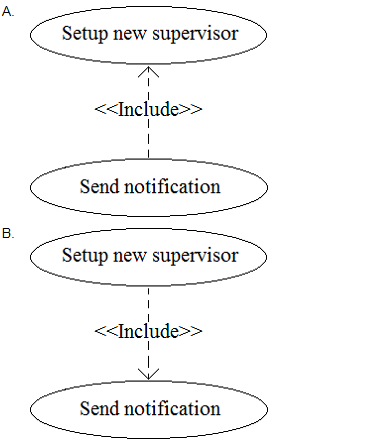
Which standard relationship should be defined between "Setup new supervisor" and "Send notification?

Correct Answer: D. Option D
Explanation:

Option D shows the correct use of theextendrelationship between the two use cases. This means that the ''Send notification'' use case is an optional extension of the ''Setup new supervisor'' use case, and it only occurs under certain conditions. The arrow points from the base use case (''Setup new supervisor'') to the extension use case (''Send notification''), as per the UML notation. Option C is incorrect because it reverses the direction of the arrow, implying that the ''Send notification'' use case is the base use case and the ''Setup new supervisor'' use case is the extension use case, which does not make sense. Options A and B are incorrect because they use theincluderelationship, which means that the ''Send notification'' use case is a mandatory part of the ''Setup new supervisor'' use case, and it always occurs whenever the ''Setup new supervisor'' use case is executed. This does not reflect the requirement that the notifications are sent only under specific conditions.Reference:

[A Guide to the Business Analysis Body of Knowledge (BABOK Guide), Version 3], Chapter 10: Techniques, pp. 424-425.

[UML 2.5 Specification], Chapter 18: Use Cases, pp. 637-638.


Question 15

A company wants to develop a product roadmap to guide future development efforts. The product owner asks a business analyst IBA) to lead the analysis effort. Feature suggestions have been compiled from customer support calls. Which of the following should the BA do first?

Correct Answer: D. Confirm the feature requests
Explanation:

Before the BA can proceed with any analysis of the features, they need to confirm that the feature requests are valid and aligned with the product vision and goals. Customer support calls may not reflect the actual needs and preferences of the target market, and may include requests that are out of scope or inconsistent with the product strategy. Therefore, the BA should first validate the feature requests with the product owner and other stakeholders, and eliminate any irrelevant or invalid ones.Reference:

BABOK Guide v3, section 7.2.2.1: ''The business analyst validates that the requirements and designs are aligned with the business need and the solution scope.''

Guide to building a product roadmap (with template and examples), section ''How to create a product roadmap'': ''The first step in creating a product roadmap is to define the product vision. This is the overarching goal or purpose of the product, and it should guide all subsequent decisions and actions.''