Free IIBA Certification in Business Data Analytics CBDA Exam Questions
Page: 1 / 11Total 152 questions
Want more questions? Get Premium Access.
Question 1
Interested in ensuring that analytics continues to contribute value to the overall organization, the lead analyst suggests developing a long term plan to define how the enterprise will identify, store, manage, share, and use its data long-term. The analyst is proposing the development of a:
Correct Answer:C. Data strategy
Question 2
A large telecommunications company wants to increase their Average Revenue Per User per month by 5%, by end of year, to increase revenue in a highly competitive market. From a SMART target perspective, what is missing?
Correct Answer:D. S - There is no mention of which product group/line the target pertains to
Explanation:
A SMART target is one that is specific, measurable, achievable, relevant, and time-bound1. The target of increasing the Average Revenue Per User (ARPU) per month by 5%, by end of year, to increase revenue in a highly competitive market is missing the specificity criterion, as it does not mention which product group or line the target applies to. The target should be more specific and clear about the scope and context of the desired outcome, such as which segment, region, or service the target relates to23. Reference: 1: Guide to Business Data Analytics, IIBA, 2020, p. 192: SMART Goals: How to Make Your Goals Achievable, MindTools, 2021, 13: How to Set SMART Marketing Goals, CoSchedule, 2021, 2.
Question 3
An analyst at a bank is trying to identify research questions for an analytical study on top customer issues across branches. During an interview with a branch manager, the analyst asks the manager what their top customer concerns are relating to this branch?
After the manager's reply, the analyst asks a follow up question on how their top customer concerns compare against the top customer concerns across all branches? Was the analyst's follow-up question valid?
Correct Answer:B. Yes, it builds on the previous question and allows the analyst to identify branch-specific
concerns
Explanation:
The analyst's follow-up question is valid because it helps to refine the scope and context of the research questions for the analytical study. By comparing the top customer concerns across branches, the analyst can identify the common and unique issues that affect customer satisfaction and loyalty. This can also help to prioritize the most critical or urgent problems that need to be addressed by the bank12. Reference: 1: Guide to Business Data Analytics, IIBA, 2020, p. 212: Business Analysis for Practitioners: A Practice Guide, PMI, 2015, p. 43.
Question 4
The team has completed their analysis on a vast amount of collected data and agree on their recommendations for action.
However, they are having difficulty in developing the appropriate messages to support their recommendations. The business analysis professional suggests which technique to assist the team?
Correct Answer:D. Storyboarding
Explanation:
Storyboarding is a technique that helps the team to develop the appropriate messages to support their recommendations by creating a visual sequence of the main points, evidence, and actions. Storyboarding helps the team to organize their thoughts, identify gaps, and communicate their findings in a clear and compelling way12 Reference: 1: Developing Key Messages for Effective Communication - MSKTC 2: 11 Ways Highly Successful Leaders Support Their Team - Redbooth
Question 5
An analytics team has been asked to answer the following question: "Given that you're a customer, would you work at our company?" The team is concerned about answering this question because it is:
Correct Answer:D. Unclear
Explanation:
The question ''Given that you're a customer, would you work at our company?'' is unclear, because it is a hypothetical and subjective question that does not specify the purpose, scope, or context of the analysis. The question also does not define what constitutes a customer, or how the customer's experience or satisfaction relates to the employee's motivation or performance. The question needs to be refined and clarified to make it more focused, relevant, and feasible for the analytics team to answer. For example, the question could be rephrased as ''How does the customer satisfaction score affect the employee retention rate in our company?'' Reference:
* Business Analysis Certification in Data Analytics, CBDA | IIBA, CBDA Competencies, Domain 1: Identify the Research Questions
* Understanding the Guide to Business Data Analytics, page 10-11
* CERTIFICATION IN BUSINESS DATA ANALYTICS HANDBOOK - IIBA, page 8, CBDA Exam Sample Questions and Self-Assessment, Question 16
Question 6
A data scientist is working with a team of upper level managers to develop a strategy for creating an enterprise analytics program. What critical success factor would help ensure the organization obtains the most value from its data?
Correct Answer:C. Management thinks analytically and fosters a culture where data science thrives
Question 7
A marketing department has established an analytics team. The analytics practice is stand-alone and analysts have limited insights into corporate strategy. Which is an expected result for analytics practices operating at the business unit level?
Correct Answer:C. The analytics team may conduct analysis that is of minimal value to the organization
Question 8
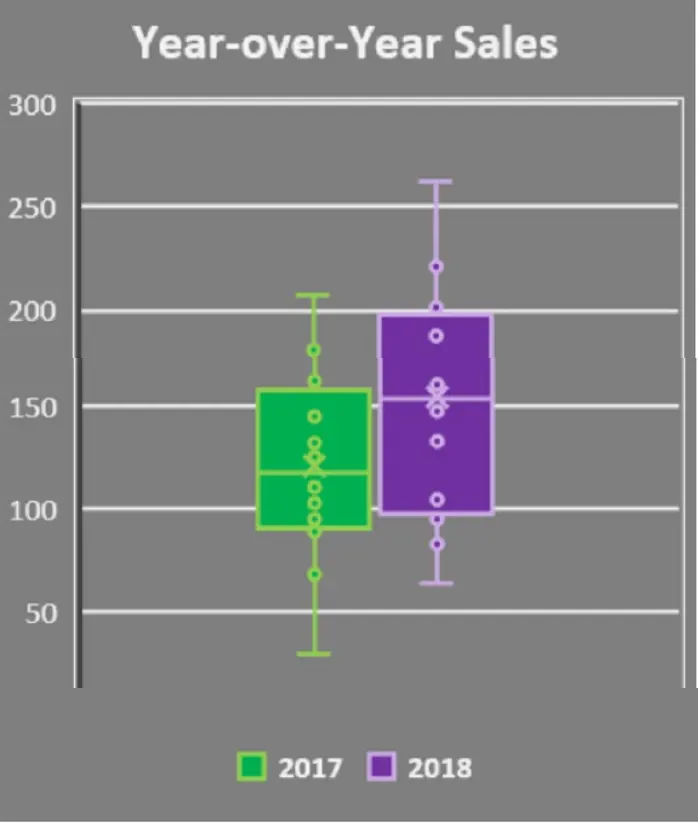
A software company launched a new product in late 2016. The product manager is reviewing a Box and Whisker plot used to compare year-over-year sales, from 2017 to 2018. What is the conclusion he can make from this chart?
Correct Answer:D. 2018 minimum and maximum sales are higher than 2017, and the 2018 1st quartile is
higher than 2017 median result
Question 9
A company wants to gauge the thoughts of their employees towards a new company product. On the 25th of March the interviewer makes a list of all employees who were at work on that day and then chooses a subset of those employees to interview. Which term describes the list of all employees present on March 25th?
Correct Answer:C. Sampling frame
Explanation:
The sampling frame is the term that describes the list of all employees present on March 25th, because it is a technique that defines the set of elements from which a sample is drawn. The sampling frame should ideally match the population of interest, which is the group of elements that the researcher wants to study or make inferences about. In this case, the population of interest is the employees of the company, and the sampling frame is the subset of employees who were at work on a specific day. The survey sample is the technique that selects a portion of the sampling frame to participate in the survey. The sample weights are the technique that assigns different values or importance to each element in the sample, based on their representation in the population. Reference:
* Business Analysis Certification in Data Analytics, CBDA | IIBA, CBDA Competencies, Domain 2: Source Data
* Understanding the Guide to Business Data Analytics, page 14
* CERTIFICATION IN BUSINESS DATA ANALYTICS HANDBOOK - IIBA, page 8, CBDA Exam Sample Questions and Self-Assessment, Question 14
Question 10
An analyst is performing regression analysis and reviewing the results. They would like to rescale the variables in the model to more clearly reflect the relationship between the regression coefficients. Which technique could be used to rescale the variables?
Correct Answer:C. Normalization
Question 11
The analytics team is struggling with which recommendation to make. Their challenge is that they have five good options and this indecision is stopping them from moving forward. To help the team finalize their recommendation, the BA professional on the team recommends they complete:
Correct Answer:D. Acceptance and evaluation criteria
Explanation:
Acceptance and evaluation criteria are the techniques that the BA professional on the team should recommend they complete, because they are the standards or measures that are used to evaluate the suitability and value of each option. Acceptance and evaluation criteria can help the team compare the benefits, costs, risks, and impacts of each option, and determine which one best meets the needs and expectations of the stakeholders. Acceptance and evaluation criteria can also help the team communicate the rationale and evidence behind their recommendation, and ensure that the recommendation is aligned with the business goals and objectives. Reference:
* Business Analysis Certification in Data Analytics, CBDA | IIBA, CBDA Competencies, Domain 5: Use Results to Influence Business Decision Making
* Understanding the Guide to Business Data Analytics, page 9
* Acceptance and Evaluation Criteria | Business Analysis
Question 12
A colleague proposes measuring job satisfaction by asking the question "What is your salary?". What is the concerning factor about this question?
Correct Answer:A. Validity
Explanation:
Validity is the extent to which a measure or a question accurately captures the intended concept or construct1. The question ''What is your salary?'' is not a valid measure of job satisfaction, as it does not reflect the various aspects of job satisfaction, such as work environment, recognition, autonomy, growth, etc. Salary is only one possible factor that may influence job satisfaction, but it is not a direct or comprehensive indicator of it23. Therefore, the question is not valid for measuring job satisfaction. Reference: 1: Guide to Business Data Analytics, IIBA, 2020, p. 302: Job Satisfaction: Application, Assessment, Causes, and Consequences, Paul E. Spector, 1997, p. 23: Job Satisfaction Survey, 1.
Question 13
A supermarket chain wants to improve supplier relations. One of the targets to track and help achieve this goal is to improve the average transaction time per order by 10%. From a SMART target perspective, what is missing?
Correct Answer:D. T - There is no mention of the time-frame by which this target must be met
Explanation:
SMART is an acronym that stands for Specific, Measurable, Achievable, Relevant, and Time-bound, which are criteria for setting effective and realistic goals1. From a SMART target perspective, what is missing in this scenario is the time-frame by which the target must be met.A time-bound target specifies the deadline or the duration for achieving the target, which helps to create a sense of urgency, motivation, and accountability2. Without a time-frame, the target is vague and indefinite, and it is difficult to monitor and evaluate the progress and the results. For example, a time-bound target could be to improve the average transaction time per order by 10% within the next six months.
The other options are not correct explanations of what is missing. The target is attainable, as it is realistic and feasible, and it does not depend on factors that are beyond the control of the organization, such as weather conditions. The target is specific, as it provides a clear and precise description of what needs to be achieved, and it does not need to provide a target for each supplier, as that would make the target too complex and cumbersome.The target is relevant, as it is aligned with the goal of improving supplier relations, and it does not assume that supplier relations is only dependent on quality of deliveries, as transaction time is also an important factor that affects the efficiency, satisfaction, and trust of the suppliers.
Question 14
The research study is complete, the data has been analyzed and the team has created the necessary high impact visuals. The business analysis professional urges the team to:
Correct Answer:D. Develop the narrative
Explanation:
Developing the narrative is the process of creating a clear, concise, and compelling story that communicates the key insights, findings, and recommendations from the data analysis to the stakeholders1.Developing the narrative is an important step after completing the research study, the data analysis, and the high impact visuals, as it helps to bridge the gap between the data and the decision-making, to engage and persuade the audience, and to drive action and change2.Developing the narrative involves defining the purpose, audience, and message of the story, choosing the best format and medium to deliver the story, and using effective storytelling techniques, such as structure, context, emotion, and call to action3.
Presenting the results to stakeholders is the process of delivering the data story to the intended audience, using the appropriate communication channels, methods, and tools4. Presenting the results to stakeholders is a subsequent step after developing the narrative, as it requires a well-crafted and well-prepared data story to be effective and impactful.Presenting the results to stakeholders involves planning and rehearsing the presentation, adapting to the feedback and questions, and evaluating the outcomes and impacts of the presentation5.
Validating regression analysis is the process of checking the assumptions, accuracy, and suitability of a statistical model that estimates the relationship between one or more independent variables and a dependent variable. Validating regression analysis is a part of the data analysis step, not a step after completing the data analysis. Validating regression analysis involves testing the significance, fit, and residuals of the model, and comparing the model with alternative models or methods.
Curating the data is the process of organizing, annotating, and preserving the data for future use, reuse, or sharing. Curating the data is a part of the data management step, not a step after completing the data analysis.Curating the data involves applying the data policies, standards, and best practices of the organization, and ensuring the quality, integrity, security, and accessibility of the data.
Question 15
To support their recommendation, the analytics team has identified investment and resources required to implement. The team has also identified key activities and events that are required to transition the organization through various stages to the future state. This information is clearly articulated in the: